Place to stay · Namib-Naukluft National Park
Naukluft Camp
NWR camp in a tree-shaded gorge in the Naukluft Mountains, east of Sesriem, with 21 campsites, six chalets and the Naukluft day walks and multi-day hiking trail.
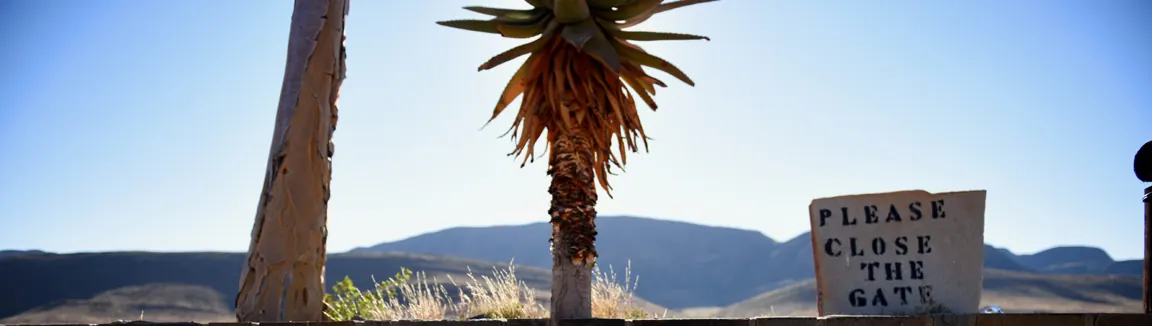
Naukluft Camp is the Namibia Wildlife Resorts camp in the mountain half of the Namib-Naukluft National Park. This section of the park was first set aside to protect Hartmann’s mountain zebra, and it sees far fewer visitors than Sossusvlei. It is in the Naukluft Mountains about 60 km east of Sesriem. People come for the hiking, and for the quiet.
What to expect
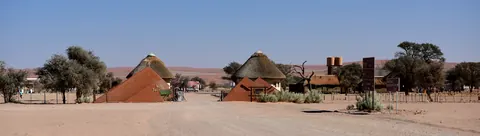
There are 21 pitches strung out along a dry riverbed in a gorge, with shade from the trees. You get a braai spot and a tap at each one, and everyone uses the same ablution block. Six bush chalets with en-suite bathrooms are let on a bed and breakfast basis if you would rather not camp. Check in at reception, where there is a small kiosk selling drinks, then it is about a 10 minute drive to the camp itself. NWR lists a bar and natural rock pools.
The walks are the main event. The Olive Trail is 10 km (around four hours) and the Waterkloof Trail (spelt Waterkluft by NWR) is 17 km, taking six to seven hours. Both are booked and paid for at Naukluft. The full Naukluft Hiking Trail is about 120 km over eight days, and NWR also sells a four-day version. Groups must be between three and 12 people, and it has to be booked in advance.
Besides the zebra, NWR lists kudu, gemsbok, klipspringer and leopard among the park’s animals, and black eagles breed on the cliffs.
Practical details
- Phone: +264 81 950 1164 or +264 63 293 244.
- NWR puts the camp 253 km from Windhoek and 100 km from Sossusvlei.
- There is also a short self-guided walk, and park entrance fees apply to it.
Good to know
You cannot reach Sossusvlei from inside this section, so plan it as a separate stop. NWR’s online booking system was showing as unavailable in October 2026, with requests going by email to reservations@nwr.com.na.
Last updated 7 October 2026. Sources: Namibia Wildlife Resorts, Naukluft Camp, Namibia Wildlife Resorts, Namib-Naukluft Park, Madbookings, Naukluft camping, Madbookings, Naukluft Camp.
The rope round Attie Pienaar's waist, and a farm bought for zebra
On the plateau above Naukluft Camp the 4x4 trail passes an old drilling rig with no engine. It went up after the road was finished in 1948, with a rope tied round the driver’s waist.
The camp sits on what was farm Naukluft. From about 1943 it belonged to Robbie Blake, a Cape Town businessman who ran sheep on the mountain, at times more than 2,000 of them. The grass was on top and the water at the bottom, so every second day the flock was walked down to the springs and back up. Blake wanted boreholes on top and had a road built to get a drill there. The park’s trail leaflet calls it Blake’s Pass and tells what happened next. Attie Pienaar and Hans Breiting stripped the rig to its frame and bolted it onto an army surplus Ford with the load bed taken off. A Willys Jeep pulled in front, weighed down with drill bits and a drum of water so its wheels would bite. The Ford had no door. On the steep stretches someone walked alongside holding the rope, the idea being to haul Pienaar out if the truck went over. It never did. The job took about two weeks. The rig’s engine later went for repair and was never put back. The Ford was sold in Maltahöhe in 1960.
A farm for sale at the right moment
Blake died in 1966 and the farm came up for sale. By then farmers had spent years shooting Hartmann’s mountain zebra for taking grazing and water from their stock and breaking fences. Eugene Joubert’s counts, repeated in The Namibian in 2025, were 50,000 to 75,000 in the Khomas Hochland and escarpment in the early 1950s, 10,700 by 1960, and 5,500 counted from the air in 1968. One pocket had survived on Blake’s mountain. Bernabé de la Bat, the first director of nature conservation, was asked to buy it, and the Naukluft Mountain Zebra Park was proclaimed in 1968. Namibia now has about 32,000.
The campsite used to go by a kudu name. Ron Swilling, in Travel News Namibia, called it Koedoesrus, “kudu’s rest”, and counted ten pitches in a grove of false ebony trees. A South African who stayed in the 1990s remembers it as Kudus Kloof.
Where the zebra are, and what comes to camp
You are more likely to hear zebra from camp than see them there. Swilling wrote of both zebra and kudu calling in the evenings. The leaflet puts the herds, 30 to 40 strong, on the plateau, and a German traveller who drove the trail and wrote it up in December 2009 found big herds at the natural waterholes up top. The round hollows on the tracks are zebra dust baths. Kudu, the leaflet says, are often seen near Fig Fountain, where the Olive Trail meets the 4x4 track. That spring has not been known to dry up, and it is full of green frogs.
What does turn up at camp is baboons. Two writers who camped here years apart both say they come for your food. One called them pesky more than violent.
Frogs at night, sore knees by day
Streams run all year in these mountains because the dolomite on top soaks up what little rain falls and lets it out at the spring lines. Ena Visagie, who wrote about the camp in 2021, says the pitches beside the stream are the ones to ask for and that the sound after dark is bullfrogs. Nobody else mentions the frogs. On the Waterkloof walk she puts the first big pool about 1.7 km in, and three separate accounts agree the pools are for swimming. She warns the full loop is no walk for bad knees. Another hiker reckoned it a good 5 km longer than signed. Two travellers, writing years apart, both settled on two nights.
Park fees
Naukluft Camp is inside Namib-Naukluft National Park. International visitors pay from US$9 €8 · N$150 a day. See all Namib-Naukluft National Park fees