City · North-West District, Botswana
Maun
Botswana's safari town on the Thamalakane River, where the flights and 4x4 trips into the Okavango Delta and Moremi start. The last fuel, banks and supermarkets before the bush.
Short answer
Maun is in North-West District, Botswana. This page lists 42 places to stay, 29 places to eat and drink and 7 sights. The nearest park with an entry fee on this site is Moremi Game Reserve, about 78 km away, where international adults pay from P270.

- Malaria
- Maun is in a malaria area.
- Places to stay
- 42
- Eat and drink
- 29
- Sights
- 7
In and around Maun
78 places listedWhere to stay in Maun 42
- 20.12°S 23.31°ECampsiteDouglas Camp & OutdoorsNew Maun-Toteng road71817295facebook.com
- 20.02°S 23.44°EHotelThree Tree HotelSekgoma Road, Maun+267 686 0900threetreehotel.com
- 20.10°S 23.34°ECampsiteNako Okavango Guest House / CampTsanakona West+267 76 991 957
- 19.95°S 23.48°EHotelKamanga Safari Hotel+267 72 502 055
- 19.95°S 23.48°EHotelSedia Riverside HotelSir Seretse Khama Road, Maun+267 686 0177sediahotel.com
- 19.95°S 23.48°ECampsiteSedia Riverside Hotel CampsitePrivate Bag 058, Maun+267 686 0177sediahotel.com
- 19.95°S 23.48°EHotelAdansonia Hotel+267 680 0286
- 19.99°S 23.41°EGuest houseThe Royal M&GMatlola Rd
Show all 42 places to stay
- Days Inn Guesthouse · Guest house
- Bae's Crib · Chalet · Tsheko Tsheko Road
- Botshelo Guesthouse · Guest house
- Enviro Villa · Hotel · Maun
- Maun Lodge · Hotel · Mathiba I Street, Maun
- Riverise Guesthouse · Guest house+267 74 226 030
- the big tree · Campsite · Audi
- 'Cresta Rileys's Lodge · Hotel
- Alfa · Hotel
- Center Lodge Conference Center · Hotel
- Centre Lodge · Hotel
- Delta Guesthouse Accomodation · Hotel
- Dolar Lodge · Hotel
- Home away · Guest house
- Janet's Place · Chalet
- Jump Street Chalet · Chalet
- Jump Street Chalets · Chalet
- Kamanga safari lodge · Hotel
- Laha Hotel · Hotel
- Larissa Hotel · Hotel
- Luxury Wild Inn · Hotel
- Madou Lodge · Hotel
- Mokoro Lodge · Hotel
- Motsebe Backpackers · Hotel
- Okavanto roadside guesthouse · Hostel
- Queness Guest House · Hotel
- Riley´s Hotel · Hotel
- Royal Tree Lodge · Hotel
- Royal Tree Lodge · Motel
- Senthaga Hotel · Hotel
- Sitatunga Camp · Campsite
- The Three Tree Hotel · Hotel
- Tree Lodge · Guest house
Sights 7
- Scenic FlightsAttraction
- SISO Afro GalleryGallery+267 74 463 946
- Chez OsiAttraction
- Kingdom Gathering Route 1st TurnAttraction
- Kommeresi PhuthologoAttraction
- Nhabe MuseumMuseum
- Telecom AntennaMonument
Restaurants and cafes 22
 Marc's EateryRestaurant · deli, burger, diner, pasta, sushi, sandwich, breakfast, international · Sir Seretse Khama Road+267 684 0883marcseatery.com
- SUNSET CAFECafe · pizza, burger, sandwich, coffee shop · Sir Seretse Khama Road, maun+267 71 858 676
- Acacia CafeCafe+267 74 064 091
- Il PomodoroRestaurant+267 74 387 590facebook.com
- TandureiRestaurant · indian, chinese+267 680 0227
- Tshilli Farmstall CafeCafe · coffee shop
- Dusty DonkeyCafe · breakfast
- Hillary'sRestaurant
- Kana Jeng CaféCafe
- Miguel's Taco ShackRestaurant · mexican
- Akacia CaféRestaurant
- CappelloRestaurant
Show all 22 restaurants and cafes
- Choice Take Away & Restaurant · Restaurant
- Chutney · Restaurant
- Delta Deli · Restaurant
- Dine Inn · Restaurant
- Ice Breakers · Restaurant
- Java & Jazz · Cafe
- Reeds · Restaurant
- The Duck · Cafe
- Nando's · Restaurant · chicken, portuguese
- Nando's · Restaurant · chicken, portuguese
Bars and pubs 7
- Bar & ButcherBar
- Delta RainBar
- Greenland BarBar
- Lafoxy BarBar
- Masters ValleyBar
- Ngatunue BarBar
- Sedia BarBar
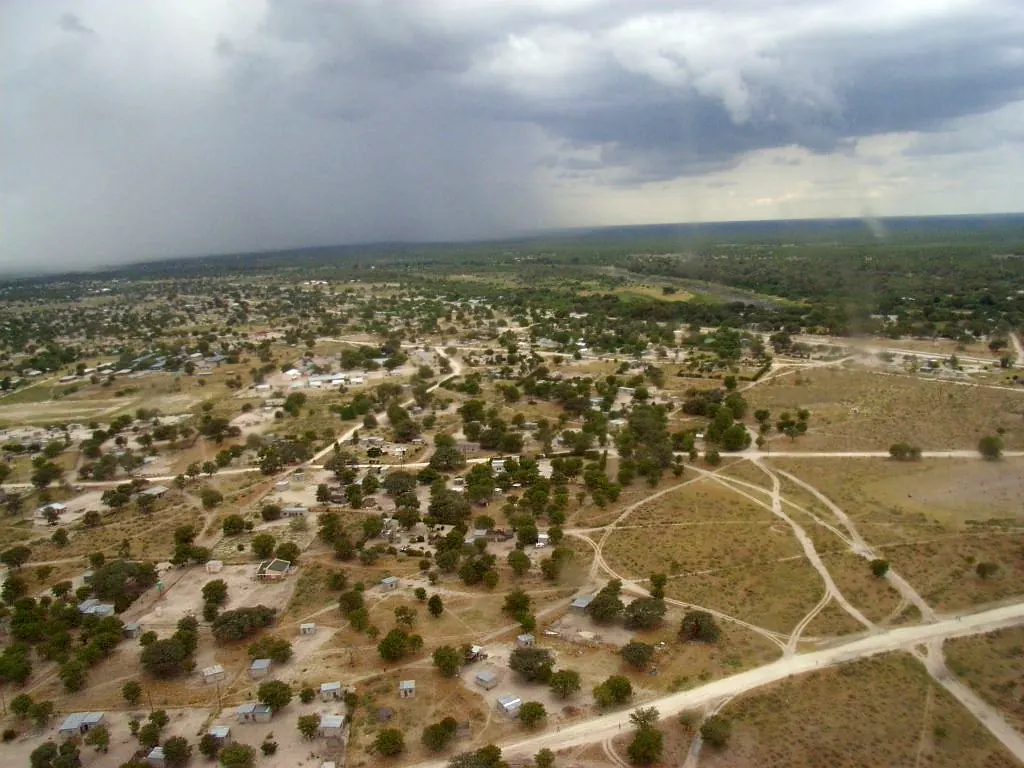
Nearly every Okavango trip starts in Maun. It is officially still a village, the second largest in Botswana with 85,350 people at the 2022 census, strung along the Thamalakane River on the southern edge of the delta. It has been the Batawana capital since 1915 and is the administrative centre of the north-west. Nobody comes for its looks. You come because the airport, the fuel, the banks and the 4x4 hire firms are all here.
Getting there
The airport is on the north side of town, about 3 km from Riley’s Hotel in the centre. Direct flights come in from Johannesburg (about 1 hour 40 minutes), Cape Town (about two and a half hours), Gaborone and Kasane, and FlyNamibia flies from Windhoek. The light aircraft for the delta camps leave from here too, and those short hops are why the Civil Aviation Authority ranks Maun second in Africa for aircraft movements, behind OR Tambo in Johannesburg.
By road, the A3 is tar both ways: about 300 km east to Nata and 280 km south-west to Ghanzi. Buses take nine to ten hours from Gaborone and about six from Francistown. The direct track to Kasane through Chobe is thick sand, 4x4 only.
When to go
May to October is dry. June and July nights average about 6°C, so pack something warm. October is the hottest month, with an average high near 35°C, and Maun holds Botswana’s heat record: 44.0°C on 7 January 2016. Most of the 450 mm or so of rain falls from November to March. The delta’s flood peaks in June and July, the best months to see it from the air.
What to do
If you are not flying to a camp, take a scenic flight anyway, by light aircraft or helicopter. Hotels such as Riley’s book boat and mokoro (dugout canoe) trips on the Thamalakane, where the cruises get close to hippos and crocodiles.
Nhabe Museum is small and more gallery than museum, with changing shows by local artists beside musical instruments and hunting tools. Thamo Telele, 20 minutes from the airport, has giraffe and zebra on a private reserve with marked walking trails and no large predators. Elephant Havens, about an hour’s drive out, raises orphaned elephants. Sexaxa, on the edge of town, is a cultural village that shows Bayei life.
Good to know
Maun is in a malaria area. The US CDC recommends tablets for Ngamiland, and UK guidance rates the risk high from October to May.
Self-drivers should treat Maun as the last of everything. There is no fuel in Moremi or at Khwai, and one 4x4 forum regular reports none on the Savuti route until Muchenje, on the Kasane side. Park fees are paid to the wildlife department at the gate, and the Moremi page has the table.
Stay off the roads after dark, when livestock and wild animals wander onto the tar. The UK Foreign Office says violent crime is rising in Maun, so keep car doors locked and bags out of sight. It also says not to swim in rivers here.
History and culture
Maun is the capital of the Batawana, the Tswana people who moved into Ngamiland in the late 1700s, and only became their seat in 1915. For most of the century since it was a cattle and hunting outpost, and the tar road from Nata arrived only in the early 1990s. That road and the safari trade turned it into Botswana's tourism town, but it is still officially a village and still the seat of the Batawana chiefs.
- Late 1700s to 1800s
After a dispute over the chieftainship, Kgosi (chief) Tawana led his followers north into Ngamiland, where they became known as the Batawana. Botswana Tourism lists their capitals in turn: Lake Ngami, then Toteng, then Tsao (Tsau). source
- 1849
The Scottish missionary David Livingstone reached Lake Ngami, where the Batawana then lived, and first saw its open water on 1 August 1849. He met their chief, a young man he called Lechulatebe (Letsholathebe), and described the Bayei of the lake and their canoes, each hollowed from a single tree trunk. source
- 1890 to 1894
Britain had set up the Bechuanaland Protectorate in 1885. On 30 June 1890 it moved the northern boundary to take in Ngamiland, the Batawana country. No British official arrived in the region until 1894. source
- 1904 to 1908
During the genocide of the Herero by German forces in what is now Namibia, around 1,000 Herero, among them their paramount chief Samuel Maharero, fled into Bechuanaland. source
- 1915
The Batawana moved their capital to Maun, until then a small Bayei village beside the Thamalakane. The name comes from the Seyei word maung, the place of river reeds. source
- 1925 to 1930s
The first known flights over the Okavango were made in July 1925 by two Airco D.H.9 aircraft of South Africa's Union Defence Force, surveying the region's rivers from a base at Livingstone. Maun's first air service began in the 1930s, using a landing strip that is now the town's main street. source
- 1946 to 1964
Kgosi Moremi III died in a car crash in 1946 and his widow, Elizabeth Pulane Moremi, ruled the Batawana as regent until 1964, when their son was old enough. In 1948 she gave the Bayei more independence, with their own dikgotla (courts). In 1960 she was the only woman on the Protectorate's new Legislative Council, and Moremi Game Reserve was created in 1963, during her regency. source
- Early 1990s
For decades Maun was known as a rough 'Wild West' sort of place, the centre of the district's cattle ranching and hunting. Tourism and the tar road from Nata, finished in the early 1990s, changed it fast. source
- The peoples of Ngamiland
- Maun is the seat of the Batawana, but the district is a mix: Hambukushu, Basubiya and Bayei, whose roots are in central Africa, the Banoka or River Bushmen, who were the delta's first inhabitants, the Bakgalagadi and the Baherero. source
- Herero dress
- Herero women wear the ohorokova, a long high-necked dress with a full skirt over several petticoats that can take up to ten metres of cloth. The style was taken over from the gowns of German missionaries in the late 1800s. Married and older women wear it every day, and Botswana Tourism says you will see it on the streets of Maun. source
- Shiyeyi, a Bantu language with clicks
- The Bayei language, Shiyeyi, has more click sounds than any other known Bantu language, picked up from the San languages around it. It is fading in Botswana, where most Bayei now speak Setswana and children learn Shiyeyi in only a few villages. source
- Food
- Local staples to try are seswaa (shredded beef or goat), papa (maize meal, the staple), morogo (a leafy green like spinach) and magwinya (fried dough balls). Mopane worms, the caterpillars of the mopane moth, are sold in season dried, stewed or fried. source
- Beer and elephants
- Maun's craft brewery brews with millet and buys it at above the market price from Okavango farmers who plant around mapped elephant corridors, working with the Ecoexist Trust. It started as a project to help farmers and elephants live side by side. source
For German visitors: Maun's Herero community is a direct result of German colonial history. The Herero in Botswana are there because they were displaced by the German Empire's genocide of 1904 to 1908 in German South West Africa, now Namibia, and they live mostly in and around Maun. source
For American visitors: The regent Elizabeth Pulane Moremi was profiled in an American newspaper, the Asbury Park Press, on 10 May 1961 under the headline 'Woman Chief of African Tribe Fighting for Woman's Freedom'. It said she held power no woman had achieved in Africa since European invaders deposed the last of the women chiefs. source
For American visitors: Elephant Havens is funded through the Elephant Havens Wildlife Foundation, set up in 2017 as a 501(c)(3) non-profit, the United States category for tax-exempt charities. source
Main sights in Maun
6- Nhabe Museum
A small museum that works more as an art gallery, with changing exhibitions by local artists alongside musical instruments and hunting tools. It is the place in town to learn something of local history and culture, and a dry hour in the rainy season.
Expert Africa, Maun - Riley's Hotel
Founded by Harry Riley in 1910 as a single spare rondavel beside his own. The writer Laurens van der Post, describing it in the 1950s, called it a remarkable little hotel for the few travellers determined enough to cross the desert. It is now a 51-room Cresta chain hotel just off Tsheko-Tsheko Road, with a bar named after its founder.
Expert Africa, Riley's Hotel - Maun Game Sanctuary (Maun Educational Park)
A small fenced reserve on the Thamalakane off Sekgoma Road, about 2 km from the centre. The Bradt guide of about 2003 described the last of Maun's original riverine woodland and fan palms, with giraffe, zebra, wildebeest and lechwe that could be approached on foot. We could not confirm its present state or hours, so ask in town before going.
Bradt Botswana Travel Guide, first edition online (about 2003), Maun, what to see and do - Sexaxa Cultural Village
A village on the outskirts of Maun that shows visitors Bayei culture and how traditional life carries on at the edge of a growing town.
Expert Africa, Maun - Thamo Telele
A lodge on a fenced private reserve about 20 minutes from the airport, formerly Royal Tree Lodge and before that Motsentsela Tree Lodge. It has links to the Giraffe Conservation Foundation, and giraffe come to drink at a waterhole beside it.
Expert Africa, Thamo Telele - Elephant Havens
An elephant orphanage outside Maun, the only one in Botswana by its own account. Keepers live alongside the calves and bottle-feed them every three hours, with the aim of weaning them and returning them to the wild.
Elephant Havens Wildlife Foundation
Did you know?
- With 85,350 people at the 2022 census, Maun is larger than anywhere in Botswana except the cities of Gaborone and Francistown and the village of Mogoditshane. It is still classed as a village, the country's second largest. source
- The Civil Aviation Authority ranks Maun second in Africa for aircraft movements, behind only OR Tambo in Johannesburg, because of the stream of short light aircraft flights to airstrips in the delta. source
- Botswana's highest recorded temperature, 44.0°C, was measured in Maun on 7 January 2016. source
- The Thamalakane River follows a geological fault at the southern end of the Okavango Delta. The fault blocks the delta's channels, so the Boro River runs into the Thamalakane at a right angle. About 40 km further on the water turns again through a gap in the fault and becomes the Boteti. source
- The BBC's Top Gear Botswana Special, first shown on 4 November 2007, had its three presenters drive cheap two-wheel-drive cars across the Makgadikgadi Pans and the Kalahari to Maun and then into the delta. source
Checked 12 October 2026.
Wildlife you might see
8- very likelyGiraffeThamo Telele, a fenced private reserve about 20 minutes from the airport, where they come to a waterhole by the lodge. Not wild around town. All yearsource
- very likelyElephant (orphaned calves)Elephant Havens outside Maun, which describes itself as the country's only elephant orphanage. These are hand-reared calves, not wild herds. All yearsource
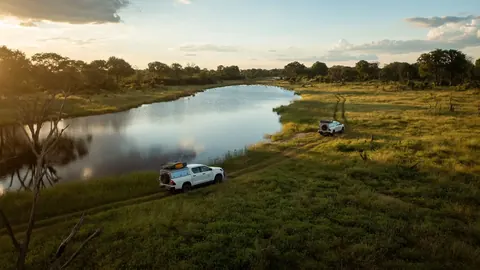
- likelyHippoThe Thamalakane River, seen on boat cruises from the riverside lodges. Expert Africa picks out April, July and August for river sightingssource
- likelyPlains zebraThamo Telele private reserve. All yearsource
- likelyAfrican fish eagleMaun Game Sanctuary (Maun Educational Park) on the Thamalakane, where the Bradt guide of about 2003 called it a fairly easily seen resident. All yearsource
- possibleNile crocodileThe Thamalakane River, on the same boat cruisessource
- possibleRed lechweThe wide banks of the Thamalakane, where they still share the grass with the town's livestocksource
- rareBat hawkMaun Game Sanctuary beside the river, hunting in the early morning or evening (Bradt guide of about 2003)source
Likelihood is for a normal visit of two or three days, from the sources linked. Nothing is guaranteed in the wild.
Hikes and walks
1- Thamo Telele reserve trails
Marked, self-guided walking trails with waterholes and a hide, on a reserve with giraffe, zebra and other plains game but no large predators. Guided walks and horse rides are offered too.
Permit: The trails are on the lodge's private fenced reserve. Ask the lodge about access if you are not staying there
Expert Africa, Thamo Telele (giraffe, zebra, walking trails)
Staying safe in Maun
- Malaria
- Maun is in a malaria area. The UK Health Security Agency's 2026 guidelines rate the northern half of Botswana, with the Okavango Delta area named, as high risk from October to May and advise antimalarial tablets for those months. For the rest of the year they rate the risk low and advise bite avoidance. source
- Malaria tablets, the US advice
- The US CDC lists Ngamiland and Okavango among the districts with malaria transmission and recommends prescription tablets there (atovaquone-proguanil, doxycycline, mefloquine or tafenoquine) without naming a season. The two bodies differ for the winter months, so ask a travel clinic which applies to your dates. source
- Crime
- The UK Foreign Office says attacks on tourists are rare but violent crime is increasing in Gaborone, Francistown and Maun, and that thieves may target cars waiting at traffic lights. Keep doors locked, windows closed and bags and phones out of sight, and do not stop for hitchhikers. source
- The river
- The UK Foreign Office says not to bathe in rivers and lakes in Botswana, because of wild animals and water-borne disease. That includes the Thamalakane, however calm it looks from a lodge deck. source
- Driving after dark
- Botswana's main roads are good tar, but the UK Foreign Office warns that stray livestock and wildlife make driving outside the towns dangerous, most of all at night. Plan to reach Maun in daylight. source
- Heat
- October to December are the hottest months. Expert Africa's advice against heat stroke is to cover up, use high-factor sunscreen and drink plenty of non-alcoholic fluids. source
Tips from travellers
- Fill the tank and the jerry cans before you leave town. One regular on the 4x4 Community forum reports that going north through Moremi and Savuti the next pump is at Muchenje, on the Kasane side, with nothing in between. one source
- Give Maun a full day before a self-drive trip. The writers of one Tracks4Africa trip report spent most of a day here buying supplies and sorting out niggles on the vehicle before heading for Moremi's North Gate, because past Maun you have to be self-sufficient. one source
- Check that your hire vehicle has a working tyre pressure gauge and an inflator before you leave town. The first rule of sand driving, and the tracks north of Maun are sand, is to let the tyres down. How far depends on the vehicle's weight and its tyres, so ask the hire firm for their figure. one source
- You do not have to pay park entry fees in Maun. A Maun self-drive agency says they are paid to the wildlife department at the park gate, by cash or card. Campsites are a separate matter: most are run by private operators and must be booked ahead. one source
- Flying on to a delta camp with more luggage than the light aircraft allows? The airport has very little luggage storage, but most safari companies will collect spare bags and keep them until you come back through. one source
- Taxis and combis (minibuses) have blue number plates. There is no central dispatch, so if you are staying out of the centre get a driver's mobile number for the trip back. several sources
Checked 12 October 2026. Conditions change, so confirm with the park or venue before you go.
Biltong for safety pins: the Maun behind the airport
In the 1950s the market in Maun was a tree. Men who had been away hunting for months poled their dugouts down the Thamalakane to a big evergreen on the bank, the Matsaudi tree, and swapped biltong for safety pins and beads. No money changed hands. Kgosi Kegaisamang Ramokwena, who described it to the Sunday Standard in 2016, said nobody ever knew when the canoes would turn up, so people simply waited. Things only changed in the late 1960s, he said, when other ways of getting about arrived. Tourists who came to look at the tree offered to pay and were told to keep their money. The village of Matsaudi, between Maun and Shorobe, takes its name from the tree.
A ward named after a mine recruiter
One of Maun’s wards is called Wenela. That is what people made of the Witwatersrand Native Labour Association, the agency the South African gold mines set up to sign on migrant workers, which ran its own depots, buses and aeroplanes across the region. Its Maun premises later housed the army.
Ronnie Kays worked in Wenela’s recruiting department for a time. He was born in 1929 in a house in Riverside that his family still lived in when he told his story in 2016. His father and grandparents had farmed cattle at Tsau from 1916. Kays became a partner in the Riley’s group in 1959, sold his hotel shares in 1983 and later bought Riley’s Garage. His brother is buried in the old graveyard behind it.
The best-known incomer was a hunter. Harry Selby grew up in Kenya and was made famous by Robert Ruark’s book Horn of the Hunter. In 1963 he moved his family to Maun to run Ker, Downey & Selby’s safaris in what was still Bechuanaland. He bridged the Khwai, built Khwai River Lodge in 1970, gave up professional hunting at 75 and died in Maun in January 2018, aged 92.
Chris McIntyre, who first came in 1988 and went on to write the Bradt guide, remembers “contemporary cowboys” driving in from the bush in battered 4x4s, with the Duck Inn opposite the airport one of the places everyone ended up. A later bar beside the airstrip, the Bull & Bush, was known as the Bullet & Ambush because someone was shot on its opening night. He also noticed old drink cans built into the mud walls of rondavels in the suburbs.
The year Ngamiland lost every cow
Farmers still bring cattle into Maun to sell, so it is odd to think that in the mid 1990s the district had none. Lung sickness (contagious bovine pleuropneumonia) appeared in Ngamiland in February 1995, after 56 years without a case in Botswana. From April 1996 the government’s answer was to slaughter every animal in the district, 320,000 of them. About 70,000 replacements had been brought in by the end of 1997 and the country was declared free of the disease the next year. Eight in ten households told researchers they meant to rebuild their herds.
Cattle are also why there is a fence between the town and the delta. The veterinary cordon everyone calls the buffalo fence crosses the Moremi road about 19 km beyond Shorobe. What wanders the streets of Maun is donkeys. A newspaper columnist who grew up here complained in 2012 that the strays were tipping over the dustbins.
A river that some years does not turn up
The Bradt guide of the early 2000s had the Thamalakane normally starting to flow around July and drying up again around December. Some years are worse. In 2016 it and the Boro dried out completely for months. Operators who could put their boats on trailers worked from Sepopa and Shakawe instead. The water came down that May and June, and the same report says people in Maun go to the banks just to watch it arrive.
So plan a boat cruise for June to August, when one local guide says you can run all the way up to the delta, and ask before counting on one in any other month. A newspaper writer on a festive season cruise at the turn of 2016, with parts of the river nearly dry, still listed African darters, woodland kingfishers and pelicans. Hippos and crocodiles are less of a sure thing. Expert Africa’s notes on one riverside lodge say they are occasionally seen there, and that the hippos are heard from the river.
The crocodiles are there even when nobody sees them. In December 2020 a mother and daughter harvesting tswii, the water lily tuber people eat here, were seized in deep water at Maun. A 16-year-old schoolboy, Ookeditse Bakae, waded in with a stone in each hand and beat the animal on the snout until it let go. His own sister had been dragged in by a young crocodile that September while collecting firewood on the bank.
For birds without a boat there is the small fenced park on the river off Sekgoma Road. That Bradt guide reckoned a keen birder could count 80 to 100 species there in three hours in summer and 50 to 80 in winter, red-necked falcon, giant eagle-owl and lesser jacana among them. The river even has a fish to its name, the Thamalakane barb, described in 1935.
Crying on the way in, crying on the way out
That same columnist wrote that people cry when work transfers them to Maun and cry harder when it transfers them out. Overseas visitors, the Bradt guide noted, mostly just change planes. Batswana see a different town. Gaborone people come up over the festive season for the river cruises and the drinking spots, and until the council shut them, the places to sit were the Beach and Big Tree, camping chairs and cooler boxes on the bank facing the animals in the wildlife park.
For the Maun under the safari business, read Caitlin Davies’s Place of Reeds (2005), which takes the meaning of the town’s name for its title. It is a memoir of her 12 years in Botswana. She taught, edited a local newspaper, was arrested twice as a journalist (once for “causing fear and alarm”, and acquitted) and helped found Women Against Rape in Maun. Hilary Mantel wrote that it is not the comforting Botswana of Alexander McCall Smith.
Quick answers
What animals can you see in Maun?
Most visitors see giraffe and elephant (orphaned calves). You have a good chance of seeing hippo, plains zebra and african fish eagle. Bat hawk is there but rarely seen.
Guides for Maun
- Driving in South Africa, Namibia and Botswana: UK Licence
- Driving in South Africa, Namibia, Botswana With a US License
- Flights from the UK to South Africa, Namibia and Botswana
- Direct Flights to South Africa from the US: Routes and Fares
- Plugs, SIM Cards and eSIMs: South Africa, Namibia, Botswana
- How Much Does a Safari Cost? South Africa, Namibia, Botswana
- How Much Does a Safari Cost from the UK? Prices in Pounds
- Best Time to Visit the Okavango Delta: Flood, Game and Prices by Month
- Botswana Entry Requirements 2026: Visas and Border Rules
- Self-Drive Botswana: Sand, Fuel, Vet Fences and Campsites
- Botswana Travel Essentials: Money, Driving, Malaria
Map of Maun
See every place on this map as a list