Park · North-West District, Botswana
Okavango Delta
The private and community concessions around the Okavango Delta, outside Moremi: fly-in camps on the channels and floodplains, and Khwai, the one corner you can reach in your own 4x4.
Short answer
Okavango Delta is in North-West District, Botswana. This page lists 109 places to stay, 1 places to eat and drink and 76 sights. The nearest park with an entry fee on this site is Moremi Game Reserve, about 77 km away, where international adults pay from P270.
- Malaria
- The delta is in a malaria area.
- Places to stay
- 109
- Park fee nearby: Moremi Game Reserve
- US$20 €18 · P270about 77 km away
- Where
- North-West District, Botswana19.31°S 22.56°E
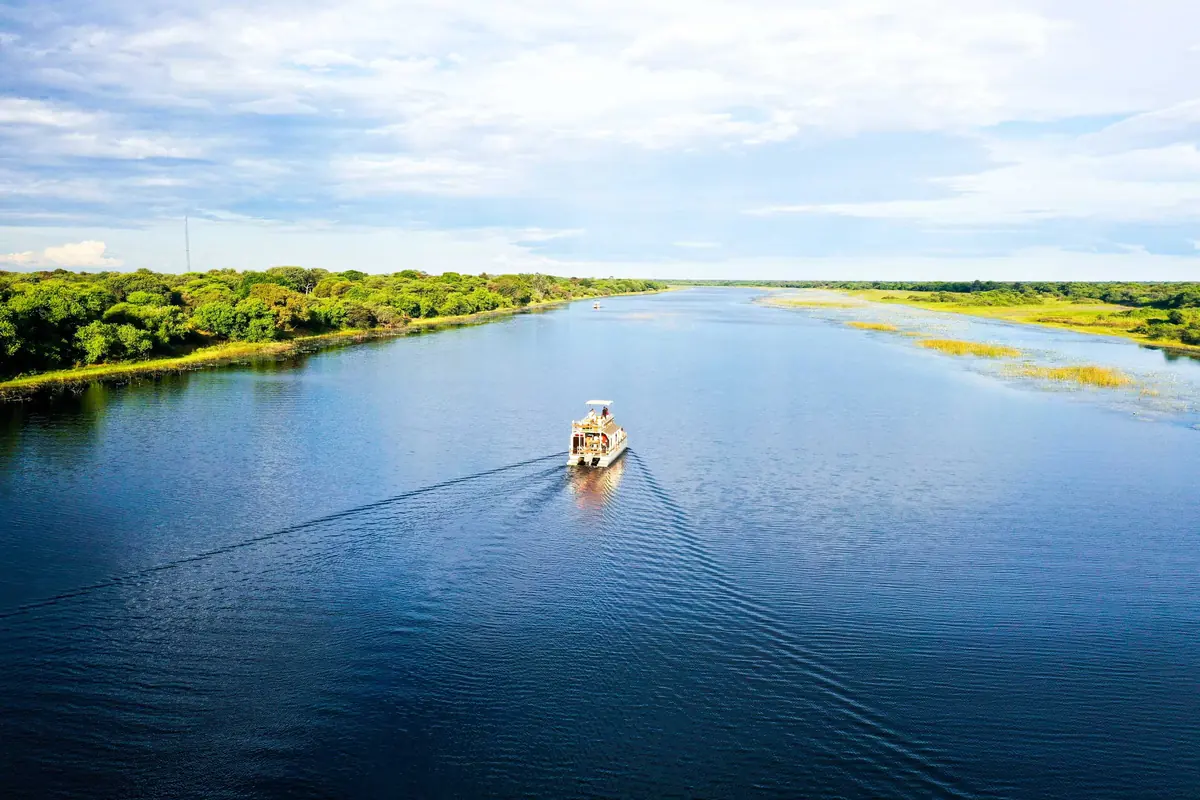
The Okavango is a river that never reaches the sea. It comes down from Angola, spreads over the Kalahari sand in north-west Botswana and nearly all of it evaporates or soaks away. What is left behind is a maze of channels, lagoons, floodplains and palm islands, a World Heritage Site since 2014. Moremi Game Reserve covers the eastern side and has its own page. This page is for the rest: the private concessions around Moremi, with their fly-in camps, and the community land at Khwai and Boro.
Getting there
Everything starts in Maun. For a concession camp you fly. The light aircraft hop from Maun takes 15 to 45 minutes and may put down at one or two other strips on the way. Mack Air allows 20 kg a person, hand luggage included, and prefers soft bags.
Khwai is the corner you can drive to. It is about 150 km from Maun and takes around four hours in a 4x4: tar as far as Shorobe, then corrugated gravel and sand through Mababe, with water over the road in some years. Khwai has no fuel, so fill up in Maun. The other way in without a lodge booking is a mokoro (dugout canoe) trip from Boro, south of Moremi, where the Okavango Kopano Mokoro Community Trust runs excursions in concession NG32.
When to go
The flood comes in the dry winter, months after the rain that feeds it fell in Angola. Water is highest from about May to August, and July to October is the busiest time. Winter days are mild but nights can drop close to freezing. October often passes 40°C. Most rain falls from December to March in afternoon thunderstorms, when the birds are at their best and the camps are quieter.
What to do
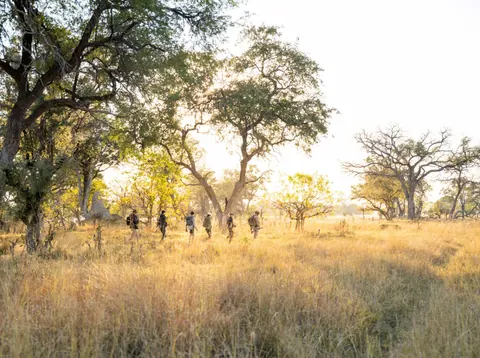
In the private concessions the guides can leave the tracks and drive after dark, and some reserves take you walking. Moremi allows none of that. On the water you go by mokoro or motorboat, and some camps fish for tigerfish, catch and release.
Expert Africa has surveyed its travellers since 2018. In the delta’s reserves more than nine in ten report elephant, hippo, zebra, giraffe and lion, about three in four leopard and six in ten wild dog. Do not come for rhino. The IUCN’s 2025 assessment says poaching left none in the wild here. It counts 482 bird species.
At Khwai you drive yourself along the river, and mokoro trips can be booked there.
Good to know
This is a malaria area. UK health guidance rates the risk high from October to May and low for the rest of the year, and the US CDC recommends tablets for the Okavango and Ngamiland districts.
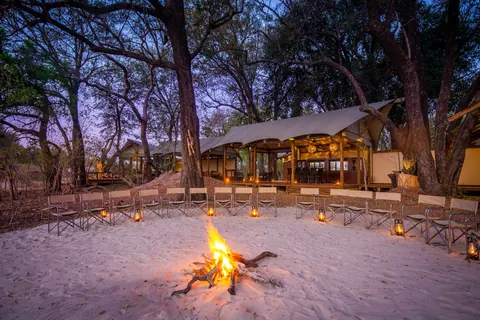
Camps and campsites are not fenced. Lodges walk you to your tent after dark, and hyenas visit the Khwai campsites at night, so keep food packed away in the vehicle. Do not swim: the UK Foreign Office warns against bathing in rivers and lakes here. The community trusts charge their own fees. Moremi’s are on the Moremi page.
History and culture
The Okavango Delta looks like untouched wilderness, but people have fished, hunted and poled canoes through it for centuries. The camps stand on land that River San, Wayeyi, Hambukushu and Batawana have all lived on or ruled, and much of what a visitor does here, the mokoro above all, comes from them.
- 1700s
The Wayeyi (also written Bayei) moved into Ngamiland, the country around the delta, from the Lozi kingdom to the north, by their own oral tradition led by a fisherman and hunter called Hankuzi. They settled alongside the River San who already lived there, learned their fishing methods, and are credited with bringing canoe building to Ngamiland. When the Batawana arrived in the early 1800s, many Wayeyi became their serfs. source
- About 1790 to 1825
The Batawana, a Tswana group who had broken away from their parent chiefdom under a leader called Tawana, reached the Kgwebe Hills near Lake Ngami in about 1790 and drove out the Bakgalagadi living there. In about 1825 the Makololo under Sebitwane scattered them and took most of their cattle. A small party escaped back to Lake Ngami and rebuilt its herds. source
- 1849
The missionary David Livingstone reached Lake Ngami, south of the delta, and described a shimmering lake some 80 miles long and 20 wide. The lake has shrunk dramatically since 1890. source
- 1890 to 1894
Britain had declared the Bechuanaland Protectorate in 1885 with its northern edge at 22 degrees south. On 30 June 1890 it pushed the boundary north to take in Ngamiland, the Batawana country around the delta. No British official arrived until 1894. source
- 1963
The Batawana set aside the eastern delta as Moremi Game Reserve, named after their late chief Moremi III. His widow, Elizabeth Pulane Moremi, was ruling at the time and acted because hunting was taking too many animals. The chief's royal hunting grounds were added in the 1970s. source
- Late 1960s
The first modern safari camps were built in the delta. In the same years, and into the early 1970s, more than 4,000 Hambukushu refugees from Angola were settled around Etsha on the western side of the Panhandle. source
- 2001 and 2002
To get rid of tsetse fly, 16,000 square kilometres of the delta were sprayed from the air with insecticide: the northern half from June to September 2001 and the southern half from May to August 2002. Surveys up to November 2005 found no tsetse at all. Eighteen earlier spraying operations had not managed it. source
- 2014
On 22 June 2014 the Okavango Delta became the 1,000th site on the UNESCO World Heritage List. source
- Peoples of the delta
- Five groups call the delta home, each with its own language: the Hambukushu, the Dceriku and the Wayeyi, who farm, fish and keep cattle, and two San groups, the Bugakhwe and the ǁanikhwe, often called River Bushmen. The Batawana have held political control since the late 1700s and made it complete in the 1850s, when the ivory trade took off. Most of them lived on the edges because tsetse fly threatened their cattle. source
- The mokoro
- A mokoro (plural mekoro) is a dugout canoe poled from the stern like a punt. It was cut from the trunk of a large straight tree such as ebony or sausage tree. More and more are now made of fibreglass, which spares the big trees. Local people still use them to get about, not only to carry visitors. source
- Polers and the nkashi
- The pole that steers a mokoro is called a nkashi in Seyei, the Wayeyi language. The Nkashi Classic is a race to find the fastest poler in Botswana, and a 2023 documentary follows three polers from Seronga, Boro and Jao Flats who compete in it. source
- Hambukushu baskets and rain-making
- The Hambukushu, who call a single member of the group a Mbukushu, are known in the Okavango as rain-makers and for their basket weaving. The women also fish with traps. source
- Community trusts
- Some of the concessions outside Moremi are held by village trusts. The Okavango Kopano Mokoro Community Trust, running since 1997, holds concession NG32 south of Moremi for the villages of Boro, Xharaxao, Daunara, Xuoxao and Xaxaba. It runs mokoro trails and six campsites, employs over 200 people, and has paid for boreholes and houses for the elderly. source
For American visitors: The 2018 National Geographic documentary Into the Okavango, an American production directed by Neil Gelinas, follows a four-month, 1,500 mile expedition down the river system through Angola, Namibia and Botswana to the delta. source
For American visitors: The National Geographic Society's Impact Story Lab made the 2023 film Nkashi: Race for the Okavango together with filmmakers, composers and artists from Botswana. One of its producers said it tells the polers' stories in their own language. source
For German visitors: In 1905 the German geographer Siegfried Passarge published Das Okavangosumpfland und seine Bewohner (The Okavango Swampland and its Inhabitants), from fieldwork in the Kalahari between 1896 and 1898. The publisher of the English translation counts it among the earliest ethnographies written from living among the people described. He also wrote a short sketch of the Hambukushu. source
For German visitors: Passarge, born in Königsberg in 1866, came to southern Africa as a geologist and surveyor for the British West Charterland Company. Read him with care: his later theories of racial geography were embraced by the Nazi Party after 1933, and he signed the German professors' pledge of loyalty to Hitler that year. source
Main sights in Okavango Delta
4- Chief's Island
The largest island in the delta, pushed up by a fault line into a block over 70 km long and 15 km wide. It was once kept as the chief's own hunting ground and is now protected. When the flood rises, much of the resident game moves onto it.
Wikipedia, Okavango Delta - Khwai village and river
A village of about 400 people on the north bank of the Khwai River, just outside Moremi's north gate. Most residents are Bugakhwe, a San group, and the elders remember living by hunting and gathering until the 1960s. They first settled inside what is now Moremi and were forcibly removed by the government. The village is building its own community-run safari business.
Wikipedia, Khwai - Boro and concession NG32
The community-run way onto the water. The Okavango Kopano Mokoro Community Trust holds NG32, south of Moremi, on a 15 year lease that the Tawana Land Board approved in February 2023, and visitors pay at the concession gate to go out by mokoro.
Botswana Daily News (BOPA, government news agency), Okavango Kopano Mokoro Trust invests in property, 15 May 2023 - Lake Ngami
The lake Livingstone made famous, filled in season by the Taughe River, which flows out of the western side of the delta. It is far smaller than it was in 1849 but still matters for birds, most of all in flood years.
Wikipedia, Lake Ngami
Did you know?
- The river never reaches the sea. Between 96 and 98 per cent of the water that enters the delta is lost to evaporation, plants and the ground, and only a little leaves by the Thamalakane and Boteti rivers. source
- The delta is almost dead flat. The land varies by less than 2 metres across 15,000 square kilometres, and the water falls only about 60 metres between Mohembo, where the river enters Botswana, and Maun. source
- About 70 per cent of the delta's islands started as termite mounds on which a tree took root. source
- The IUCN records 482 bird species and 130 mammal species in the delta. It also reports that rhino poaching over the past decade was so severe that no wild rhino remain inside the World Heritage property. source
- Botswana banned elephant hunting in 2014 under President Ian Khama and lifted the ban in May 2019 under his successor, Mokgweetsi Masisi, citing growing conflict between people and elephants. source
- A methane lake on Saturn's moon Titan, Ngami Lacuna, is named after Lake Ngami. source
Checked 12 October 2026.
Wildlife you might see
15- very likelyElephantThroughout the delta. The IUCN calls the Okavango the core area for Botswana's elephants, about 130,000 of them and the largest population in the world. All yearsource
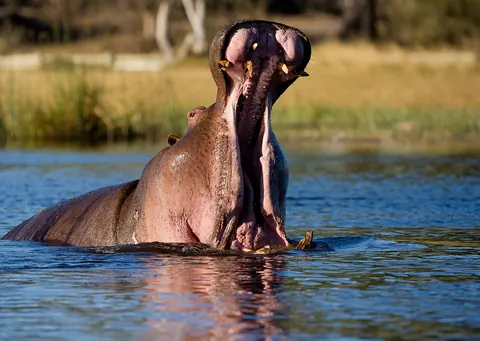
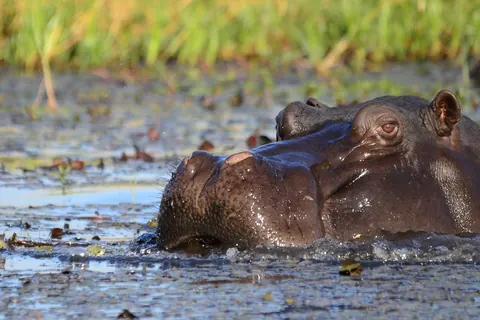
- very likelyHippoLagoons and channels. 98% of surveyed travellers saw one (Expert Africa's survey of its own travellers in the delta's private reserves, running since 2018). All yearsource
- very likelyZebra, giraffe and blue wildebeestThe open floodplains. Each was seen by 93% or more of surveyed travellers. All yearsource
- very likelyLionAcross the reserves. 93% of surveyed travellers saw lionsource
- likelyBuffaloIn large numbers all year. 85% of surveyed travellers saw them. All yearsource
- likelyRed lechweIn and beside the water. It is the most abundant large mammal in the delta, at roughly 88,000 animals. All yearsource
- likelyLeopardTree islands and riverine forest. 73% of surveyed travellers saw one, helped by guides who can leave the tracks and drive at night in the concessionssource
- likelySpotted hyena68% of surveyed travellers saw onesource
- likelyNile crocodileLagoons and river banks, including the Khwai River. All yearsource
- likelyBirds: 482 species recorded, with wattled crane, slaty egret and southern ground hornbill among 24 globally threatened onesThroughout. The delta is an Important Bird Area, and 33 waterbird species occur here in numbers above 0.5% of their global or regional population. All yearsource
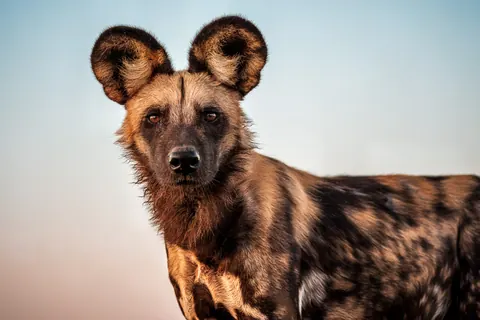
- possibleAfrican wild dogEasiest to find on the northern and eastern sides of the delta. 61% of surveyed travellers saw them, but packs range widely and no camp can promise themsource
- possibleCheetah56% of surveyed travellers saw onesource
- possibleSitatungaThe deep-water and papyrus areas, where it keeps far into the swamp. 25% of surveyed travellers saw onesource
- possibleSable and roan antelopeThey range across the region but are uncommon. Sable was seen by 29% of surveyed travellers and roan by 25%source
- rareWhite and black rhinoDo not plan on it. The IUCN's 2025 assessment says poaching was so severe that no wild rhino remain in the World Heritage propertysource
Likelihood is for a normal visit of two or three days, from the sources linked. Nothing is guaranteed in the wild.
Staying safe in Okavango Delta
- Malaria
- The delta is in a malaria area. The UK Health Security Agency's 2026 guidelines rate the northern half of Botswana, with the Okavango Delta named, as high risk from October to May and advise antimalarial tablets for those months. For the rest of the year they rate the risk low and advise bite avoidance only. source
- Malaria tablets, the US advice
- The US CDC lists the Okavango and Ngamiland districts among the areas with malaria transmission and recommends prescription tablets there (atovaquone-proguanil, doxycycline, mefloquine or tafenoquine) without naming a season. The two bodies differ for the winter months, so ask a travel clinic which advice applies to you. source
- Unfenced camps and emergencies
- Camps here are not fenced and dangerous animals walk through them. At Kwara, for example, guests are escorted to their rooms after dark and each room has an air horn for emergencies. Do the same wherever you stay: do not walk about alone at night, and keep tents closed against baboons and vervet monkeys. In an emergency Kwara can have a guest flown out, but only in daylight, because the bush airstrips have no lights. source
- Hippos, crocodiles and the water
- The UK Foreign Office says not to bathe in rivers and lakes in Botswana because of wild animals and water-borne disease. That goes for every channel and lagoon in the delta, however clear it looks. source
- Mokoro trips
- A mokoro is a dugout canoe poled from the stern, and a hippo can tip one over with ease. Leave the route to your poler. source
- Remote driving
- For remote areas the UK Foreign Office advises booking transport and somewhere to stay ahead, carrying emergency water and fuel, and in very remote areas travelling in convoy or with a satellite phone in case of a breakdown. source
Tips from travellers
- Pack for the light aircraft. Mack Air allows 20 kg a person including hand luggage and prefers soft bags. official
- Flights from Maun to the camps take 15 to 45 minutes and run as a shuttle, so times shift with the day's bookings and you may stop at one or two other airstrips on the way. one source
- Driving to Khwai, fill up in Maun, about 150 km away. There is no fuel station in the concession. one source
- The Maun to Khwai road is tar to Shorobe, then about 25 km of corrugated gravel to the veterinary gate and roughly 60 km on to Mababe. One driver who did it in September 2022 found deep water on the road just before Mababe and deep sand on the track beside the power lines. Conditions change from year to year, so ask in Maun before you set off. one source
- Hyenas walk through the Khwai and Moremi North Gate campsites after dark. One pair of campers at Magotho had a hyena take the braai spice off their table while the steaks were still cooking. Keep food packed away in the vehicle. one source
- Mokoro and boat trips depend on water. The northern and eastern parts of the delta hold the most, and levels are generally highest from about May to August, so ask a camp which months its mokoros actually ran last year. one source
Checked 12 October 2026. Conditions change, so confirm with the park or venue before you go.
Crocodile hunters, sneezing dogs and the canal Maun refused
In 1957 Bobby Wilmot took two plywood boats, each with a 10 horsepower Johnson outboard, up the Santantadibe channel from Motsaudi, near Shorobe. He hunted at night with a spotlight, and by his own count shot 54 crocodiles from 68 rounds in two weeks. When a bull hippo rammed one of the boats, they patched it with condensed milk tins and nails pulled out of the hull.
Men after skins opened a good deal of the delta to outsiders. Xakanaxa, inside Moremi, started in the 1960s as Wilmot’s crocodile camp, because it was the easiest way onto the big lagoons from Maun. He died of a snake bite in 1968. His son Lloyd, who had been helping him for two years, went on running hunting trips until the end of 1970, gave it up, and in 1972 set up Xaxaba as a camp for people with cameras.
The canal Maun said no to
The southern delta was nearly turned into a ditch. In the 1980s the government drew up a scheme to dredge channels there so that more water would reach Maun and the diamond mine at Orapa. Work was due to start in January 1991.
It never did. Archibald Mogwe, the minister for water, came to Maun to explain the scheme and was told by the town that it neither needed nor wanted it. President Masire then suspended the project. Greenpeace had been threatening a boycott of Botswana’s diamonds under the slogan “Diamonds are for death”, which cannot have hurt the town’s case. The government then asked the IUCN to review the whole plan. The American anthropologist Thayer Scudder was first among the authors, and their report said the scheme would harm the swamp and the people living off it, and pointed to groundwater instead. The dredging was shelved.
Why the islands are crusted white
Look down from the plane and many islands have a pale crust on them, away from the trees at the edge. It is salt, mostly sodium bicarbonate. Terence McCarthy of Wits University spent more than 30 years working out why. The trees on the rim drink so hard that the water table under the island sits lower than the swamp around it. Fresh water flows in, the trees take the water and leave the salts, and the salts collect in the groundwater under the middle.
That is how the swamp stays fresh, though about nine tenths of the river goes into the air.
His work turned up a second set of engineers. Hippos wear paths through the swamp vegetation to reach the grazing on the islands. Those trails pick up flow from channels that are dying, scour deeper and become new channels.
Dogs that vote, and other things to look for
Tico McNutt arrived in 1989 as a graduate student and lived in a tent just outside Moremi for five years, following wild dogs. The spot became known as Dog Camp, and the study area runs to some 3,000 square kilometres. In 2017 he and three colleagues reported what had been recorded at 68 “rallies” in five packs: a pack decides whether to get up and hunt by sneezing. If the dominant dogs are in on it, a few sneezes will do. If they are not, it takes about ten.
For visitors, the dogs whelp in the cold months, June to August. McNutt’s own project calls that the best time of year to find a pack, because dogs that normally range far have to keep coming back to one den. Khwai is where self-drivers report them most. One forum poster followed a pack of ten for about three hours there in a December. A Tracks4Africa writer saw two in the long grass at the water’s edge from a mokoro and called it pure luck, which outside the denning months it is.
Duba Plains is the place people get wrong. The Jouberts made it famous with Relentless Enemies, their film of three lion prides and the buffalo herd they lived off. In 2014 the lions split into smaller groups. One company that inspects the camp says they now live mostly on red lechwe, leopard are seen more often, and Duba has no zebra, wildebeest, impala or giraffe at all.
In the Panhandle, around Shakawe, the thing to time is the catfish run. As the water drops, from about August to October, catfish in their thousands swarm along the channels hunting smaller fish, with tigerfish after them and fish eagles and other birds overhead. Pel’s fishing owl is the bird everyone asks for. One birding guide puts the whole delta at about 100 pairs, and found his high in the branches late in the afternoon. Sitatunga feed at dawn and dusk and are best looked for from a mokoro.
The north bank had a bad year in 2020. Around 330 elephants died near Seronga. The first report came on 25 April, and the deaths stopped towards the end of June, when the seasonal pans dried up. The government blamed toxins from cyanobacteria in those pans. Hyenas and vultures feeding on the carcasses stayed healthy.
On the water, and on foot
Two accounts of mokoro and walking trips, one by a writer on a group tour in 2018 and one by someone who went to record sound, dwell on the small things at water level. She lists frogs and water lilies. The sound recordist came back with jacanas, frogs and the cry of a fish eagle, and the hollow ring of ripples along the hull. She says the side sat a few inches above the water and not a drop came in, and that the hippos were close enough to stop her breathing.
Both were struck by the walking. The recordist writes that coming up on a lion with no vehicle and no rifle is a different thing from a game drive. She found lion tracks on a walk after hearing a roar in the night, and never saw the animal.
In and around Okavango Delta
186 places listedWhere to stay in Okavango Delta 109
- 18.87°S 22.66°EHotelDuke's Camp+27 21 001 1574naturalselection.travel
- 19.58°S 23.54°EHotelGomoti Plains Camp+27 10 446 7691machabasafaris.com
Show all 109 places to stay
- Jao village & Camp · Hotel
- Khwai River Lodge · Hotel · 5 star
- Eagle Island Camp · Hotel
- Khwai Explorers camp · Campsite+267 74 991 125
- Khwai Guest House · Guest house+267 686 3685bushways.com
- Kwetsani Camp · Hotel
- Machaba Camp · Hotel+27 10 446 7691machabasafaris.com
- Magotho Campsite · Campsite · Khwai
- Mogogelo Camp · Campsite+267 686 5644mogogelocamp.com
- Santawani Lodge · Hotel
- Tracker Dogs · Campsite · trackerdogs4@gmail.com
- Xaranna Okavango Delta Camp · Hotel
- Mbudi Campsite · Campsite+267 680 1054
- Nagapie Camp Site · Campsite · Mogotlo
- Okavango Island · Campsite · NG/12 Concession
- RraDinare · Hotel+0000000000
- Acacia 2 campsite · Campsite
- Atzaro Camp · Hotel
- Baines Camp · Campsite
- Banoka Bush Camp · Hotel
- Buffalo campsite · Campsite
- Butlers · Campsite
- Chitabe Camp · Hotel
- Circle Rd site · Campsite
- Combretum campsite · Campsite
- Daonarar Safari Camp · Chalet
- Delta Camp · Campsite
- Delta Campsite · Campsite
- Duba Plains · Campsite
- Elephant Pool camp 1 · Campsite
- Elephant Pool cap 1 · Campsite
- Explorers Sable Camp · Campsite
- Glamping tent town · Campsite
- Got stuck · Campsite
- Gunn's Camp · Hotel
- Hyena Pan Tented Camp · Hotel
- Jao Campsite · Campsite
- Kadizora · Hotel
- Kala Camp · Hotel
- Khwai Expedition Camp · Campsite
- Khwai Safari Grounds · Campsite
- Kiri Camp · Hotel
- Koro campsite · Campsite
- Kudu 1 campsite · Campsite
- Kudu 2 campsite · Campsite
- Kwapa Training Camp · Campsite
- Kwedi · Hotel
- Leopard (Tent 5) · Campsite
- Little Sable · Campsite
- Little Vumbura · Hotel
- Magothlo Camp 7 · Campsite
- Magotho Camp · Campsite
- Magotlo · Campsite
- Magotlo 1 · Campsite
- Magotlo 10 · Campsite
- Magotlo 2 · Campsite
- Magotlo 3 · Campsite
- Magotlo 4 · Campsite
- Magotlo 5 · Campsite
- Magotlo 6 · Campsite
- Magotlo 7 · Campsite
- Magotlo 8 · Campsite
- Magotlo 9-15 · Campsite
- Mapula Lodge · Hotel
- Matshwanw campsite · Campsite
- Mbiroba Camp · Hotel
- Mbudi Camping grounds · Campsite
- Mbudi Campsite 1 · Campsite
- Mbudi Campsite 2 · Campsite
- Mbudi Campsite 3 · Campsite
- Mbudi campsite 8 · Campsite
- Mokolwane Camp · Chalet
- Mophane campsite · Campsite
- Moremi Crossing · Hotel
- Mukutshumu Camp · Campsite
- North Forest Cam AGA · Campsite
- Nxabega Okavango Tented Camp · Hotel
- Nyanti House · Campsite
- O Bona Moremi Safari Lodge · Motel
- Oddballs Camp · Hotel
- Oddballs enclave · Hotel
- Pom Pom Camp · Hotel
- Reception · Campsite
- Sable alley (Khwai Private Reserve) · Campsite
- Sandibe · Hotel
- Sango Safari Camp · Hotel
- Santawani · Hotel
- Seba Camp · Campsite
- Shindi Camp · Campsite
- Shuma campsite · Campsite
- Stanley's Camp · Hotel
- Starling Lodge · Hotel
- Swimming pool · Campsite
- Tsaro Elephant Lodge · Hotel
- Tuludi camp · Campsite
- Vumbura North Camp · Campsite
- Vumbura Plains Camp · Campsite
- Vumbura South Camp · Campsite
- Xudum Okavango Delta Lodge · Hotel
- Xugana Lodge · Hotel
Sights 76
- 4 palmsMonument
- 4 palmsMonument
- 4 waysMonument
- 8k XingMonument
- Big BaobabMonument
- Boat stationMonument
- Boat stationMonument
- BomaViewpoint
- BoreholeMonument
- Bryden IslandViewpoint
- bush walkAttraction
- CampAttraction
Show all 76 sights
- Coucal Vlei · Viewpoint
- Croc Xing (not iron bridge) · Monument
- Croton Passage · Viewpoint
- delta entrance · Attraction
- Elephant skull · Monument
- Elephant skull nr camp · Monument
- Elephant skull TL spot · Monument
- Film camp · Monument
- Film camp bridge · Monument
- Giraffe bridge · Monument
- Grumbles Lagoon · Monument
- Grumbles Xing · Monument
- Hamerkop Pan · Viewpoint
- Hippo Pool · Viewpoint
- Hippo Pool · Viewpoint
- Hippo view · Viewpoint
- Hyena den · Attraction
- Hyena Den · Attraction
- Iron bridge · Monument
- Iron bridge - actual one of wood · Monument
- Iron bridge - keep · Monument
- Join the road · Monument
- Junction · Monument
- Junction · Monument
- Junction · Monument
- Junction · Monument
- Junction · Monument
- Junction · Monument
- Junction · Monument
- Junction main access & bottom road · Monument
- Junction to boat station · Monument
- Junction to grumbles crossing · Monument
- Junction to kigelia street · Monument
- Junction to Xudjwana borehole · Monument
- Junction West PJ's · Monument
- Junction with South Road · Monument
- Kigelia street junction · Monument
- lagoon 3 Entry · Attraction
- lagoon 3 exit · Attraction
- Lechwe plains · Monument
- Lightning Island · Viewpoint
- Lion bridge · Monument
- Lycaon Pan · Viewpoint
- Main access X middle road · Monument
- Mantis island · Monument
- Old APU Camp · Viewpoint
- Road to xarana · Monument
- Sausage Tree Crossing · Viewpoint
- Single palm pan · Monument
- Termite mound · Monument
- The Traffic cone · Monument
- Topless palm · Monument
- Tsaro Elephant Lodge · Ruins
- Water xing · Monument
- Waterhole · Viewpoint
- Waterhole · Viewpoint
- Waterhole · Monument
- Waterlily crossing · Monument
- Wild Dog Pan · Viewpoint
- Xhamu Lagoon · Attraction
- Xudum Forest · Monument
- Xudum lagoon Xing · Monument
- Xudum Xing · Monument
- Zebra-Logo · Attraction
Bars and pubs 1
- Kaziikini BarBar
Quick answers
What animals can you see in Okavango Delta?
Most visitors see elephant, hippo, zebra, giraffe, blue wildebeest and lion. You have a good chance of seeing buffalo, red lechwe, leopard, spotted hyena, nile crocodile and birds: 482 species recorded. White and black rhino are there but rarely seen.
Guides for Okavango Delta
- First Safari: South Africa, Namibia or Botswana?
- Malaria on Safari: Kruger, Etosha, Okavango, Malaria-Free Parks
- Plugs, SIM Cards and eSIMs: South Africa, Namibia, Botswana
- How Much Does a Safari Cost? South Africa, Namibia, Botswana
- How Much Does a Safari Cost from the UK? Prices in Pounds
- Safari in the UK School Holidays: Which Break, Which Park
- Safari Tipping in South Africa, Botswana and Namibia
- Best Time to Visit the Okavango Delta: Flood, Game and Prices by Month
- Botswana Travel Essentials: Money, Driving, Malaria
Map of Okavango Delta
See every place on this map as a list