Park · North-West District, Botswana
Tsodilo Hills
Four quartzite hills in the Kalahari west of the Okavango Panhandle, with more than 4,500 rock paintings. Botswana's first World Heritage Site, walked with a local guide.
Short answer
Tsodilo Hills is in North-West District, Botswana. This page lists 2 places to stay and 6 sights.
- Malaria
- Tsodilo is in the Okavango district of the north west.
- Places to stay
- 2
- Where
- North-West District, Botswana18.74°S 21.74°E
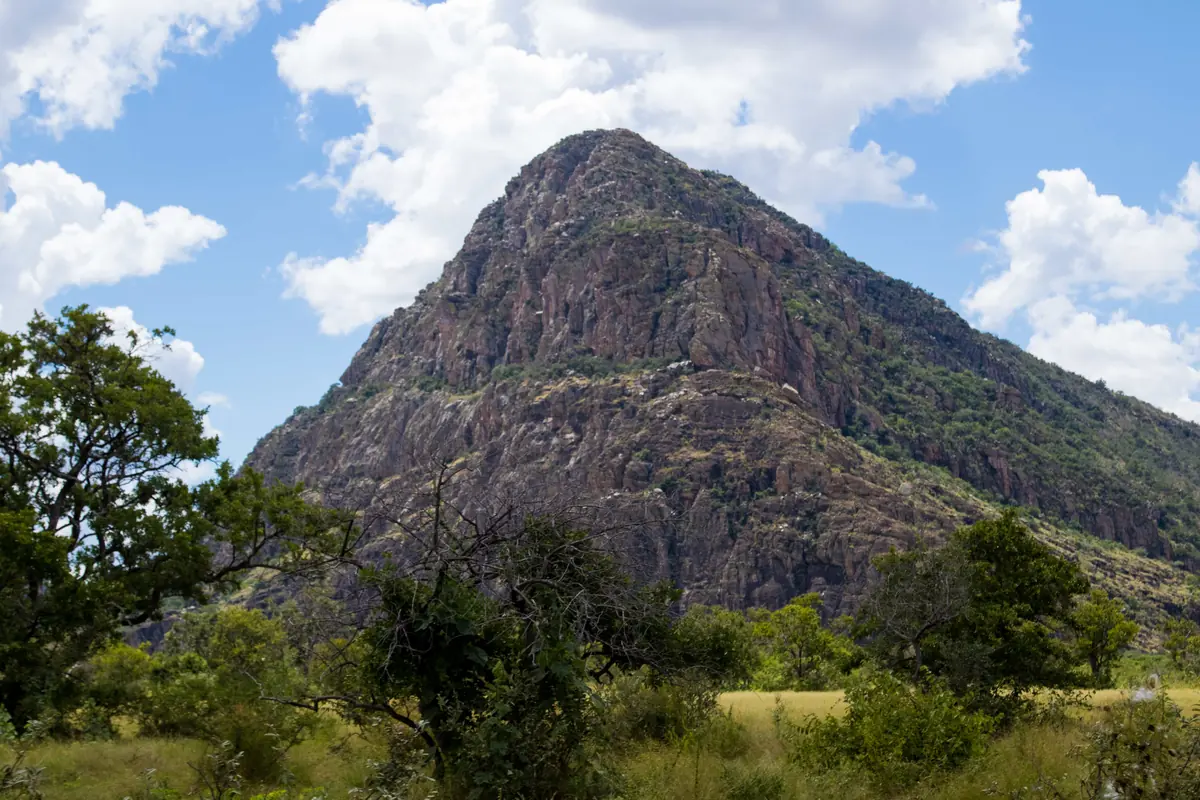
Tsodilo is four quartzite hills standing on their own in flat Kalahari sand, west of the Okavango Panhandle and close to the Namibian border. People have used them for about 100,000 years and left more than 4,500 paintings on the rock, packed into roughly 10 square kilometres. It became Botswana’s first World Heritage Site in 2001. The hills are called Male, Female and Child, with a smaller fourth to the north.
Getting there
The turn-off is on the A35 near Nxamasere, about 35 km south of Shakawe. From the tar a gravel track runs west for just under 40 km to the gate and office, then on past Male Hill to the car park below Female Hill. Reports on that track differ. Some call it a good graded road, others say it wants a 4x4 and softer tyres, so ask in Shakawe how it is running. There is an airstrip near the hills, and some Panhandle lodges arrange guided trips. From Nxamaseri the 4x4 transfer takes an hour to an hour and a half.
When to go
May to September is the comfortable time for walking: dry, clear, and cold at night from May to July, when it can drop to between 5 and 10 °C. From October to April it gets very hot and days can reach 40 °C, so walk early or late. The rains fall between December and April, and the track in can get difficult after a heavy downpour.
What to do
You walk the hills with a guide from the local community. Independent visitors are required to hire one. The Rhino Trail around Female Hill is the shortest and the one most people do. It passes the Van der Post Panel (eland, giraffe and handprints), red rhinos and figures the guides read as a whale and a penguin. The Lion Trail leads on to the climb up Male Hill, steep and loose underfoot, a two to three hour walk best started at sunrise. Male Hill tops out at around 1,400 m, some 400 m above the plain, and is often called Botswana’s highest point, though two hills in the south east are measured higher. The Cliff Trail takes in eight more painted sites. The small site museum is reported open 07:30 to 16:30.
The paintings were done with a finger, not a brush, mostly in red, and about 160 of them show cattle.
Good to know
There is no shop, no fuel and nowhere to buy food at the hills, so fill up and stock up before you leave the tar. The campsite between the two biggest hills has toilets and a shower but no electricity. Tsodilo is in the north west, where the US CDC lists both Okavango and Ngamiland as malaria areas, and British guidance rates the north of Botswana high risk from October to May, so talk to a travel clinic about tablets. Wear proper shoes for the boulders, carry more water than you think you need, and do not touch the paintings. Local people hold the hills sacred, as the home of ancestral spirits.
History and culture
Tsodilo is a cluster of four quartzite hills in the Kalahari with one of the densest collections of rock paintings in Africa, more than 4,500 of them. People have come here for around 100,000 years to shelter, mine, trade, herd cattle and pray, and the Hambukushu and San families who live beside the hills still hold them sacred. Knowing a little of that past turns a walk past faded red animals into something much bigger.
- About 100,000 years ago
The earliest signs of people at Tsodilo go back roughly this far. The caves and shelters are thought to have been used ever since, though perhaps only now and then. source
- AD 550 to 760
People living at Divuyu, on top of Female Hill, worked iron and copper. Finds there have been carbon-dated to these years, which makes it one of the earliest known sites of large-scale metalworking in southern Africa. source
- From the 800s
Nqoma, next to Divuyu, was for perhaps 400 years the home of a wealthy elite and a trading centre with links right across the continent. Diggers found iron and copper bangles, chains and earrings. Imported glass beads and cowrie shells turned up at the two sites. source
- About 800 to 1200
Cattle were common around the hills in these centuries, and about 160 paintings show them. Because the cattle are painted in the same style as the wild animals, most of the red art is thought to date from this time. Tsodilo stopped being a major trading centre in the 1100s. source
- 1852
A party of Griqua traders passed close by on the way to Andara on the Okavango, bringing the first horses known to reach Tsodilo. The white paintings of riders on horseback cannot be older than that. source
- 1898
The German geologist Siegfried Passarge reached the hills on 1 July 1898. He mapped them, wrote up the geology and photographed a few of the paintings. The British Museum's history of research at Tsodilo starts with him. source
- 1951 to 1958
The French explorer François Balsan photographed and traced the Rhino Panel over two days in September 1951. The South African writer Laurens van der Post came later meaning to film the paintings, and his 1958 book The Lost World of the Kalahari made the hills known around the world. source
- 2001
President Mogae opened the site museum in May 2001. source
- 2001
Tsodilo was put on the World Heritage List, the first site in Botswana to be listed. source
- Two communities
- Two peoples live beside the hills: the Hambukushu and the Juǀ'hoansi, a San people (the word used in Botswana is Basarwa). Elders from both were the guides and storytellers the first researchers relied on in the 1960s. source
- A family of hills
- The San call the tallest hill the Male, the next the Female and the smallest the Child. One version of the story says the fourth hill is the man's first wife, whom he left for a younger woman. source
- The Hambukushu creation story
- In Hambukushu tradition the god Karunga set the first people and their cattle down on Tsodilo. Grooves in the rock are said to be the marks of hooves slipping as the cattle went down to the first spring. source
- A sacred place
- People at Tsodilo say spirits live in the hills and can both heal and punish, so visitors are expected to behave with respect. White Paintings Shelter was used for healing dances in which people laid their hands on the paintings to draw on their power. source
- Community tourism
- The Tsodilo community trust runs campsites and makes crafts for sale, work paid for by the diamond companies Debswana and De Beers. The African World Heritage Fund recognised that funding with an award in 2015. source
For German visitors: The story of research at Tsodilo starts with a German. The geologist Siegfried Passarge mapped the hills on 1 July 1898 and photographed some of the paintings, and in 1907 he published tracings of those photographs in his book Die Buschmänner der Kalahari. source
Main sights in Tsodilo Hills
7- Van der Post Panel
A rock face on Female Hill painted with eland, giraffe and handprints. Laurens van der Post tried to film it in the 1950s. After a run of bad luck, including jammed cameras and a swarm of bees, he gave up and left a note of apology to the spirit of the hills at the panel.
British Museum, African Rock Art: Botswana (research history and distribution) - Rhino paintings, Female Hill
Two rhinos painted on Female Hill. Rhino, giraffe and eland are by far the animals painted most often at Tsodilo. The French explorer François Balsan traced what is now called the Rhino Panel in 1951.
British Museum, African Rock Art: Botswana (research history and distribution) - The whale and the penguin
Paintings on the Rhino Trail that guides point out as whales and a penguin, though the sea is about a thousand kilometres away. Treat that reading as a good story. Nobody knows what the painter meant.
Tracks4Africa, everything you need to know about Tsodilo Hills - White Paintings Shelter
A shelter on Male Hill holding about half of all the white paintings at Tsodilo: people with hands on hips, riders on horses, an elephant and rows of m shapes. The white art is later than the red and often painted over it.
British Museum, African Rock Art: Tsodilo Hills, Botswana - Rhino Cave
A cave at the north end of Female Hill with a rhino painted in white and a red giraffe on one wall, and hollows and grooves ground into the other. Stone spear points found here date from the Middle Stone Age.
Wikipedia, Tsodilo - Depression Shelter
A shelter on the north-west side of Female Hill named for the hollows ground into its walls, with red paintings of cattle beside them. People first used it at least 30,000 years ago.
Wikipedia, Tsodilo - Tsodilo site museum
A small museum by the office on the meaning of the paintings to the people who live here, housed in a building in the local style. One travel writer found it looking neglected in 2021, so do not expect much.
Wikivoyage, Tsodilo
Did you know?
- The Tsodilo paintings were made with a finger, not a brush, which sets them apart from the fine-line San art found elsewhere in southern Africa. The human figures carry no bows and wear no clothes or ornaments. source
- About 160 of the paintings show cattle, drawn in the same style as the giraffe, eland and rhino around them. That is the main clue to their age, because cattle were common here between about 800 and 1200. source
- Male Hill, at about 1,400 m, is often called the highest point in Botswana. Otse Hill and Monalanong Hill in the south east are both measured at around 1,490 m, so the title is disputed. source
- A schematic zebra painted at Tsodilo became the first logo of Botswana's National Museum and Art Gallery. source
- In 2006 an archaeologist said a python-shaped rock in Rhino Cave showed ritual 70,000 years ago, the oldest known anywhere. Archaeologists who had dug the cave in the 1990s rejected the claim, saying the dating does not support it. source
- Tsodilo is not a national park. It has been a protected national monument since 1927 and is run by the Department of National Museum and Monuments with a management body that includes the local community trust. source
Checked 12 October 2026.
Wildlife you might see
9- very likelyOther birdsAll over the hills. At least 147 species are on record, which makes the birding better than the game viewingsource
- likelyVerreaux's eagle and rock kestrelAround the hills, where both are regularly seensource
- possibleGreater kuduThe bush around the foot of the hillssource
- possibleSteenbokThe sandy flats around the hillssource
- possibleChacma baboonOn and around the rocks. Baboons are the monkeys you are most likely to meet heresource
- possibleGiraffeThe woodland around the hills. Game is thin here and this is not a safari stopsource
- rareLeopardA few live in the hills. They are seldom seensource
- rareHyenaPass through the hills now and thensource
- rareTsodilo thick-toed geckoThe species carries the name of the hills and is found only in Botswanasource
Likelihood is for a normal visit of two or three days, from the sources linked. Nothing is guaranteed in the wild.
Hikes and walks
4- Rhino Trail
The shortest and most walked route, a loop around Female Hill. It passes the Van der Post Panel, the red rhino paintings and the figures known as the whale and the penguin.
Permit: Walked with a local guide, who is paid on top of the entry fee
Tracks4Africa, everything you need to know about Tsodilo Hills - Lion Trail
Named after the lion painting it passes, with four painted sites along the way. It is also the start of the route up Male Hill.
Permit: Walked with a local guide, who is paid on top of the entry fee
Wikivoyage (German), Tsodilo - Male Hill summit
A steep climb over loose boulders to the top of the highest hill, about 410 m above the surrounding bush. Lodge guides start it at sunrise to beat the heat. The view takes in the Kalahari flats and the Panhandle.
Permit: Walked with a local guide, who is paid on top of the entry fee
Expert Africa, Tsodilo Hills Sleep-Out Camp - Cliff Trail
A longer route than the Rhino Trail that takes in eight painted sites. Ask at the gate which trails are open and how long the guide expects each to take.
Permit: Walked with a local guide, who is paid on top of the entry fee
Wikivoyage (German), Tsodilo
Staying safe in Tsodilo Hills
- Malaria
- Tsodilo is in the Okavango district of the north west. The US CDC lists Okavango and Ngamiland among the districts with malaria transmission and recommends prescription tablets there (atovaquone-proguanil, doxycycline, mefloquine or tafenoquine). See a travel clinic well before you fly. source
- Malaria season, the UK advice
- The UK Health Security Agency's 2026 guidelines rate the northern half of Botswana as high risk from October to May and advise antimalarial tablets for those months. For the rest of the year they rate the risk low and advise bite avoidance only. The US advice names no season, so ask a clinic which applies to you. source
- Heat and water
- Days can reach 40 °C in the hot months. Walk early in the morning or late in the afternoon, carry your own drinking water and use strong sun protection. source
- Footing on the hills
- The trails cross uneven ground, and the climb up the hills goes over loose boulders. Wear sturdy closed shoes. source
- Wild animals
- Tsodilo is not known for game, but dangerous animals do occur here. Keep children close, stay with your guide on the trails and do not wander from the campsite after dark. source
- Remote driving
- For remote areas the UK Foreign Office advises taking emergency water and fuel, being ready for off-road conditions and making arrangements in advance. It also warns of livestock and wild animals on roads outside towns, most of all at night, so plan to be off the A35 before dark. source
Tips from travellers
- Bring everything with you. There is no shop, fuel station, café or restaurant at the hills, so fill the tank and buy food and water before you turn off the tar. several sources
- Reports on the gravel track from the A35 differ, from a good graded road to a bumpy one that wants a 4x4. Ask in Shakawe before you set out, and let some air out of the tyres at the start of the gravel to guard against punctures. several sources
- The campsite has flush toilets and a shower but no electricity, so charge batteries before you arrive and bring your own light. several sources
- Not every guide speaks much English. If the stories behind the paintings matter to you, ask at the gate for a guide who does, or come on a lodge trip with its own guide. one source
- If you are not self-driving, ask the Panhandle lodges. Xaro Lodge, reached by boat from Drotsky's Cabins near Shakawe, can arrange guided trips to the hills. one source
- Stay for sunset if you can. The western cliffs glow copper in the last light, which is why the local Juǀ'hoansi call the hills the Copper Bracelet of the Evening. one source
Checked 12 October 2026. Conditions change, so confirm with the park or venue before you go.
Fish bones in the desert and the mines that made hair glitter
Dig down at the foot of Male Hill and you hit fish. When Larry Robbins of Michigan State University and his team took the floor of White Paintings Shelter down seven metres in the early 1990s, fish bones turned up among the stone tools, along with barbed bone points of the kind that probably tipped fishing spears. The nearest fish today swim in the Okavango River, about 40 km away to the north-east across dry sand.
The flat ground west of the hills is an old lake bed. Geographers have dated its shelly deposits to two long wet spells, roughly 40,000 to 32,000 years ago and again from 27,000 to 12,000 years ago. A later team from the Free University of Berlin sent 120 kg of the sediment home to read its snail shells and diatoms, and put the lake at around 30 square kilometres. For long stretches of the Stone Age there was fishing water on the doorstep.
Glitter for the hair
The hills were mined too, and at least 21 old workings have been recorded. The miners were after specularite, a blue-grey kind of haematite that grinds down to a sparkling powder. The Setswana word is sebilo. Travellers and missionaries in South Africa in the 1800s watched people mix it with grease and work it into their hair until it hung in thin, shining threads, and that is the comparison Robbins draws for Tsodilo.
The busy years were about AD 800 to 1000, when the village of Nqoma on Female Hill had the richest variety of metal jewellery of any known site of its day in southern Africa, and Robbins argues that Nqoma controlled the digging. The inspectors who assessed Tsodilo for the World Heritage List called the output enormous, and some mining went on into the 1800s.
The cave a headman showed them
Archaeologists had worked at Tsodilo for years before any of them saw Rhino Cave. Xhao Xontae, headman of the Juǀ’hoansi, led them there in the mid 1990s, while the paintings were being counted. The way in is over and between boulders on the northernmost ridge of Female Hill, and the easier of the two entrances still ends in a drop of about two metres.
Inside, a slab of quartzite nearly seven metres long has 346 hollows ground into its face. On midwinter afternoons a strip of sunlight comes through a gap in the roof and moves across them for a few hours. Sheila Coulson of the University of Oslo later dug up spear points of coloured stone that had come from 50 km and more than 100 km away, and had then been burnt, smashed or simply left.
The headman’s own people have had a harder time of it. The 1994 management plan wanted the core area fenced and spare population encouraged to settle elsewhere, and by 2001 the San village that used to stand between the hills had been moved nearly four kilometres away. In June 2025 an elder named Xontae Xhao, which is also the name of the old headman’s son, told a visiting government committee that nobody had consulted them about the move. Others objected to their ancestors’ remains being dug up and shown in the museum.
What van der Post left out
Laurens van der Post’s jammed cameras and his note of apology are the famous part. The details are better. His guide was a man called Samutchoso, not a San himself, who had banned hunting near the hills. Members of the party hunted a warthog and a steenbok regardless. Then the film magazines jammed, the tape recorders died and the bees came. The note is said to have gone into the ground in a lime juice bottle. When the BBC showed the series in 1956, the spoiled half frames went on screen as evidence, in an episode called “The Spirits of the Slippery Hills”.
His biographer J.D.F. Jones thought the whole episode exaggerated, not least the claim to have discovered hills that Europeans had known since the start of the century. The bees are real enough, though. The hills have no surface water beyond a few small springs and seeps, and one journalist driving in was warned by a couple coming out not to leave open water standing in camp, because the bees swarm to it.
Pythons at the spring, and things heard after dark
Visitors to Tsodilo hear more animals than they see. One writer camping here in late December listed barn owls, francolins and the footfalls of kudu, and watched a spotted eagle owl eat a mouse by torchlight. By day the noise is grey hornbills. Then there is the wind. A Panhandle lodge owner told the same journalist that it circles the foot of the hills, and one couple in July 2000 slept in their Land Rover when it came up.
The animals with standing here are the snakes. The World Heritage evaluation of 2001 records that two rock pythons had lived at the waterhole halfway up Female Hill for at least ten years, and were treated as messengers from the spirit world. A Botswana newspaper in 2007 wrote of pythons at the Gobeku spring too, the one said never to run dry. The San also tell of a giant serpent with spiralling horns like a kudu’s in the water cave on the west side of Female Hill.
The Tsodilo gecko was first collected here over three days in April 1965 by Wulf Haacke of the Transvaal Museum. Its body is no more than six centimetres long, it comes out at night and it is known from nowhere else. And Shortridge’s 1934 book on the mammals of South West Africa lists klipspringer at Tsodilo. The author of the Bradt guide to Botswana could find no report of one since.
Camping has changed. On a South African overlanding forum in 2014, two people who had been in the winter of 2013 reported that wild camping among the hills had stopped and that everyone now went into a fenced community campsite with its own gate. A regular from Maun had heard only disappointing stories since the move.
In and around Tsodilo Hills
8 places listedWhere to stay in Tsodilo Hills 2
- 18.76°S 21.74°ECampsiteMakuba Woods
- 18.74°S 21.73°ECampsiteMalasto ?
Sights 6
 TsodiloArchaeological site
- Dancing PenisesAttraction
- ElenantilopenAttraction
- LionAttraction
- RhinoAttraction
- Whale and PenguinAttraction
Quick answers
What animals can you see in Tsodilo Hills?
Most visitors see other birds. You have a good chance of seeing verreaux's eagle and rock kestrel. Leopard, hyena and tsodilo thick-toed gecko are there but rarely seen.
What are the best hikes in Tsodilo Hills?
Rhino Trail, Lion Trail, Male Hill summit and Cliff Trail. See the hikes section for times, difficulty and permits.
Map of Tsodilo Hills
See every place on this map as a list