Town · Kavango East, Namibia
Divundu
Fast-growing river village on the B8 at the western end of the Caprivi Strip, and the base for Popa Falls, the Mahango core area of Bwabwata and the road to Botswana.
Short answer
Divundu is in Kavango East, Namibia. This page lists 4 places to stay and 1 places to eat and drink. The nearest park with an entry fee on this site is Popa Falls Game Park, about 4 km away, where international adults pay from N$200.
- Malaria
- UK travel health advice rates Kavango East, Kavango West and the Zambezi Region as high risk for malaria all year, and recommends antimalarial tablets (atovaquone/proguanil, doxycycline or mefloquine).
- Places to stay
- 4
- Eat and drink
- 1
- Park fee nearby: Popa Falls Game Park
- US$12 €11 · N$200about 4 km away
In and around Divundu
5 places listedWhere to stay in Divundu 4
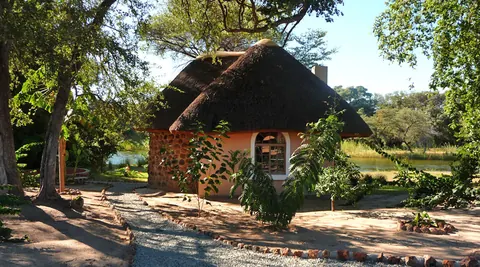
 HotelDivundu Guest HouseDivundu
- 18.10°S 21.56°ECampsiteCampsite Divundu Guest House
Restaurants and cafes 1
- GhuparoRestaurant · Divundu
Divundu is a village on the Okavango River (called the Kavango in Namibia) in the Kavango East Region, about 200 km east of Rundu on the B8. This is where the Caprivi Strip starts, and just past the village the main road crosses the river at Bagani into Bwabwata National Park. Most people stop for fuel and food, sleep at one of the river lodges and use it as a base for Popa Falls and Mahango. The census counted 746 people here in 2011 and 5,787 in 2023.
Getting there
The B8 from Rundu is tarred and runs on through Bwabwata to Kongola and Katima Mulilo. For Botswana, the C48 heads south through Bagani and the Mahango core area to the Mohembo border post, 32 km away. About 13.5 km has a light seal and the rest is gravel, and in 2024 the government announced an upgrade to full tar in phases, so expect roadworks. Through the park the B8 is unfenced, with a 120 km/h limit. Elephants cross it and animals are killed on it every year, so ease off and do not drive it at night.
When to go
June to October is the dry season and the best time for game, as the pans inland dry out and animals come to the river to drink. The Namibia Tourism Board says birding is better in the wetter months, November to March. Between February and April the high water all but covers the rapids, and the river is at its lowest in the second half of October, when the rock ledge stands clear.
What to do
Popa Falls, a few kilometres away, is not a waterfall but a set of rapids dropping about four metres over a quartzite ledge, inside Namibia’s smallest game park. Namibia Wildlife Resorts runs a rest camp on the river and you can walk to the rapids from it. Over 400 bird species have been recorded here.
Mahango, about 14 km south of Popa Falls, is the western core area of Bwabwata and the best day out from Divundu. It is known for its big baobabs, big herds of elephant and buffalo, hippo and crocodile on the waterfront, and scarcer antelope such as sable, roan and tsessebe. It is open to day visitors only. Across the river is the Buffalo core area, where the old army base of 32 Battalion stood.
The lodges on the river run boat cruises up to Popa Falls and guided visits to nearby villages.
Good to know
UK travel health advice puts the Kavango East Region at high risk of malaria all year and recommends antimalarial tablets, so see a travel clinic before you leave home and cover up from dusk. The river has crocodiles and hippos, so do not swim. Travellers rate the Divundu fuel station as reliable, but it has had queues after long weekends and has run dry at least once, so top up in Rundu too. Park entry for Bwabwata (Mahango included) and Popa Falls is in the fee tables on those pages.
History and culture
Divundu sits where the Okavango River enters the Caprivi Strip, in the home country of the Hambukushu, one of the five Kavango kingdoms, whose kings have their homestead here. Its past is a border story: a strip of land Germany gained in 1890, Catholic missions, a South African army zone through the liberation war, the spill-over of Angola's civil war in 2000, and since then a national park and a village that has grown fast.
- Before colonial rule
The Hambukushu, a Bantu-speaking people who trace their origins to Barotseland in today's western Zambia, settled along the Okavango here and downstream into the delta in Botswana. In Namibia they are one of the five Kavango kingdoms, each with its own traditional authority. source
- 1890
Under the Heligoland Zanzibar Treaty with Britain, Germany added the Caprivi Strip to German South West Africa, hoping for a river route to the Zambezi and its East African colony. The Victoria Falls made that route useless, and the Germans did little with the strip. source
- 1913
Catholic missionaries first reached this stretch of the river in 1909, during German rule, and in 1913 a mission station was set up at Andara, near Divundu, under the German missionary Joseph Gotthardt. The Andara Catholic Hospital and a school hostel followed in the 1960s, and the hospital still runs. source
- 1915
Germany had ruled the territory since 1884. South African forces defeated the Germans in 1915, during the First World War, and South Africa went on to govern it as South West Africa, applying apartheid there from the late 1940s, with pass laws and curfews for Black residents. source
- 1966 to 1989
Much of what is now Bwabwata was proclaimed the Caprivi Game Reserve in 1966 and the Caprivi Game Park in 1968, but during the liberation war the South African Defence Force declared it a military area, and it could only be run properly as a park after independence. source
- 1975 to 1993
The South African Army's 32 Battalion, made up mostly of Angolans who had fought for the FNLA (the movement that lost out to the MPLA in 1975), kept the bulk of its troops at Buffalo on the Okavango. It fought mostly inside Angola and was disbanded in 1993. source
- 1989
Popa Falls Game Park was proclaimed around the rapids, a tiny reserve of riverine forest that became a popular stopover for travellers on their way to Khaudum, Bwabwata and the parks of the Zambezi Region. source
- 21 March 1990
Namibia became independent after a long liberation struggle led by SWAPO, and Sam Nujoma was sworn in as its first president. source
- January 2000
Angola's civil war spilled over the border. On 3 January three French children were killed and their parents wounded in an ambush in this area, which the Namibian government blamed on the Angolan rebel movement UNITA. On 14 January five people, believed to be Health Ministry staff, died when a minibus was attacked near Divundu. source
- 2007
The Caprivi Game Park and the Mahango reserve were joined as Bwabwata National Park, which is managed with the people who live in it. source
- 2009 to 2023
Divundu was declared a settlement area in 2009 and a village with its own council in 2015. By the 2023 census it had 5,787 people. source
- Languages
- In the 2023 census the main home languages in Kavango East households were Rukwangali (28.4%), Rumanyo, which covers Rugciriku and Rusambyu (25.7%), and Thimbukushu (15.1%), the language of the Hambukushu, who made up 17.5% of the region's people. source
- The Hambukushu
- The Hambukushu are known along the river as rain makers, and for their basket weaving; women traditionally catch fish with traps. source
- Khwe San in the park
- About 5,500 people live inside Bwabwata, most of them Khwe San. Their Kyaramacan Association runs the Nǁgoabaca campsite and earns income from tourism, trophy hunting and the sale of devil's claw, a plant sold abroad as a remedy for pain and fever. source
- Crafts
- Kavango men are known as wood carvers, making drums, masks, furniture and dugout canoes that are sold all over Namibia, while women weave baskets and make clay pots to sell to visitors. source
For German visitors: The Caprivi Strip (Caprivizipfel in German) is named after Leo von Caprivi, the German chancellor who negotiated it from Britain in 1890 under the Heligoland Zanzibar Treaty, the same deal that gave Germany the North Sea island of Heligoland. source
For German visitors: Joseph Gotthardt, who founded the Andara mission in 1913, was born in Thalheim in the Westerwald, was consecrated bishop at Hünfeld in 1924 and became the first Vicar Apostolic of Windhoek and later archbishop. source
For German visitors: The German government, through the development bank KfW, has paid for infrastructure, equipment and planning in Bwabwata under the Namibia Parks Programme (NamParks). source
Main sights in Divundu
4- Popa Falls
Rapids where a quartzite ledge crosses the Okavango, inside Namibia's smallest game park, with a Namibia Wildlife Resorts rest camp beside them. Go when the river is low to see the rock channels.
Ministry of Environment, Forestry and Tourism, Popa Falls Game Park - Mahango core area and its baobabs
The western core area of Bwabwata, south of Divundu on the Botswana border, known for its big baobab trees and river-front game drives. Day visits only.
Namibia Tourism Board, Kavango Open Africa Route - Andara mission
The Holy Family Parish at Andara, a Catholic mission founded in 1913 among the Hambukushu. Its hospital, built in the 1960s, is still in use, so visit respectfully.
Namibia Tourism Board, Kavango Open Africa Route - Old 32 Battalion base, Buffalo core area
The remains of the South African army base in the Buffalo core area, the place that gave 32 Battalion its nickname, the Buffalos. Most of it is in ruins now.
Namibia Tourism Board, Kavango Open Africa Route
Did you know?
- Divundu grew from 746 people in 2011 to 5,787 in 2023, an average of 17.1% a year. The census report names only Nkurenkuru (23.6%) as growing faster. source
- Popa Falls Game Park covers just 0.25 square kilometres, the smallest game park in Namibia, yet 417 bird species have been recorded there. source
- At Popa Falls the Okavango drops about four metres across its full width of about 1.2 km. The rapids are an important habitat for two rare fish, the broadhead catfish and the ocellated spiny eel. source
- The Okavango never reaches the sea. It rises in Angola, where it is called the Cubango, and ends in the Okavango Delta in the Kalahari in Botswana. source
- Divundu has its own vehicle registration office, and cars registered here carry DV number plates. source
Checked 7 October 2026.
Wildlife you might see
12- very likelyVervet monkeyRiverside lodges and camps, and the Popa Falls rest camp. All yearsource
- very likelyBirds: 417 species recorded at Popa Falls, including slaty egret, bat hawk and western banded snake eaglePopa Falls Game Park and the riverine forest around it. All yearsource
- likelyHippoThe Okavango along the Mahango waterfront road, and now and then at Popa Falls. All yearsource
- likelyNile crocodileThe Okavango, at Popa Falls and along the Mahango waterfront. All yearsource
- likelyElephantMahango core area, in large herdssource
- likelyRed lechwe and common reedbuckFloodplains along the Okavango in Mahangosource
- possibleSable and roan antelopeMahango core areasource
- possibleBuffaloMahango and the Buffalo core area across the riversource
- possibleTsessebeMahango core areasource
- rareLion and leopardMahango and the Buffalo core areasource
- rareAfrican wild dogBwabwata, one of their last refuges in Namibiasource
- rarePel's fishing owlRiverine forest in Bwabwatasource
Likelihood is for a normal visit of two or three days, from the sources linked. Nothing is guaranteed in the wild.
Hikes and walks
1- Popa Falls rapids walk
Namibia Wildlife Resorts says the rapids can be reached on foot from its rest camp. They are a run of cascades where the river has split the rock into channels, so the walk shows most when the water is low. Crocodiles live here, so stay well back from the edge.
Permit: Inside Popa Falls Game Park; see the fee table for that park
Namibia Wildlife Resorts, Popa Falls Resort
Staying safe in Divundu
- Malaria
- UK travel health advice rates Kavango East, Kavango West and the Zambezi Region as high risk for malaria all year, and recommends antimalarial tablets (atovaquone/proguanil, doxycycline or mefloquine). See a travel clinic before you go, use repellent and cover up from dusk, and get any fever checked straight away, even after you are home. source
- Crocodiles and hippos
- All the perennial rivers in this area have crocodiles and hippos, and none of them is safe for a swim. Hippos defend their patch and can outrun a person on land, so outside the settlements keep clear of the bank. Fresh dung scattered on a path down to the water marks a hippo exit; turn back if you find one. source
- The B8 through Bwabwata
- East of Divundu the B8 runs through the park unfenced, with a 120 km/h limit. Many animals die under cars on this road every year, endangered wild dogs among them. Keep your speed down and avoid driving it after dark if you can. source
- The C48 to Mohembo
- The 32 km road south through Mahango to the Botswana border (Mohembo, spelt Muhembo on some signs) has about 13.5 km of light seal and 19 km of gravel, and heavy trucks have left it in poor shape, worst in the rainy season. In September 2024 the Ministry of Works and Transport announced it would be upgraded to full tar in phases, so expect roadworks. About 13 km of it runs through the game area, so take it slowly. source
- Driving in Mahango
- The Namibia Tourism Board says to use only a 4x4 in Mahango and to travel with at least two vehicles. Guided tours can be arranged if you would rather not drive yourself. source
Tips from travellers
- Fill up at Divundu. Travellers on a South African 4x4 forum rate its fuel station as reliable, though one found long queues after a long weekend and another found it out of fuel once. Top up in Rundu as well if you can. several sources
- Mahango is open to day visitors only, so sleep at Popa Falls or one of the river lodges near Divundu and drive in. Go in the dry season, June to October, when the game gathers along the river. official
- See Popa Falls when the river is low. From February to April the rapids are almost under water; the lowest level usually comes in the second half of October, when the rock ledge is exposed. one source
- Ask your lodge about a boat trip. The ministry notes that several lodges near Popa Falls offer them, and the river is where the hippos, crocodiles and most of the birds are. official
- Never leave food unattended at riverside camps. Vervet monkeys raid lodges near the river, open bins and food boxes, and will make off with keys or sunglasses left lying around. several sources
Checked 7 October 2026. Conditions change, so confirm with the park or venue before you go.
Quick answers
What animals can you see in Divundu?
Most visitors see vervet monkey, birds: 417 species recorded at popa falls, including slaty egret, bat hawk and western banded snake eagle. You have a good chance of seeing hippo, nile crocodile, elephant, red lechwe and common reedbuck. Lion, leopard, african wild dog and pel's fishing owl are there but rarely seen.
Map of Divundu
See every place on this map as a list