Park · Kavango East, Namibia
Khaudum National Park
A remote Kalahari park on the Botswana border where big elephant herds and roan antelope come to the waterholes. Deep sand, two small camps and no fuel inside, so it is strictly for well-prepared 4x4 parties.
Short answer
At Khaudum National Park, international visitors pay N$200 (about US$12, €11 or £9) per adult and N$150 per child per day. The rates apply from 1 April 2026 to 31 March 2027.
- Daily fee, international adult
- US$12 €11 · N$200
- Malaria
- Khaudum is in Kavango East, with the southern approach through Otjozondjupa.
- Places to stay
- 2
- Park fee nearby: Popa Falls Game Park
- US$12 €11 · N$200about 113 km away
Khaudum National Park fees 2026/27
Checked Ministry of Environment, Forestry and Tourism tariffValid 1 April 2026 to 31 March 2027, per person per day, in Namibian dollars.
| Who | Adult | Child |
|---|---|---|
| International visitorsUS, Europe and everyone else | US$12 €11 · N$200 | US$9 €8 · N$150 |
| SADC nationals | N$130 | N$80 |
| Namibian citizens | N$40 | Free |
- Children aged 8 and under enter free. The child rate is for ages 9 to 15; Namibian children in that age group pay nothing. From 16 the adult rate applies.
- Vehicle fee per day, on top of the per person fee: N$60 for 10 seats or less, N$150 for 11 to 25 seats, N$600 for 26 to 50 seats and N$1,000 for 51 seats or more.
- The Namibian rate is for Namibian citizens. The gazette sets fees by nationality, so a foreigner living in Namibia pays the rate for their nationality.
- Each fee is half park entrance fee and half conservation fee; the figures shown are the two added together.
- These fees were gazetted with effect from 1 April 2026 and have no end date. I show them as valid to 31 March 2027, the end of Namibia’s financial year, and will re-check then.
- Fees are set by Ministry of Environment, Forestry and Tourism. Official tariff · Seen a new rate? Tell us
US$1 = N$16.64 · €1 = N$18.60 · £1 = N$22.31 (ECB rate, 3 Nov 2026, N$1 = R1). Converted amounts are approximate; you pay in Namibian dollars.
How we got these figures
- SafariFind prints N$60, N$40 and N$20 for these parks and lower child rates, which match neither the gazette nor the other reports; I went with the gazette.
- Government Gazette No. 8877 of 1 April 2026, Government Notice No. 115 (MEFT fee schedule), copy hosted by the Legal Assistance Centre · official · checked 7 Oct 2026
- Namibian.org (19 January 2026) · one source · checked 7 Oct 2026
- TravelComments.com (29 January 2026) · one source · checked 7 Oct 2026
- SafariFind · one source · checked 7 Oct 2026
Khaudum is 3,842 square kilometres of Kalahari sandveld in the far north-east, against the Botswana border. It became a nature reserve in 1989 and a national park in 2007. MEFT puts visitors at under 3,000 a year, so you will see far more elephants than other people. The park is fenced only along the Botswana border and a short stretch in the west, so animals move freely, and in the dry season several thousand elephants gather at its waterholes. Come for that, for roan antelope and for the slim chance of wild dog, and accept that the driving is the hard part.
Getting there
There are two gates. In the north, a track of about 46 km of deep, loose sand leaves the B8 at Katere, between Rundu and Divundu, and runs to Khaudum Gate. Allow around three hours for it. In the south, a gravel road turns north off the C44 in Tsumkwe, in the Otjozondjupa Region, and runs to Sikereti Gate, about an hour’s drive. You need a proper 4x4 with good ground clearance on both routes. MEFT advises at least two vehicles per party.
When to go
July to October is the best time for game, once the rain pools have dried and animals depend on the waterholes. Rain falls roughly November to April, mostly December to March. Summer days can reach 45°C. Winter days are warm, but nights can drop below 5°C, so pack warm layers for camp.
What to do
You drive from waterhole to waterhole and sit. The park has twelve artificial waterholes and two natural springs, and nearly all have a viewing platform where you can get out of the car. The tracks in the south are mostly firm or only lightly sandy. North of the Dussi and Tari Kora waterholes they turn to deep sand. Doringstraat and Burkea are known for big elephant herds, and Tsoanafontein has drawn wild dogs. About 320 bird species have been recorded, including ground hornbill and racket-tailed roller.
There are two camps, both run privately together with the local conservancy and traditional authority. Sikereti in the south has tents and four campsites. Khaudum Camp in the north has six campsites on a dune above the Khaudum omuramba (dry riverbed). Khaudum Camp has to be booked in advance, and I would not turn up at Sikereti without a booking either. A new six-suite lodge, Vestige Xaudum, is due to open inside the park on 15 March 2027.
Good to know
There is no fuel, shop or fresh food in the park. Fill up at Tsumkwe, about 52 km from the southern gate, or at Divundu or Rundu in the north. Sand roughly doubles fuel use. MEFT asks you to carry three days of food and 100 litres of water per vehicle. Khaudum lies in a malaria area and the CDC recommends antimalarials for both Kavango East and Otjozondjupa, so see a travel clinic first. Phone signal is patchy at best. Fees are in the table on this page.
Wildlife you might see
12- very likelyElephantAt almost every waterhole. All yearsource
- very likelyKudu, giraffe, steenbok and warthogThroughout the park. All yearsource
- likelyRoan antelopeFairly common, but usually seen only at a distance. All yearsource
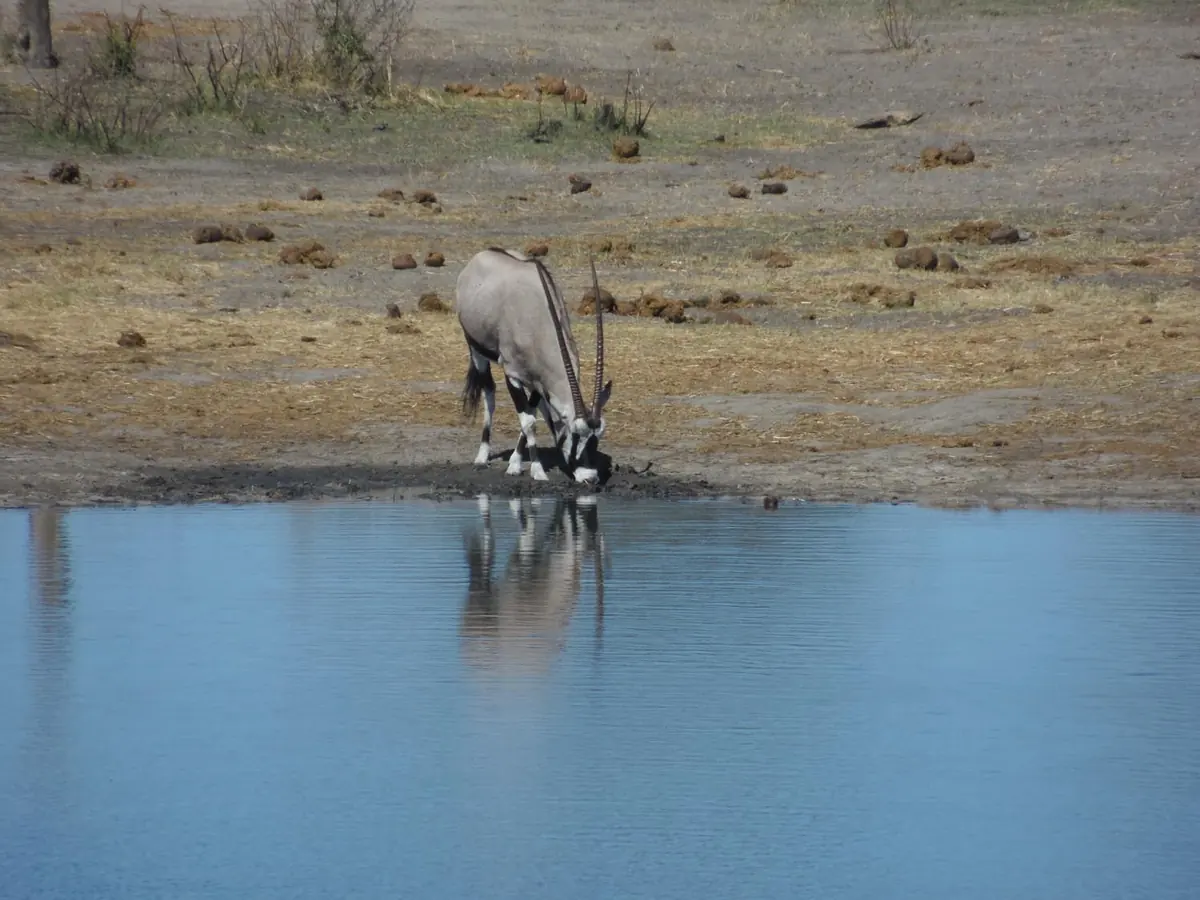
- likelyGemsbok (oryx), eland and blue wildebeestsource
- likelyBirds: about 320 species, including southern ground hornbill, Bradfield's hornbill and racket-tailed rollerWoodland and waterholes. Summer migrants such as Abdim's stork, yellow-billed kite and African golden oriole arrive in the rainy seasonsource
- possibleImpalaOnly in the south of the park, around Sikeretisource
- possibleTsessebe, red hartebeest and reedbuckRecorded in the park by MEFTsource
- possibleSpotted hyena and side-striped jackalsource
- rareAfrican wild dogAnywhere in the park, which is known for its large packs, but you need luck to find them. Watch for predator tracks on the sand roadssource
- rareLionThroughout the parksource
- rareLeopardThe park is known for its leopards, but sightings are never guaranteedsource
- rareCheetahsource
Likelihood is for a normal visit of two or three days, from the sources linked. Nothing is guaranteed in the wild.
Staying safe in Khaudum National Park
- Malaria
- Khaudum is in Kavango East, with the southern approach through Otjozondjupa. The CDC lists both as malaria transmission areas and recommends prescription antimalarials for them, so see a travel clinic well before you leave and take care against mosquito bites, especially in the evenings. source
- Deep sand and going in convoy
- All roads into and through the park need a 4x4 because of heavy, loose sand. MEFT recommends at least two vehicles per party, food for three days and 100 litres of water per vehicle per day. Help can be a very long way off if you break down. Keep to established tracks, which is also a park rule. source
- Elephants
- Do not drive up close to a herd. If elephants are on the track, stop and wait for them rather than making a new track round them. A head shake means an elephant is annoyed: stay in the car, then either reverse away slowly or turn the engine off, keep quiet and let it move off in its own time. source
- Heat and water
- Summer temperatures can reach 45°C and MEFT warns that dehydration is common here. Drink plenty through the day. The tap water at Khaudum Camp and Sikereti is fit to drink, but carry your own supply for the drives. source
- Medical help
- Medical care nearby is very limited: at Tsumkwe, the closest village, it is a nurse, and MEFT notes a state clinic on the Katere road about 37 km from Khaudum Camp. Carry a good first-aid kit and plan for being a long way from help. source
- The Botswana border
- The eastern edge of the park is the Botswana border. Never cross it except at an official border post. Anyone found there is assumed to be a poacher. source
Tips from travellers
- There is no fuel in the park. The nearest is at Tsumkwe, 52 km from the southern gate, or in the north at Divundu (90 km east of Katere) and Rundu (120 km west of Katere). Carry jerry cans if your tank is small. one source
- Let your tyres down before the sand. One party found the going much easier once they dropped from 1.5 to 1.1 bar, and carried sand boards for when they got stuck. Watch the rocky patches at low pressure. one source
- Leave early on the sand track of roughly 45 km between Khaudum Gate and the B8 at Katere. It takes around three hours, and the sand is hardest going in the heat. one source
- Do not tow a trailer, least of all in the deep sand of the north. You may have to reverse away from elephants. one source
- Pick a waterhole with a viewing platform, take food and water, and wait. People who have done it say this beats driving around, and in cool weather the game often comes to drink later in the day. several sources
- Allow six to seven hours for the roughly 100 km drive between Sikereti and Khaudum Camp. one source
- Bring all your food. There are no shops in or near the park and no fresh produce in the villages around it. official
- Do not count on phone signal. One party found none anywhere in the park and suggests a satellite phone or satellite messenger if you need to stay in touch. one source
Checked 7 October 2026. Conditions change, so confirm with the park or venue before you go.
The trekkers at Leeupan and the hippo that walked to Khaudum
In July 1878 the wagons of three separate Dorsland trek parties came together at Leeupan, a pan in what is now Khaudum. They were in a bad way. Malaria had been killing them along the Okavango since the previous October and tsetse fly had taken their oxen. One party of about 65 people under Gert du Preez lost every man, and a rescue party had to fetch the surviving women and children to the laager at the pan. There the trekkers elected new leaders, wrote a set of rules for a single united trek and, by the park’s own account, shot elephants. The unity did not last. Most went on towards the Okavango, one group turned back for the Transvaal, and the following year those still trekking reached Etosha and the Kaokoveld. Nobody of European descent ever settled here. Leeupan is still on the park map, as one of the waterholes.
People were here long before the wagons. Pottery dated to the 1500s has turned up near Sikereti, and San hunters used this sandveld for longer than anyone can put a date to. The park itself began with land the Gciriku Traditional Authority pledged in the 1980s.
A park named for an animal it no longer has
Khaudum is usually translated as “omuramba of the buffalo”. There are no buffalo now, though the ministry’s own guide map says there once were. The omiramba, the shallow grassy watercourses that cross the sand, were a game route between Etosha and the Okavango Delta. Fences in both countries and the border fence between them put an end to that. A 2022 study built on tracking data from 261 elephants across southern Africa found that Khaudum’s herds cannot easily reach the elephants on the western side of the Delta, close as it is.
The elephants are the other thing that has changed. Before boreholes they were seasonal visitors that left as the pans dried. Permanent water turned around 3,000 of them into more or less full-time residents, and the battered bush around the waterholes is the result. Even so, most still leave once the rains fill the pans outside the park, many of them south into Nyae Nyae. Dirk Heinrich, reporting from the park in 2025, puts their normal absence at December to July or August. That gap is when the bush and the groundwater recover. In the drought he was writing about it never came. The best rain measured in the park was 200 mm against a normal 400 to 600, the elephants stayed, and the ministry had pumped for 15 months instead of three or four.
The hippo at Tsoanafontein
In 2016 floodwater spilling out of Botswana brought eleven hippos into the Nyae Nyae pans south of the park. Most went back as the water shrank. One, probably a bull, did not. He walked more than 60 km on the last leg and settled at Tsoanafontein, the spring in the south-west corner near Sikereti. The travel writer Willie Olivier was shown a phone photograph of the animal by a barman in Tsumkwe in late November 2018, and did not believe the story until he saw it. He never got to the waterhole. Elephants wrecked the solar pump, the water ran out, and with no shade to speak of the animal was dead within days. Olivier heard the news in early December.
What turns up, and when
Timing decides almost everything. Anja Denker, who camped here one January, found Doringstraat, Leeupan, Tsau and Burkea without a single large animal, though she did see three ground hornbills at Burkea and roan in the distance at Soncana. A family who crossed the park in March 2025 wrote much the same: green bush, tall grass and very little game in three days.
Later in the year the picture flips. A party in August 2025 sat down to lunch at a deserted Doringstraat and ended up counting about 75 elephants, walking in from four directions and waiting their turn at the water. Olivier once counted more than a hundred in a single herd. The park’s advice is to sit at a waterhole through the hot hours and drive the open omuramba grass early and late.
Khaudum holds the largest roan population in Namibia, and animals from here have been moved back to parts of their former range. The usual group is a dozen or so cows and calves with one bull. One August a photographer met herds of 20 to 30 and one of more than 50.
Lions are heard far more than seen, but they are less rare than the park’s reputation suggests, and the guide map lists them among the predators seen most often. Winter campers on the dune at Khaudum Camp keep reporting them. One party in 2025 heard lions and hyaenas from the first night and found them a short way below the camp on the second morning. Another had three lions in the camp itself in June 2024. Wild dogs are a lottery. Olivier once found six lying in the shade of the Tsoanafontein platform.
Branches on the track
What visitors agree on is how empty it is. The March family met their first other vehicle after three days, a June party saw no other tourists at all, and the first new faces the August convoy saw were three rangers at Dussi. Three separate accounts call the game skittish or easily spooked. Elephants leave broken branches and whole trees across the two-track, and two drivers on the 4x4 forums swear by a machete. One party at Khaudum Camp heard what they took for rain on the roof in the night. In the morning the tree beside them had been stripped of its seed pods and there were elephant tracks in the sand next to it.
Fire is part of the place too. From July to September the air is often hazy with smoke from bushfires in Botswana, and in 2011 someone who had been visiting for 22 years told The Namibian that most of the park had burnt inside a month. The game is counted at the waterholes over a full moon each year. For one count in the drought the people taking part paid their own way, brought diesel for the pump generators and manned eleven water points for 72 hours.
In and around Khaudum National Park
15 places listedWhere to stay in Khaudum National Park 2
- 18.50°S 20.76°ECampsiteKhaudum Camp
- 19.11°S 20.71°ECampsiteSikereti Camp
Sights 13
- Baikiaea WaterholeViewpoint
- Burkea WaterholeViewpoint
- Doringstraat WaterholeViewpoint
- Dussi WaterholeViewpoint
- ElandsvlakteViewpoint
- Khaudum WaterholeViewpoint
- Leeupan WaterholeViewpoint
- Omuramba WaterholeViewpoint
- Shiyambi WaterholeAttraction
- Soncana WaterholeAttraction
- Tari Kora waterholeViewpoint
- Tsau WaterholeViewpoint
Show all 13 sights
- Tsoanafontein Waterhole · Attraction
Quick answers
How much is the entry fee for Khaudum National Park?
International visitors pay N$200 (about US$12, €11 or £9) per adult and N$150 per child per day. These rates apply from 1 April 2026 to 31 March 2027 and are set by Ministry of Environment, Forestry and Tourism (MEFT).
Do Namibians and SADC citizens pay less at Khaudum National Park?
Namibian citizens pay N$40 per adult and SADC nationals pay N$130 per adult per day. You need ID or a passport to get the lower rate.
When were these Khaudum National Park fees last checked?
We last checked them on 7 October 2026 against 4 published sources. We re-check every two weeks, but always confirm with Ministry of Environment, Forestry and Tourism (MEFT) before you travel.
What animals can you see in Khaudum National Park?
Most visitors see elephant, kudu, giraffe, steenbok and warthog. You have a good chance of seeing roan antelope, gemsbok (oryx), eland and blue wildebeest, birds: about 320 species, including southern ground hornbill, bradfield's hornbill and racket-tailed roller. African wild dog, lion, leopard and cheetah are there but rarely seen.
Khaudum and the parks nearest it
| Park | International adult | Distance | Where |
|---|---|---|---|
| Khaudum National Park | US$12 €11 · N$200 | · | Kavango East |
| Popa Falls Game Park | US$12 €11 · N$200 | 113 km | Kavango East |
| Mangetti National Park | US$12 €11 · N$200 | 175 km | Kavango West |
| Bwabwata National Park | US$12 €11 · N$200 | 211 km | Zambezi |
Guides for Khaudum National Park
Where the Khaudum fees come from
- Government Gazette No. 8877 of 1 April 2026, Government Notice No. 115 (MEFT fee schedule), copy hosted by the Legal Assistance Centre
- Namibian.org (19 January 2026)
- TravelComments.com (29 January 2026)
- SafariFind
Open data: all park fees (CSV) · JSON (CC BY 4.0)
Cite as: Travel Africa Guide, "Khaudum National Park fees 2026/27", checked 7 October 2026, https://travelafrica.guide/namibia/khaudum-national-park/
Map of Khaudum National Park
See every place on this map as a list