Park · Chobe District, Botswana
Chobe National Park
Botswana's first national park, known for the elephant herds that crowd the Chobe River near Kasane in the dry season. Boat trips and day visits in the north, deep sand and Savuti in the south-west.
Short answer
At Chobe National Park, international visitors pay P270 (about US$20, €18 or £15) per adult and P135 per child per day. The rates apply from 1 April 2022 to 31 March 2027.
- Daily fee, international adult
- US$20 €18 · P270
- Malaria
- The US CDC lists Chobe district, and Chobe National Park by name, as a malaria transmission area and recommends prescription antimalarials for it.
- Places to stay
- 28
- Park fee nearby: Moremi Game Reserve
- US$20 €18 · P270about 143 km away
Chobe National Park fees 2026
Checked Department of Wildlife and National Parks (DWNP), Ministry of Environment and Tourism tariffValid 1 April 2022 to 31 March 2027, per person per day, in pula.
| Who | Adult | Child |
|---|---|---|
| International visitorsUS, Europe and everyone else | US$20 €18 · P270 | US$10 €9 · P135 |
| SADC nationals | P205 | P102.5 |
| Botswana citizens | P30 | P15 |
- Children under 8 enter free. From 8 they pay half the adult rate, which is the child figure shown. Where the half rate stops is not settled: one guide says it runs to 17, three others say 15, so a 16 or 17 year old may be charged as an adult.
- Vehicle fee per day, on top of the per person fee: P115 for a foreign-registered private vehicle under 3,500 kg and P30 for a Botswana-registered one. A trailer or caravan is P60 foreign, P15 local. From 3,500 to 7,000 kg it is P1,000 foreign and P500 local, and over 7,000 kg P1,500 and P800.
- The SADC rate is also what foreigners living in Botswana pay. The resident row here is the rate for Botswana citizens.
- On a trip run by a licensed Botswana tour operator the entry fee is lower: P190 for non-residents, P145 for residents and SADC nationals, P20 for citizens. Ask whether your game drive or boat cruise price already includes it.
- Camping is charged separately. Ihaha is run by Kwalate Safaris, Savuti and Linyanti by SKL, and each sets its own rate, far above the P60 a night DWNP charges non-residents at a campsite it runs itself.
- A rise was due on 1 April 2026 and the ministry put it off the day before. Gabz FM reported in May that it had been pushed out by two years, and a July report had the existing fees still in place. No new date had been published when I checked on 12 October 2026.
- The fees started on 1 April 2022 and have no end date. I show them as valid to 31 March 2027, the end of Botswana's financial year, and will re-check then.
- Fees are set by Department of Wildlife and National Parks (DWNP), Ministry of Environment and Tourism. Official tariff · Seen a new rate? Tell us
US$1 = P13.47 · €1 = P15.06 · £1 = P18.07 (ECB rate and the Bank of Botswana rand rate, 3 Nov 2026). Converted amounts are approximate; you pay in pula.
How we got these figures
- Chobe and Moremi are Category A in the 2022 schedule. Every other park and reserve is Category B and cheaper.
- The child ages are not in the ministry's 2022 schedule. ChobeNationalPark.co.za gives half price for 8 to 17. Tawana Self Drive says under 16, and Cheetah Safaris and Ostrich Trails say 8 to 15. The FAOLEX copy of the 2000 regulations leaves out the footnotes to the fee schedule, so I could not settle it from the law. The child figures are half the adult rate.
- ChobeNationalPark.co.za prints the SADC child rate as P102.20. Half of P205 is P102.50, which is what I show.
- Africa Travel Essentials gives the SADC rate as P220. The ministry schedule and four other sources give P205.
- SafariFind says higher fees took effect on 1 April 2026. They did not: the ministry postponed them on 31 March 2026, so I left that page out.
- The minister described the proposal as moving the non-resident fee from P380 to P500 and the citizen fee from P30 to P50. P380 matches no entry fee in the 2022 schedule, so I have not tied the proposal to a particular park.
- Ministry of Environment, Natural Resources Conservation and Tourism, Revised User Fees and Services (the 2022 schedule, copy linked from Tourism Update) · official · checked 12 Oct 2026
- Tourism Update (23 February 2022) · one source · checked 12 Oct 2026
- travelnews.africa (2022 report of the DWNP announcement) · one source · checked 12 Oct 2026
- ChobeNationalPark.co.za (independent park guide, updated 13 May 2026) · one source · checked 12 Oct 2026
- Tawana Self Drive, Maun (page updated 16 April 2026) · one source · checked 12 Oct 2026
- Africa Travel Essentials (24 March 2026) · one source · checked 12 Oct 2026
- Cheetah Safaris (page updated 15 January 2026, child ages only) · one source · checked 12 Oct 2026
- Ostrich Trails, Mabuasehube guide (updated 27 June 2025, child ages only) · one source · checked 12 Oct 2026
- National Parks and Game Reserves Regulations, 1 April 2000 (the fee schedule before 2022), copy hosted by FAOLEX · official · checked 12 Oct 2026
- Botswana Daily News, government news agency (24 February 2026, the proposed increase) · official · checked 12 Oct 2026
- TravelComments.com (1 April 2026, increase postponed) · one source · checked 12 Oct 2026
- Gabz FM News (5 May 2026, increase put off by two years) · one source · checked 12 Oct 2026
- Travel and Tour World (29 July 2026, existing fees stay) · one source · checked 12 Oct 2026
Chobe is Botswana’s first national park and the easiest to reach, because its north-eastern corner sits beside the town of Kasane, about an hour by road from Victoria Falls. It covers about 11,700 square kilometres of Kalahari sand, with the Chobe River along the northern edge. People come for elephants. In the dry season hundreds at a time drink at the riverfront, and you can watch them from a boat as easily as from a vehicle.
Getting there
Kasane is the base. Its airport has scheduled flights from Johannesburg, Gaborone and Maun, and Sedudu Gate, the main entrance, is on the edge of town. From Victoria Falls in Zimbabwe it is about 80 km through the Kazungula border. From Livingstone in Zambia you cross the Kazungula Bridge, which replaced the old ferry in May 2021. Ngoma Gate, at the western end of the riverfront, is next to the Namibian border and 51 km from Kasane on tar.
Savuti, in the south-west, is a different trip. You reach it on sand tracks from Kasane through Ghoha Gate or from Maun through Mababe Gate, or by light aircraft.
When to go
May to October is dry, and that is when the game gathers along the river. June to August mornings are cold, around 8°C. September and October are the hottest months, up to 35°C. The rains run from November to March. Animals spread out and tracks at Savuti and Nogatsaa turn to mud or go under water, but zebra herds pass through Savuti from December to February.
What to do
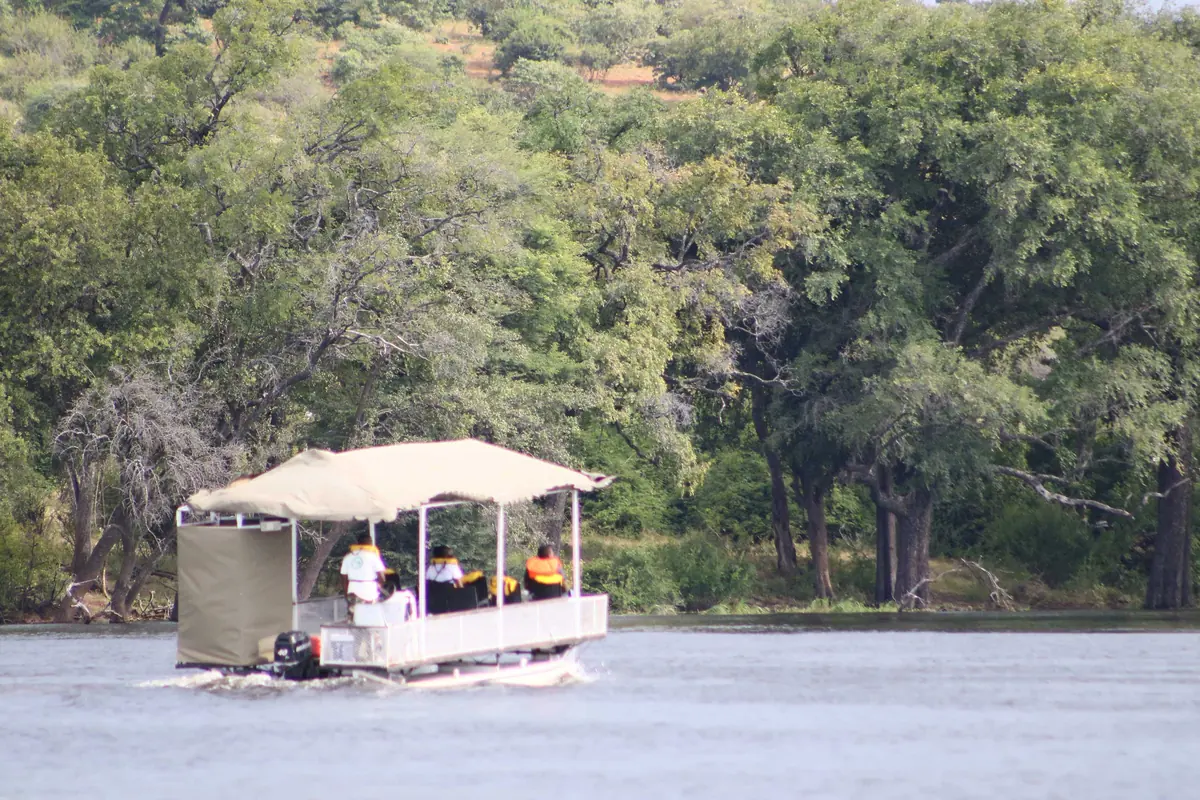
Take a boat on the Chobe from Kasane, in the afternoon if you can, when elephants come down to drink and sometimes swim across. The riverfront drive between Sedudu and Ngoma crosses the floodplain that holds the only puku in Botswana, a fawn antelope you would otherwise go to Zambia for. Most people sleep in Kasane and come in on guided drives. Chobe Game Lodge is the one lodge on this stretch inside the park.
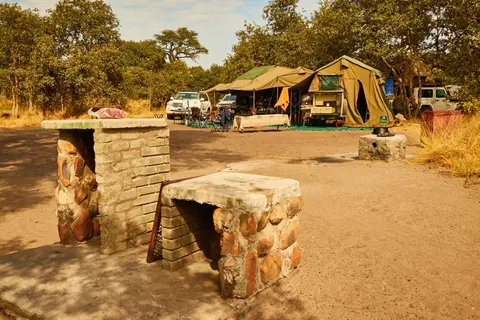
Savuti needs more time. Its channel flows and dries up over decades, whatever the rainfall, and its lions are known for taking young elephants. Guided drives also go to the San rock paintings in the Gubatsa Hills. Self-drivers camp at Ihaha on the river, or at Savuti and Linyanti. None of the campsites is fenced.
Good to know
Chobe is a malaria area. The US CDC names the park and recommends tablets, and the UK advice rates the risk high from October to May. You need a 4x4 to drive yourself here. Let your tyres down for the sand and carry all your fuel, because there is none in the park and none between Kasane and Maun on the Savuti route. Gates open 06:00 to 18:30 from April to September and 05:30 to 19:00 from October to March. The limit is 40 km/h, you stay in the vehicle and nobody swims. Book campsites well ahead for the dry season. Don’t expect rhino. Fees are in the table on this page.
History and culture
Chobe is Botswana's oldest national park, laid out along a river that became a colonial frontier in 1890 and is still the line between Botswana and Namibia. San hunters, Subiya farmers and fishermen, Kololo armies and a timber settlement all came before the park, and knowing that makes the riverfront more than a place to count elephants.
- Earliest times
The first people here were San hunter-gatherers, called Basarwa in Botswana, who moved with the water and the game. They left paintings on the rock hills at Savuti, inside today's park. source
- Around 1600 to the 1700s
By their own tradition the Subiya (also Basubiya or Baikuhane), a Bantu-speaking people from the north, settled along the Chobe, which they call the Ikuhane after an early chief. The same tradition has a queen, Mwale, ruling from the Goha Hills north of Savuti before her successors moved back to the river at Kavimba. source
- 1851
The Scottish missionary David Livingstone reached the court of Sebetwane, king of the Kololo, at Linyanti. The Kololo were Sotho-speakers who had fought their way north from what is now South Africa's Free State and conquered the Lozi kingdom on the upper Zambezi. Sebetwane died on 7 July 1851, shortly after the two met. source
- 1885
Britain declared the Bechuanaland Protectorate on 31 March 1885, at first only as far north as latitude 22 degrees south, well short of the Chobe. On 30 June 1890 it extended the protectorate northwards, and Germany recognised the claim the next day. source
- 1890
A treaty between Britain and Germany signed on 1 July 1890 set the line between their territories in the main channel of the Chobe River. That line is still the border between Botswana and Namibia, with the park on the southern bank. source
- 1931 to 1968
A national park was first proposed in 1931, and the next year about 24,000 square kilometres around Chobe became a non-hunting area. A tsetse fly outbreak in 1943 stalled the plan. The Chobe Game Reserve followed in 1960, smaller than first hoped, and soon after independence on 30 September 1966 it became Botswana's first national park. Sources give the year as 1967 or 1968. source
- 1975
People still lived and worked inside the new park, above all at Serondela on the river, where there was a timber industry. The settlements were moved out by stages and the park has had no residents since 1975. It was enlarged slightly in 1980 and 1987. source
- 1999
Botswana and Namibia both claimed an island in the Chobe River near Kasane, called Sedudu in Botswana and Kasikili in Namibia. They took the dispute to the International Court of Justice, which ruled on 13 December 1999 that the northern channel is the main one and the island belongs to Botswana. Boats of both countries may use the channels around it. source
- People of the Chobe Enclave
- The villages wedged between the park's two halves are mostly Subiya: Kavimba, Mabele, Satau and Parakarungu. Kachikau is a Batawana village, a branch of the Tswana whose people farm dry land and keep cattle. Kasane itself is a mix of people who came for work. source
- Population
- The 2022 census counted 28,743 people in the whole of Chobe District. Kasane, the district capital and the gateway to the park, had 9,143, and Kazungula next door 8,704. source
- Language
- The Subiya speak Chikuhane and call themselves Baikuhane, which means the followers of the chief Ikuhane or the people of the Chobe River. Their name for the river is the Ikuhane. source
For German visitors: The far bank of the Chobe is Namibia's Caprivi Strip, which Germany gained under the Heligoland-Zanzibar Treaty, signed in Berlin on 1 July 1890 and negotiated under Chancellor Leo von Caprivi. Germany wanted the strip for access to the Zambezi. The wording of that treaty, which put the border in the main channel of the Chobe, was what the judges in The Hague had to interpret in the Sedudu Island case more than a century later. source
For American visitors: For Americans the park's best-known link is Hollywood. Elizabeth Taylor remarried Richard Burton at Kasane in October 1975, while the couple were on holiday in the park, with two Chobe Game Lodge staff as witnesses. source
Main sights in Chobe National Park
5- Gubatsa Hills rock paintings, Savuti
San paintings on a small group of rocky hills that stand out of the flat country at Savuti. They are the clearest sign in the park of the people who lived here first, and the Savuti lodges take guests to see them.
Expert Africa, Chobe National Park - Savuti Channel and Marsh
The dry or flowing channel, depending on the decade, and the marsh it feeds. The bleached dead trees along the banks date from earlier floods and are the image most people carry away from Savuti.
Expert Africa, Chobe National Park - Sedudu Island
The island in the Chobe River that went to the International Court of Justice, which put its size at about 3.5 square kilometres. It goes under water for several months from around March. You see it from the water, on a boat trip from Kasane.
International Court of Justice, Kasikili/Sedudu Island (Botswana/Namibia), case summary - Serondela
Another name for the riverfront, and the site of the timber settlement that was moved out of the park by 1975. Traces of the timber days can still be seen.
Wikipedia, Chobe National Park - Chobe Game Lodge
The one lodge on the riverfront inside the park, open for about 50 years. A photograph of Burton and Taylor, who stayed for more than a month in 1975, hangs in the downstairs bar.
TTG, Chobe Game Lodge hits major milestone
Did you know?
- The Savuti Channel switches itself on and off for decades at a time. It had dried up by the late 1880s, flowed again from 1957 (drowning the trees that had grown up in its bed), stopped in the early 1980s and came back in 2008. Since about 2016 the flow has been patchy. The channel is about 100 km long and drops only 18 metres along the way, so a small shift in the ground is enough to block or reopen it. source
- Savuti's lions hunt elephants, which very few lions anywhere do. A study published in 2009 found they take mostly calves and juveniles. source
- Puku live in one place in Botswana, the Chobe floodplain. To see this fawn antelope anywhere else you would have to cross into Zambia, where there are plenty. source
- Elizabeth Taylor and Richard Burton married each other for the second time at Kasane in October 1975, while on holiday in the park. The district commissioner, Ambrose Masalila, conducted the ceremony and two Chobe Game Lodge staff were the witnesses. The marriage lasted nine months. source
- Chobe is part of the Kavango-Zambezi Transfrontier Conservation Area, about 520,000 square kilometres of linked parks and wildlife land across Angola, Botswana, Namibia, Zambia and Zimbabwe. The five countries signed the treaty for it on 18 August 2011. source
Checked 12 October 2026.
Wildlife you might see
13- very likelyElephantThe Chobe riverfront between Sedudu and Ngoma, and the Linyanti in the north-west. Bulls at the Savuti waterholes. All year on the river, in the biggest herds from June to October. Fewer in the rains, when they spread outsource
- very likelyCape buffaloFloodplains and islands along the Chobe River. Big herds from June to Octobersource
- very likelyHippoThe Chobe River, best seen from a boat. All yearsource
- very likelyNile crocodileSandbanks and channels of the Chobe River. All yearsource
- very likelyGiraffe, kudu, impala and warthogRiverfront woodland and floodplain edges. All yearsource
- very likelyAfrican fish eagle and other water birdsTrees and sandbanks along the Chobe River. More than 450 bird species have been recorded in the park. All year. Carmine bee-eaters and other migrants arrive with the rains, November to Marchsource
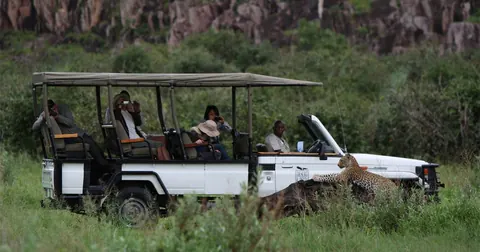
- likelyLionAlong the riverbank, where they are often seen lying up, and around the Savuti Marsh, where the prides are large. Easiest from May to October, when prey is tied to watersource
- likelyPlains zebraSavuti Marsh, on the migration between the Chobe River and the pans to the south. December to Februarysource
- possibleSpotted hyenaSavuti, where the clans can be very largesource
- possibleLeopardThe rocky escarpment near Ngoma and the outcrops at Savutisource
- possiblePukuThe Chobe floodplain only. This is the one place in Botswana where it lives, and there are not many. All yearsource
- possibleSable and roan antelopeRiverfront woodland, seen now and then rather than dailysource
- rareAfrican wild dogLinyanti and Savuti, sometimes the western riverfront near Ngomasource
Likelihood is for a normal visit of two or three days, from the sources linked. Nothing is guaranteed in the wild.
Staying safe in Chobe National Park
- Malaria
- The US CDC lists Chobe district, and Chobe National Park by name, as a malaria transmission area and recommends prescription antimalarials for it. The parasite is mostly falciparum, the dangerous kind. Book a travel clinic well before you fly, and see a doctor fast if you get a fever during the trip or for up to a year after it. source
- Malaria season
- UK travel health advice rates the northern half of Botswana as high risk from October to May and recommends tablets for those months. For the rest of the year it rates the risk low and advises bite avoidance. The dry-season months most people choose for game viewing are the lower-risk ones, but cover up and use repellent at dusk all the same. source
- Staying in the vehicle
- The park regulations forbid walking or getting out of a vehicle or boat except at a campsite, lodge, hide, day-use site or other designated facility. Riding on the roof or a roof rack is banned too. This is elephant, buffalo and lion country with no fences, so the rule is there for a reason. source
- Speed and driving hours
- The limit on park tracks is 40 km/h, and 80 km/h on the tarred transit road that crosses the park to Ngoma. You may not drive between gate closing and opening: 18:30 to 06:00 from April to September, 19:00 to 05:30 from October to March. Be in camp or out of the gate by then. source
- Unfenced campsites
- Savuti and Linyanti campsites have no fences, and the operator tells guests to stay inside the camp area, keep children with an adult at all times and not walk off into the bush. Feeding or disturbing any animal is against the rules, because animals that get used to people end up being destroyed. source
- The river
- Swimming is banned in the park outside a lodge pool, as is every other water sport. The Chobe is full of hippos and large crocodiles, so the rule is no hardship. source
Tips from travellers
- There is no fuel inside the park and none on the route between Kasane and Maun through Savuti. One regular on the route says to carry enough for 800 km of tar driving, although the distance is about 600 km plus game drives, because deep sand burns far more. Fill up in Kasane or Maun. several sources
- Let your tyres down for the sand and take a spade, a compressor and a tyre repair kit. Between Mababe Gate and Savuti there are two tracks: the sand-ridge road is quicker but heavy sand, and the marsh road is the one to avoid when it is wet. several sources
- Do not try Savuti as a day trip from Kasane. Forum regulars say there is little to see on the road down, you get there in the midday heat when nothing is moving, and then you have to hurry back before the gate shuts. Give the riverfront two days instead, and allow about three hours from Sedudu to Ihaha and two more to Ngoma if you want to stop and look. one source
- Campsites inside the park fill early for June to October. One regular visitor was told to book a year ahead. Ihaha is booked through Kwalate Safaris, and Savuti and Linyanti through SKL Camps. one source
- June to August mornings are cold, about 8°C, even though afternoons reach the high 20s. Dress in layers for an early boat or an open vehicle. By September and October it is up to 35°C. one source
- Do not expect rhino. The last ones were moved out of the park to protect them from poaching, so Chobe has four of the Big Five. one source
Checked 12 October 2026. Conditions change, so confirm with the park or venue before you go.
The forest that grew while Chobe's elephants were gone
On Sunday 5 July 1874 a 22-year-old ivory hunter, Frederick Selous, walked west along the south bank of the Chobe, over the ground the riverfront drive covers today. Bush came down almost to the water, he wrote, leaving a strip of short grass between ten and a hundred yards wide. Herds of “pookoo” stared at his party and bounded off. The buffalo he called a nuisance. There were so many that they trampled out the elephant spoor he was following, then gave him away by running towards the elephants as he closed in.
The tsetse fly was worse. Selous blamed it on the buffalo, and said that in September and October it made hunger and thirst feel like small things. In 1877 he took three donkeys up the river. One was dead in a fortnight and the second in five weeks. The third lasted nearly three months and carried a buffalo head eighty miles back to his wagons.
Rinderpest, ivory and the trees on the bank
Rinderpest reached the river in 1896 and killed the buffalo. Percy Reid, a hunter who knew the Chobe before and after, told Selous that in 1895 he had counted thirty or forty flies on one man’s back. In 1899 he went up one bank and came back down the other without seeing a fly. The ivory trade had already removed most of the elephants.
A Norwegian and Botswanan research project on the riverfront built its case on that double blow. Christina Skarpe, lead author of its 2004 summary, called the paper “The Return of the Giants”. With the elephants shot out and the grazers dead of disease, trees got their chance on ground that big animals had kept open. On that reading the big riverside trees were partly the product of an emptied river, and the elephants have been taking them down since they came back.
Skarpe’s team did not conclude there were too many elephants. They saw no ecological reason to change the numbers artificially. And when Stein Moe fenced off seedlings to see what stops the trees returning, the culprit was impala. Behind a full fence more than three in four seedlings lived. In the open fewer than one in five ana trees did, and the losses followed impala numbers and no other browser’s.
Inside the park the counts were falling anyway. Elephants Without Borders estimated 26,609 from the air in 2010, then 17,774 in 2014 and 15,404 in 2018, though the margin on that last figure runs from under 11,000 to just over 20,000. Mike Chase’s list of possible reasons includes fires, artificial waterholes that closed or failed, poaching along the Chobe and Linyanti and herds simply moving out. You will not notice it on the river in September.
Selous’s buffalo did come back. On a Tuesday night in early November 2018 a herd of about a thousand that had been grazing on the Namibian side stampeded into the river, and some 400 were trampled, fell from the steep banks and drowned. Botswana’s environment ministry thought lions had probably set them off, and added that mass drownings were nothing unusual on this river. The meat was given to people living nearby.
Eight mares and a fortnight to Nxai Pan
Zebra graze the Chobe floodplain in the dry months. Some were known to go to Savuti for the rains, but until 2012 nobody knew how far the rest went. That September and October Robin Naidoo of WWF, working with Elephants Without Borders and Namibia’s environment ministry, collared eight mares on both banks of the river. In early December they left. Seven reached Nxai Pan between 14 and 27 December, 250 km due south, after a median of 14 days on the move, and the eighth turned up on 9 January. Some covered more than 50 km in a day. “No one expected that,” Naidoo said.
They stayed about ten weeks and dawdled home, taking 85 days on average. A count from the air on 21 February 2013 found at least 1,500 zebra on the pan. Measured end to end it is the longest land migration known in Africa (the Serengeti wildebeest wander in a rough circle and cover more ground in total). Around Christmas, look for Chobe’s zebra there.
Thirty lions against fifty hyenas
Dereck and Beverly Joubert came to Botswana in 1981, joined a lion research station at Savuti and did much of their watching at night. What they filmed was a pride of about 30 lions at war with a hyena clan of 40 to 50, at a time when hyenas were thought of as cautious scavengers. Eternal Enemies (1992) made their name. Their later years belong to the Linyanti.
Baboons at Ihaha, a wall for elephants at Savuti
At Savuti’s public campsite the wash block stands behind a slanted wall with a doorway too narrow for an elephant, and the taps are built to resist trunks. The road in is the other shock: one driver in May 2021 reported thick sand most of the way, with humps that held him to between 15 and 35 km/h. He stayed one night after good rains, heard lions close by and saw little, and the regulars on the forum told him Savuti needs two or three nights at least. Against that, one guided group in June 2025 had lions on a giraffe carcass ringed by more than twenty hyenas, then six wild dogs hunting, then got stuck in the sand going after a leopard, all in a day.
Ihaha, on the river, is about baboons. Three unconnected campers complain of them: one lost the children’s sausages, another found the hot water wrecked. A honey badger and its mate came through one family’s camp night after night in July 2011. Lions are less certain than the brochures suggest. One party spent about a week in the park one July, starting at Ihaha, and saw none, while another camper had a lioness walk up to his site as he sat at the braai. That 2011 family found nearly everything west of Serondela. The western end does well in Expert Africa’s records too: of its travellers at a camp near Ngoma Gate who have logged sightings since mid 2018, 95% saw lion, 68% sable, 64% leopard and 44% roan.
In and around Chobe National Park
47 places listedWhere to stay in Chobe National Park 28
- 18.32°S 24.89°EHotelNogatsaa Pans Chobe Lodge+27 11 267 8501ghohahills.com
- 18.57°S 24.06°ECampsiteCamp Savuti
- 18.61°S 24.05°ECampsiteBOGA Leopard Rock
- 18.64°S 24.10°ECampsiteBOGA Rhino Vlei
- 18.57°S 24.04°ECampsiteBoga Site
- 18.39°S 24.24°ECampsiteGhoha Gate
- 18.44°S 24.22°EResortGhoha Hill Campsite
Show all 28 places to stay
- Linyanti Wildlife Gate · Campsite
- Boga · Campsite
- Boga leopard rock · Campsite
- Camp Madambuza · Campsite
- Camp Seite RSV2 · Campsite
- Camp Site RSV1 · Campsite
- Chobe Game Lodge · Hotel
- Hatab 22 · Campsite
- hatab 8A · Campsite
- Hatab A site · Campsite
- Hatab B site · Campsite
- HATAB Camp · Campsite
- Hatab Campsite 9A · Campsite
- Ihaha Camp · Campsite
- Linyanti Campsite · Campsite
- Mobile Operation Campsite CNP · Campsite
- Sanctuary Chobe · Hotel
- Savuti Elephant Camp · Hotel
- Zwezwe · Campsite
Sights 19
- Baobab GalleryAttraction
- Baobab stretch pointAttraction
- Bushman PaintingsAttraction
- Do not take this road! DANGERViewpoint
- Elephant bonesViewpoint
- Elephant skullViewpoint
- Kalwezi-ke-NkangaViewpoint
- Leopard RockAttraction
- Marabou PanAttraction
- NanyangaViewpoint
- Ngoma Education CenterAttraction
- Nogatsaa Game HideViewpoint
Show all 19 sights
- Puku Flats · Attraction
- Quarry Hill · Viewpoint
- Rhino Vlei · Attraction
- Saregho Hide · Viewpoint
- Savuti Waterhole · Viewpoint
- waterhole · Attraction
- Waterhole · Attraction
Quick answers
How much is the entry fee for Chobe National Park?
International visitors pay P270 (about US$20, €18 or £15) per adult and P135 per child per day. These rates apply from 1 April 2022 to 31 March 2027 and are set by Department of Wildlife and National Parks (DWNP), Ministry of Environment and Tourism.
Do Botswanans and SADC citizens pay less at Chobe National Park?
Botswana citizens pay P30 per adult and SADC nationals pay P205 per adult per day. You need ID or a passport to get the lower rate.
When were these Chobe National Park fees last checked?
We last checked them on 12 October 2026 against 13 published sources. We re-check every two weeks, but always confirm with Department of Wildlife and National Parks (DWNP), Ministry of Environment and Tourism before you travel.
What animals can you see in Chobe National Park?
Most visitors see elephant, cape buffalo, hippo, nile crocodile, giraffe, kudu, impala and warthog. You have a good chance of seeing lion and plains zebra. African wild dog is there but rarely seen.
Chobe and the parks nearest it
| Park | International adult | Distance | Where |
|---|---|---|---|
| Chobe National Park | US$20 €18 · P270 | · | Chobe District |
| Moremi Game Reserve | US$20 €18 · P270 | 143 km | North-West District |
| Nxai Pan National Park | US$14 €13 · P190 | 158 km | North-West District |
| Makgadikgadi Pans National Park | US$14 €13 · P190 | 222 km | Central District |
Guides for Chobe National Park
- First Safari: South Africa, Namibia or Botswana?
- Malaria on Safari: Kruger, Etosha, Okavango, Malaria-Free Parks
- US Dollars, Cards and Cash in South Africa, Namibia, Botswana
- How Much Does a Safari Cost from the UK? Prices in Pounds
- Safari in the UK School Holidays: Which Break, Which Park
- Chobe Gate Times, Riverfront Slots and the Ngoma Transit Road
- Self-Drive Botswana: Sand, Fuel, Vet Fences and Campsites
- Botswana Travel Essentials: Money, Driving, Malaria
Where the Chobe fees come from
- Ministry of Environment, Natural Resources Conservation and Tourism, Revised User Fees and Services (the 2022 schedule, copy linked from Tourism Update)
- Tourism Update (23 February 2022)
- travelnews.africa (2022 report of the DWNP announcement)
- ChobeNationalPark.co.za (independent park guide, updated 13 May 2026)
- Tawana Self Drive, Maun (page updated 16 April 2026)
- Africa Travel Essentials (24 March 2026)
- Cheetah Safaris (page updated 15 January 2026, child ages only)
- Ostrich Trails, Mabuasehube guide (updated 27 June 2025, child ages only)
- National Parks and Game Reserves Regulations, 1 April 2000 (the fee schedule before 2022), copy hosted by FAOLEX
- Botswana Daily News, government news agency (24 February 2026, the proposed increase)
- TravelComments.com (1 April 2026, increase postponed)
- Gabz FM News (5 May 2026, increase put off by two years)
- Travel and Tour World (29 July 2026, existing fees stay)
Open data: all park fees (CSV) · JSON (CC BY 4.0)
Cite as: Travel Africa Guide, "Chobe National Park fees 2026", checked 12 October 2026, https://travelafrica.guide/botswana/chobe-national-park/
Map of Chobe National Park
See every place on this map as a list