Town · Chobe District, Botswana
Kasane
Small river town in Botswana's far north-east, the base for boat trips and game drives in Chobe National Park and about an hour by road from Victoria Falls.
Short answer
Kasane is in Chobe District, Botswana. This page lists 25 places to stay, 14 places to eat and drink and 3 sights. The nearest park with an entry fee on this site is Chobe National Park, about 116 km away, where international adults pay from P270.
- Malaria
- The US CDC lists Chobe District as a malaria transmission area and recommends prescription antimalarials for it.
- Places to stay
- 25
- Eat and drink
- 14
- Sights
- 3
In and around Kasane
42 places listedWhere to stay in Kasane 25
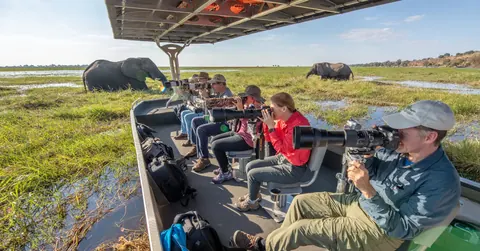
- 17.81°S 25.15°EHotelChobe Bush LodgeRiver Road, Kasane+267 625 0336chobesafarilodge.com
- 17.78°S 25.16°EHotelCresta Mowana Safari Resort & Spa+267 625 0300crestamowana.com
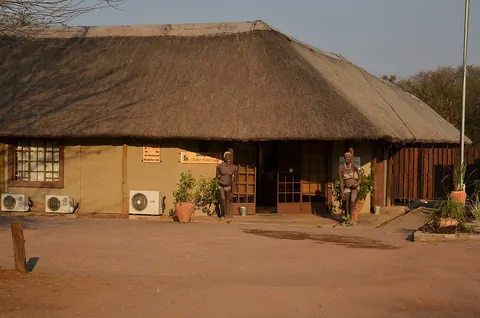 HotelThebe River LodgePresident Avenue, Kasane
- 17.80°S 25.16°EGuest houseAmariah Guest HouseSehudi Road, Kasane+267 624 0010
- 17.81°S 25.15°EHotelChobe Safari LodgeRiver Road, Kasane
- 17.79°S 25.18°EHotelTlou LodgePresident Avenue
- 17.79°S 25.15°EHotelWaterlily LodgePresident Avenue, Kasane
Show all 25 places to stay
- Amogelang Guest House · Guest house · Nare Crescent, Kasane
- Chiloto Guesthouse · Guest house · Mabele Road
- Chobe River Lodge · Hotel · President Avenue, Kasane
- Kasane Travel Lodge · Hotel · Plateau Road, Kasane
- Liya Guest House · Guest house · Tholo Crescent, Kasane
- Sandpiper Villas Hotel · Hotel · Kasane
- Sunset Guest House · Guest house · Tholo Crescent, Kasane
- The Old House · Guest house · President Avenue, Kasane
- Chobe Marina Lodge · Hotel
- Chobe Safari Lodge Camping Site · Campsite
- Chobe towers · Guest house
- Plateau Guests house · Guest house
- Thebe River Camp · Campsite
- Top stay inn · Guest house
- Travelodge · Hotel
- Universe guest house · Guest house
Sights 3
- Clario Travel AgentAttraction
- JettyAttraction
- Thebe River SafariAttraction
Restaurants and cafes 9
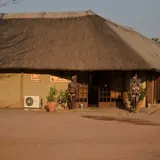 Thebe RiverRestaurant · President Avenue, Kasane
- Pizza plus Coffee & CurryRestaurant · pizza, indian · President Avenue, Kasane
- Hunters Pub & GrillRestaurant
- Pepe NeroRestaurant · Kachikau Road
- TandureiRestaurant · chinese, indian
- Café BuzzCafe
- DelightRestaurant
- Liquor restaurantRestaurant
- Serondela RestaurantRestaurant
Bars and pubs 5
- Centre BarBar
- Chillers BarBar
- Savannah BarBar
- Sevuva BarBar
- Sundowner BarPub
Kasane is the town you sleep in to see Chobe. It runs along the south bank of the Chobe River in Botswana’s far north-east corner, with Namibia on the opposite bank and Zambia and Zimbabwe a few kilometres downstream. The 2022 census counted 9,143 people. It is the administrative centre of Chobe District, but for a visitor it is one main road of lodges and jetties, with the national park starting at the edge of town.
Getting there
Kasane Airport is 4 km south of town and has scheduled flights from Johannesburg, Gaborone and Maun. Most lodges collect their guests. By road it is tar from Nata, just over 300 km and four to four and a half hours. Victoria Falls is about an hour away through the Kazungula Road border post. For Livingstone in Zambia you cross the Kazungula Bridge at Kazungula, 8 km east of town, which replaced the ferry in May 2021. A tar road runs 51 km west to Ngoma and Namibia. The tracks to Savuti and Maun are sand and need a 4x4.
When to go
June to October is dry, and that is when the big elephant and buffalo herds come down to the river. Mornings from June to August are cold, about 8°C, which you feel on a boat. The rains run from November to March. Sedudu Island, out in the river, goes under water for several months from around March.
What to do
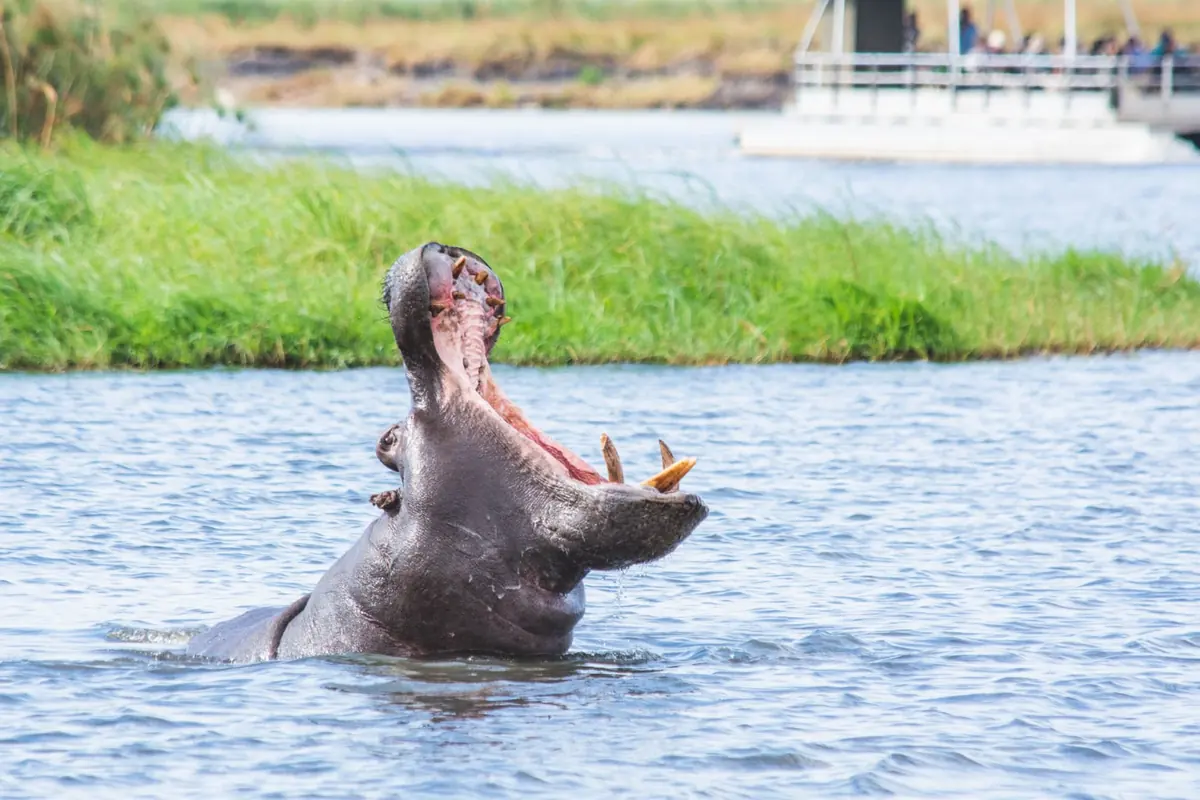
Go out on the river. Most lodges and plenty of operators in town run boat trips, and the afternoon one, roughly 15:00 to 18:00, is the one to take because it ends with sunset on the water. Elephants swim across, and hippos and crocodiles are everywhere. Add a morning game drive through Sedudu Gate and you have seen the riverfront properly.
The town fills half a day at most. A hollow baobab behind the police station once served the colonial administrators as a lock-up. Seboba, at the rapids, has picnic sites and, with luck, the seldom-seen African finfoot. The CARACAL Biodiversity Centre is open daily from 09:00 to 17:00, and the same NGO runs a snake park with about 50 snakes of 17 species.
Good to know
Kasane is in a malaria area. The US CDC recommends tablets for Chobe District and UK advice rates the risk high from October to May, so see a travel clinic before you fly.
There are no fences between the park and the town, and elephants roam the ground between the airport and town. Don’t walk in from the airport. Take a taxi and agree the fare first. Keep out of the river. The UK government also notes occasional break-ins at riverfront lodges in the Chobe area.
Stock up here. Kasane has a Spar, a Choppies and a Shoprite, and several banks with ATMs. If you are driving on to Savuti, fill every tank, becuase there is no fuel between Kasane and Maun on that route.
History and culture
Kasane is a young town on an old crossing. For centuries people and goods moved between central and southern Africa at the meeting of the Chobe and Zambezi rivers, and the border that a British and German treaty drew down the Chobe in 1890 still runs past the town's jetties. The colonial magistrate moved here in 1921 and Chobe Safari Lodge opened on the river bank in 1959.
- Around 1600
By their own tradition the Subiya (also Basubiya or Baikuhane), a Bantu-speaking people who came down from the Kafue and the Zambezi valley, settled along the Chobe River, which they call the Ikuhane after an early chief. They are still the main people of the river villages west of Kasane. source
- Mid-1800s
The meeting of the Chobe and the Zambezi at Kazungula, 8 km east of today's town, was a long-used crossing between central and southern Africa. David Livingstone and other European travellers of the time first saw the Zambezi here before crossing to what is now Zambia. Local people crossed in mekoro, dugout canoes. source
- 1890
A treaty between Britain and Germany, signed on 1 July 1890, put the line between their spheres of influence in the main channel of the Chobe River. The British side is now Botswana and the German side, on the bank opposite Kasane, is now Namibia. source
- 1909 to 1921
Kazungula was the administrative centre of the Chobe district from 1909. In 1921 the resident magistrate's residence was moved to Kasane, which has been the district's centre since. source
- 1959
Chobe Safari Lodge opened on the river bank in Kasane. By its own account it has been taking guests since 1959, which makes it older than the national park next door. source
- 1978
The war in Rhodesia, now Zimbabwe, spilled into Chobe District. In February 1978 fifteen soldiers of the Botswana Defence Force were killed at Lesoma in an ambush by Rhodesian security forces. Botswana honours them on Fallen Heroes Day. source
- 1989 to 1991
Work began in 1989 on a new airport to replace the airfield that had served the Chobe since the 1960s. The old airfield was turned into a golf course, and on 1 August 1991 the new airport became an official point of entry into Botswana. Its present terminal opened on 22 February 2018. source
- 2021
The Kazungula Bridge over the Zambezi opened on 10 May 2021, ending the pontoon ferry that had been the only direct link between Botswana and Zambia. The road and rail bridge is 923 metres long and took seven years to build. source
- The Subiya and their language
- The Subiya call themselves Baikuhane and their language Chikuhane. The same people live across the river in Namibia and in south-western Zambia, where their traditional leaders have their seats, so family ties here run across three countries. source
- A town of incomers
- The Subiya live mainly in the river villages of Parakarungu, Satau, Kavimba and Mabele, and the Batawana in Kachikau. Kasane itself is different. It is a mix of groups who came looking for work. source
- Neighbours by boat
- Impalila Island, the tip of Namibia facing Kasane, has no road link to the rest of its own country. It can only be reached by boat. Most of its 2,500 to 3,000 people buy their groceries on the Botswana side and use the pula as their everyday currency. source
- Basket weaving
- Chobe Women's Arts and Crafts, next to the CARACAL Biodiversity Centre, sells baskets woven by local women. You will often find a weaver at work there, glad to show the technique. source
For German visitors: The border in the river off Kasane goes back to a German treaty. The agreement of 1 July 1890 between Britain and Germany put the line between their spheres of influence in the main channel of the Chobe. In 1999 the judges in The Hague had to decide what those words meant to settle who owned Sedudu Island. source
For German visitors: In November 1914, after the eastern Caprivi was captured from Germany in the First World War, the British magistrate at Kazungula was given authority over it as well. For a time the German strip across the river was run from this side. source
For American visitors: For Americans, Kasane's best-known moment is a Hollywood one. Elizabeth Taylor remarried Richard Burton here on 10 October 1975, sixteen months after their first marriage ended, with the manager and a guide from Chobe Game Lodge as witnesses. source
Main sights in Kasane
7- The prison baobab
A baobab behind Kasane Police Station with a hollow big enough to hold adults. Colonial administrators locked people up in it until they could be sent on to a real prison. The trunk has split in places since, but the tree is alive.
Your Botswana, things to do in Kasane - Sedudu Island
The island in the Chobe that Botswana and Namibia (which calls it Kasikili) took to the International Court of Justice. The court ruled on 13 December 1999 that the northern channel is the main one, which put the island in Botswana. It covers about 3.5 square kilometres and floods for several months from around March.
International Court of Justice, Kasikili/Sedudu Island (Botswana/Namibia), case summary - Seboba
A riverside park at the rapids where the Chobe runs over a shelf of rock. It has a few picnic sites and good birding.
Your Botswana, things to do in Kasane - Kasane Hot Springs
A warm, salty spring in a wildlife corridor between Kasane and Kazungula, long believed locally to have healing powers. Ask at your lodge before going, because animals use the same ground.
Your Botswana, things to do in Kasane - Lesoma Memorial Monument
A memorial at Lesoma, a village in Chobe District, to the fifteen Botswana Defence Force soldiers killed there in 1978. It marks the day Rhodesia's war reached Botswana.
Your Botswana, things to do in Kasane - CARACAL Biodiversity Centre
The education centre of CARACAL, a conservation NGO, where visitors can get close to snakes and other reptiles, birds and small mammals. The NGO's snake park holds about 50 snakes of 17 species, black mamba and boomslang among them, and it runs education programmes for Batswana children. Open daily from 09:00 to 17:00.
Your Botswana, things to do in Kasane - Kazungula Bridge
The 923 metre road and rail bridge over the Zambezi, 8 km east of town, close to the point where Botswana, Zambia, Namibia and Zimbabwe nearly meet. Before it opened, a pontoon ferry carried everything. In 2003 one capsized under an overloaded truck and 18 people drowned.
Wikipedia, Kazungula Bridge
Did you know?
- The 2022 census counted 9,143 people in Kasane, which it lists as a village, and 8,704 in Kazungula next door. Between them they hold well over half of Chobe District's 28,743 people. source
- The name comes from masane, the Subiya word for the waterberry tree, which grows along the river here. source
- Elizabeth Taylor and Richard Burton married each other for the second time at Kasane on 10 October 1975. The district commissioner, Ambrose Masalila, conducted the ceremony, the news took five days to get out, and the marriage lasted nine months. source
- Botswana and Zambia share only about 135 metres of border, in the middle of the Zambezi. The Kazungula Bridge is built on a curve so that it stays out of Namibia and Zimbabwe on either side. source
- The first commercial boat at the Kazungula crossing was a pontoon brought from Austria in pieces and put together on the river bank in 1884. source
- Governments meeting in Kasane in March 2015 signed up to the Kasane Statement, a set of commitments against the illegal trade in wildlife that still carries the town's name. source
Checked 12 October 2026.
Wildlife you might see
11- very likelyElephantThe Chobe River bank and islands, seen from a boat or on a game drive along the riverfront. The park has no fences, so they wander outside it too. All year, in herds of hundreds from June to Octobersource
- very likelyHippoThe Chobe River, at eye level from a boat. All yearsource
- very likelyNile crocodileSandbanks and channels of the Chobe River. All yearsource
- very likelyCape buffaloFloodplains and islands along the river, seen from a boat or on a game drive. Big herds from June to Octobersource
- likelyAfrican fish eagle and kingfishersTrees and banks along the river on any boat trip. All yearsource
- likelyWater monitorRiver banks, seen on the sunset cruisesource
- possibleLionThe riverfront tracks inside the park, on a game drive from Kasanesource
- possiblePukuThe Chobe floodplain inside the park, the only place in Botswana where this fawn antelope livessource
- possibleAfrican skimmer and carmine bee-eaterThe river and its banks. Many lodges run dedicated birding trips to look for skimmers, along with rock pratincole and Pel's fishing owlsource
- rareAfrican finfoot and half-collared kingfisherSeboba, at the rapids on the Chobe River in Kasane. Both are seldom seen anywheresource
- rareLeopardRiverfront tracks inside the park, where they are residentsource
Likelihood is for a normal visit of two or three days, from the sources linked. Nothing is guaranteed in the wild.
Staying safe in Kasane
- Malaria
- The US CDC lists Chobe District as a malaria transmission area and recommends prescription antimalarials for it. Book a travel clinic well before you fly, and see a doctor fast if you get a fever during the trip or for up to a year after it. source
- Malaria season
- UK travel health advice rates the northern half of Botswana as high risk from October to May and recommends tablets for those months. For the rest of the year it rates the risk low and advises bite avoidance. Mosquitoes that carry malaria bite mostly between dusk and dawn, so cover up and use repellent in the evening. source
- Elephants in town
- There are no fences between the national park and the land around it, and animals move freely. Elephants roam the ground between the airport and town, so arrange a transfer or taxi instead of walking it. source
- The river
- The UK government's advice for Botswana is not to bathe in rivers and lakes, because of wild animals and water-borne disease. The Chobe at Kasane has hippos and crocodiles in numbers, so keep back from the bank. source
- Roads after dark
- Wildlife and livestock stray onto Botswana's tar roads, and the risk is highest at night. Plan to reach Kasane from Nata in daylight, and do the same on the road to Ngoma. source
- Lodge break-ins
- The UK government notes isolated room break-ins and thefts at lodges in the Chobe area, mainly those facing the river. Lock your room and do not leave cash, passports or cameras lying out. source
Tips from travellers
- Take the afternoon boat trip. It runs for about three hours from around 15:00 and ends with sunset on the water, which is when elephants are most often at the river. several sources
- Fill up in Kasane before heading for Savuti. There is no fuel between Kasane and Maun on that route, and people who have driven it carry enough for 800 to 900 km of tar driving because deep sand burns so much more. several sources
- Mornings and evenings from June to August are cold, about 8°C at dawn, even though the days are warm. Bring a fleece and a windproof for an early boat or open vehicle. several sources
- Agree the taxi fare before you get in, and take the driver's number so you can ring for a lift back later. Lodges between Chobe Safari Lodge and the Mowana are within about 2 km of each other, close enough to walk by day. one source
- Buy supplies in Kasane. It has a Spar, a Choppies and a Shoprite, so campers can stock up before going into the park. several sources
- Self-drivers can pay park fees at the wildlife office in Kasane or at Sedudu Gate. A forum regular warns that the card machine is sometimes down, so carry enough pula to cover it. one source
Checked 12 October 2026. Conditions change, so confirm with the park or venue before you go.
Kasane's lodge mongooses and a three-metre elephant path
The banded mongooses that trot across the lodge lawns in Kasane carry a disease that was first found here. Kathleen Alexander, a Virginia Tech researcher who works out of the CARACAL centre in town, first saw tuberculosis in them in 2000. A decade and seven outbreaks later she and her colleagues showed it was a new member of the TB family and named it Mycobacterium mungi, after the mongoose. Nobody has found it in banded mongooses anywhere else.
What the lodge mongooses are up to
Between 2007 and 2011 Alexander and Pete Laver followed 41 troops around Kasane, Kazungula and the edge of the park. A typical troop had 13 adults, the smallest four and the largest 50. Nine of the troops they mapped closely lived at lodges, one in town and one beside an army camp. Those troops slept in something man-made on four nights out of five: under cement paths and foundations, in drain pipes and road culverts, under floorboards. Nearly four in five of their drinks came from people too, and lawn sprinklers alone supplied about a sixth. In the dry months they hardly bothered to travel. These troops used about 27 hectares then and 40 in the rains, the reverse of what the textbooks predict for a wild animal when food is short.
The TB spreads in an odd way. Mongooses talk by smell, pressing their noses to the scent marks other troop members leave from their anal glands. The bacterium is in those marks and gets in through small cuts on the nose. A sick one is easy to pick out, thin and with a swollen, eroded snout, and it is usually dead within two or three months. Outbreaks come in seasons, and the deaths are heavy enough to put a small troop’s survival in doubt. Don’t feed them.
Elephants through a gap three metres wide
Kasane sits between elephants and their water. When Seboba’s fence went up along the river, the elephants kept coming anyway and broke things, so gaps were opened in it and the damage stopped. Tempe Adams and Mike Chase of Elephants Without Borders, which has its office here, put camera traps on seven of these corridors from November 2012 to April 2014. The cameras took 2,619 pictures of elephants. One corridor, running about 750 metres from the edge of town down to Seboba, narrows to three metres between fences. Bulls use it. So do cows with young calves, which earlier studies had found keeping well clear of settlements.
August was the busiest month, with about 13 elephant detections a day, and April came close behind. In the rains they mostly stayed away, because there is water in the bush. More came after dark than by day. But the same team later compared Kasane with the farming villages of the Chobe Enclave, where elephants wait for night and move only between six in the evening and six in the morning. In town they walk through at any hour, people or no people. One camera in the industrial area recorded 19 species, from civet to buffalo. A tar road crosses every corridor the team studied, which is the real reason not to drive here fast after sunset.
The sawmill town upriver
For about twenty years the busy place on this river was not Kasane. In 1935 the Susman Brothers started cutting timber in the north of the district and put their sawmill at Serondela, upstream in what is now Chobe National Park. The Susmans stopped in 1938. Chobe Concessions took up the rights in 1944 and by 1956 had taken out 6.8 million cubic feet of mahogany and teak. The historian Jeff Ramsay, writing in Mmegi, gives Serondela just over 3,000 people at its height, with a cinema, a beer hall, shops and an airstrip, and barges carrying the cut timber to Livingstone. That is a third of Kasane today. When the mill shut it emptied, he says, and the last of the settlement was cleared from the park by 1975. Traces of it can still be seen on the riverfront.
The same year the loggers arrived, the mine recruiters did. Wenela, which signed up men from central Africa for the Johannesburg gold mines, opened a depot at Kazungula in 1935 and kept it until 1969, and by Ramsay’s account ran its own clinic, airstrip and river boats.
Tourism came late. The Chobe River Hotel opened in 1959, started by Charles Trevor and Ethnee Holmes à Court, and took its first tourists the year after, in huts and tents while the main building was still going up. It became Chobe Safari Lodge in 1972. Ethnee left for Australia in 1967 and lived to 98. Her son Robert became Australia’s first billionaire.
Twenty to a boat, and catapults for the baboons
Two things come up again and again in what visitors write. The river delivers: a couple on a lodge pontoon counted more than 50 elephants at one spot and found African skimmers on an island with eggs and chicks, and a family writing in 2026 saw skimmers nesting along the bank as well. And you share it. The same couple had about 20 others on board and watched rival boats push too close to swimming elephants. A camper in October 2010 said much the same about the crowds, and one forum poster in 2025 found a busy riverside campsite too cramped.
Cats are the gamble. That couple’s morning drive produced no lion and no leopard, while the family got one glimpse of a leopard coming out of the bushes.
Camp life has its own cast. The 2010 camper pitched a couple of metres from the water behind a fence put up for hippos and crocodiles. One overlander reports guards patrolling a Kasane campsite with catapults to keep baboons off the tables, and Chobe Safari Lodge lists warthogs, bushbuck and monkeys among its residents. If you are driving in, the gate times say how early you can be on the riverfront.
Quick answers
What animals can you see in Kasane?
Most visitors see elephant, hippo, nile crocodile and cape buffalo. You have a good chance of seeing african fish eagle, kingfishers and water monitor. African finfoot, half-collared kingfisher and leopard are there but rarely seen.
Guides for Kasane
- Driving in South Africa, Namibia and Botswana: UK Licence
- Driving in South Africa, Namibia, Botswana With a US License
- Flights from the UK to South Africa, Namibia and Botswana
- Direct Flights to South Africa from the US: Routes and Fares
- Plugs, SIM Cards and eSIMs: South Africa, Namibia, Botswana
- Chobe Gate Times, Riverfront Slots and the Ngoma Transit Road
- Botswana Entry Requirements 2026: Visas and Border Rules
- Self-Drive Botswana: Sand, Fuel, Vet Fences and Campsites
- Botswana Travel Essentials: Money, Driving, Malaria
Map of Kasane
See every place on this map as a list