Place to stay · Kasane
Pangolin Chobe Hotel
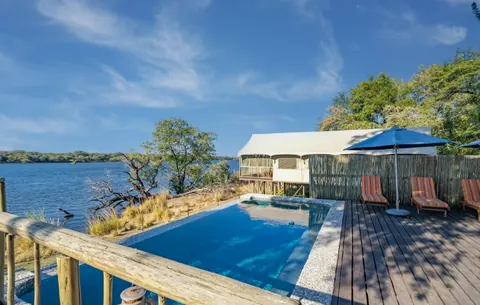
A 14-room hotel on the plateau above the Chobe River in Kasane, built around a wildlife photography gallery, with cameras, lenses and a photo host included in the stay.
The Pangolin Chobe Hotel is a hotel for people who want to photograph animals, including people who have never owned a proper camera. It stands on the plateau above the Chobe River in Kasane, looking across to the floodplains on the Namibian side, a few hundred metres from the Chobe National Park boundary. Pangolin Photo Safaris owns and manages it, and opened it in 2018 after seven years of running photo boats on the river.
What to expect
There are 14 rooms, nine with a king bed and five twins, all opening off a central gallery hung with wildlife photographs. Rooms are en suite and air-conditioned, each with a balcony, a safe, and plenty of surfaces and charging points for camera gear. The bed bases are cast in concrete, so twins cannot be pushed together. Each twin bed is a double, though.
Canon cameras, telephoto lenses and memory cards are lent to guests, and a photo host coaches you on the outings and afterwards in the editing suite at the end of the gallery. There is also an underground hide for night visitors.
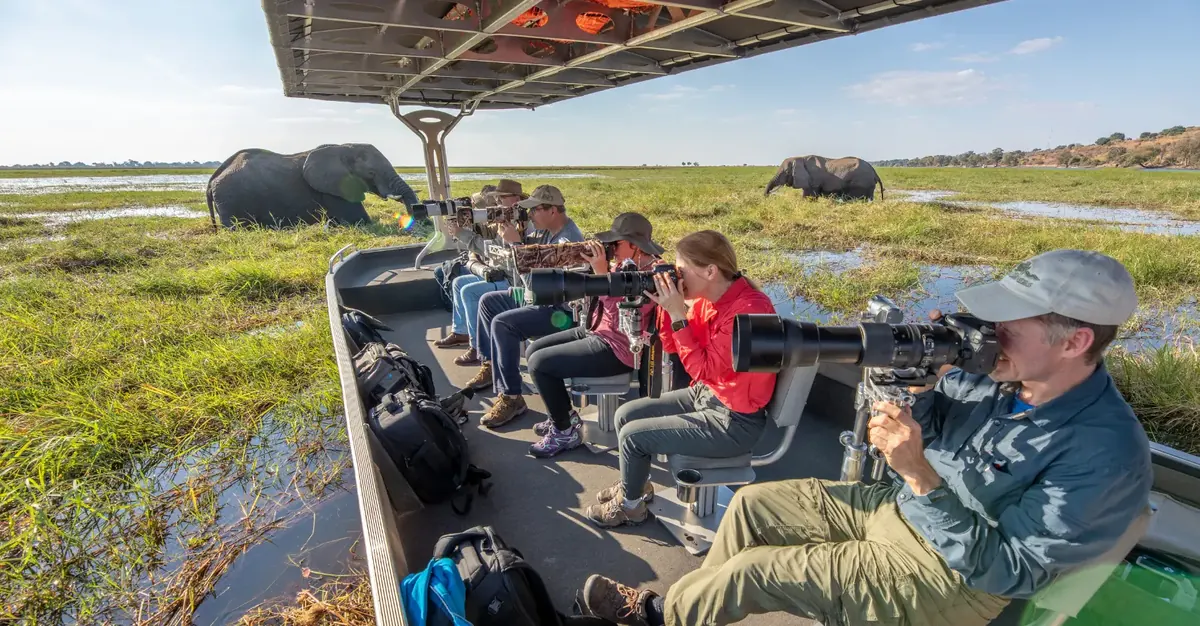
Most outings are on the water. The photo boats seat eight, with swivelling chairs and camera mounts, and go out for three to four hours. Game drives last four to five hours with at most four photographers per vehicle. Pangolin says to expect roughly three boat trips for every drive.
Practical details
- All meals are part of the stay, along with a selection of drinks: wine, local beer, soft drinks and spirits. Brunch after the morning outing is the main daytime meal, and dinner is often on the pool deck.
- The boats are moored below the hotel, a five-minute transfer away.
- Bookings go through the Cape Town reservations office, open Monday to Friday, 8.30am to 5pm South African time.
Good to know
If boats are not your thing, this is the wrong address, because the river is the point. Non-photographers travelling with a keen one will find the whole timetable built around light and camera settings.
Last updated 12 October 2026. Sources: Pangolin Photo Safaris, The Pangolin Chobe Hotel, Pangolin Photo Safaris, Our Story, Pangolin Photo Safaris, Contact Us.
Two strangers at a fire, and a hotel for people with no camera
In January 2011 two men who had never met sat down at the same campfire in Phalaborwa, on the edge of the Kruger. Gerhard Swanepoel, Guts to everyone, grew up in Pretoria, had been in the army and was running overland tours. Toby Jermyn was a Londoner out of telecoms who had just spent a year driving from Cape Town to Kenya. By their own telling each had reached the same idea separately. Photo safaris were fixed-date trips for people who already owned the gear, and nobody stayed in one place long enough to learn its seasons. Eight months later Guts was living in Kasane with one boat built for the job and a set of cameras.
Seven in ten arrive with no camera
The hotel followed in 2018, on the hill you climb as you come into town from the park side. Two years on, Jermyn said 70% of the guests so far had turned up without a camera of their own. One traveller’s account from 2019 shows how that works. Johann Groenewald of Tracks4Africa wrote that Guts was on the boat himself and had everyone shooting in manual mode from the start, including Groenewald’s twelve-year-old daughter, who had never cared for photography and went home with a lion on her memory card.
Boats bunch up and jostle at a good sighting, he wrote, and his skipper’s answer was to guess where the animals would walk next and be parked there first, sun behind the boat.
The architect and the science teacher’s camera
Thatayaone Jongman, one of the photo hosts, worked as an architect in Gaborone for 16 years. He grew up in a small village, and it was a camping trip with a lion and a kudu that turned a hobby into something more. He came to Pangolin as an understudy and has been a host since January 2023. Walter Aaron, also born and raised in Botswana, borrowed his science teacher’s camera at high school and pointed it at his classmates. He qualified as a guide in 2013, and when tourism shut in 2020 he photographed weddings and street scenes instead.
In April 2026 the hotel hosted Wild Shots Outreach, a South African non-profit, for five workshops with 15 young people from around Kasane. Their teacher, Rifumo Mathebula, took the same course as a schoolboy near the Kruger in 2016. Some of the students had lived beside Chobe all their lives and had never looked at its animals through a long lens.
A river that runs backwards
The Chobe below the hotel changes direction. Early in the year the Zambezi floods, pushes in at Kazungula and sends water west over the floodplain the rooms face. Around July or August it turns and drains east again, and by November it is at its lowest.
Photographers care because of the African skimmer. Pangolin puts their arrival around May, and they need bare sandbanks, where they lay in a scrape in the sand in colonies of fewer than 50 pairs. There are only 15,000 to 25,000 in the world. They feed mostly at dawn and dusk, the longer lower half of the bill slicing the water, so the late boat is the one for them. The woodland kingfisher is a bird of the wet months instead, November to March, and Pangolin’s guides treat its call as the start of summer.
Don’t expect a pangolin
The company’s own conservation page calls a sighting the holy grail and admits nobody knows how many are left. The name is a cause, not a promise. Jermyn founded Pangolin.Africa, a non-profit registered in South Africa in 2018, and a slice of every bed night goes to it. In 2019 it put out a film, Eye of the Pangolin, about two South African film-makers trying to get all four African species on camera.