Park · Hardap, Namibia
Namib-Naukluft National Park
Namibia's largest park, almost 50,000 square kilometres of desert from the Swakop River south to the Lüderitz road, with the Sossusvlei dunes, Deadvlei and the Naukluft mountains.
Short answer
At Namib-Naukluft National Park, international visitors pay from N$150 (about US$9, €8 or £6.50) per adult per day, depending on which section you visit. The rates apply from 1 April 2026 to 31 March 2027.
- Daily fee, international adult
- US$9 €8 · N$150from, by section
- Malaria
- Hardap and Erongo, the regions most visitors see in this park, are not on the CDC's list of regions where malaria tablets are advised.
- Places to stay
- 35
- Park fee nearby: NamibRand Nature Reserve
- US$21 €19 · N$350about 106 km away
Namib-Naukluft National Park fees 2026/27
Checked Ministry of Environment, Forestry and Tourism tariffValid 1 April 2026 to 31 March 2027, per person per day, in Namibian dollars.
| Pay point | International visitors | SADC nationals | Namibian citizens |
|---|---|---|---|
| Park entry and conservation fee | US$17 €15 · N$280child N$180 | N$180child N$100 | N$60child free |
| Sandwich Harbour section | US$9 €8 · N$150child N$100 | N$100child N$50 | N$50child free |
- Children aged 8 and under enter free. The child rate is for ages 9 to 15; Namibian children in that age group pay nothing. From 16 the adult rate applies.
- Vehicle fee per day, on top of the per person fee: N$60 for 10 seats or less, N$150 for 11 to 25 seats, N$600 for 26 to 50 seats and N$1,000 for 51 seats or more.
- Sandwich Harbour has its own lower fees. Its vehicle fee per day is N$50 for 10 seats or less, N$100 for 11 to 25 seats, N$400 for 26 to 50 seats and N$700 for 51 seats or more. The main park rate applies at Sossusvlei, which lies inside the park.
- The Namibian rate is for Namibian citizens. The gazette sets fees by nationality, so a foreigner living in Namibia pays the rate for their nationality.
- Each fee is half park entrance fee and half conservation fee; the figures shown are the two added together.
- These fees were gazetted with effect from 1 April 2026 and have no end date. I show them as valid to 31 March 2027, the end of Namibia’s financial year, and will re-check then.
- Fees are set by Ministry of Environment, Forestry and Tourism. Official tariff · Seen a new rate? Tell us
US$1 = N$16.64 · €1 = N$18.60 · £1 = N$22.31 (ECB rate, 3 Nov 2026, N$1 = R1). Converted amounts are approximate; you pay in Namibian dollars.
How we got these figures
- SafariFind gives the same adult figures but lower child rates (N$140 foreign, N$90 SADC) than the gazette; I used the gazette child rates.
- TravelComments.com says Sandwich Harbour was left out of the 2026 increase, and the gazette keeps it on a separate, lower schedule. SafariFind says it is exempt from park fees altogether; the gazette does not support that.
- Government Gazette No. 8877 of 1 April 2026, Government Notice No. 115 (MEFT fee schedule), copy hosted by the Legal Assistance Centre · official · checked 7 Oct 2026
- Tourism Update (27 January 2026) · one source · checked 7 Oct 2026
- Namibian.org (19 January 2026) · one source · checked 7 Oct 2026
- Africa Beat (6 February 2026) · one source · checked 7 Oct 2026
- TravelComments.com (29 January 2026) · one source · checked 7 Oct 2026
- SafariFind · one source · checked 7 Oct 2026
- Wikipedia: Sossusvlei · one source · checked 7 Oct 2026
This is Namibia’s biggest park, close to 50,000 square kilometres running about 600 km down the coast from the Swakop River to the B4 road to Lüderitz (ǃNamiǂNûs). Most of it is closed or roadless. People come for one corner of it: Sossusvlei, where some of the highest dunes in the world, up to 325 metres, close around white clay pans. The Naukluft mountains to the east are the other draw, with day trails and one of the toughest long hikes in southern Africa.
Getting there
Sesriem, the gate for Sossusvlei, is 334 km from Windhoek according to Namibia Wildlife Resorts (NWR), and the main sights are reached on gravel roads. Naukluft Camp is 253 km from Windhoek, and NWR puts it about 100 km from Sossusvlei. From the gate a tarred road runs some 60 km to the 2x4 car park. The last 5 km or so to Sossusvlei and Deadvlei is deep sand: drive it only in a 4x4 and only if you know sand, otherwise take the NWR shuttle.
When to go
Summer days at Sossusvlei often reach 40°C and winter nights drop to about 10°C, so I would pick the cooler months if you plan to climb dunes. The long Naukluft trail is only open from the start of March to the end of October. Light is best at sunrise and sunset.
What to do
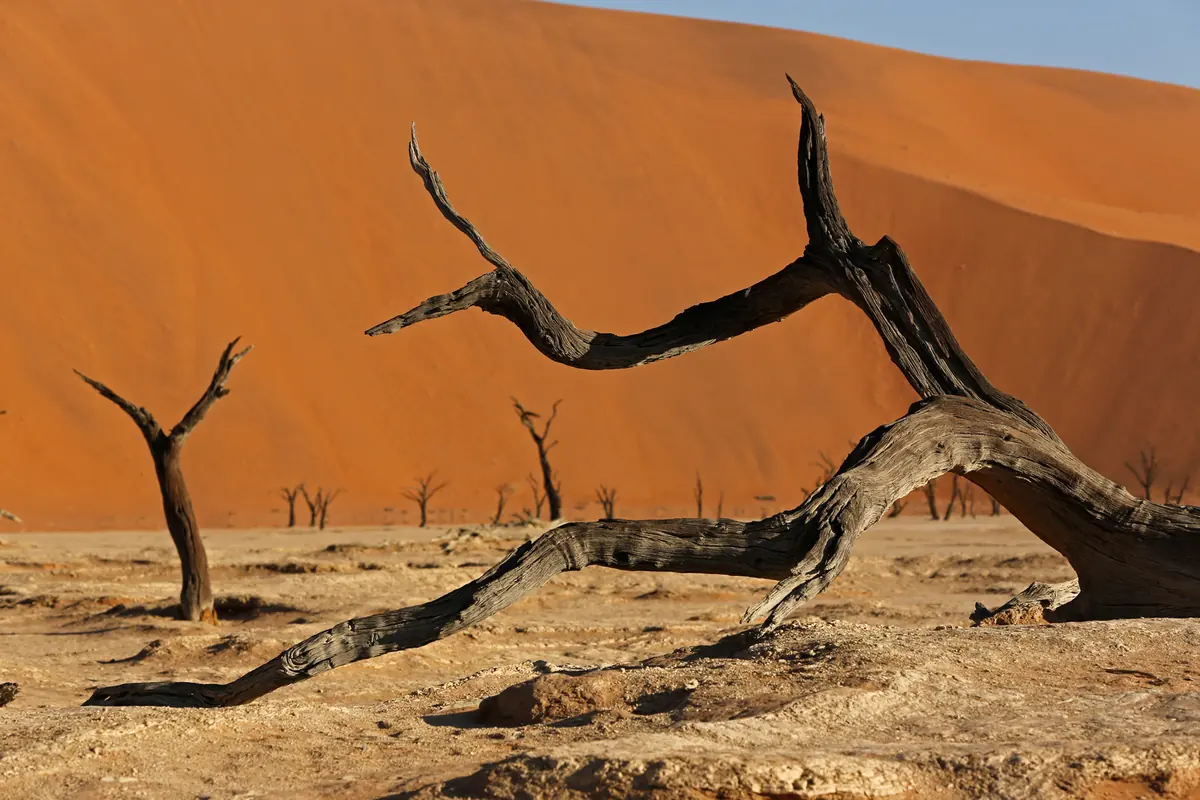
Be at the dunes early. Dune 45, 45 km from Sesriem on the tar road, is where most people stop first. Deadvlei is a walk of about 1 km from the 4x4 car park, a white pan of dead camelthorn trees that NWR says are carbon-dated at 500 to 600 years old. Big Daddy, the tallest dune here, stands above it. Sesriem Canyon, about 1 km long and 30 to 40 metres deep, is near the gate and best late in the day. At Naukluft Camp the Olive Trail (10 km) and Waterkluft Trail (17 km) are day hikes where you may meet Hartmann’s mountain zebra. Further north are the Kuiseb Canyon and the Welwitschia Trail, and Sandwich Harbour lies on the coast south of Walvis Bay.
Good to know
The Sesriem gate opens at sunrise and closes at sunset. Only guests staying inside the gate can set off earlier and reach the dunes for first light. That means NWR’s Sesriem Campsite and Sossus Dune Lodge, the Sesriem Oshana Campsite (a Sun Karros and NWR joint venture beside the NWR camp) and the private Dead Valley Lodge. Sesriem and Solitaire have fuel, and there is little else, so fill up at each. The park has a bad record for crashes, mostly visitors driving too fast on gravel, so keep it slow and carry a good spare. The park spreads over Erongo, Hardap and ǁKaras, none of them on the CDC’s list of regions for malaria tablets, so the advice is just to avoid bites. Leaving the public roads for the small campsites or unproclaimed tracks needs a permit from Sesriem, Naukluft Camp or a ministry office in Windhoek or Swakopmund. Fees, including the separate Sandwich Harbour rate, are in the table on this page.
Wildlife you might see
15- likelyGemsbok (oryx)Around Sossusvleisource
- likelySpringbokAround Sossusvleisource
- likelyOstrichAround Sossusvleisource
- likelyChacma baboonNaukluft Camp, where troops raid campsites for foodsource
- likelyFlamingoSandwich Harbour lagoon, south of Walvis Bay. At Sossusvlei only in the rare years the Tsauchab River floods the pansource
- possibleHartmann's mountain zebraThe Naukluft section, first set aside as a sanctuary for them, and on the trails from Naukluft Campsource
- possibleKuduNaukluft sectionsource
- possibleKlipspringerRocky slopes in the Naukluftsource
- possibleBlack-backed jackalNaukluft sectionsource
- possibleBat-eared foxNaukluft sectionsource
- possibleNamib desert beetleOn the dunes around Sossusvlei, collecting water from the morning fog on its backsource
- possibleVerreaux's (black) eagleNesting on the cliffs of the Naukluftsource
- possibleDune larksource
- rareLeopardNaukluft mountainssource
- rareBrown hyaenasource
Likelihood is for a normal visit of two or three days, from the sources linked. Nothing is guaranteed in the wild.
Hikes and walks
5- Olive Trail
The shorter of the two day hikes that start at Naukluft Camp.
Permit: Booked at Naukluft Camp. NWR says that from November 2026 to June 2027 it can be booked only there.
Namibia Wildlife Resorts: Naukluft Camp - Waterkluft Trail (Waterkloof)
The longer day hike from Naukluft Camp. Start early and carry plenty of water.
Permit: Booked and paid for only at Naukluft Camp, NWR says
Namibia Wildlife Resorts: Naukluft Camp - Naukluft Hiking Trail
A long route through the mountains and one of the hardest multi-day hikes in southern Africa, with chains on some steep rock faces and stone shelters to sleep in. Open only from the start of March to the end of October. Shorter four-day versions cover 61 km or 55 km.
Permit: Booked with Namibia Wildlife Resorts, whose Naukluft Camp page says booking and payment are at the camp. You need the NWR booking receipt and a doctor's health certificate, and groups must be 3 to 12 people.
Travel News Namibia: Exploring the Naukluft on foot - Hiddenvlei walk
Starts at the 2x4 car park near Sossusvlei and goes out to a quieter clay pan among the dunes, about 4 km there and back. Markers are few, so follow earlier footprints and take water.
Stingy Nomads: Sossusvlei and Dune 45 - Sesriem Canyon
A narrow gorge about 1 km long and 30 to 40 metres deep, close to the Sesriem gate. The pools at the bottom fill again after good rains.
Namibia Wildlife Resorts: Sesriem Campsite
Staying safe in Namib-Naukluft National Park
- Malaria
- Hardap and Erongo, the regions most visitors see in this park, are not on the CDC's list of regions where malaria tablets are advised. Malaria is rare outside those northern and eastern regions, and the CDC's advice there is to avoid mosquito bites. source
- Desert heat
- Summer days at Sossusvlei often reach 40°C, and the gap between day and night temperatures is large, so winter mornings start cold. Carry plenty of water, climb the dunes early, and pack something warm for sunrise. source
- Gravel roads
- Most roads to and through the park are gravel. The UK government says accidents on gravel are common, advises no more than 80 km/h when roads are bad in the January to April rains, two spare tyres and no driving outside towns at night because of animals. source
- Sand at Sossusvlei
- The last 5 km or so to Sossusvlei and Deadvlei is deep sand, and inexperienced drivers bury rental cars there often. Unless you have driven sand before, leave the car at the 2x4 car park and take the NWR shuttle. source
- Tides at Sandwich Harbour
- The beach route to Sandwich Harbour narrows where the dunes meet the sea and is impassable at high tide or in rough seas. Check tide times for the trip back too, never stop or park where waves reach, and go with a guide unless you know the route. source
- Fuel
- Fuel is scarce. Sesriem has a filling station, and Solitaire and Betta are the other stops on the roads around the park, so fill up at each one. source
Tips from travellers
- Sleep inside the Sesriem gate if sunrise on the dunes matters to you. Guests at NWR's Sesriem Campsite and Sossus Dune Lodge, the Sesriem Oshana Campsite and Dead Valley Lodge can set off before the main gate opens. The main gate only opens at sunrise and often has a queue. several sources
- Gate times change with the month and move in half-hour steps, so ask at your camp the night before. one source
- Go back to Dune 45 late in the afternoon. Most day visitors have left to get out by sunset, so it is much quieter. one source
- Drive slowly on the gravel. Most crashes here involve visitors going too fast, often with a burst tyre, and letting a little air out of the tyres helps on rough stretches. several sources
- Lock all food in the car at Naukluft Camp. Baboons raid the campsites. several sources
- Buy permits for small campsites and unproclaimed tracks before you set off. There is no office at the turn-offs; they are sold at Sesriem, Naukluft Camp and ministry offices in Windhoek and Swakopmund. several sources
Checked 7 October 2026. Conditions change, so confirm with the park or venue before you go.
The patrol that found Sossusvlei dry, and the men who hid here
In February 1909 a German lieutenant called Walter Trenk rode out of Sesriem with 15 mounted troopers to settle a rumour. Somewhere down the Tsauchab River, people said, lay a “Bushman Paradise”. The patrol left on the 9th and followed the riverbed. On the night of the 11th something spooked the horses and they scattered, so the men spent the next morning on foot rounding them up. That evening they reached the place where the river simply ends against the dunes. There was no water in the pan and nobody living there. The only sign of people was a patch of !nara bushes with ostrich wings laid over the fruit, which Trenk took for scarecrows. At midnight he turned for home. His report, printed in the colonial gazette the following year, is the first written record of anyone visiting Sossusvlei.
Peter Bridgeford, who dug the report out in 2011, points to one detail you can still check from the tar road. Trenk noted dead camelthorns about 35 km below Sesriem, and they are still standing.
Trenk was unlucky with the water, but so is nearly everyone. The Tsauchab gets as far as the pan about once a decade. Photographs posted by a 4x4 forum member in late January 2022 show it holding water after heavy rain near Sesriem.
Otto, the carp and the unlicensed dog
The park’s best story belongs to the north, in the Kuiseb canyon. Henno Martin and Hermann Korn were German geologists who had arrived in 1935 and made the first geological maps of the Naukluft. In 1940, facing internment, they loaded a lorry and drove into the canyon with a dog named Otto, chosen, Martin wrote, because the name looks the same from either end. They stayed about two and a half years.
Martin’s book, The Sheltering Desert, is worth reading before you drive the Kuiseb road. They named their first home Carp Cliff after finding fish in a canyon pool, built a wall to keep the west wind out of the overhang they lived under, and sowed radishes and carrots in a damp sandbank. Korn insisted on a bed of tobacco. It came up as acacia seedlings. Their rifle had been handed in when war broke out, so they hunted with a pistol and a shotgun. A wireless brought them the air battles over Britain. Martin lay out two nights by the carp pool to shoot the hyaena that kept stealing the fish.
It ended in 1942 when Korn fell ill with what turned out to be beriberi. Martin drove him out to a farmer they knew, Korn told the police where his friend was, and seven armed officers came to fetch him. The charge sheet included failing to pay the dog licence. The magistrate handed down small fines, and before the war ended the two were picking well sites for the government. Korn was killed in a motor accident in 1946.
The Naukluft has an older war. Hendrik Witbooi fought the Germans from these mountains after their attack on Hornkranz in April 1893. He surrendered to Theodor Leutwein here on 15 September 1894.
The beetle everyone gets wrong
Oryx are the safe bet. More than eight in ten travellers who log sightings with Expert Africa report them. One camper at Sesriem wrote of gemsbok walking between the pitches.
The famous fog beetle is harder than the brochures suggest. The behaviour was first described in 1976 by William Hamilton and Mary Seely. In night fog Onymacris unguicularis climbs the slip face of a dune, stands on its head and lets droplets run down to its mouth. Some take on a third of their body weight. A 2010 study tested four Namib beetles and found it was the only one that did this. The species usually credited with the trick did not. Gobabeb, the research station on the Kuiseb that Charles Koch first ran in 1962, gets fog on about 94 days a year, and you would have to be on a dune in the dark to watch a beetle use it.
Look up along the Tsauchab instead. Lappet-faced vultures build on the tops of trees, and volunteers have been ringing the chicks since 1991, in October. In 2014 they ringed a record 100, the hundredth in the Tsauchab on the way to Sossusvlei.
Horses at Garub, jackals at Sandwich
Far to the south, 20 km west of Aus, the park takes in much of the range of the Garub wild horses. In 1915 some 10,000 South African soldiers and 6,000 horses were based here, and a German aircraft bombed the camp and scattered the animals. The herd stood at 286 after the rains of 2010 and 2011, then drought and spotted hyaenas cut it to 77. Researcher Telané Greyling counted 100 horses killed by hyaenas in 2013 alone, half of them foals, and for five years almost no foal lived. The ministry shot three hyaenas in February 2019, which angered conservationists, because spotted hyaenas are a vulnerable species here too. The horses drink roughly every 30 hours in summer and every 72 in winter.
Sandwich Harbour, south of Walvis Bay, is a record of failed businesses. A meat cannery opened in 1890 and was abandoned five years later when the lagoon mouth sanded up. In the 1930s there was a scheme to build a guano island with sand pumps shipped from the Netherlands. Jackals walked across at low tide and chased the birds off. Further down the coast the steamer Eduard Bohlen ran aground in thick fog on 5 September 1909, seven months after Trenk’s ride. She now lies about 400 metres from the sea.
What campers say about Sossusvlei is plainer. Ask for a pitch away from the road at Sesriem, because passing vehicles (one camper blamed the lodge and balloon trucks) cover the nearest sites in gravel dust. Be off the dunes well before midday, when the sand gets too hot to walk on. One family ended up carrying their children back from Deadvlei.
In and around Namib-Naukluft National Park
78 places listedWhere to stay in Namib-Naukluft National Park 35
 CampsiteHomeb Campsite
- 23.34°S 15.68°ECampsiteAruvlei Camp Site
- 24.17°S 16.30°ECampsiteCamp Tjeriktik
- 23.45°S 15.36°ECampsiteMirabib Campsite
- 22.71°S 14.96°ECampsiteSwakop Campsite
Show all 35 places to stay
- Tinkas Campsite · Campsite
- Bloedkoppie Campsite 1 · Campsite
- Bloedkoppie Campsite 2 · Campsite
- Bloedkoppie Campsite 3 · Campsite
- Bloedkoppie Campsite 4 · Campsite
- Bloedkoppie Campsite 5 · Campsite
- Bloedkoppie Campsite 6 · Campsite
- Donald se boom · Campsite
- Ganab Camp site · Campsite
- Ganab Station · Campsite
- Goanikontes Oasis Rest Camp · Campsite
- Gobabeb Research & Training Station · Hotel
- Groot Tinkas Campsite #1 · Campsite
- Groot Tinkas Campsite #2 · Campsite
- Groot Tinkas Campsite #3 · Campsite
- Kries se Rus Camp site · Campsite
- Leeukop Camp · Campsite
- Oswater Campsite · Campsite
- Rock Arch Camp #1 · Campsite
- Rock Arch Camp #2 · Campsite
- Saddle Hill Camp · Campsite
- Sossus Dune Lodge · Hotel
- Tsam Ost camp site #1 · Campsite
- Ubusis Hikers Hut · Campsite
- Uri Camp · Campsite
- Vogelfederberg camp site · Campsite
Sights 39
 Dead VleiAttraction
 Dune 45Viewpoint
 Eduard BohlenAttraction
 SossusvleiAttraction
- AruvleiAttraction
- Dune 40Viewpoint
- Elim DuneViewpoint
- Fairy CirclesAttraction
- Garub Wild HorsesAttraction
- Granadula View PointViewpoint
- Hidden VleiAttraction
- Hotsas BirdhideViewpoint
Show all 39 sights
- Hotsas Waterhole · Viewpoint
- Kuiseb Canyon · Attraction
- Letartre point · Viewpoint
- Moon Landscape · Attraction
- Naravlei · Attraction
- Quiver Trees · Attraction
- Rock Arch · Viewpoint
- Sandwich Harbor viewpoint · Viewpoint
- Sesriem Canyon · Attraction
- Tropic of Capricorn · Attraction
- Tumas View · Viewpoint
- UNESCO world heritage plaque · Memorial
- Viewpoint Moonscape · Viewpoint
- Vlei View · Viewpoint
- Welwitschia Drive Beacon 1 · Attraction
- Welwitschia Drive Beacon 10 · Attraction
- Welwitschia Drive Beacon 11 · Attraction
- Welwitschia Drive Beacon 12 · Attraction
- Welwitschia Drive Beacon 13 · Attraction
- Welwitschia Drive Beacon 2 · Attraction
- Welwitschia Drive Beacon 3 · Attraction
- Welwitschia Drive Beacon 5 · Attraction
- Welwitschia Drive Beacon 6 · Attraction
- Welwitschia Drive Beacon 7 · Attraction
- Welwitschia Drive Beacon 8 · Attraction
- Welwitschia Drive Beacon 9 · Attraction
- Welwitschia Mirabilis · Attraction
Hiking trails 3
- Waterkloof Hiking TrailHiking trail · 16.6 km · Moderate
- Naukluft Hiking TrailHiking trail · 64.9 km · Moderate
- Olive TrailHiking trail · 8.1 km
Restaurants and cafes 1
- GoanikontesRestaurant
Quick answers
How much is the entry fee for Namib-Naukluft National Park?
International visitors pay N$280 (about US$17, €15 or £12.50) per adult and N$180 per child per day. These rates apply from 1 April 2026 to 31 March 2027 and are set by Ministry of Environment, Forestry and Tourism (MEFT).
Do Namibians and SADC citizens pay less at Namib-Naukluft National Park?
Namibian citizens pay N$60 per adult and SADC nationals pay N$180 per adult per day. You need ID or a passport to get the lower rate.
When were these Namib-Naukluft National Park fees last checked?
We last checked them on 7 October 2026 against 7 published sources. We re-check every two weeks, but always confirm with Ministry of Environment, Forestry and Tourism (MEFT) before you travel.
What animals can you see in Namib-Naukluft National Park?
You have a good chance of seeing gemsbok (oryx), springbok, ostrich, chacma baboon and flamingo. Leopard and brown hyaena are there but rarely seen.
What are the best hikes in Namib-Naukluft National Park?
Olive Trail (10 km), Waterkluft Trail (Waterkloof) (17 km), Naukluft Hiking Trail (120 km) and Hiddenvlei walk (4 km). See the hikes section for times, difficulty and permits.
Namib-Naukluft and the parks nearest it
| Park | International adult | Distance | Where |
|---|---|---|---|
| Namib-Naukluft National Park | US$9 €8 · N$150 | · | Hardap |
| NamibRand Nature Reserve | US$21 €19 · N$350 | 106 km | Hardap |
| Hardap Game Park | US$12 €11 · N$200 | 263 km | Hardap |
| Daan Viljoen Game Park | US$12 €11 · N$200 | 295 km | Khomas |
Guides for Namib-Naukluft National Park
Where the Namib-Naukluft fees come from
- Government Gazette No. 8877 of 1 April 2026, Government Notice No. 115 (MEFT fee schedule), copy hosted by the Legal Assistance Centre
- Tourism Update (27 January 2026)
- Namibian.org (19 January 2026)
- Africa Beat (6 February 2026)
- TravelComments.com (29 January 2026)
- SafariFind
- Wikipedia: Sossusvlei
Open data: all park fees (CSV) · JSON (CC BY 4.0)
Cite as: Travel Africa Guide, "Namib-Naukluft National Park fees 2026/27", checked 7 October 2026, https://travelafrica.guide/namibia/namib-naukluft-national-park/
Map of Namib-Naukluft National Park
See every place on this map as a list