Village · Karas, Namibia
Aus
Small settlement in the Aus Mountains on the B4 to Lüderitz, with the Namib's wild horses at Garub, marked hiking trails and the ruins of a First World War prison camp.
Short answer
Aus is in Karas, Namibia. This page lists 6 places to stay, 1 places to eat and drink, 6 sights and 6 hiking trails. The nearest park with an entry fee on this site is Tsau ǁKhaeb (Sperrgebiet) National Park, about 85 km away, where international adults pay from N$280.
- Malaria
- Aus and the rest of ǁKaras are outside the regions where the CDC says malaria is present (those are all in the north and east).
- Places to stay
- 6
- Eat and drink
- 1
- Sights
- 6
In and around Aus
19 places listedWhere to stay in Aus 6
 CampsiteKlein-Aus Vista Desert Horse CampsiteAus+264 63 258 021klein-aus-vista.com
- 26.65°S 16.24°EHotelKlein-Aus Vista Desert Horse Inn+264 63 258 021klein-aus-vista.com
- 26.68°S 16.22°EHotelKlein-Aus Vista Eagle's Nest Chalets+264 63 258 021klein-aus-vista.com
- 26.68°S 16.23°EHotelKlein-Aus Vista Geisterschlucht Cabin+264 63 258 021klein-aus-vista.com
- 26.67°S 16.26°ECampsiteNamib Garage Camping
- 26.67°S 16.26°EGuest houseNamib Garage Guesthouse
Sights 6
 Garub Train StationAttraction
- Commonwealth War GravesMemorial
- Kaiser-Wilhelm-DenkmalMonument
- Old Car Hudson 1930erAttraction
- Prisoner of War CampAttraction
- SchutzwallAttraction
Hiking trails 6
- Eagle TrailHiking trail · 16.7 km · Moderate
- Geister TrailHiking trail · 9.5 km · Moderate
- Mountain TrailHiking trail · 3.9 km · Moderate
- Schanzen TrailHiking trail · 5.1 km · Easy
- Schutztruppe TrailHiking trail · 10.3 km · Easy
- Vista TrailHiking trail · 4.2 km · Easy
Restaurants and cafes 1
 Bahnhof Hotel AusRestaurant · german, african · Lüderitz St+264 67 240 975
Aus is a small settlement in the Aus Mountains of southern Namibia, on the B4 between Keetmanshoop and the coast at Lüderitz (ǃNamiǂNûs). Plenty of drivers only fill the tank and keep going, which is a pity. The wild horses of the Namib drink at Garub just down the road, there are marked trails in the hills, and the remains of a First World War prison camp lie just outside the village. It makes the obvious overnight stop on the way to or from the coast.
Getting there
Aus is on the tarred B4, about 230 km west of Keetmanshoop and 125 km east of Lüderitz. Kolmanskop is roughly 115 km away on the same road. Fill up here; one travel writer reports the pumps are open around the clock. The track up to the war cemetery is unsealed and rough near the top, and the Geisterschlucht cabin at Klein-Aus Vista can need a 4x4 at some times of year.
When to go
At about 1,485 m, Aus gets proper winters. It is one of the few places in Namibia where snow falls, most recently in June 2025, and August campers need kit for nights below freezing. Summers are hot and dry. The best reason to time a trip is the flowers. If winter rain has fallen, the plains bloom for a few weeks, usually in early August. It does not happen every year, so ask Klein-Aus Vista before you plan around it.
What to do
Start with the horses. At Garub, about 20 km west on the B4, a borehole feeds a trough the feral horses of the Namib drink from, with a shaded hide beside it and no fee or permit. Numbers crashed after spotted hyenas settled nearby in the early 2010s, so a sighting is not guaranteed. Oryx and ostriches use the same water.
Klein-Aus Vista, just west of the village, runs six marked trails in the Aus Mountains, from walks of about 90 minutes to the Eagle Trail of 17.7 km. Buy a park permit at the Desert Horse Inn reception first. Out there are stone ramparts the German colonial army (the Schutztruppe) built against the South Africans, and a bullet-riddled 1934 Hudson said to be left from a shoot-out with diamond smugglers.
Back in the village there is the 1913 obelisk to Kaiser Wilhelm II near the railway. East of town are the brick foundations of the camp where South Africa held about 1,500 German prisoners from 1915 to 1919, and the cemetery where many of them, and their guards, were buried after the 1918 flu.
Good to know
Aus is outside Namibia’s malaria regions. The CDC lists only rare cases away from the north and east and advises avoiding mosquito bites rather than taking tablets. The horses graze near the B4 around Garub, so slow down there.
History and culture
Aus began as a Nama water place in the mountains above the Namib, grew as a station on the German railway from Lüderitz, and in 1915 became the place where South Africa held the German soldiers it had just defeated. Much of that story is still lying in the veld: a monument to the Kaiser by the tracks, the sunken brick floors of the prison camp and a cemetery where both sides are buried side by side.
- Before the 1880s
The name Aus comes from Khoekhoe, the language of the Nama herders of southern Namibia, and is usually given as "big snake". source
- 1883 to 1884
Heinrich Vogelsang, working for the Bremen merchant Adolf Lüderitz, bought the bay at Angra Pequena and some of the land around it from the Nama leader Josef Frederiks II of Bethanie. The German flag was raised at the bay on 7 August 1884. source
- 1905 to 1907
During the German war of 1904 to 1908 against the Herero and Nama, now recognised as genocide, prisoners in the concentration camp on Shark Island at Lüderitz were used as forced labour, among other things on the railway from Lüderitz to Aus. Between about 1,000 and 3,000 Herero and Nama men, women and children died in that camp before it closed in April 1907. source
- 1914 to 1915
Early in the First World War the Germans built a radio station at Aus with two 50 m masts, and the place was heavily fortified. When the Schutztruppe (the colonial army) left Aus they took the station down, on 27 March 1915, and blew up whatever they could not carry away. source
- 1915 to 1919
After the German forces surrendered in 1915, the South African army built a camp at Aus for about 1,500 German prisoners. They started in tents, then made their own bricks and built small houses. The last prisoners left in May 1919 and the camp closed. source
- 1918
The flu pandemic reached the camp late in 1918 and killed about 70 prisoners and some 60 of the South African garrison. Most were buried in the cemetery on the hillside north west of the camp. source
- 1915 to 1990
South Africa took the territory in 1915 and ran it as South West Africa, from 1920 as a League of Nations mandate. It later extended its apartheid laws there, and kept control after the United Nations ended the mandate in 1966. source
- 1990 to 1998
At independence in 1990 Aus was a village with a seven seat council. In the first local elections in 1992 SWAPO won four of the seats and the DTA three, but village status was withdrawn before the 1998 elections and Aus now falls under the ǁKharas Regional Council. source
- Language
- Afrikaans is the most common home language in southern Namibia. In the 2023 census it was the main language in about 32% of households in ǁKaras, Khoekhoegowab (Nama/Damara) in about 18% and Oshikwanyama in about 14%. source
- Churches
- Afrikaans speakers only began settling around Aus in the 1920s, and the Dutch Reformed Church followed them. For years one minister served Aus, Bethanie and Lüderitz, with church council meetings moving between the three, until the separation of Aus was completed in 1949. source
For German visitors: The German war dead in the Aus cemetery are cared for by the Volksbund Deutsche Kriegsgräberfürsorge alongside the Commonwealth War Graves Commission, and both signs stand at the gate. source
For German visitors: One likely source of the Garub horses is the stud farm at Kubub, which Emil Kreplin, formerly mayor of Lüderitz, leased from 1911 to 1919. Army horses scattered in early 1915, when a German aircraft bombed the South African camp near Garub, probably joined them. source
For German visitors: Aus has a custom of marking Kaiser Wilhelm II's birthday on 27 January, because the village's history is so tied up with him. The monument at the station went up in 1913 for the 25th year of his reign. source
Main sights in Aus
5- Prisoner of war camp
Just east of Aus, reached on tracks off the C13 towards Rosh Pinah. Little is left beyond a memorial stone in German, Afrikaans and English and low brick walls, some with floors dug below ground against the heat and cold. The site was declared a national monument in 1985.
Dark Tourism: Aus - Aus war cemetery
Soldiers of both sides, German prisoners and their South African guards, are buried here side by side, many of them killed by the 1918 flu. One grave belongs to Mary Ann Nelson, wife of the garrison adjutant, who died nursing prisoners and soldiers alike and was buried with military honours although she was a civilian.
Namibian.org: Spanish flu - Kaiser Wilhelm II monument
A white obelisk near the railway in the village, put up by the townspeople in 1913 for the 25th year of the Kaiser's reign. A plaque also records the opening of the railway from here to Lüderitz.
Dark Tourism: Aus - Garub waterhole
About 20 km west of Aus off the B4. A shaded hide looks over the trough where the feral horses drink, with no fee or permit.
Wikivoyage: Aus - Geisterschlucht and the Hudson wreck
In the hills at Klein-Aus Vista a rusted, bullet-holed Hudson sits at the entrance to the Geisterschlucht (ghost canyon), and further along are the stone ramparts the Germans built in the First World War to hold off the South Africans.
Klein-Aus Vista: Geisterschlucht Cabin
Did you know?
- German prisoners had a grim joke about the place: "In Aus ist's aus", roughly "in Aus it's all over". source
- The Garub waterhole began as a pump for the steam trains. When diesel locomotives took over in 1977 the water stopped and horses died of thirst, until the diamond company CDM put in tanks and a trough in 1980. source
- In winter the Namib horses can go close to 72 hours without water, far longer than most horses. source
- The bullet-riddled car in the hills at Klein-Aus Vista is a 1934 Hudson Terraplane, built in Detroit. Local legend says the two smugglers killed in it still look for their diamonds by moonlight. source
- A galloping horse about 140 m long has been laid out in stones on the plain at Klein-Aus Vista, in honour of the wild horses. You see it best from the viewpoint on the Vista or Schutztruppe trails. source
Checked 10 October 2026.
Wildlife you might see
6- likelyOryx (gemsbok)Garub waterhole. All yearsource
- likelyOstrichGarub waterhole and the plains west of Aus. All yearsource
- possibleNamib desert horse (feral)At the Garub waterhole and hide, about 20 km west of Aus off the B4, and on the plains beside the road. All year; the horses come to drink every two to three days, but hyena predation has cut their numbers sharply, so a sighting is not guaranteedsource
- possibleSpringbokThe southern Namib plains around Garubsource
- rareSpotted hyenaAround Garub, where a clan has preyed on the horses' foals since the early 2010ssource
- rareLeopardThe horses' range in the southern Namib; known to take young horses now and thensource
Likelihood is for a normal visit of two or three days, from the sources linked. Nothing is guaranteed in the wild.
Hikes and walks
6- Schanzen Trail
Brown arrows, starting at the Desert Horse Inn or the campsite info kiosk. Klein-Aus Vista grades it easy to intermediate.
Permit: Park permit from the Desert Horse Inn reception at Klein-Aus Vista
Klein-Aus Vista: Hiking - Vista Trail
Red arrows from the campsite info kiosk. It passes a viewpoint over the huge galloping horse laid out in stones on the plain below. Graded easy to intermediate.
Permit: Park permit from the Desert Horse Inn reception at Klein-Aus Vista
Klein-Aus Vista: Hiking - Schutztruppe Trail
Yellow arrows, from the campsite or the Geisterschlucht info kiosk. Named after the German colonial army. Graded easy to intermediate, but it is a long morning.
Permit: Park permit from the Desert Horse Inn reception at Klein-Aus Vista
Klein-Aus Vista: Hiking - Mountain Trail
Black arrows, from the Eagle's Nest or Geisterschlucht info kiosk. Graded intermediate to advanced.
Permit: Park permit from the Desert Horse Inn reception at Klein-Aus Vista
Klein-Aus Vista: Hiking - Geister Trail
Green arrows, from the Geisterschlucht or Eagle's Nest info kiosk. Graded intermediate to advanced.
Permit: Park permit from the Desert Horse Inn reception at Klein-Aus Vista
Klein-Aus Vista: Hiking - Eagle Trail
Blue arrows from the Eagle's Nest info kiosk, 17.7 km or 20.4 km depending on the loop you take. The longest trail here, graded intermediate to advanced.
Permit: Park permit from the Desert Horse Inn reception at Klein-Aus Vista
Klein-Aus Vista: Hiking
Staying safe in Aus
- Malaria
- Aus and the rest of ǁKaras are outside the regions where the CDC says malaria is present (those are all in the north and east). Elsewhere there are only rare cases, and the advice is to avoid mosquito bites, with no tablets needed. source
- Horses on the road
- The Garub horses graze close to the B4 between Aus and Lüderitz, and vehicle accidents are among the recorded problems where horses and people meet. Slow down on that stretch. source
- Cold nights
- Winters in Aus can be very cold, and it is one of the few places in Namibia where it sometimes snows, most recently on 26 June 2025. Pack warm clothes, and a proper winter sleeping bag if you camp. source
- Gravel tracks
- The tracks to the war cemetery and the prison camp are unsealed and get rougher as you go. One travel writer reckons an AWD or 4x4 is the better choice for the last climb to the cemetery, and saw a two-wheel-drive car left at the bottom of the slope while its driver walked up. Wear closed shoes and long trousers to walk the camp ruins. source
- 4x4 access
- The Geisterschlucht cabin at Klein-Aus Vista can only be reached by 4x4 at some times of year. Ask when you book. source
Tips from travellers
- Fill up in Aus. It is the refuelling stop on this stretch of the B4, and one travel writer reports the petrol station and shop beside it are open 24 hours. one source
- The wildflowers only come after good winter rain and not every year. Phone Klein-Aus Vista reception before you plan a trip around them; the bloom is usually in early August. several sources
- Get to the Garub hide early. A researcher who has followed the horses for years makes a habit of reaching it by sunrise, and winter mornings there are cold, so take a warm jacket. one source
- If you stay at the Geisterschlucht cabin, Klein-Aus Vista suggests ordering a braai (barbecue) pack at the Desert Horse Inn reception, 6 km away, rather than counting on a table at the restaurant. official
- The Kaiser monument, the cemetery, the prison camp and the Hudson wreck can all be seen in about two hours with your own car, which fits into an afternoon stopover. one source
Checked 10 October 2026. Conditions change, so confirm with the park or venue before you go.
The mayor's racehorses and the six years without a foal
Emil Kreplin was the first mayor of Lüderitzbucht and he was in on the diamond rush from the start. He ran the railway station there, and when the railway worker Zacharias Lewala handed in a diamond from beside the line in April 1908, Kreplin and his track foreman August Stauch moved fast to secure the mining rights. He also had a farm at Kubub, in the hills south of Aus, and bred horses there: heavy ones to pull loads on the diamond fields and fast ones for the racetrack at Lüderitz. Then the war came. Kreplin was interned, his wife died in the 1918 flu, and when he came back to the country for good in 1930 most of the fortune was gone. In April 1932 he went down to the beach at Swakopmund and shot himself.
His horses did better than he did. Walter Rusch, a historian, and Mannfred Goldbeck went through the old breeding records, and the Kubub stud’s photo albums show the same build and markings you see at the trough today. Kubub is the likeliest root of the herd at Garub, which lies only 30 km or so away.
What the South African army left at Garub
The other half of the bloodline came by ship. South African troops landed at Lüderitz in September 1914 and worked inland along the railway, and by early 1915 a very large mounted force was camped around the borehole at Garub, usually put at 10,000 men and 6,000 horses. The Germans had two aircraft in the colony. Their pilot Paul Fiedler had already bombed the camp at Tschaukaib, further down the line, on 17 December 1914, and in the new year bombs fell on Garub too, some of them aimed at about 1,700 horses out grazing. The animals bolted into the desert. By the end of March the Germans had given up Aus and the campaign moved on, and the horses that were never rounded up are thought to have met Kreplin’s in the hills.
The genetics fit that small, mixed beginning. Results published in 2001 gave the Garub horses the second lowest genetic variety of any horse population tested up to then, and placed them nearest to Arabian types without being close. Earlier blood typing had turned up a variant found in no other breed.
Garub mattered in the first place because of water. When the rails reached Aus on 1 November 1906 there was no boiler water at either end of the line, and locomotives ran on sea water distilled at the coast until a well was sunk at Garub. The old station building still stands, with the graffiti some tourists left on it in early 2020. Trains pass it again: the rebuilt line reopened in 2014 and has carried manganese to the port since 2019.
Six years without a foal
People have interfered with the herd more often than the “wild” label suggests. In 1987 eight horses were taken for ranger patrols in Etosha, which did not work. In the 1992 drought, with about 276 on the plain, 104 were caught and sold, and at least half of those were dead within five years.
Nothing came as close to ending them as the spotted hyenas that split off from a clan further north in 2010 and settled around Garub. In 2013 alone they killed about 100 horses, half of them foals, and from then until 2018 not a single foal lived. A herd of 286 fell below 80. In November 2018 the count was 47 stallions and 33 mares, and the youngest horse was six years old. The foundation that watches over them had spent 2017 feeding the hyenas to draw them off. The ministry first agreed to catch and move the clan, could not dart them, and in 2019, with the minister Pohamba Shifeta involved in person, shot several. Eight foals were born that year and lived.
So the herd has youngsters in it again. Dr Telané Greyling, who has studied these horses since the 1990s, reported the foals in good shape in 2024 after rain the previous September, and the foundation said the same in August 2025, with grass for up to a year. The worry has shifted to the old borehole, which no longer gives enough for everything that drinks there, so ministry staff top up the tank every day. Ron Swilling, who has watched from the hide for ten years, writes of bands breaking into a trot and then a gallop as they near the water, and meeting each other with a snort and a kick. That is one writer’s account, but it fits the counts: between six and eleven separate bands in the ten years to 2003, and damage to the veld limited to about 100 m round the trough. Swilling, Goldbeck and Greyling put the whole story in a book in 2011.
A clock tower made by prisoners
The prison camp 5 km east of the village held up to 1,552 men, nearly all NCOs and privates, with just three officers among them. One travel writer puts the guard at about 600. The prisoners were there almost four years, long enough, by the same account, to put up a clock tower and lay out gardens, a theatre, a cinema and sports grounds. Only ruins are left. The 2.8 m memorial stone dates from 1935 and was redone in 2010.
Where the Namib runs into two Karoos
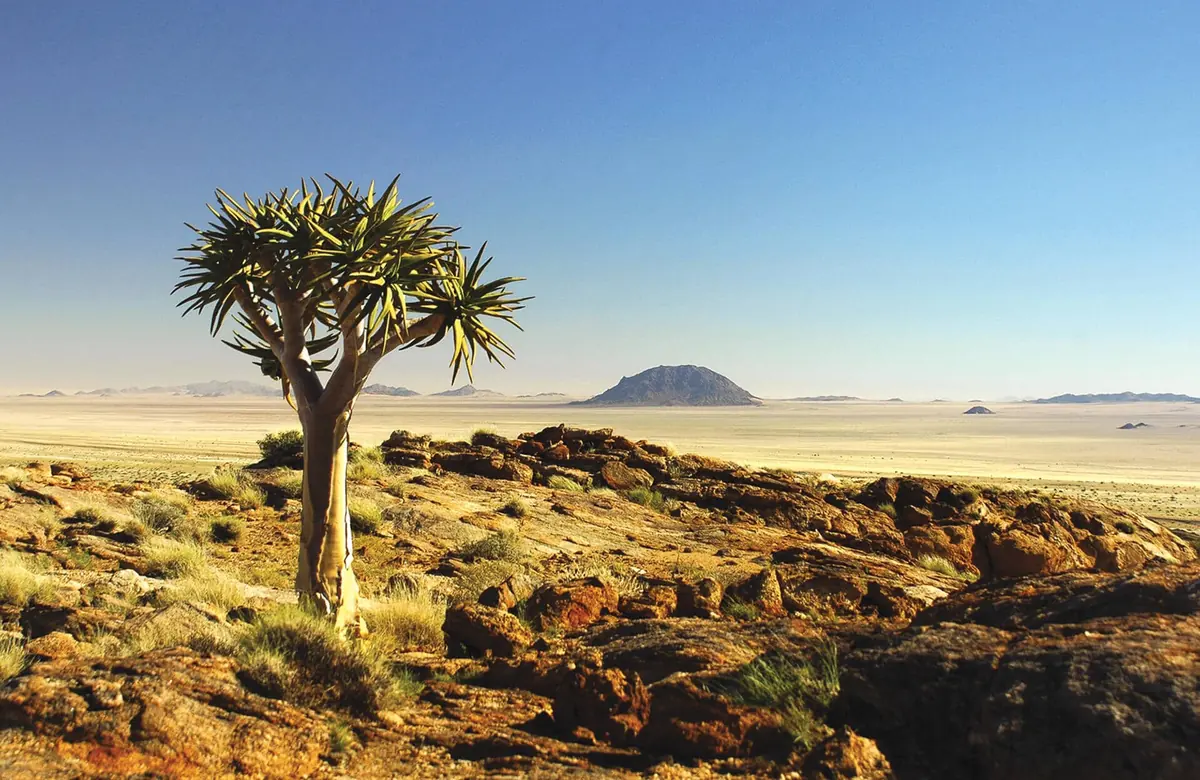
Aus sits roughly where the southern Namib, the Nama Karoo and the Succulent Karoo meet. The third of those is the one botanists care about. It holds about a third of the world’s 10,000 or so succulent species and 115 kinds of reptile, 48 of them found nowhere else. The flowers after winter rain get the attention, but the succulents are there all year, and the private reserve at Klein-Aus Vista takes in 510 square kilometres of that granite hill and plain.
Quick answers
What animals can you see in Aus?
You have a good chance of seeing oryx (gemsbok) and ostrich. Spotted hyena and leopard are there but rarely seen.
What are the best hikes in Aus?
Schanzen Trail (5.1 km), Vista Trail (4.1 km), Schutztruppe Trail (10.8 km) and Mountain Trail (6.4 km). See the hikes section for times, difficulty and permits.
Map of Aus
See every place on this map as a list