Park · Karas, Namibia
Tsau ǁKhaeb (Sperrgebiet) National Park
Namibia's old forbidden diamond coast, now a national park you mostly see on a permitted tour: the Kolmanskop ghost town, Pomona and the Bogenfels rock arch.
Short answer
At Tsau ǁKhaeb (Sperrgebiet) National Park, international visitors pay N$280 (about US$17, €15 or £12.50) per adult and N$180 per child per day. The rates apply from 1 April 2026 to 31 March 2027.
- Daily fee, international adult
- US$17 €15 · N$280
- Malaria
- The CDC advises malaria tablets only for regions in the north and east of Namibia.
- Places to stay
- 1
- Where
- Karas, Namibia27.32°S 15.81°E
Tsau ǁKhaeb (Sperrgebiet) National Park fees 2026/27
Checked Ministry of Environment, Forestry and Tourism tariffValid 1 April 2026 to 31 March 2027, per person per day, in Namibian dollars.
| Who | Adult | Child |
|---|---|---|
| International visitorsUS, Europe and everyone else | US$17 €15 · N$280 | US$11 €10 · N$180 |
| SADC nationals | N$180 | N$100 |
| Namibian citizens | N$60 | Free |
- Children aged 8 and under enter free. The child rate is for ages 9 to 15; Namibian children in that age group pay nothing. From 16 the adult rate applies.
- Vehicle fee per day, on top of the per person fee: N$60 for 10 seats or less, N$150 for 11 to 25 seats, N$600 for 26 to 50 seats and N$1,000 for 51 seats or more.
- The Namibian rate is for Namibian citizens. The gazette sets fees by nationality, so a foreigner living in Namibia pays the rate for their nationality.
- Each fee is half park entrance fee and half conservation fee; the figures shown are the two added together.
- These fees were gazetted with effect from 1 April 2026 and have no end date. I show them as valid to 31 March 2027, the end of Namibia’s financial year, and will re-check then.
- Most visitors only see Kolmanskop or go in on a concession tour. Kolmanskop's operator sells its own permit and tour ticket, and its 2026/2027 price page says it does not know when the ministry will start charging park fees there and that any government fee will be added on top. So as far as I can tell you don't pay this fee at Kolmanskop yet, but ask the operator what your ticket or tour price covers.
- Fees are set by Ministry of Environment, Forestry and Tourism. Official tariff · Seen a new rate? Tell us
US$1 = N$16.64 · €1 = N$18.60 · £1 = N$22.31 (ECB rate, 3 Nov 2026, N$1 = R1). Converted amounts are approximate; you pay in Namibian dollars.
How we got these figures
- SafariFind gives the same adult figures but lower child rates (N$140 foreign, N$90 SADC) than the gazette; I used the gazette child rates.
- Government Gazette No. 8877 of 1 April 2026, Government Notice No. 115 (MEFT fee schedule), copy hosted by the Legal Assistance Centre · official · checked 7 Oct 2026
- Tourism Update (27 January 2026) · one source · checked 7 Oct 2026
- Namibian.org (19 January 2026) · one source · checked 7 Oct 2026
- Africa Beat (6 February 2026) · one source · checked 7 Oct 2026
- TravelComments.com (29 January 2026) · one source · checked 7 Oct 2026
- SafariFind · one source · checked 7 Oct 2026
- Kolmanskuppe (Ghost Town Tours), tours and prices 2026/2027 · official · checked 10 Oct 2026
Tsau ǁKhaeb (Sperrgebiet) National Park is the old diamond coast of ǁKaras, running from the Orange River north to the Namib-Naukluft and wrapping right round Lüderitz (ǃNamiǂNûs). Germany sealed it off in 1908, soon after the railway worker Zacharias Lewala found a diamond near Kolmanskop, and the public stayed out for about a century. That left the succulent desert almost untouched, with some 1,050 plant species on the ministry’s count. Most of the park is still closed, so what you see is what a permit allows.
Getting there
Lüderitz is the base. The tarred B4 crosses the park on the 125 km from Aus, which has a garage, so fill up there. You may not leave the road in between. Kolmanskop is 10 km inland from Lüderitz and you can drive there yourself.
Your own car is not allowed further south. The concession holder takes you in its 4x4 through the Rotkop gate, about 20 km east of town, and the permit needs a copy of your passport sent well ahead, as processing takes four or five days. At the far southern end, Oranjemund is reached on about 90 km of tar from Rosh Pinah, with an ID check on the way. There is no public road up the coast between the two towns.
When to go
Any month, but plan around the wind. Shrubs here live on fog off the cold Atlantic, and Oranjemund averages about 50 mm of rain a year. At Pomona and Bogenfels the summer wind often tops 60 km/h and raises proper sandstorms, and around Lüderitz November to January is the windiest time. In a year with good winter rain the succulents flower, usually around August, but that is never certain.
What to do
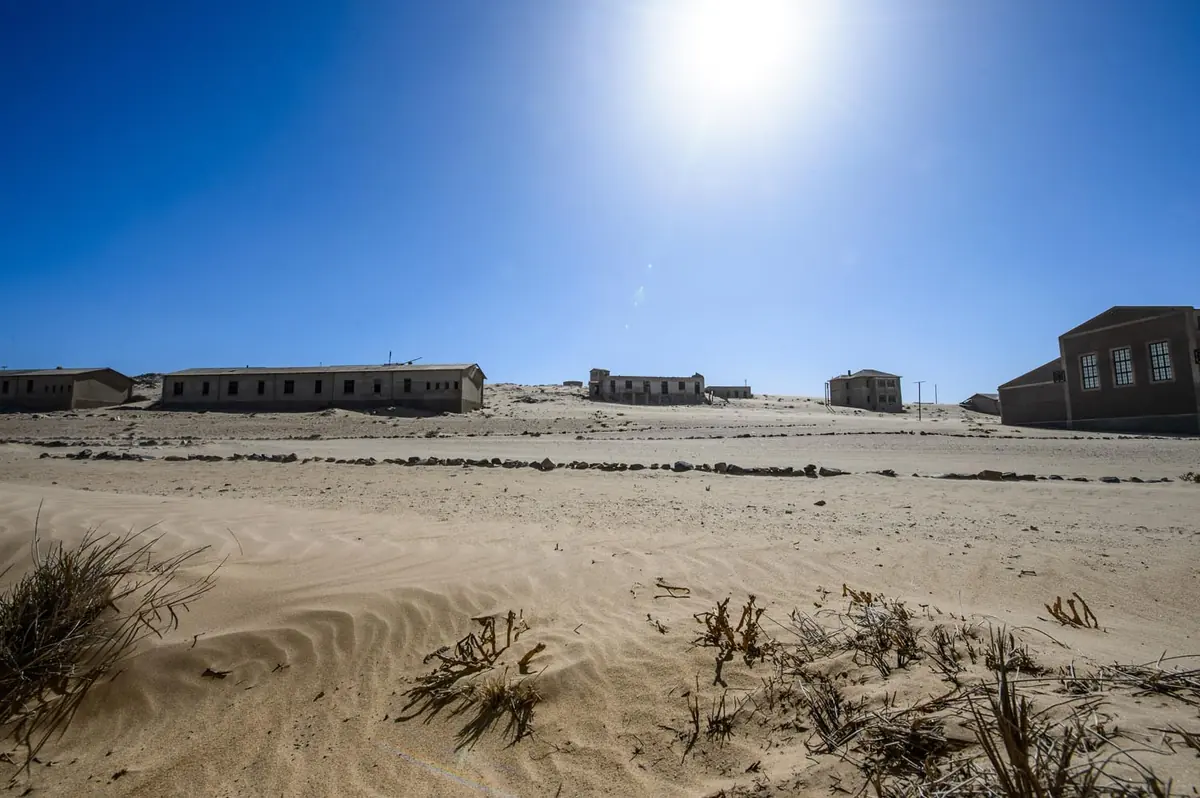
Start at Kolmanskop, the diamond town abandoned in 1956 where dunes now fill the houses. Guided tours in English and German leave at 09:30 and 11:00 from Monday to Saturday and at 10:00 on Sundays and public holidays, and last 45 to 60 minutes. A normal permit is good until 13:00; photographers can buy a sunrise to sunset pass. No drones.
The full day trip south is the big one. The ministry gave the concession for the old mining area to Sandwich Harbour 4x4. Its route stops at the old Grillental pump station and runs through the Idatal valley to Pomona, a ghost town spread over a wider area than Kolmanskop, then goes on to Bogenfels, a 55 m rock arch over the surf. You can climb onto the top if heights don’t bother you. Some trips also pass Elizabeth Bay.
Good to know
The CDC lists malaria as rare outside the north and east, which takes in ǁKaras, and advises only mosquito bite precautions here, no tablets. This is still a proclaimed diamond area: picking up anything at all is forbidden. The ministry’s park fee is in the table on this page. The Kolmanskop operator says its ticket does not include government park fees and any added will be for your account, so ask what your booking covers. Take water and a windproof jacket; there are no toilets out there.
Wildlife you might see
10- likelyOryx (gemsbok)In and around Oranjemund, where they roam the streets and have right of way. All yearsource
- likelyWetland birds (almost 60 species recorded)Along the Orange River on the park's southern edgesource
- possibleSpringbokThe inland plainssource
- possibleCape fur sealAlong the coastsource
- possibleHeaviside's dolphinOff the coastsource
- possibleAfrican penguinOn the islands off the coast. The colony on Halifax Island, off Lüderitz, can be watched with good binoculars from the Lüderitz Peninsulasource
- possibleDune lark and black-headed canaryResident birds of the parksource
- rareBrown hyenaKolmanskop, where brown hyenas use the ruined buildings for sheltersource
- rareSouthern right whaleOffshoresource
- rareLappet-faced vulture and Ludwig's bustardRecorded among the park's 120 or so land bird speciessource
Likelihood is for a normal visit of two or three days, from the sources linked. Nothing is guaranteed in the wild.
Staying safe in Tsau ǁKhaeb (Sperrgebiet) National Park
- Malaria
- The CDC advises malaria tablets only for regions in the north and east of Namibia. Elsewhere, ǁKaras included, it lists malaria as rare and advises mosquito bite precautions only. source
- A working diamond area
- Most of the park is still closed to the public. On the B4 between Aus and Lüderitz, and on every other road into Lüderitz, you may not leave the road. Pomona and Bogenfels are reached only with the concession holder, in its own vehicles. source
- Pick nothing up
- Guides warn before you set off that you may not pick up anything inside the restricted area, let alone pocket it. Leave stones, glass and old mining scrap where they lie. source
- Kolmanskop ruins
- You enter Kolmanskop at your own risk. Your permit covers the town only; going beyond its boundary into the mining area is prosecuted, and nobody may be there between sunset and sunrise. source
- Wind and sandstorms
- At Pomona and Bogenfels the wind often tops 60 km/h in summer and whips up sandstorms. Around Lüderitz the windiest months are November to January. source
- Bogenfels cliff top
- The arch is 55 m high and you can walk onto the top of it. Keep well back from the edge, more so in strong wind. source
Tips from travellers
- Book the Bogenfels and Pomona trip well ahead. Permits for the restricted diamond area take four or five days to process. one source
- Set aside a whole day for the trip south. It is a full day 4x4 tour with lunch out in the desert. one source
- Climb onto the top of Bogenfels for the view over the coast; a writer with a fear of heights went up anyway for the best view of the area. From the beach below, the arch looks quite different. several sources
- Get to Kolmanskop in the morning. A normal permit lets you in only until 13:00, and the guided tours leave at 09:30 and 11:00 from Monday to Saturday and at 10:00 on Sundays and public holidays. For sunrise or sunset light buy the photographers' day pass instead. official
- Check if your ticket or tour includes a government park fee. The Kolmanskop operator says its prices do not include park fees and any that the ministry adds will be for the visitor's account. official
- Take water, snacks and a windproof layer on any trip into the park. There are no toilets out in the desert once you leave town. one source
Checked 7 October 2026. Conditions change, so confirm with the park or venue before you go.
Fairytale Valley, a floppy-eared hyena and the forbidden coast
“Mooi klip”, pretty stone. Those are the words history gives Zacharias Lewala, a labourer shovelling sand off the railway near Grasplatz station in April 1908. He had worked on the mines at Kimberley and knew what a rough diamond looked like. His foreman, August Stauch, was a Thuringian railwayman who had come out a year earlier because a doctor thought desert air would help his asthma. Stauch dragged the stone across the glass of his watch. It cut.
What the pretty stone did to two men
Stauch had the find confirmed by a mining engineer called Sönke Nissen, and the two of them pegged a claim at Kolmanskop. That September the German government closed the coast from the Orange River north for some 360 km, and 100 km inland. Stauch became a millionaire, ran one of the big mining companies, then lost nearly all of it in the crash of 1931. He died of stomach cancer in Eisenach in 1947, back in the Thuringia he had left.
About Lewala the record goes almost silent. A writer in the German magazine Der Spiegel put it bluntly: the name survived and little else, because nobody paid him for the find or thanked him. Where he went afterwards, and when he died, I could not find recorded anywhere. If you take the tour out of Lüderitz, remember that the story you hear at each stop rests on a man the paperwork forgot.
The valley they worked on their stomachs
Pomona, south of Elizabeth Bay, had a mining history before any of this. In the 1860s two men, Aaron de Pass and Captain John Spence, got mining rights there from the Nama chief David Christian. Then Stauch went prospecting south with the Berlin mining professor Robert Scheibe and came on a valley where diamonds lay on the surface. He named it Idatal after his wife, Ida. Everyone else called it Märchental, the Fairytale Valley. Two more valleys got his daughters’ names, Barbara and Marianne, and another went to Scheibe.
The tale told about it is that the stones were picked up at night, glittering in the moonlight, by men crawling across the gravel on their bellies. Believe the detail or not, the output was real: over a million carats came out of the Pomona field between 1912 and 1914. To serve it the company built a 119 km narrow gauge railway from Kolmanskop through Pomona to Bogenfels, electric, in a desert with no water. It took four years to finish, in 1913. South African troops wrecked it two years later. One magazine writer who did the trip in 2022 found tools still scattered around the 1911 pump station at Grillental, and at Pomona only rust-coloured lines on the ground where the track ran. Pomona had a school and a bowling alley. It has a cemetery too, and the Rough Guide describes a graveyard out here that the sand is slowly taking.
For all that effort only about a twentieth of the park has ever been mined. The rest was simply left alone for a hundred years, which is the real reason to come.
Mosul, Pisa and the seals at Baker’s Bay
The animal that belongs to this coast is the brown hyena, the strandwolf. The Brown Hyena Research Project, run from Lüderitz by Ingrid Wiesel, has followed them since 1997 and reckons Namibia holds 800 to 1,200, about half of them along the coastal Namib. They can walk 40 km in a night.
What they eat is seal. At the Baker’s Bay colony the researcher Marie Lemerle sat for some 450 hours in her first months in 2020 and 2021, sunrise to sunset, and identified 22 different hyenas by leg stripes and torn ears. The two clans that own the place come only after dark. Outsiders, some of them living more than 50 km inland, come during the day, probably to avoid a fight, which is why the project calls Baker’s Bay one of the best places anywhere to watch brown hyenas in daylight. December, when the pups are born, is the busy time, and three or four hyenas may be on the colony at once, with jackals taking newborns alongside them.
The regulars have names. Mosul, first photographed at Van Reenen Bay in 2010, would kill a pup, eat, then sleep against the rocks for hours. Pisa, whose left ear is flipped backwards, never ate at the colony. He carried what he got a few hundred metres off, hid it in a bush and came back for more, about three times a visit. His daughter Little Pisa has the same ear, one blind eye and a habit of going for other hyenas, her own clan included. At Elizabeth Bay the old female Obelixa, collared in 2009, lived to about 15. The clan’s breeding female now is Ellis, who rests in the old buildings of the ghost town and had a cub, Mangeni, in March 2025.
Now the honest part. Baker’s Bay is closed to the public, so you will not see any of that. Your chance is a guided trip to Elizabeth Bay, which the researchers sometimes join if asked, and even there the project says plainly that sightings can never be promised. On the long drive to Bogenfels what tour write-ups mention is oryx, springbok, ostrich and jackal. If you do meet a hyena, it is shy and no danger. Keep calm and give it room.
Older things under the sand
The name Tsau ǁKhaeb is Nama for deep, soft sand, and the sand hides more than diamonds. At Grillental, where the tour stops for the pump station, the river beds are about 21 million years old and have given up fossils of a sabre-toothed cat, a hyrax and a python-like snake from a time when rivers ran here. Further south, some 80 km north of Oranjemund, a meteorite punched the Roter Kamm crater about five million years ago: 2.5 km across and 130 m deep, its floor under at least 100 m of sand, and a long way from any of the day routes out of Lüderitz.
In and around Tsau ǁKhaeb (Sperrgebiet) National Park
30 places listedWhere to stay in Tsau ǁKhaeb (Sperrgebiet) National Park 1
- 26.63°S 15.09°ECampsiteCamping Diaz Point
Sights 29
 KolmanskopAttraction · Lüderitzkolmanskuppe.com
 Roter Kamm craterAttraction
- Agate BeachAttraction
- ArchitektenhausRuins
- BakeryRuins
- BogenfelsAttraction
- BuchhalterhausRuins
- ButcherRuins
- Diaz PointMemorial
- DirektorenhausRuins
- DoktorenhausRuins
- Eberlanz HöhleCave
Show all 29 sights
- Essy Bay · Attraction
- Fjord · Viewpoint
- Grossebucht · Viewpoint
- Halifax Point · Viewpoint
- Hospital · Ruins
- Ice Factory · Ruins
- Ingenieurhaus · Ruins
- Junggesellenhaus · Ruins
- Kleiner Fjord · Viewpoint
- Knochenbucht · Viewpoint
- Lehrerhaus · Ruins
- Little Arch „Kleiner Bogenfels“ · Viewpoint
- Quartiermeisterhaus · Ruins
- Rocky Bay · Viewpoint
- School · Ruins
- Warehouse · Ruins
- Witmuur · Viewpoint
Quick answers
How much is the entry fee for Tsau ǁKhaeb (Sperrgebiet) National Park?
International visitors pay N$280 (about US$17, €15 or £12.50) per adult and N$180 per child per day. These rates apply from 1 April 2026 to 31 March 2027 and are set by Ministry of Environment, Forestry and Tourism (MEFT).
Do Namibians and SADC citizens pay less at Tsau ǁKhaeb (Sperrgebiet) National Park?
Namibian citizens pay N$60 per adult and SADC nationals pay N$180 per adult per day. You need ID or a passport to get the lower rate.
When were these Tsau ǁKhaeb (Sperrgebiet) National Park fees last checked?
We last checked them on 10 October 2026 against 7 published sources. We re-check every two weeks, but always confirm with Ministry of Environment, Forestry and Tourism (MEFT) before you travel.
What animals can you see in Tsau ǁKhaeb (Sperrgebiet) National Park?
You have a good chance of seeing oryx (gemsbok) and wetland birds (almost 60 species recorded). Brown hyena, southern right whale, lappet-faced vulture and ludwig's bustard are there but rarely seen.
Tsau ǁKhaeb (Sperrgebiet) and the parks nearest it
| Park | International adult | Distance | Where |
|---|---|---|---|
| Tsau ǁKhaeb (Sperrgebiet) National Park | US$17 €15 · N$280 | · | Karas |
| Fish River Canyon (ǀAi-ǀAis) | US$17 €15 · N$280 | 181 km | Karas |
| NamibRand Nature Reserve | US$21 €19 · N$350 | 235 km | Hardap |
| Namib-Naukluft National Park | US$9 €8 · N$150 | 308 km | Hardap |
Where the Tsau ǁKhaeb (Sperrgebiet) fees come from
- Government Gazette No. 8877 of 1 April 2026, Government Notice No. 115 (MEFT fee schedule), copy hosted by the Legal Assistance Centre
- Tourism Update (27 January 2026)
- Namibian.org (19 January 2026)
- Africa Beat (6 February 2026)
- TravelComments.com (29 January 2026)
- SafariFind
- Kolmanskuppe (Ghost Town Tours), tours and prices 2026/2027
Open data: all park fees (CSV) · JSON (CC BY 4.0)
Cite as: Travel Africa Guide, "Tsau ǁKhaeb (Sperrgebiet) National Park fees 2026/27", checked 10 October 2026, https://travelafrica.guide/namibia/tsau-khaeb-sperrgebiet-national-park/
Map of Tsau ǁKhaeb (Sperrgebiet) National Park
See every place on this map as a list