Park · Karas, Namibia
Gondwana Canyon Park
Private nature reserve of 1,160 km² on the eastern side of the Fish River Canyon, with Gondwana lodges off the C37, a 47 km self-drive route and game that has come back since the sheep left.
Short answer
Gondwana Canyon Park is in Karas, Namibia. This page lists 6 places to stay and 2 sights. The nearest park with an entry fee on this site is Fish River Canyon (ǀAi-ǀAis), about 27 km away, where international adults pay from N$280.
- Malaria
- The park is in ǁKaras, which is not one of the regions where the CDC says malaria is transmitted, and UK travel health advice rates the risk in this part of Namibia as very low.
- Places to stay
- 6
- Park fee nearby: Fish River Canyon (ǀAi-ǀAis)
- US$17 €15 · N$280about 27 km away
- Where
- Karas, Namibia27.54°S 17.88°E
Gondwana Canyon Park is the private reserve that runs along the eastern side of the Fish River Canyon in ǁKaras. It is where many people stay when they come to see the canyon, because the state park’s own place to sleep near the main viewpoints is the campsite at Hobas. The land was overgrazed sheep farms until the mid-1990s, when a group of Namibian businessmen started buying them up. Fences came down and game was brought back, and today it covers 1,160 km² of flat-topped mountains, granite hills and quiver trees.
Getting there
You need a car. From Keetmanshoop the usual route is the B4 towards Lüderitz (ǃNamiǂNûs), then gravel on the C12 and the C37. Published directions for the Roadhouse put the Naute Dam turn-off about 30 km along the B4, then roughly 35 km on the D545 and 50 km on the C12 before you reach the C37. Canyon Roadhouse is about 14 km north of the Hobas gate, Canyon Village about 16 km from Hobas and Canyon Lodge about 20 km east of the main viewpoint.
When to go
This is very dry country, with something like 80 to 100 mm of rain a year, mostly between January and March. Summer in and around the canyon is fierce. Days in the canyon reach 48 °C, which is why the multi-day hike through it is only allowed in the cooler months. Winter days are mild, but nights are cold enough that the lodges put hot water bottles in the rooms, so pack a warm jacket.
What to do
The main event is the canyon itself, and the classic viewpoints sit inside the state ǀAi-ǀAis/Richtersveld Transfrontier Park beyond Hobas, a short drive from the lodges. That needs a separate entry fee, paid at the Hobas gate (see the fee table for the canyon). The lodges also run guided drives to the two main lookouts if you would rather not drive.
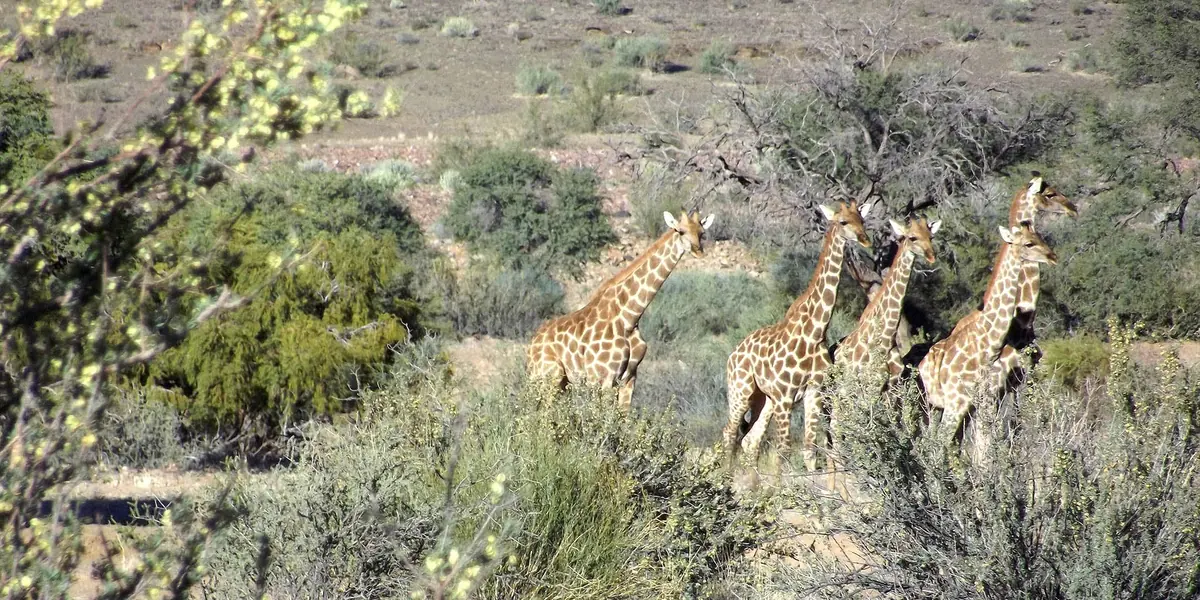
Inside Gondwana’s own land the best option is the //Garas route, a 47 km marked 4x4 self-drive. The lodge gives you a trail map. Look out for mountain zebra, oryx, springbok and kudu, plus giraffe, red hartebeest and blue wildebeest, which were brought back after the sheep left (the hartebeest in 2006, the giraffe in 2013). There are short hikes too. A trail climbs from Canyon Village onto the plateau and drops back past Archway Rock to Canyon Lodge, and the Roadhouse has its own marked walk. Tell reception before you set off.
Stop at Canyon Roadhouse even if you sleep elsewhere, for the old cars and trucks parked inside and out.
Good to know
The park is outside the regions where the CDC lists malaria transmission, and UK travel health advice rates the risk here as very low, so bite avoidance is enough. Fuel and tyre repairs are available at Canyon Roadhouse. The gravel is hard on tyres: one overlander writing in 2024 picked up two flats around Hobas over two days. Carry two spares if your hire company allows it. Leave the //Garas route before sunset, and avoid driving at night outside towns because of wildlife on the road.
Wildlife you might see
12- very likelyOryx (gemsbok)Herds on the //Garas self-drive; some wander onto the Canyon Lodge lawns after dark. All yearsource
- likelyHartmann's mountain zebraAcross the park; seen on the guided morning walks from Canyon Lodge. All year; after good rains the herds spread out across the park and onto neighbouring land, so sightings dropsource
- likelySpringbokAcross the park, including the //Garas self-drive. All yearsource
- likelyKlipspringerOn the Canyon Lodge grounds, where a colony lives, and on the //Garas self-drive. All yearsource
- possibleKuduAround Canyon Lodge, where a kudu family lives, and elsewhere in the park. All yearsource
- possibleOstrichAcross the park. All yearsource
- possibleGiraffeReintroduced to the park, with releases in 2013. All yearsource
- possibleRed hartebeestReintroduced to the park in 2006. All yearsource
- possibleBlue wildebeest and plains zebraGrazing on the grassy plains along the //Garas self-drive. All yearsource
- possibleSteenbokSeen on the //Garas self-drive. All yearsource
- possibleRosy-faced lovebirdAlong the //Garas self-drive routesource
- rareLeopardPresent in the park but seldom seensource
Likelihood is for a normal visit of two or three days, from the sources linked. Nothing is guaranteed in the wild.
Hikes and walks
3- Canyon Village to Canyon Lodge trail
Goes up from Canyon Village to the top of the plateau, where you look out over the plains next to the canyon, and finishes at Canyon Lodge by way of Archway Rock. Go early in the day outside winter.
Permit: None; free for guests
Gondwana Collection Namibia, Canyon Village - Canyon Roadhouse marked walking trail
A self-guided marked trail into the hills around the Roadhouse. The operator does not publish a distance.
Permit: None; free for guests. Tell reception before you set off
Gondwana Collection Namibia, Canyon Roadhouse - Fish River Canyon hiking trail (Hobas to ǀAi-ǀAis)
Next door in the state ǀAi-ǀAis/Richtersveld Transfrontier Park rather than Gondwana's land. Permits are issued only for the cooler months (1 May to 15 September), and Namibia Wildlife Resorts can delay the opening while the river is high. No facilities on the way and no open fires.
Permit: Hiking permit from Namibia Wildlife Resorts, booked ahead, plus a doctor's fitness certificate shown at Hobas; groups of at least 3
Wikipedia, Fish River Canyon
Staying safe in Gondwana Canyon Park
- Malaria
- The park is in ǁKaras, which is not one of the regions where the CDC says malaria is transmitted, and UK travel health advice rates the risk in this part of Namibia as very low. No tablets are advised, just care against mosquito bites. If you carry on to the north or north-east, check the advice for those regions. source
- Heat
- Summer days in the canyon reach about 48 °C and nights stay near 30 °C. Walk early, carry far more water than you think you need, and keep the long hikes for the winter months. source
- Gravel roads
- The roads into the park are gravel. UK advice, aimed especially at the January to April rains when gravel roads break up, is to keep below 80 km/h, carry two spare tyres and plenty of water, and check conditions before you leave. Take out full insurance too, since most hire policies do not cover accidents that involve no other vehicle or animal. source
- Night driving
- Avoid driving after dark outside towns, where wildlife and livestock on the road are a serious hazard. source
Tips from travellers
- Fill up at Canyon Roadhouse, which has a fuel station. Do not count on every small town for fuel: one traveller in 2024 could only buy 20 litres of diesel at Bethanie (Bethanien) on the way down. one source
- The famous viewpoints are in the state park, not Gondwana's. You pay a separate entry fee at the Hobas gate, then drive on to the viewpoints. several sources
- Planning the big canyon hike? Check the opening date with Namibia Wildlife Resorts before you book flights. In 2026 the trail only reopened on 17 July, once the river had dropped to a safe level, and NWR warned that rocks at the river crossings could still be slippery. official
- The //Garas self-drive opens from sunrise and you must be out of the park before sunset. You get a trail map for it. official
- Tell the lodge in advance if you expect to arrive late. The gravel roads take longer than the map suggests. official
- Pack a warm jacket even in a hot month. Desert nights here are cold, and in winter the lodges put a hot water bottle in the rooms. official
Checked 7 October 2026. Conditions change, so confirm with the park or venue before you go.
Sixty boreholes and a truck full of rocks
In 1973 August Sycholt wrote a piece for the magazine Ster about a couple farming on the lip of the Fish River Canyon. Christiaan and Johanna Fourie had not had a neighbour for nine years. They had come to the farm Altdoring in the 1950s on a donkey cart and lived at first in a shelter among the rocks. Christiaan sank more than 60 boreholes across 15,000 hectares and only a few ever gave water. They kept karakul sheep and goats, Johanna boiled soap from karakul fat, and three or four times a year they went to town to sell pelts and buy groceries. Their two boys were at school in Karasburg.
The Fouries held on until the late 1990s, then sold, and Altdoring is now part of the park. Manni Goldbeck, a co-founder of Gondwana who retold the Ster piece in 2025, says all that is left of the farm is an old bakkie rusting beside the road between Canyon Lodge and ǀAi-ǀAis, full of bullet holes. It carried rocks for jackal-proof fencing until it broke down and cost too much to fix.
What the fences were for
Afrikaner farmers settled this country from the 1940s, and the state helped pay for mesh fences dug into the ground so that jackals could not get under them and at the lambs. Arsenic and strychnine did the rest, and took the genets, foxes, aardwolves, eagles and vultures as well. The big game was long gone by then. Hunters and traders who crossed the Orange River had shot out the rhino early in the 1800s and the giraffe by the 1830s. Giraffe hide was cut into long riempies, the thongs wanted for ox-wagons, and klipspringer pelts went for saddle blankets.
Then the karakul market fell away as buyers overseas turned against fur, and a drought ran from the mid-1980s into the early 1990s. When Gondwana started buying, the first job was taking the wire down. An Austrian newspaper feature on the park puts it at 500 km of fencing.
Old wrecks have done rather well out of all this. A Tracks4Africa writer who stopped at Canyon Roadhouse in 2014 reported that its car theme started with one rusted vehicle in the yard of the original farm. In February 2026 Gondwana announced a 1957 Nash Metropolitan for it, a small car built in England for American buyers.
The lieutenant in the canyon
Not far from Altdoring, down in the southern part of the Fish River Canyon, there is a grave, and Goldbeck writes that Christiaan Fourie was one of the few people who knew where it was. Leutnant Thilo von Trotha was 27 when he was shot there on 14 June 1905, during Germany’s war against the Nama, while he was talking peace with Nama fighters. The grave record kept by South African genealogists says he was shot from behind, because the Nama suspected the talks were cover for a cavalry raid further down the valley to take back stolen livestock.
The accounts do not agree on who he had gone to meet. Goldbeck names Cornelius Frederiks, the Bethanie leader. The grave record and a Business Day writer who hiked past in 2023 both say Bondelswarts. Goldbeck also calls him a nephew of Lothar von Trotha, the general who issued the extermination order against the Herero in October 1904. The grave is no secret now. People on the multi-day canyon hike walk right past it.
Counting without binoculars
Once a year, over a weekend in late June, the park counts its game, and since 2022 anyone can sign up. The 2025 count was the 23rd and drew 60 people, lodge guests among the staff and conservation partners. Teams drive eight fixed routes at a steady speed and note each animal, its age class and how far it stood from the track. Binoculars stay in the bag. The count is done the same way every year so that one year can be set against the next, and the totals are worked out with a correction for how easy each species is to spot. Springbok are the ones the park watches as its indicator, because they are sensitive to changes in the veld.
Nobody should book here for the game alone. Expert Africa keeps a tally of what its travellers report seeing: most guests at all three Gondwana places saw oryx, about two thirds at Canyon Lodge and Canyon Village saw zebra (a third at the Roadhouse), and roughly a quarter at Canyon Lodge saw wildebeest. A Gondwana writer who drove the plains between the Holoog and Klein Karas mountains in 2013 logged plains zebra, red hartebeest, oryx, wildebeest, ostrich, springbok and kudu, was told mornings are better, and met mountain zebra only as tracks on a walking trail. One overlander whose trip report went up in October 2024 did better without trying, waking at the Hobas campsite in the state park next door to zebra grazing close to camp.
Rhino, after more than 150 years
In July 2025 Gondwana, the conservation group Elephants, Rhinos and People and the environment ministry announced a black rhino sanctuary in the park. They bill it as the largest privately owned one in the world. By March 2026 a calf had been born and the anti-poaching unit was working with drones and sensors. How many rhino there are is not published, and not one of Expert Africa’s travellers has recorded seeing one, so do not expect to meet a rhino on a self-drive. Gondwana said that March that guided tracking for lodge guests was coming soon, and a rhino information centre is planned for the Roadhouse.
Two things from the same records are useful before you choose a bed. Expert Africa’s own write-up of the Roadhouse says the rooms share walls and you hear the neighbours and their plumbing. Canyon Village is built for bigger groups, and one traveller there reserved a particular dinner table to keep clear of the tour parties.
In and around Gondwana Canyon Park
8 places listedWhere to stay in Gondwana Canyon Park 6
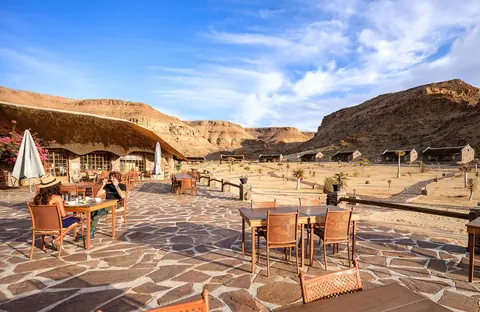 HotelCanyon Village+264 63 693 025gondwana-collection.com
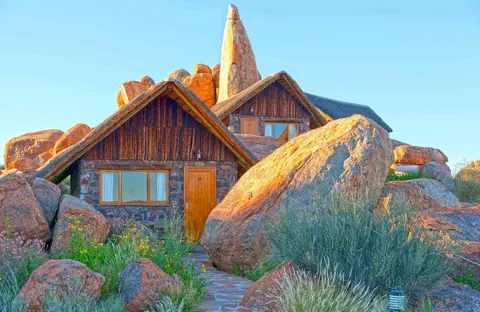 HotelCanyon Lodge+264 61 427 200gondwana-collection.com
 HotelCanyon Roadhouse
- CampsiteCanyon Roadhouse Campsite
- 27.19°S 17.70°ECampsiteGuruchab River Camp
- 27.26°S 17.70°ECampsiteKoelkrans Camp
Sights 2
- historic limekilnRuins
- KriegsgräberMemorial
Quick answers
What animals can you see in Gondwana Canyon Park?
Most visitors see oryx (gemsbok). You have a good chance of seeing hartmann's mountain zebra, springbok and klipspringer. Leopard is there but rarely seen.
What are the best hikes in Gondwana Canyon Park?
Canyon Village to Canyon Lodge trail, Canyon Roadhouse marked walking trail and Fish River Canyon hiking trail (Hobas to ǀAi-ǀAis) (88 km). See the hikes section for times, difficulty and permits.
Map of Gondwana Canyon Park
See every place on this map as a list