Park · Hardap, Namibia
NamibRand Nature Reserve
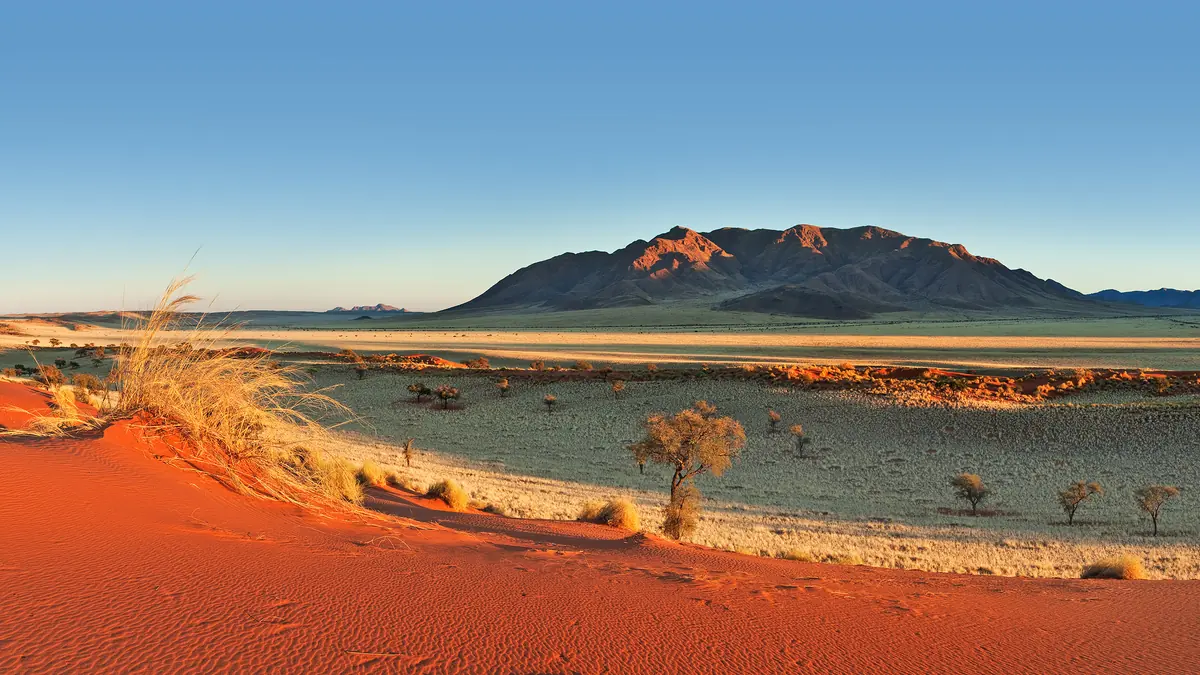
Private desert reserve south of Sossusvlei, made from 17 old sheep farms, with a handful of lodges and campsites, guided dune walks and some of the darkest night skies on earth.
Short answer
At NamibRand Nature Reserve, international visitors pay N$350 (about US$21, €19 or £15.50) per adult and N$175 per child per night. The rates apply from 1 January 2026 to 31 December 2026.
- Entry fee, international adult
- US$21 €19 · N$350
- Malaria
- The CDC lists Namibia's malaria areas as the Kavango regions, Kunene, Ohangwena, Omaheke, Omusati, Oshana, Oshikoto, Otjozondjupa and Zambezi.
- Places to stay
- 10
- Park fee nearby: Namib-Naukluft National Park
- US$9 €8 · N$150about 106 km away
NamibRand Nature Reserve fees 2026
Checked NamibRand Nature Reserve tariffValid 1 January 2026 to 31 December 2026, per person per night, in Namibian dollars.
| Who | Adult | Child |
|---|---|---|
| International visitorsUS, Europe and everyone else | US$21 €19 · N$350 | US$11 €9 · N$175 |
| SADC nationals | N$175 | N$87.5 |
| Namibian citizens | N$87.5 | N$43.75 |
- The park fee is compulsory for every night you spend on the reserve. The lodge, camp or activity operator you book with collects it on the reserve's behalf.
- Children pay half the adult fee. The SADC and Namibian price list sets the child rate at ages 3 to 12, with the adult rate from 13; the international price list gives no age range and neither list gives a fee for children under 3.
- The resident rate is the one the price list gives for Namibians.
- Some lodges fold the park fee into their own levy instead of showing it separately. Wolwedans charges a sustainability levy of N$1,600 per adult and N$800 per child per night in 2026, which includes the NamibRand park fee.
- For 2027 the published international rate rises to N$420 per adult and N$210 per child per night.
- Fees are set by NamibRand Nature Reserve. Official tariff · Seen a new rate? Tell us
US$1 = N$16.64 · €1 = N$18.60 · £1 = N$22.31 (ECB rate, 3 Nov 2026, N$1 = R1). Converted amounts are approximate; you pay in Namibian dollars.
How we got these figures
- NamibRand Nature Reserve's own site says the five tourism concessionaires collect a daily park fee from guests on the reserve's behalf, but it does not print the amount.
- The figures come from the 2026 rack price lists (non-SADC and SADC) of NamibRand Family Hideout, the reserve's self-catering house and campsites, dated 7 July 2025 and linked from its Downloads/Rates page. Both lists say the fee includes VAT and is non-commissionable; the non-SADC list says children pay half price.
- The 2027 non-SADC price list (dated 4 March 2026) gives N$420 per adult and N$210 per child per night. The 2027 SADC list was not used.
- No second independent source giving the 2026 figures was found, so each row is confirmed by one source.
- NamibRand Family Hideout, rack price list 2026 (non-SADC) · official · checked 7 Oct 2026
- NamibRand Family Hideout, rack price list 2026 (SADC and Namibian) · official · checked 7 Oct 2026
- NamibRand Family Hideout, rack price list 2027 (non-SADC) · official · checked 7 Oct 2026
- NamibRand Nature Reserve, Tourism · official · checked 12 Oct 2026
- Wolwedans Collection, rack rates 2026 · official · checked 12 Oct 2026
NamibRand is a private nature reserve on the eastern edge of the Namib, south of Sossusvlei in Hardap. It started as one man’s idea in the 1980s, when Albi Brückner began buying worn-out sheep farms, and 17 of them have since been joined into one block with the fences taken out. It shares a 100 km border with the Namib-Naukluft park. People come for red dunes, fairy circles and mountains with almost nobody else around, and for the night sky.
Getting there
Most people drive. The C27 is the road in, and you reach it from Maltahöhe in the east, from Sesriem in the north or from Aus in the south. Count on four to seven hours from Windhoek depending on where you stay, much of it on gravel. Tok Tokkie Trails, near the C27 and D826 junction, puts Sesriem about 110 km away. Wolwedans says its lodges are about two hours from Sesriem. Light aircraft also fly from Windhoek to airstrips on the reserve.
When to go
Kwessi Dunes, for one, is open all year. Rain is scarce, with a long-term average of about 70 mm a year, and in a dry year it can be almost nothing. April to October brings mild days and cold mornings, and the reserve has recorded frost in the dunes. November to March is hot, with the odd thunderstorm. The Tok Tokkie walking trail is seasonal. Its 2026 rate sheet covers trails from 16 February to 29 November.
What to do
Visits run through the reserve’s five tourism concessions: the Wolwedans camps, Kwessi Dunes, the self-catering Family Hideout and its three campsites, Tok Tokkie Trails and Namib Sky, who fly hot-air balloons at sunrise. Wolwedans adds e-bike and horse rides to its drives.
The walk I would pick is Tok Tokkie’s three-day trail through low, grassy dunes, sleeping out on stretcher beds. On the way you might come across oryx, springbok, ostrich or a bat-eared fox, and after dark you may hear barking geckos. Leopard and cheetah live here but few people see them.
At night, look up. In 2012 NamibRand became Africa’s first International Dark Sky Reserve, at the strictest Gold tier, and in 2024 it was named Africa’s first Wilderness Quiet Park.
Good to know
NamibRand is outside the malaria areas the CDC lists for Namibia, so bite avoidance is all you need. Fill up before you arrive. The Family Hideout names Betta, where the D826 meets the C27, as the nearest fuel and basic shop, about 42 km south of its turn-off, with Sesriem the next option north. Drivers report corrugations on the C27 that vary month to month. Keep under 80 km/h on gravel, carry two spares and do not drive after dark. Beds are capped at one per 1,000 hectares, so book well ahead. The park fee is collected by your lodge or camp (see the fee table). At the Family Hideout the only phone signal is at reception, 5 km away, and flying a drone needs the reserve’s permission.
Wildlife you might see
15- very likelyOryx (gemsbok)Across the reserve, one of its two most common large mammals. All year, though in a dry year many move west into the Namib-Naukluft park and the count drops sharplysource
- very likelySpringbokPlains across the reserve. All year; numbers fall in drought yearssource
- very likelyBarking geckoAround the camps; you hear the clicking calls far more than you see one. At sunsetsource
- likelyBurchell's (plains) zebraPlains across the reserve. All yearsource
- likelyOstrichDunes and plains. All yearsource
- possibleBat-eared foxDunes and plains, including along the Tok Tokkie trailsource
- possibleGiraffeA small reintroduced herd, 16 animals in the 2024 count. All yearsource
- possibleHartmann's mountain zebraListed among the reserve's large mammalssource
- possibleKlipspringerListed among the reserve's large mammalssource
- possibleDune larkVegetated dunes; a Namib endemic. All yearsource
- rareKudusource
- rareLeopardThe reserve calls it elusive; guests only sometimes see onesource
- rareCheetahSeen only occasionally on drivessource
- rareBrown hyena and spotted hyenaAcross the reservesource
- rareLappet-faced vultureVery few nests on the reserve; the neighbouring Namib-Naukluft park has many more. All yearsource
Likelihood is for a normal visit of two or three days, from the sources linked. Nothing is guaranteed in the wild.
Hikes and walks
3- Tok Tokkie Trail
A fully catered walk through low vegetated dunes and mountain country, sleeping out on stretcher beds, with your luggage driven ahead. Groups of 2 to 8. Tok Tokkie's 2026 rate sheet gives trail dates from 16 February to 29 November 2026, so plan inside that window.
Permit: Guided only, booked through Tok Tokkie Trails; the NamibRand park fee is included
Tok Tokkie Trails, fact sheet (PDF) - Wolwedans Bushman Walk
An interpretive walk through the dunes with a San (Bushman) guide, reading the night's tracks and looking for small desert life such as the tok tokkie beetle. Suitable for all ages.
Permit: For Wolwedans guests, included in the stay
Wolwedans Collection, activity sheet 2026 to 2027 (PDF) - Family Hideout Koppie Climb
A walk up a rocky hill near the Hideout for the view. The Hideout also runs a guided educational walk in the dunes.
Permit: Guided, booked through the Family Hideout, with transport to the start
NamibRand Family Hideout, Activities
Staying safe in NamibRand Nature Reserve
- Malaria
- The CDC lists Namibia's malaria areas as the Kavango regions, Kunene, Ohangwena, Omaheke, Omusati, Oshana, Oshikoto, Otjozondjupa and Zambezi. Hardap, where NamibRand lies, is not one of them, and elsewhere the CDC says insect bite precautions are enough with no tablets. source
- Gravel roads
- Every road in is gravel. The UK government advises staying under 80 km/h on gravel, carrying two spare tyres and plenty of water, and not driving at night outside towns because of animals on the road. Roads get worse in the rains from January to April. source
- Fuel
- Fill up before you come. The Family Hideout names Betta, where the D826 meets the C27, about 42 km south of its turn-off, as the nearest fuel and basic shop, with Sesriem about 110 km north. source
- Heat and cold
- From November to March temperatures climb and thunderstorms build. From April to October days are pleasant but early mornings and evenings are cold, so bring warm layers for dawn drives and sleepouts. source
- Sand driving
- On the Family Hideout's self-drive 4x4 loop you have to let your tyres down to avoid getting stuck, and driving off the marked route is not allowed. source
Tips from travellers
- Book early. The reserve allows only one guest bed per 1,000 hectares and no more than 25 beds in one place, so there are few rooms and campsites to go round. official
- Sossusvlei is not a day trip from Wolwedans. The Sesriem gate is over two hours' drive each way and Sossusvlei another 45 minutes beyond it, so Wolwedans itself suggests a night near Sesriem for the dunes and then time on NamibRand. official
- Drivers who know the area say the C27 can be badly corrugated and that it changes from month to month, so ask about the road shortly before you go and allow extra time. several sources
- The park fee is collected by whoever you stay or walk with, not at a gate. See the fee table for the amounts. official
- For the stars, aim for a clear, moonless night. That is when Tok Tokkie says the Dark Sky Reserve status really shows. official
- Expect to be offline. At the Family Hideout phone signal and wifi are only found at reception, 5 km from the house and campsites. official
Checked 7 October 2026. Conditions change, so confirm with the park or venue before you go.
A sandgat, five cheetahs and a gecko named after a safari firm
The Brückner family found out over lunch. Two weeks earlier Albi Brückner, a Windhoek businessman, had made the winning bid at an auction for Gorrasis, a drought-beaten sheep farm on the edge of the Namib, and he had told nobody at home. His daughter Christine said he had bought a sandgat, a sand hole. The business set up in 1984 was called Sandgat Farming Ventures, and he used to boast that the farm had cost him what a secondhand car would.
From 1959 he was a partner in an engineering firm that sold pumps and diesel engines, and he worked the south. On Thursdays, when farmers came in to Maltahöhe for their post, he sat in the hotel selling to them and hearing how badly things were going. By the early 1980s the karakul trade had collapsed and the rain had stayed away. Around Gorrasis the neighbours were shooting oryx and springbok to get by.
The meeting at Wolwedans
He meant to farm it, with Damara sheep and Nguni cattle, and when the stock needed more ground he bought the farms next door as they went under, Wolwedans among them in 1987. It still lost money. In 1991 he called a meeting on Wolwedans. Chris Brown of the government’s nature conservation department and David Peddie, a planner from Zimbabwe, both told him to give up stock for game and visitors. The farm’s name is older than any lodge on it: “wolf” is what Afrikaans farmers called the spotted hyaena.
The first wardens, Mark and Charlie Paxton, took down fences and flattened old kraals. Trophy hunting paid most of the bills until 1995, when Eric Hesemans asked the board if he could fly hot-air balloons. The blesbok, which do not belong in Namibia, lasted longer. The reserve culled them in 2008 and fed the meat to its new cheetahs.
The state had wired off the eastern edge of the Namib-Naukluft to hold its game in, away from poachers, and oryx walking east in dry years died against it. By 2009 more than 2,000 km of boundary and internal fencing had come down. Brückner died on 8 December 2016, aged 86.
Kia and the Keerweder five
Cheetahs were common on these farms until about 1980, by which time stock farmers had cut them right down. In 2008 two groups tried to put them back. N/a’an ku sê let a male and two females go at Straussenwasser in the south that May.
The Cheetah Conservation Fund brought five males that had spent six years in captivity. Let out in July 2008, they crossed the mountains on to farmland and were darted and brought back within a month. For the second try, on 9 December, two captive females called Misty and Rosy were put in the pens at Keerweder so the males would stay close. By February 2009 the five had stopped taking handouts and were killing young oryx on Keerweder Pan. Their names were Kia, Mushara, Cadbury, Ra and Lindt, and in those first months every kill anyone witnessed was Kia’s. A researcher who followed them for ten and a half hours one day later that year watched them set off in a 1-2-2 line with Kia in front, botch a run at fifteen hartebeest, then pull a springbok out of a herd of more than two hundred in the midday heat.
They were not kind to the giraffe. In November 2009 a young cow died giving birth, and the Keerweder males killed her calf the following night.
What you will and won’t see
Expert Africa keeps a tally of what its travellers report. Nearly all of them see oryx and more than nine in ten see zebra. About one in six sees giraffe, which keep to the north. Brown hyaena comes in at 7 per cent. Cheetah and leopard are at nought. The cats are there all the same. Staff saw a leopard with cubs near Straussenwasser over Easter 2025, a brown hyaena was drinking at the Kwessi waterhole almost every evening in late January 2026, and the reserve’s July 2026 newsletter has a photograph of a male cheetah in a cage trap, about to be collared.
Expert Africa’s own team counted ten aardwolves and eight jackals on a single cool, overcast June afternoon and were told by their guide that they had been luckier than most.
Rain decides the rest. The reserve averaged 4.3 mm in the 2024 season and the count that May found 119 springbok on the routes. A year later, after 56.7 mm, the same count gave 684.
Plaques in the fairy circles
Here and there a fairy circle has a numbered ceramic plaque in the middle. The reserve raised money by “selling” circles to Wolwedans guests, and wrote down the buyer, the date and the GPS position of each. Walter Tschinkel, a biologist from Florida State University, saw a use for that. He had two satellite pictures of the sand between Jagkop and the Bushman Hills, taken in 2004 and 2008, and from the circles that appeared and vanished between them he worked out in 2012 that an average circle lasts about 41 years. The sold circles, found again years later, pointed to something nearer 60. What makes them is still argued over. Norbert Jürgens blamed sand termites in 2013. Stephan Getzin, whose team dug up hundreds of grass plants and found the roots unchewed, says the grass dies of thirst, and in November 2025 he was at Wolwedans teaching the guides his side.
There is also a gecko. In 2011 Bill Branch and three colleagues described a banded species under 45 mm from snout to vent, known for certain only from the grounds of Sossusvlei Desert Lodge, then part of the reserve. They named it Pachydactylus etultra. Etultra is Latin for “and beyond”, a thank-you to &Beyond, which runs the lodge.
In the south, John and Jill Kinahan mapped something older: 51 stone hunting blinds in three rows below a saddle that looks out over the Gorrasis basin. They reckon it took fifty or more people, some hiding and the rest walking oryx gently towards them. The oryx paths still cross that saddle.
In and around NamibRand Nature Reserve
11 places listedWhere to stay in NamibRand Nature Reserve 10
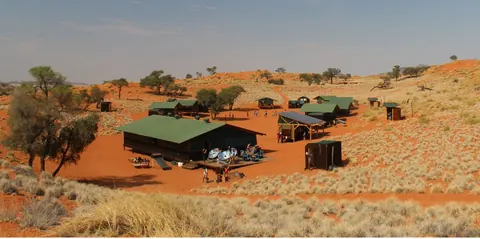 CampsiteNaDEET Centre Campnadeet.org
- 25.33°S 15.98°EMountain hutWolwedans Boulders / Dune Camp+264 61 230 616wolwedans.com
- 25.14°S 15.99°EGuest houseWolwedans Dune Camp+264 61 230 616wolwedans.com
- 24.88°S 15.90°EHotelMwisho Tented Camp
- 25.29°S 16.07°EHostelNamibRand Family Hideout
- 25.29°S 16.06°ECampsiteNamibRand Family Hideout Orion
- 25.29°S 16.05°ECampsiteNamibRand Family Hideout Venus
- 25.24°S 16.06°EHotelTok Tokkie
- 25.10°S 15.97°EHotelWolwedans Dunes Lodge
Show all 10 places to stay
- Wolwedans Private Camp · Hotel
Sights 1
- Wedding PointViewpoint
Quick answers
How much is the entry fee for NamibRand Nature Reserve?
International visitors pay N$350 (about US$21, €19 or £15.50) per adult and N$175 per child per night. These rates apply from 1 January 2026 to 31 December 2026 and are set by NamibRand Nature Reserve (fee as published by NamibRand Family Hideout).
Do Namibians and SADC citizens pay less at NamibRand Nature Reserve?
Namibian citizens pay N$87.5 per adult and SADC nationals pay N$175 per adult per night. You need ID or a passport to get the lower rate.
When were these NamibRand Nature Reserve fees last checked?
We last checked them on 12 October 2026 against 5 published sources. We re-check every two weeks, but always confirm with NamibRand Nature Reserve (fee as published by NamibRand Family Hideout) before you travel.
What animals can you see in NamibRand Nature Reserve?
Most visitors see oryx (gemsbok), springbok and barking gecko. You have a good chance of seeing burchell's (plains) zebra and ostrich. Kudu, leopard, cheetah and brown hyena are there but rarely seen.
What are the best hikes in NamibRand Nature Reserve?
Tok Tokkie Trail (22 km), Wolwedans Bushman Walk and Family Hideout Koppie Climb. See the hikes section for times, difficulty and permits.
NamibRand and the parks nearest it
| Park | International adult | Distance | Where |
|---|---|---|---|
| NamibRand Nature Reserve | US$21 €19 · N$350 | · | Hardap |
| Namib-Naukluft National Park | US$9 €8 · N$150 | 106 km | Hardap |
| Hardap Game Park | US$12 €11 · N$200 | 196 km | Hardap |
| Tsau ǁKhaeb (Sperrgebiet) National Park | US$17 €15 · N$280 | 235 km | Karas |
Guides for NamibRand Nature Reserve
Where the NamibRand fees come from
- NamibRand Family Hideout, rack price list 2026 (non-SADC)
- NamibRand Family Hideout, rack price list 2026 (SADC and Namibian)
- NamibRand Family Hideout, rack price list 2027 (non-SADC)
- NamibRand Nature Reserve, Tourism
- Wolwedans Collection, rack rates 2026
Open data: all park fees (CSV) · JSON (CC BY 4.0)
Cite as: Travel Africa Guide, "NamibRand Nature Reserve fees 2026", checked 12 October 2026, https://travelafrica.guide/namibia/namibrand-nature-reserve/
Map of NamibRand Nature Reserve
See every place on this map as a list