Park · Khomas, Namibia
Daan Viljoen Game Park
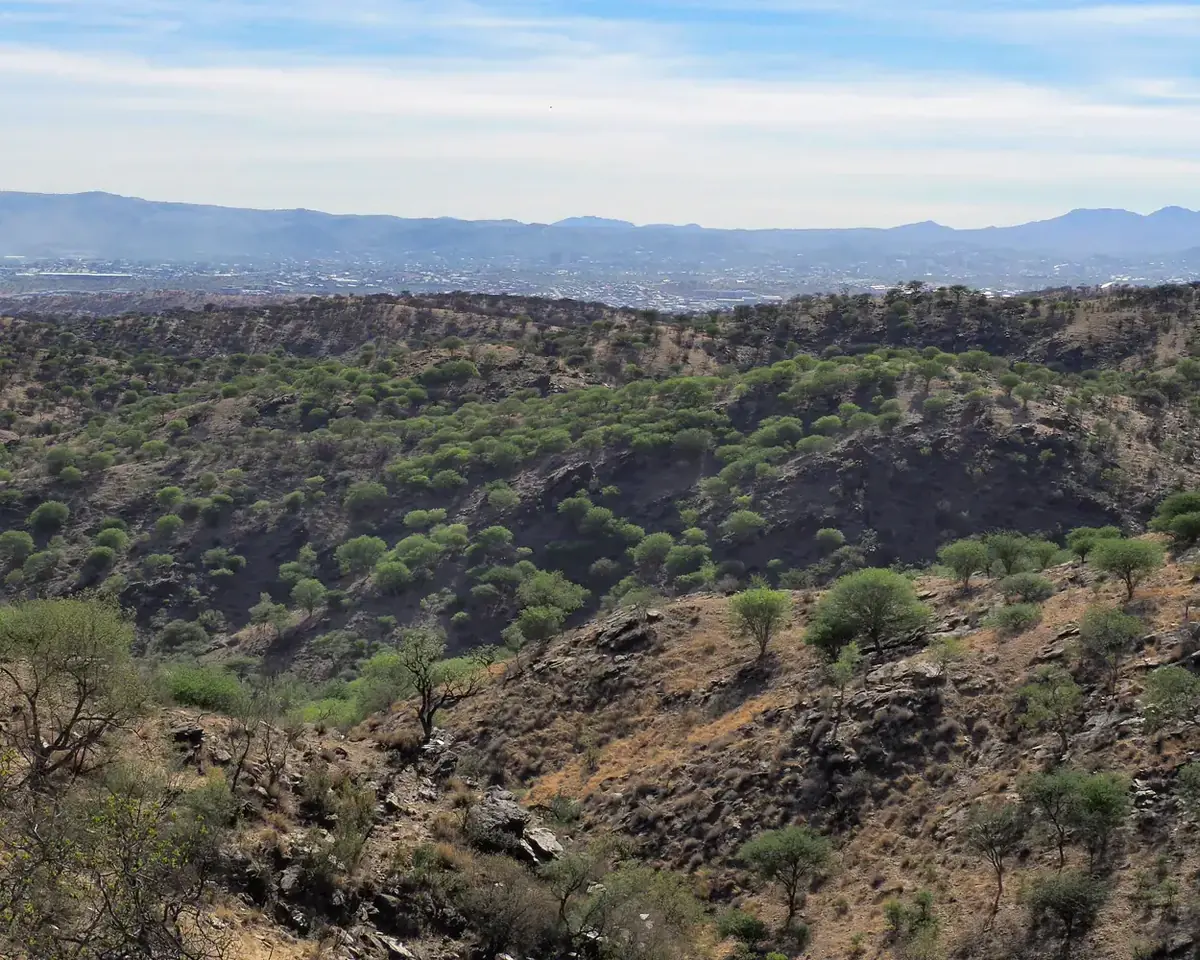
A small state game park in the Khomas Hochland about 24 km west of Windhoek, where you are allowed to walk marked trails among zebra, oryx and wildebeest.
Short answer
At Daan Viljoen Game Park, international visitors pay N$200 (about US$12, €11 or £9) per adult and N$150 per child per day. The rates apply from 1 April 2026 to 31 March 2027.
- Daily fee, international adult
- US$12 €11 · N$200
- Malaria
- Daan Viljoen is in the Khomas region, which is not on the US CDC's list of Namibian malaria areas, and the CDC says there is no transmission in Windhoek.
- Places to stay
- 2
- Park fee nearby: Von Bach Game Park
- US$12 €11 · N$200about 58 km away
Daan Viljoen Game Park fees 2026/27
Checked Ministry of Environment, Forestry and Tourism tariffValid 1 April 2026 to 31 March 2027, per person per day, in Namibian dollars.
| Who | Adult | Child |
|---|---|---|
| International visitorsUS, Europe and everyone else | US$12 €11 · N$200 | US$9 €8 · N$150 |
| SADC nationals | N$130 | N$80 |
| Namibian citizens | N$40 | Free |
- Children aged 8 and under enter free. The child rate is for ages 9 to 15; Namibian children in that age group pay nothing. From 16 the adult rate applies.
- Vehicle fee per day, on top of the per person fee: N$60 for 10 seats or less, N$150 for 11 to 25 seats, N$600 for 26 to 50 seats and N$1,000 for 51 seats or more.
- The Namibian rate is for Namibian citizens. The gazette sets fees by nationality, so a foreigner living in Namibia pays the rate for their nationality.
- Each fee is half park entrance fee and half conservation fee; the figures shown are the two added together.
- These fees were gazetted with effect from 1 April 2026 and have no end date. I show them as valid to 31 March 2027, the end of Namibia’s financial year, and will re-check then.
- Fees are set by Ministry of Environment, Forestry and Tourism. Official tariff · Seen a new rate? Tell us
US$1 = N$16.64 · €1 = N$18.60 · £1 = N$22.31 (ECB rate, 3 Nov 2026, N$1 = R1). Converted amounts are approximate; you pay in Namibian dollars.
How we got these figures
- SafariFind prints N$60, N$40 and N$20 for these parks and lower child rates, which match neither the gazette nor the other reports; I went with the gazette.
- Government Gazette No. 8877 of 1 April 2026, Government Notice No. 115 (MEFT fee schedule), copy hosted by the Legal Assistance Centre · official · checked 7 Oct 2026
- Namibian.org (19 January 2026) · one source · checked 7 Oct 2026
- TravelComments.com (29 January 2026) · one source · checked 7 Oct 2026
- SafariFind · one source · checked 7 Oct 2026
Daan Viljoen is the nearest proper game park to Windhoek, about 24 km west of the city in the hills of the Khomas Hochland. At 40 square kilometres it is tiny by Namibian standards. The lodge says there are no large predators, and that is the point: you can get out of the car and walk among Hartmann’s mountain zebra, oryx and blue wildebeest, something you cannot do in Etosha. (MEFT’s species list does name leopard, so stay alert on the longer walks.)
Getting there
Take the C28 west out of Windhoek, the shortest way to Swakopmund, over the Bosua Pass. The park turn-off comes up after roughly 20 km, and the road to it is tarred, so any hire car will do. Beyond the park the C28 turns to gravel and gets steep at the Bosua Pass, which can defeat a sedan. Most people heading for the coast use the B2 instead.
When to go
Rain is light, about 250 to 350 mm a year, and falls mostly from January to March. The dry months from May to November are the usual recommendation. Windhoek residents come out at weekends, so go on a weekday if you can.
What to do
Walking is the main reason to come. The Wag ’n Bietjie trail (3 km there and back) follows a dry riverbed from near the office to the Stengel Dam, past old Damara graves, and is fine for children. It takes its name from the buffalo-thorn (wag-’n-bietjie, “wait a bit”), whose hooked thorns snag clothing. The Rooibos trail (9 km) climbs to a trig beacon at 1,783 m, the highest point in the park, with views over the Windhoek valley, and takes about three hours. There is also a 32 km overnight trail (the Sweet Thorn), which MEFT says has to be booked.
You can drive a short, rocky game loop (about 6.5 km) past the waterholes in your own car if it has decent clearance, or book a guided drive at the lodge. Birders have more than 200 species to look for, including near-endemics such as Rüppell’s parrot, Monteiro’s hornbill, white-tailed shrike and the rockrunner. The Augeigas Dam, walled in 1933 after a bad drought, draws game and waterbirds when it holds water.
Good to know
The park is run by MEFT, while the old government rest camp has been rebuilt and run since 2011 by Sun Karros in partnership with Namibia Wildlife Resorts, with chalets, campsites, a restaurant and a pool. Pay the park entry fee at the MEFT office, and carry cash for it. Hikers sign in before setting off and sign out on return, and the office has a trail map. Sources give different leaving times for day visitors, so ask at the gate. The baboons have learnt to steal food, so keep it locked away. The US CDC says there is no malaria transmission in Windhoek, and the Khomas region is not on its list of malaria areas.
Wildlife you might see
14- likelyBlue wildebeestAround the waterhole beyond the office and in the valleys below the Rooibos trailsource
- likelyHartmann's mountain zebraHills and valleys across the parksource
- likelyOryx (gemsbok)Thornveld along the walking trailssource
- likelyWarthogAcross the parksource
- likelyBaboonAround the lodge and camp, where they raid unguarded foodsource
- possibleGiraffeThornveld across the parksource
- possibleKuduThornveld and kudu bushsource
- possibleSpringbokOpen ground across the parksource
- possibleRed hartebeestOpen ground across the parksource
- possibleKlipspringerRocky hillsidessource
- possibleRüppell's parrot, Monteiro's hornbill and white-tailed shrikeThornveld and rocky slopes, part of a bird list of about 200 speciessource
- possibleRockrunner and Carp's titRecorded in the park, among its near-endemic birdssource
- possibleWaterbirdsAugeigas Dam and Stengel Dam. After good rains, when the dams hold watersource
- rareElandAcross the park, but seldom seensource
Likelihood is for a normal visit of two or three days, from the sources linked. Nothing is guaranteed in the wild.
Hikes and walks
3- Wag 'n Bietjie trail
Starts near the office and follows a dry riverbed for 1.5 km to the Stengel Dam, then back the same way. Suits families with children. The buffalo-thorn it is named after has hooked thorns that snag clothing.
Permit: Park entry fee, sign in at the MEFT office
Travel News Namibia, Tackle the Rooibos Trail - Rooibos trail
Climbs through thornveld to a trig beacon at 1,783 m, the park's highest point, with views over the Windhoek valley, then drops through a riverbed and returns past the Augeigas Dam. Some steep sections have loose gravel.
Permit: Park entry fee, sign in at the MEFT office
Travel News Namibia, Tackle the Rooibos Trail - Overnight trail (Sweet Thorn)
MEFT lists a 32 km overnight trail that has to be booked (Info Namibia names it the Sweet Thorn). Confirm with the office that it is running before you plan around it.
Permit: Booking needed through the park office
Ministry of Environment, Forestry and Tourism (MEFT), Daan Viljoen Game Park
Staying safe in Daan Viljoen Game Park
- Malaria
- Daan Viljoen is in the Khomas region, which is not on the US CDC's list of Namibian malaria areas, and the CDC says there is no transmission in Windhoek. It does not recommend tablets here. It does for the regions on its list, which include Kunene, Otjozondjupa, Omaheke and Zambezi. source
- Walking
- You may walk without a guide here, but the animals are wild. Stay on the marked routes and keep your distance from game. The hills are rocky and uneven and get hot fast, so take more water than you think you need, a hat and proper walking shoes, and tell someone which route you have chosen. source
- Signing in
- Hikers must sign in at the office before setting off and sign out when they get back. The office opens at 06:30 and has a trail map. source
- Baboons
- Baboons here have learnt to steal food. Do not leave any lying around at the chalets or campsites, and do not feed them. source
- Roads
- The road from Windhoek to the park is tarred. West of the park the C28 is gravel almost all the way to the coast, and the steep Bosua Pass section can become impassable for sedans, so most drivers to Swakopmund use the B2. source
Tips from travellers
- Go on a weekday. Windhoek residents come out at weekends and the park and lodge get busier. one source
- Pay the park entry fee at the office on arrival and carry cash for it. The lodge rates do not include it. one source
- Older press reports (2014 and 2020) say day visitors could eat at the Boma restaurant and use the pool for a deposit or a seasonal day fee, with early hikers let off. A tour operator now says the lodge keeps day visitors off the campsite and wants them out of the park by 16:00, and Sun Karros publishes no day visitor rules of its own. Treat the lodge as for staying guests unless the gate tells you otherwise. one source
- The self-drive game route is short (about 6.5 km) and is described as a 4x4 route. It is rocky in places, so take it slowly in a car with good ground clearance, or book a guided drive at the lodge. several sources
- Sources give different times for day visitors to leave the park, so check at the gate when you arrive. one source
Checked 10 October 2026. Conditions change, so confirm with the park or venue before you go.
The reserve that was emptied to make a game park
The dam the lodge chalets look out over was built by hand. After the drought of the early 1930s the Damara families who lived on this ground walled off the Augeigas River themselves in 1932 and 1933, men, women and children, and finished before the big rains of 1934. In the account their descendants gave in 1991 it is the Alfeus Haraseb Dam, not the Augeigas.
Aukeigas, the name the park replaced
Before it was Daan Viljoen this was Aukeigas, in Khoekhoegowab ǃAoǁaexas, home of the ǀKhomanin, the Damara of the Khomas mountains. Karl ǁAribeb, who wrote a paper on the ǀKhomanin claim for the 2018 land conference, says the German administration gave them the farms Fürstenwalde and Augeigas in 1914. Under South African rule it became one of the Damara reserves.
Then the administration wanted the people out of the hills. The first group was moved off in 1947. One of them, Salatiel Seibeb, ended up as a headman of the Okombahe reserve, more than 200 km away to the north-west. Others were sent to Okakarara and Otjimbingwe. The last trek came in 1956, a drought year in which many cattle died, and it went to Sorris-Sorris, a farm tacked on to the top of the Okombahe reserve to take them. The Odendaal Commission’s 1964 report gave the reason: the land was wanted for a game park.
How many people? ǁAribeb puts the 1956 removal at 254 families, about 1,500 people, with 1,780 head of large stock and 15,820 of small. The ethnologist Oswin Köhler, in his 1959 survey of the district, gives a March 1957 census at Sorris-Sorris of 54 households and 298 people. Both numbers can be true if most families had already been scattered elsewhere, but I have not seen anyone reconcile them.
Named for the man in office at the time
Daniel “Daan” Viljoen was Administrator of South West Africa from December 1953 to December 1963, which covers the 1956 trek. The rest camp opened in 1962 while he was still in the job. The legal declaration came later, in Proclamation 19 of 1968, under his successor Wennie du Plessis. That is why you see 1962 on some websites and 1968 on the ministry’s.
The people of Aukeigas did not let it go. On 1 May 1991 they set up the ǃAoǁaexas Community to speak at Namibia’s first land conference that winter, and in 1992 some of them left Sorris-Sorris and squatted on the edge of their old land. In 2019 the ǀKhomanin chief, Juliane Gawaǃnas, asked the commission on ancestral land to have the park renamed after Haraseb, the headman behind the dam. The name is still Daan Viljoen.
The old graves in the park belong to this story. The community’s own account names a church and cemetery here, ǂArexas, where the last funerals were held in the 1950s. Whether the graves walkers pass are that cemetery or another one, nobody has written down that I could find. Walk past slowly either way.
Zebra that winter on a few square kilometres
One zebra study quotes an odd figure for the Hartmann’s mountain zebra here. Inside the fence their winter home ranges were only 6 to 10 square kilometres, against 10 to 20 in the far west of Etosha, and much smaller again in summer. A hiker who wrote up the 9 km trail for a Namibian travel magazine in 2020 only picked zebra out from the beacon, in a valley far below, where gemsbok turned up a few minutes later. The wildebeest were easier: heading for the waterhole past the office, early, on a cold morning. Kudu, hartebeest, springbok and giraffe never showed.
Expert Africa asks its travellers to log what they saw, and only two have done so here, in November 2018 and September 2025. Both logged giraffe and wildebeest. One of them also had zebra and oryx. Neither saw eland or leopard. Two people is no sample, but it matches what the Giraffe Conservation Foundation says its school groups see on their walks: giraffe, wildebeest, oryx, jackal, baboon, ostrich. Brown hyena turn up now and then, which is worth knowing next to the “no predators” line.
Blue wildebeest from here were among the animals sent north to stock the Waterberg.
Two and a half thousand children a year
Since 2016 the Giraffe Conservation Foundation has run its Khomas schools programme from the park, and it was still going in 2025. By its own 2020 count about 2,500 Grade 3 and 4 children a year, three in four of them from government schools that are often short of resources, spend a school day on a three kilometre walk learning tracks, droppings and trees. For many it is the first time they have seen these animals in the wild. Team leader Naemi Antonius called the work exhausting on hot summer days. On a weekday morning in term you may well meet a class.
The dam is often not a lake
Photographs sell a lake. Travellers kept finding a puddle: very little water in June 2013, the dams empty in December 2015, a small pool in February 2017, and a single duck on what was left when the magazine hiker passed. One guest in 2017 thought the whole view from the rooms suffered for it.
Other things come up more than once in visitors’ accounts. Baboons work the chalet terraces. The walk from the far chalets to the restaurant is long, one couple did it at night across open ground with animals wandering about and did not enjoy it, and a June visitor noted it was dark by seven and that you need a torch. The 9 km trail, by one walker’s account, is more about scenery than game. That walker did it in 35 degree heat in December and says to go at the start of the day.
The camp shut around 2008 and reopened in 2011. A walker in January 2016 still passed the abandoned old buildings on the longer trail.
In and around Daan Viljoen Game Park
3 places listedWhere to stay in Daan Viljoen Game Park 2
- 22.54°S 16.95°ECampsiteDaan Viljoen Campsitesunkarros.com
- 22.54°S 16.95°EChaletDaan Viljoen Lodgesunkarros.com
Restaurants and cafes 1
- Die KraalRestaurant
Quick answers
How much is the entry fee for Daan Viljoen Game Park?
International visitors pay N$200 (about US$12, €11 or £9) per adult and N$150 per child per day. These rates apply from 1 April 2026 to 31 March 2027 and are set by Ministry of Environment, Forestry and Tourism (MEFT).
Do Namibians and SADC citizens pay less at Daan Viljoen Game Park?
Namibian citizens pay N$40 per adult and SADC nationals pay N$130 per adult per day. You need ID or a passport to get the lower rate.
When were these Daan Viljoen Game Park fees last checked?
We last checked them on 7 October 2026 against 4 published sources. We re-check every two weeks, but always confirm with Ministry of Environment, Forestry and Tourism (MEFT) before you travel.
What animals can you see in Daan Viljoen Game Park?
You have a good chance of seeing blue wildebeest, hartmann's mountain zebra, oryx (gemsbok), warthog and baboon. Eland is there but rarely seen.
What are the best hikes in Daan Viljoen Game Park?
Wag 'n Bietjie trail (3 km), Rooibos trail (9 km) and Overnight trail (Sweet Thorn) (32 km). See the hikes section for times, difficulty and permits.
Daan Viljoen Game Park and the parks nearest it
| Park | International adult | Distance | Where |
|---|---|---|---|
| Daan Viljoen Game Park | US$12 €11 · N$200 | · | Khomas |
| Von Bach Game Park | US$12 €11 · N$200 | 58 km | Otjozondjupa |
| Okonjima Nature Reserve | US$15 €13 · N$250 | 188 km | Otjozondjupa |
| Hardap Game Park | US$12 €11 · N$200 | 233 km | Hardap |
Where the Daan Viljoen Game Park fees come from
- Government Gazette No. 8877 of 1 April 2026, Government Notice No. 115 (MEFT fee schedule), copy hosted by the Legal Assistance Centre
- Namibian.org (19 January 2026)
- TravelComments.com (29 January 2026)
- SafariFind
Open data: all park fees (CSV) · JSON (CC BY 4.0)
Cite as: Travel Africa Guide, "Daan Viljoen Game Park fees 2026/27", checked 7 October 2026, https://travelafrica.guide/namibia/daan-viljoen-game-park/
Map of Daan Viljoen Game Park
See every place on this map as a list