Park · Otjozondjupa, Namibia
Waterberg Plateau Park
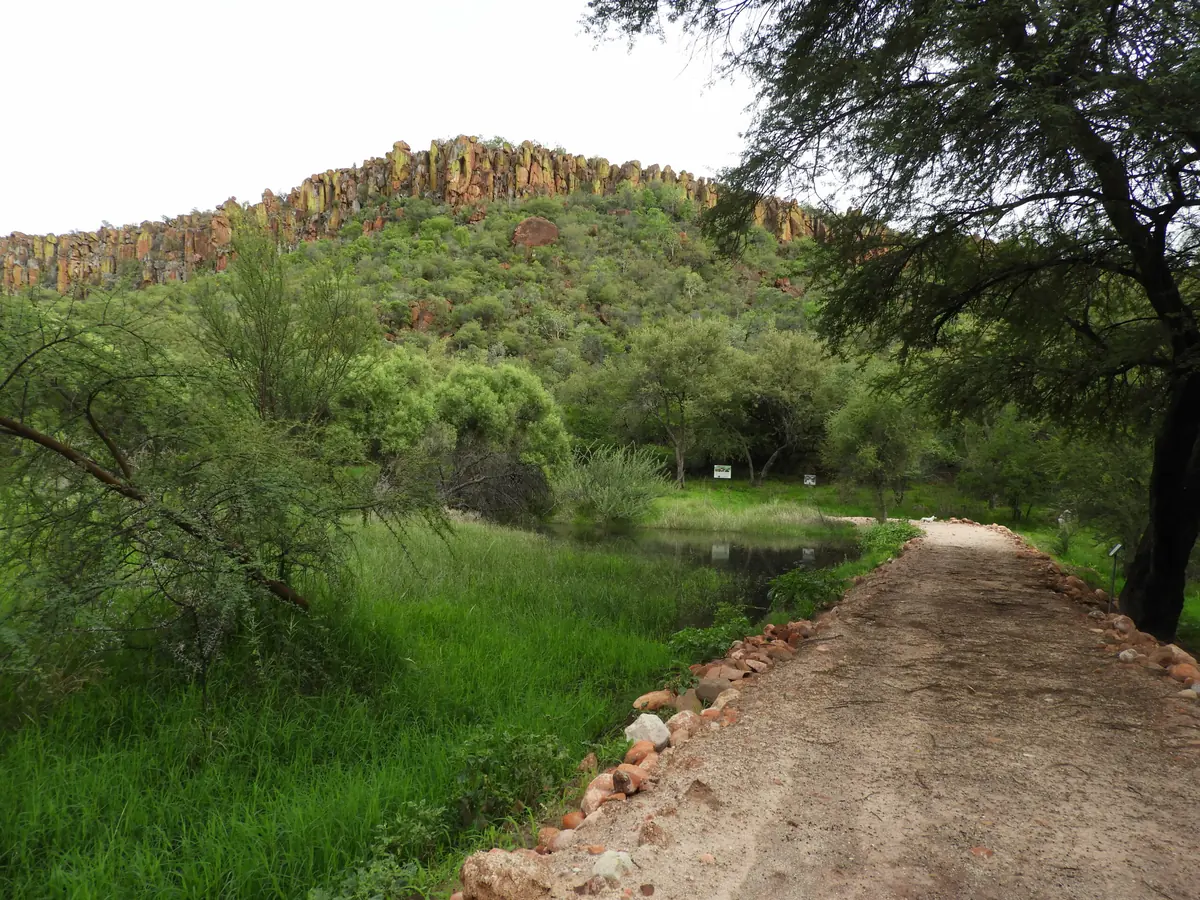
A red sandstone table mountain 68 km east of Otjiwarongo, made a park in 1972 for rare game. Walk the trails below the cliffs and see the plateau top on a guided drive.
Short answer
At Waterberg Plateau Park, international visitors pay N$280 (about US$17, €15 or £12.50) per adult and N$180 per child per day. The rates apply from 1 April 2026 to 31 March 2027.
- Daily fee, international adult
- US$17 €15 · N$280
- Malaria
- Otjozondjupa, the region the park lies in, is one of the areas where the US CDC recommends preventive malaria tablets.
- Places to stay
- 12
- Park fee nearby: Okonjima Nature Reserve
- US$15 €13 · N$250about 84 km away
Waterberg Plateau Park fees 2026/27
Checked Ministry of Environment, Forestry and Tourism tariffValid 1 April 2026 to 31 March 2027, per person per day, in Namibian dollars.
| Who | Adult | Child |
|---|---|---|
| International visitorsUS, Europe and everyone else | US$17 €15 · N$280 | US$11 €10 · N$180 |
| SADC nationals | N$180 | N$100 |
| Namibian citizens | N$60 | Free |
- Children aged 8 and under enter free. The child rate is for ages 9 to 15; Namibian children in that age group pay nothing. From 16 the adult rate applies.
- Vehicle fee per day, on top of the per person fee: N$60 for 10 seats or less, N$150 for 11 to 25 seats, N$600 for 26 to 50 seats and N$1,000 for 51 seats or more.
- The Namibian rate is for Namibian citizens. The gazette sets fees by nationality, so a foreigner living in Namibia pays the rate for their nationality.
- Each fee is half park entrance fee and half conservation fee; the figures shown are the two added together.
- These fees were gazetted with effect from 1 April 2026 and have no end date. I show them as valid to 31 March 2027, the end of Namibia’s financial year, and will re-check then.
- Fees are set by Ministry of Environment, Forestry and Tourism. Official tariff · Seen a new rate? Tell us
US$1 = N$16.64 · €1 = N$18.60 · £1 = N$22.31 (ECB rate, 3 Nov 2026, N$1 = R1). Converted amounts are approximate; you pay in Namibian dollars.
How we got these figures
- SafariFind gives the same adult figures but lower child rates (N$140 foreign, N$90 SADC) than the gazette; I used the gazette child rates.
- Government Gazette No. 8877 of 1 April 2026, Government Notice No. 115 (MEFT fee schedule), copy hosted by the Legal Assistance Centre · official · checked 7 Oct 2026
- Tourism Update (27 January 2026) · one source · checked 7 Oct 2026
- Namibian.org (19 January 2026) · one source · checked 7 Oct 2026
- Africa Beat (6 February 2026) · one source · checked 7 Oct 2026
- TravelComments.com (29 January 2026) · one source · checked 7 Oct 2026
- SafariFind · one source · checked 7 Oct 2026
The Waterberg is a block of red sandstone about 50 km long, rising up to 200 m above the Kalahari bush east of Otjiwarongo. It became a reserve in 1972, a refuge for rare game, and its sheer cliffs kept out poachers and predators so well that the park now supplies other Namibian parks with sable, roan, buffalo and rhino. It makes a handy stop between Windhoek and Etosha, but one night leaves time for little more than a game drive. If you want to walk, give it two.
Getting there
Turn east off the B1 near Otjiwarongo onto the tarred C22, then take the D2512 to the park office at Onjoka, beside Namibia Wildlife Resorts’ Waterberg Camp (MEFT still calls it Bernabé de la Bat Rest Camp). The park is roughly 300 km north-east of Windhoek. The D2512 is gravel, and the lodge owners next door say an ordinary car usually copes, though after a heavy storm you can meet mud and big puddles for a day or so. NWR lists a shop and restaurant at the camp but no fuel, so fill up in Otjiwarongo.
When to go
May to October is the pick. The rains are over, the bush is thinner and game sticks near water, and the cool mornings are good for hiking. In mid winter they drop to around 5°C, which you feel on an open game drive vehicle. From November to April days can pass 30°C and short thunderstorms build, and January to March is wettest.
What to do
You cannot drive yourself onto the plateau. Guided drives leave the camp morning and afternoon and stop at hides over waterholes, where you wait for sable, roan and other rare game to come and drink. Among Expert Africa’s travellers, giraffe, oryx and eland are the sightings reported most often, and about four in ten saw white rhino. Leopard live along the cliffs but are rarely seen.
Around Waterberg Camp nine short trails run along the foot of the cliffs. The climb to Mountain View takes about 45 minutes and is the one to do at sunrise. Serious hikers can book the multi-day unguided trail on the plateau or a guided wilderness trail with a ranger. Next door, the private Waterberg Wilderness reserve has its own trails, rhino drives and a 2.2 km History Path to a site of the 1904 battle.
Good to know
The foothills are where the Ovaherero lost the battle of Ohamakari to German troops in August 1904, the start of a genocide in which nearly two thirds of the Ovaherero died. German soldiers’ graves lie near the camp. Otjozondjupa is one of the regions where the CDC recommends malaria tablets, so see a travel clinic first. Baboon troops are common, so never leave food out. The park fee is charged per person and per vehicle each day; see the fee table on this page. The UK government advises against driving outside towns at night, when livestock and wild animals stray onto the roads.
Wildlife you might see
13- likelyGiraffeOn the plateau drives and in the bush savannah at the foot of the mountain. All yearsource
- likelyElandOn the plateau, where the park was first set up to protect them and herds of up to a hundred gather. All yearsource
- likelyOryx (gemsbok)On game drives, and in the bush savannah below the plateau. All yearsource
- likelyBaboonOn the rocks around the plateau. All yearsource
- possibleWhite rhinoOn the plateau, where it was reintroduced; the private Waterberg Wilderness reserve next door runs its own rhino drives on the plains. All yearsource
- possibleSable antelopePlateau woodland, best from the hides at the waterholes on a guided drive. All yearsource
- possibleRoan antelopePlateau woodland and the waterhole hides. All yearsource
- possibleBuffaloOn the plateau, one of the park's bred and protected species. All yearsource
- possibleDamara dik-dik and klipspringerDense bush and rocks on the slopes below the cliffs. All yearsource
- possibleRüppell's parrot, Hartlaub's spurfowl (francolin) and rockrunnerWoodland and rocky slopes; the park has more than 200 bird species. All yearsource
- possibleVerreaux's eagle (black eagle)Over the cliffs; one of 33 birds of prey recorded at the Waterberg. All yearsource
- rareBlack rhinoOn the plateau, reintroduced from Damaraland in 1989. All yearsource
- rareLeopardAlong the cliffs and dense slopes; none of Expert Africa's reporting travellers saw one. All yearsource
Likelihood is for a normal visit of two or three days, from the sources linked. Nothing is guaranteed in the wild.
Hikes and walks
7- Camp walks to Mountain View
Several short marked trails start at Waterberg Camp and run along the foot of the cliffs. The direct climb to Mountain View is popular at sunrise; ask at reception for the trail map.
Permit: No booking needed for the short walks around Waterberg Camp; park entry fee applies
Viatu, A complete guide to the Waterberg Plateau and its hikes - Aloe Circle, Fig Tree Walk and Mission Way loop
An easy circuit from Waterberg Camp linking several of the camp trails along the base of the plateau, with a side climb to Mountain View. Cooler months (May to November) suit it best.
Permit: No booking needed; park entry fee applies
Viatu, A complete guide to the Waterberg Plateau and its hikes - Waterberg unguided hiking trail
A self-guided trail on top of the plateau. MEFT gives it as 48 km and older guides as 42 km. Hikers carry their own food, the overnight shelters have water and fires are not allowed.
Permit: Booking required through Namibia Wildlife Resorts
Ministry of Environment, Forestry and Tourism (MEFT), Waterberg Plateau Park (42 km figure from Travel News Namibia) - Guided wilderness trail
A ranger-led hike on the plateau summit. Book through Namibia Wildlife Resorts before you travel.
Permit: Booking required; walked with a park ranger
Travel News Namibia, Waterberg Plateau Park - Giraffe Crossing
The longest of the marked trails in the Waterberg Wilderness valley, crossing the bush savannah below the plateau. The plateau itself is out of bounds without a guide.
Permit: On the private Waterberg Wilderness reserve; ask at its reception
Waterberg Wilderness Private Nature Reserve, hiking map - Dassie, Fountain and Porcupine Highway loop
Links three Waterberg Wilderness trails past the spring in the valley, with a steep climb of about 40 minutes to a lookout over the plains. The reserve's own map gives the trails on their own as 3.2 km, 1.0 km and 1.0 km.
Permit: On the private Waterberg Wilderness reserve; ask at its reception
Viatu, A complete guide to the Waterberg Plateau and its hikes - History Path
Information boards lead to a site of the 1904 Battle of Waterberg and a 1906 camp for Herero refugees.
Permit: On the private Waterberg Wilderness reserve; ask at its reception
Waterberg Wilderness Private Nature Reserve, activities
Staying safe in Waterberg Plateau Park
- Malaria
- Otjozondjupa, the region the park lies in, is one of the areas where the US CDC recommends preventive malaria tablets. Talk to a travel clinic before you go and use repellent from dusk. source
- Stay off the plateau without a guide
- The plateau top is closed to private vehicles and to anyone walking without a guide. Go up only on a guided game drive, a guided walk or a booked hiking trail. source
- Baboons
- Baboon troops are common around the camps. Do not leave food out, and never feed them. source
- Heat
- Summer days can reach 38 to 40°C, and nights can still turn cold. Hike early, carry plenty of water and wear a hat. source
- Gravel roads and night driving
- The road in is gravel. In the January to April rains gravel roads get worse, so carry two spare tyres, and do not drive outside towns after dark, when livestock and wild animals wander onto the road. source
Tips from travellers
- You cannot self-drive in the park. Book the morning or afternoon game drive at the camp office when you arrive, and allow for it when planning a one night stop. several sources
- Take warm clothes on the game drive, especially from May to August, when early mornings and evenings on the open vehicle are cold. several sources
- If you stay at Waterberg Wilderness next door, arrive before 3 pm to join its afternoon rhino drive. official
- NWR lists a restaurant, bar, shop and pool at Waterberg Camp but no fuel. Fill up in Otjiwarongo, 68 km away. official
- Older guides still call the Waterberg Namibia's only breeding colony of Cape vultures. German Wikipedia reports the last of them had died out by the mid 2000s, so do not count on seeing one. several sources
Checked 7 October 2026. Conditions change, so confirm with the park or venue before you go.
The vultures that gave up on the cliffs
In the 1940s and 50s about 500 Cape vultures lived on the cliffs of Okarukuwisa, a 1,884 m mountain at the Waterberg. By 1970 there were roughly 300. In 1987 the count was 14. When a helicopter flew the cliff face around 2000 the crew found no nest in use, and at least eleven birds were still roosting there. Rob Simmons, a government conservation scientist, warned that on that trend they would be gone within twenty years.
Teabag, Sky Banker and a bird called CV6
Maria Diekmann’s farm, Uitsig, faces those cliffs. In September 2000 she set up the Rare and Endangered Species Trust there, and in January 2004 caught the first Cape vulture to carry a satellite tag. It was named Sky Banker after the bank that paid for the transmitter. A year-old bird called Teabag flew to Angola, then Kamanjab, then the Skeleton Coast, came home and was dead by the first days of January 2005, poison suspected. Farmers lace a carcass for jackal or leopard, and because vultures feed in a crowd Diekmann reckoned one carcass can kill anything from 50 to 500 birds.
The best traveller of the lot was CV6, an immature female tagged on 15 February 2005. In less than two years she covered at least 64,000 km over six countries. An adult male, CV5, spent at least 46 nights asleep on the pylons of a power line instead of rock.
Then came the odd part. By 2008 the few old males left were nesting again, but in trees, not on the cliffs, and their mates were female white-backed vultures, a different species. Nobody had recorded that before. A University of Cape Town student, Pippa Schultz, used Diekmann’s tracking data to ask how the birds find food in thick bush. She laid out offal in woodland of different densities and the vultures found none of it where there were more than 2,600 trees to the hectare. Around the Waterberg the thornbush runs from about 1,000 to 10,000. Kudu and eland, the carcasses they like best, are plentiful out there. The vultures just could not get down to them.
Peregrines and Verreaux’s eagles are on record as breeding on the same sandstone.
One buffalo, 26 farms
Bernabé de la Bat, the conservation director the rest camp is named after, said in 1973 that the plateau should become a last stronghold for the rare animals of the far north. So the founders were brought in: roan from Kavango, sable from western Caprivi, eland and giraffe from Mangetti, wildebeest from Daan Viljoen, white rhino from Natal. The buffalo came from Addo in the Eastern Cape.
Those buffalo are now the only ones in Namibia south of the veterinary fence, and they are certified disease free. The law does not care. A buffalo that strays into farmland is to be destroyed on sight, for fear of foot-and-mouth. On 12 April 2015, while officials were busy dehorning rhino, one broke through the fence. The state declared 26 neighbouring farms restricted, banned every movement of cattle, goats and game, and sent a helicopter. Cameras went up at water points. Within two weeks the animal was spotted on the ministry’s own farm next door, where it had been all along. Near the end of April 2018 a buffalo was seen at Okauarongo village in Okakarara and two whole veterinary districts were frozen for about two months. A communal farmers’ group demanded ear tags on the park’s buffalo.
The traffic goes the other way too. A founder herd went from here to Simalaha in Zambia in 2018, and in June 2020 thirty giraffe were caught on the plateau, thirteen of them bound for Mangetti, where their line started.
The chief who would not sell
The restaurant at the camp is a red-brick German police station from 1908, in use as one until 1955. One of Kambazembi’s kraals stood within a kilometre of it. He led the Waterberg Ovaherero from 1860 until he died in September 1903, is said to have kept 40,000 cattle around the mountain, opposed selling land to settlers and went on wearing hides when the missionaries wanted Victorian dress. Less than a year after his death the war reached his mountain.
The mudbrick ruins at the camp are older still, a Rhenish mission founded in 1873, wrecked in 1880 and rebuilt in 1891. One of the camp walks, Mission Way, is named for it. The farm next door, now Waterberg Wilderness, was bought in 1911 by Friedrich von Flotow, grandson of the man who wrote the opera Martha.
What the top is like on foot
Getting lost is the thing to plan for on the unguided trail. A group who wrote up their four days in 2016 took the return path by mistake on the second day and reached the next hut hours early. The hiker who mapped the route for OpenStreetMap found the resort staff had no maps to hand out and said the bush is thick enough to lose yourself properly. The 2016 writer also stopped every half hour to empty sand out of their shoes. The overnight shelters, by the same report, are a wall around a floor of soft sand, with a tap and a toilet, and the nights get very cold.
What you get for it is sign more than sightings. That group found rhino tracks and dung, and the moment that made their trip was a group of buffalo crashing across the track a few metres ahead. On the last descent they counted four Rüppell’s parrots, more than in the three days before.
On the game drive, be realistic. Among Expert Africa’s travellers only a quarter saw sable and a fifth saw roan, the two animals the park is known for. One visitor complained that the guide preferred Namibian politics to wildlife. Down in camp the reports mention baboons and mongooses outside the chalets, and several praise the walk up to the rim at sunrise, though one traveller got lost on the way down.
In and around Waterberg Plateau Park
28 places listedWhere to stay in Waterberg Plateau Park 12
- 20.51°S 17.25°ECampsiteWaterberg Rest Camp+264 67 305 001nwr.com.na
- 20.48°S 17.30°EHotelWaterberg Valley Lodge+264 61 247 951waterberg-wilderness.com
- 20.48°S 17.30°ECampsiteWaterberg Plateau Campsitewaterberg-wilderness.com
- 20.48°S 17.29°ECampsiteAndersson Campsite
- 20.39°S 17.25°ECampsiteAnthephora Camp
- 20.43°S 17.25°ECampsiteHuilboom Camp
- 20.35°S 17.26°ECampsiteOkarakuvisa Camp
- 20.47°S 17.23°ECampsiteOtjokurionsia Camp
- 20.46°S 17.30°ECampsiteOtjomapenda Camp
Show all 12 places to stay
- Otjorongomba Camp · Campsite
- Waterberg Plateau Lodge · Hotel
- Waterberg Wilderness Lodge · Hotel
Sights 7
- Kalahari viewpointViewpoint
- MissionRuins
- Otto RichterMemorial
- remembering of fallen HererosMemorial
- Waterberg Plateau ViewpointViewpoint
- Willi KillerMemorial
- zum Gedenken an Abteilung Deimling 1904Memorial
Hiking trails 8
- History PathHiking trail · 2.3 km · Moderate
- Waterberg 4-Day Unguided Hiking TrailHiking trail · 34.5 km · Hard
- Andersson TrailHiking trail · 2.6 km
- Dassie TrailHiking trail · 3.1 km
- Fountain TrailHiking trail · 1.1 km
- Giraffe CrossingHiking trail · 4.3 km
- Porcupine HighwayHiking trail · 1.1 km
- Plateau trailHiking trail · 2.3 km
Restaurants and cafes 1
- Waterberg RestaurantRestaurant
Quick answers
How much is the entry fee for Waterberg Plateau Park?
International visitors pay N$280 (about US$17, €15 or £12.50) per adult and N$180 per child per day. These rates apply from 1 April 2026 to 31 March 2027 and are set by Ministry of Environment, Forestry and Tourism (MEFT).
Do Namibians and SADC citizens pay less at Waterberg Plateau Park?
Namibian citizens pay N$60 per adult and SADC nationals pay N$180 per adult per day. You need ID or a passport to get the lower rate.
When were these Waterberg Plateau Park fees last checked?
We last checked them on 7 October 2026 against 6 published sources. We re-check every two weeks, but always confirm with Ministry of Environment, Forestry and Tourism (MEFT) before you travel.
What animals can you see in Waterberg Plateau Park?
You have a good chance of seeing giraffe, eland, oryx (gemsbok) and baboon. Black rhino and leopard are there but rarely seen.
What are the best hikes in Waterberg Plateau Park?
Camp walks to Mountain View, Aloe Circle, Fig Tree Walk and Mission Way loop (3.9 km), Waterberg unguided hiking trail and Guided wilderness trail. See the hikes section for times, difficulty and permits.
Waterberg Plateau Park and the parks nearest it
| Park | International adult | Distance | Where |
|---|---|---|---|
| Waterberg Plateau Park | US$17 €15 · N$280 | · | Otjozondjupa |
| Okonjima Nature Reserve | US$15 €13 · N$250 | 84 km | Otjozondjupa |
| Von Bach Game Park | US$12 €11 · N$200 | 179 km | Otjozondjupa |
| Etosha National Park | US$17 €15 · N$280 | 226 km | Oshana |
Where the Waterberg Plateau Park fees come from
- Government Gazette No. 8877 of 1 April 2026, Government Notice No. 115 (MEFT fee schedule), copy hosted by the Legal Assistance Centre
- Tourism Update (27 January 2026)
- Namibian.org (19 January 2026)
- Africa Beat (6 February 2026)
- TravelComments.com (29 January 2026)
- SafariFind
Open data: all park fees (CSV) · JSON (CC BY 4.0)
Cite as: Travel Africa Guide, "Waterberg Plateau Park fees 2026/27", checked 7 October 2026, https://travelafrica.guide/namibia/waterberg-plateau-park/
Map of Waterberg Plateau Park
See every place on this map as a list