Park · Otjozondjupa, Namibia
Okonjima Nature Reserve
A private 22,000 ha reserve off the B1 between Windhoek and Etosha, home of the AfriCat Foundation, where collared leopards make a sighting far likelier than usual. Staying guests only.
Short answer
At Okonjima Nature Reserve, everyone pays from N$250 (about US$15, €13.50 or £11) per adult per night, depending on which section you visit. The rates apply from 1 January 2026 to 31 December 2026. From 1 January 2027 to 31 December 2027 everyone pays N$385 (about US$23, €21 or £17.50) per adult per night.
- Entry fee, every adult
- US$15 €13 · N$250from, by section
- Malaria
- Okonjima calls itself malaria free, but the US CDC lists the whole Otjozondjupa region as a malaria transmission area and recommends preventive tablets there.
- Places to stay
- 9
- Park fee nearby: Waterberg Plateau Park
- US$17 €15 · N$280about 84 km away
Okonjima Nature Reserve fees 2026
Checked Okonjima Nature Reserve tariffValid 1 January 2026 to 31 December 2026, per adult per night, in Namibian dollars.
| Pay point | All visitors |
|---|---|
| Park levy, lodge and villa guests | US$21 €19 · N$350child free |
| Park levy, campsite guests | US$15 €13 · N$250child free |
- The park levy is added to the room or campsite rate for every night on the reserve. It is charged for adults aged 14 and over; children under 14 pay no levy.
- The lodge rate applies at Plains Camp, Bush Camp, the Private Bush Suite and the African Villa. The campsite rate applies at the individual campsites and the PAWS tented group campsite.
- Okonjima publishes one rate for all visitors, with no separate rate for international, SADC or Namibian guests.
- From 1 January 2027 the levy is N$385 per adult per night at all lodges and campsites.
- Fees are set by Okonjima Nature Reserve. Official tariff · Seen a new rate? Tell us
US$1 = N$16.64 · €1 = N$18.60 · £1 = N$22.31 (ECB rate, 3 Nov 2026, N$1 = R1). Converted amounts are approximate; you pay in Namibian dollars.
How we got these figures
- The 2026 rack rate sheet linked from Okonjima's rates page (document updated 15 July 2026) gives the park levy as N$350 per person per night at the lodges and villa and N$250 at the campsites, and says it is charged for adults 14 years and older.
- The 2027 rack rate sheet on the same page (updated 15 July 2026) gives N$385 for every lodge and campsite.
- Neither sheet lists a day visitor entry fee, so no day visitor row is recorded.
- Okonjima, rack rates 2026 · official · checked 12 Oct 2026
- Okonjima, rack rates 2027 · official · checked 12 Oct 2026
- Okonjima, rates · official · checked 12 Oct 2026
Okonjima Nature Reserve fees 2027
Checked Okonjima Nature Reserve tariffValid 1 January 2027 to 31 December 2027, per adult per night, in Namibian dollars.
| Pay point | All visitors |
|---|---|
| Park levy, lodge and villa guests | US$23 €21 · N$385child free |
| Park levy, campsite guests | US$23 €21 · N$385child free |
- These rates apply from 1 January 2027.
- The park levy is added to the room or campsite rate for every night on the reserve. It is charged for adults aged 14 and over; children under 14 pay no levy.
- In 2027 the levy is the same at the lodges and the campsites. In 2026 campers paid N$250 and lodge guests N$350.
- The lodge rate applies at Plains Camp, Bush Camp, the Private Bush Suite and the African Villa. The campsite rate applies at the individual campsites and the PAWS tented group campsite.
- Okonjima publishes one rate for all visitors, with no separate rate for international, SADC or Namibian guests.
- Fees are set by Okonjima Nature Reserve. Official tariff · Seen a new rate? Tell us
US$1 = N$16.64 · €1 = N$18.60 · £1 = N$22.31 (ECB rate, 3 Nov 2026, N$1 = R1). Converted amounts are approximate; you pay in Namibian dollars.
How we got these figures
- The 2027 rack rate sheet linked from Okonjima's rates page (document updated 15 July 2026) gives the park levy as N$385 per person per night for every lodge, the villa and both campsites, and says it is charged for adults 14 years and older.
- The sheet lists no day visitor entry fee, so no day visitor row is recorded.
- Okonjima, rack rates 2027 · official · checked 12 Oct 2026
- Okonjima, rates · official · checked 12 Oct 2026
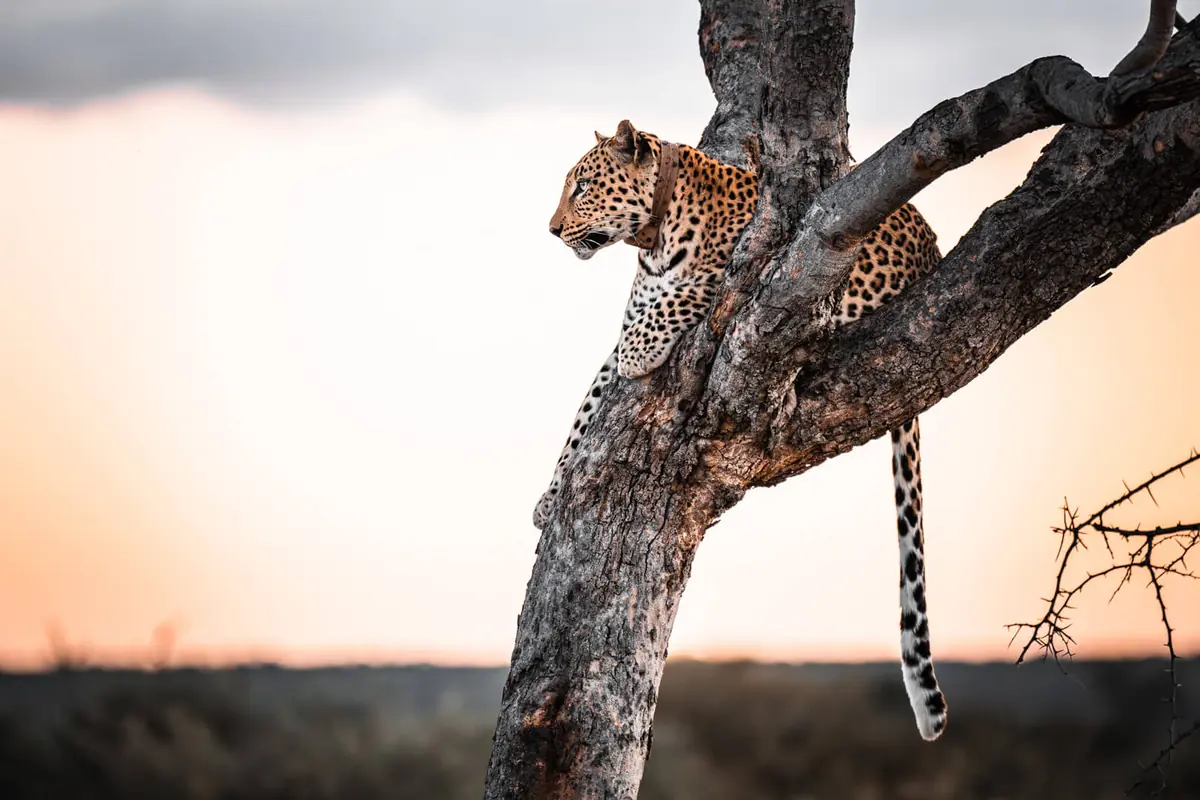
Okonjima is a fenced private reserve of about 22,000 ha in the Omboroko Mountains of Otjozondjupa, roughly halfway between Windhoek and Etosha. The Hanssen family built it from four old cattle farms, and it is home to the AfriCat Foundation, which has studied leopard here since 1997. That research is the reason to come. Some leopards wear radio collars, so guides find them far more often than you could alone. The name means place of the baboon in Otjiherero.
Getting there
Drive the B1, tarred from Windhoek. The turn-off is about 48 km south of Otjiwarongo, just after the Otjiwarongo 50 km sign if you come from the south. Then it is 10 km of gravel to the gate and another 14 to 16 km to the camps. Okonjima puts it at two and a half hours from Windhoek and three to four from Etosha. One traveller who drove it found the gravel easy in a two-wheel-drive car. Fill up in Okahandja or Otjiwarongo, because service stations are far apart outside the towns.
When to go
It is open all year. Travellers prefer the dry months, roughly May to October, when the grass is short and tracking is easier. The plateau sits at about 1,700 m, so early drives in the cooler months are properly cold. Bring gloves. In the summer rains the bush thickens, and Okonjima asks drivers to phone ahead about the road, since the reserve is bordered by rivers that are dry most of the year but not always. July to December is high season, so book early.
What to do
Leopard tracking is the main event. About 40% of the 35 or more leopards identified here carry collars, but nothing is promised and Okonjima suggests staying at least two days. Brown hyena tracking works the same way, and the game drive uses no telemetry at all. Night drives look for aardwolf, bat-eared fox and porcupine. Rhino tracking on foot goes out with the anti-poaching team, and pangolin tracking is for guests staying two nights or more. Several activities are booked only at the lodge. Free self-guided trails of 2 to 5 km run through the fenced lodge area, and guided hikes climb towards Hidden Valley, the reserve’s highest ground.
Good to know
There are no day visitors. Only guests at the four lodges or the five self-catering campsites get in, and campers in high season must bring all their own food.
The AfriCat Carnivore Care Centre, where guests saw rescued cheetah and lions in enclosures, closed at the end of June 2026. A new tour, Into AfriCat, Behind the Science, replaces it, so ignore older blogs that promise the cheetah visit. There are no wild lion or elephant here.
Malaria is where sources disagree. Okonjima calls itself malaria free, but the US CDC lists all of Otjozondjupa as a malaria area and advises tablets, and the UK’s NaTHNaC rates the risk high from December to April. Ask a travel clinic, and use repellent in the evenings anyway.
Arrive before dark. Okonjima advises finishing each day’s driving before sunset, and Namibian law requires headlights on at all times.
Wildlife you might see
12- likelyLeopardAcross the reserve, found by guides on leopard tracking using the radio collars that about 40% of the 35 or more known leopards wear. All year; Okonjima recommends staying at least two dayssource
- likelyGiraffeAcross the reserve; one of the species brought back when the reserve was created. All yearsource
- likelyPlains and mountain zebraAcross the reserve. All yearsource
- likelyOryx (gemsbok), kudu and warthogAcross the reserve; these never had to be restocked when the farms became a reserve. All yearsource
- possibleBrown hyenaTracked with collars on the afternoon brown hyena activity; a shy animal that mostly moves at night. All year, sightings never guaranteedsource
- possibleWhite rhinoTracked on foot with the anti-poaching team; the reserve keeps only a few rhino. All year, weather permittingsource
- possibleDamara dik-dikThe self-guided walking trails, where Okonjima says walkers can meet anything from dik-dik to giraffe. All yearsource
- possibleChacma baboonAcross the reserve, which takes its name from them. All yearsource
- possibleSable, waterbuck and blue wildebeestIntroduced on trial and now doing well on the reserve. All yearsource
- possibleAardwolf, bat-eared fox and porcupineOn the night drive, which leaves after dinner. After dark, weather permittingsource
- possibleRüppell's parrot, Monteiro's hornbill and Hartlaub's spurfowlAll three are on the reserve's checklist of 171 bird species. All yearsource
- rareGround pangolin (Temminck's)Tracked on foot with a guide or AfriCat researcher, groups of six at most. At night in summer (September to May) and late afternoon to late evening in winter (June to August)source
Likelihood is for a normal visit of two or three days, from the sources linked. Nothing is guaranteed in the wild.
Hikes and walks
7- Giraffe Trail
An easy walk through Terminalia woodland to a lookout over the reserve. It is 4.7 km from the Plains Camp parking, about 4 km from Bush Suite and about 5 km from Bush Camp. Tell reception which trail you are walking and carry water.
Permit: Free for staying guests; maps at reception
Okonjima, Giraffe Trail map - Dik-Dik Trail
Three loops of about 4.4 km each along a dry river bed and a flat bush road. Campers can link it with Lundu's Lane for a 7.7 km walk.
Permit: Free for staying guests; maps at reception
Okonjima, Dik-Dik Trail map - Lundu's Lane
Follows a small rocky stream down to the larger sandy river until it meets the Dik-Dik Trail.
Permit: Free for staying guests; maps at reception
Okonjima, Lundu's Lane map - Chacma Trail
A rocky trail along the edge of the Omboroko range. Lodge guests can add Leopard's Loop for 5.1 km in all.
Permit: Free for staying guests; maps at reception
Okonjima, Chacma Trail map - Leopard's Loop
A rocky climb of about 60 m up Okonjima North Hill, a good walk for sunrise or sunset. Lodge guests finish on a flat road back to the vehicle; campers start at the campsite swimming pool.
Permit: Free for staying guests; maps at reception
Okonjima, Leopard's Loop map - Hidden Valley Trail
A mountain hike with about 300 m of climbing, up to around 1,870 m near the reserve's highest point.
Permit: Guided hike, booked at the lodge (see tips)
Okonjima, Hidden Valley Trail map - Mavu's Track
A rocky climb of about 110 m with a view south to the Omatako peaks, finishing on a flat road back to the vehicle.
Permit: Guided hike, booked at the lodge (see tips)
Okonjima, Mavu's Track map
Staying safe in Okonjima Nature Reserve
- Malaria
- Okonjima calls itself malaria free, but the US CDC lists the whole Otjozondjupa region as a malaria transmission area and recommends preventive tablets there. Ask a travel clinic before you go, and use repellent at dusk whatever you decide. source
- Leopards and vehicles
- Leopards here are used to vehicles, so the rules are about not unsettling them. Stay seated, keep arms and clothing inside, do not call out or throw anything, and keep your voice down. Guides move away if a cat looks bothered. source
- Walking trails
- Self-guided trails are walked at your own risk. Tell reception which trail you are taking, carry water and a phone, watch for snakes, skip the earphones and do not let children run. source
- Driving
- Okonjima advises finishing every day's driving before sunset and checking tyre pressure before you leave through the security gate on the B1. Keep headlights on at all times, which Namibian law requires. source
- Summer rains
- The reserve is bordered by rivers that are dry most of the year. In the rainy summer months Okonjima asks drivers to phone ahead to check the road. source
Tips from travellers
- Book a stay, not a visit. Okonjima takes no day visitors and its activities are only for guests sleeping on the reserve. official
- Give it at least two days. Okonjima itself recommends a minimum two-day stay for a fair chance of watching leopard, since even collared cats are never guaranteed. official
- The AfriCat Carnivore Care Centre visit to see rescued cheetah and lions closed at the end of June 2026. Into AfriCat, Behind the Science, a tour of the research and the redeveloped information centre, has replaced it. official
- Pack warm layers and gloves for early drives in the dry season. One traveller who went in September wished she had brought gloves for the morning drive. one source
- Campers in high season (July to December) must be fully self-sufficient for food and drink, because the lodge is full and cannot serve campers meals. official
- Fill up with fuel in Okahandja or Otjiwarongo and check your spare before the gravel, as services are thin outside the towns. one source
- Hidden Valley Trail and Mavu's Track are guided mountain hikes. They cannot be booked ahead, only at the lodge and at management's discretion, and children under 8 cannot go. official
Checked 7 October 2026. Conditions change, so confirm with the park or venue before you go.
The alarm clock that timed Okonjima's leopards
Long before camera traps, Wayne Hanssen wanted to know what time of night the leopards on his father’s cattle farm came to feed, and he could not sit up every night to find out. So he tied a bait to the battery of an alarm clock. When a leopard pulled the meat, the battery came out and the clock stopped. Later he rigged a mousetrap to an infra-red beam so that it fired the shutter of an old camera, and the leopards took their own portraits.
That is roughly how leopard research began at Okonjima, with a farmer’s son who had shot his first leopard at 15.
Three leopards a year, and the calves kept dying
The high ground here was used in the 1890s to rest German military horses, because at 1,700 m and more it seemed to be above the reach of African horse sickness. It was a cattle farm by the 1920s. Val and Rose Hanssen arrived in 1970 after drought pushed them off two farms in the Khomas Hochland, and their Brahman herd came up from Windhoek by train to Otjiwarongo.
Then calves started to vanish, and leopard tracks and drag marks led to what was left of them. The family lost 20 to 30 a year and did what every farmer did: gin traps, box traps, a rifle, and trophy hunters who paid for the big males. By their own count they killed about three leopards a year for twenty years, and the losses never moved. What worked was duller. Cows calved inside predator-proof pens at the water points and the calves stayed there until about four months old. Losses fell to three or fewer a year.
The family came to believe that shooting only emptied a territory for the next leopard, and their first proper study bore it out. In June 1998, working with the government carnivore researcher Dr Flip Stander, they caught and collared four leopards within a month. Lise Hanssen followed them daily on foot while Stander flew over twice a month. Four months in, one of the males was killed on a farm 11 km away. A younger leopard had his range inside a week.
A cheetah cub among the pots and biltong
Guests came before conservation did. In 1986 a safari operator wanted an overnight stop near Otjiwarongo, on the way to Etosha, for clients who were keen birders. Rose Hanssen knew her birds.
What the visitors found was a farmhouse shared with a baboon called Elvis (he stayed 11 years), two warthogs named Nympho and Schizo, a honey badger called Benny and a monitor lizard known as T4. In 1989 Val went to a political party’s fundraising auction of chairs, pots and biltong and came home with a caged cheetah cub nobody else had bid on. She was named Chinga. In those years Wayne also began sitting guests on rock ledges after dark to wait for leopards at his bait sites, with little regard for safety, the family now admits. Trapped and orphaned cheetahs and leopards from other farms began to arrive. Rose died in 1992, the cattle were sold, and the rescue work became the AfriCat Foundation the next year.
Why there are no cheetahs any more
Older blogs and guidebooks sell Okonjima as a place to track cheetah on foot. That is over, and the leopards are the reason.
When the 1998 study measured the farm it found about 5.6 leopards per 100 square kilometres. In 2015 and 2016, after the electric fence went up and the hunting stopped, researcher Jenny Noack and colleagues ran 95 camera stations for nearly ten months and identified 36 leopards. That works out at 14.5 per 100 square kilometres, the highest density then recorded in Namibia. Nearly half the kills they logged were warthog.
Into this AfriCat released 50 captive-raised cheetahs between 2000 and 2018. Almost all learned to hunt. Almost half were dead within a year, mostly killed by leopards and spotted hyenas, and the project was stopped. There are no cheetahs in the reserve now.
Brown hyenas did better. They were hardly ever recorded in the cattle days. A camera survey has put them at 24 per 100 square kilometres, among the highest figures for the species anywhere, and AfriCat now counts six clans whose ranges cover more than nine-tenths of the reserve. The fence had to be altered for pangolins. They walk low along fence lines and curl up when threatened, and a pangolin that curls around a live wire goes on being shocked until it dies. A pilot study in 2017 flagged the danger and the bottom wire was raised. Kelsey Prediger then led the pangolin project from 2018 to 2021.
What a tracking drive is really like
The guide stops, holds up an aerial and listens. Often there is nothing and the vehicle moves on. Roxanne Reid, a South African travel writer, went out at seven one morning in 2015 with guide Martin Njekwa, who told her the odds were about even. The first tries picked up no signal. Then, from a slight rise, he got two at once. About 45 minutes after leaving camp they were looking at Shanti, two years old and newly pushed out by her mother, and they stayed with her for roughly an hour. Jojo turned up within 15 minutes of that and spent half an hour eyeing a family of warthogs. A magazine writer on an afternoon drive the following year found the big male Mafana sulking in a gully, then watched a female called Lila come down from a shepherd’s tree after eating an impala.
Njekwa, now head guide, puts the success rate of a drive at around 80%. Among travellers who log their sightings with the operator Expert Africa, 94% report leopard here, about two-thirds brown hyena, under half white rhino, roughly a fifth pangolin, and 7% aardvark.
One blogger warns that the fences and the collars can feel less wild than an open park, and that a drive may be spent following one collared cat. Fair enough, but this is a research site first. Even the 20 square kilometres around the camps, where the unguided walking trails are, sits behind a second fence meant to keep leopards out.
In and around Okonjima Nature Reserve
12 places listedWhere to stay in Okonjima Nature Reserve 9
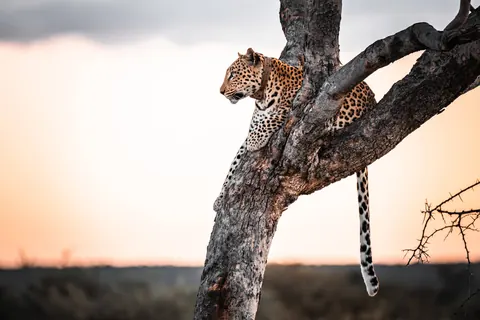 HotelOkonjima Luxury Bush CampPO Box 793, Otjiwarongo+264 83 373 1400okonjima.com
- HotelOkonjima Lodgeokonjima.com
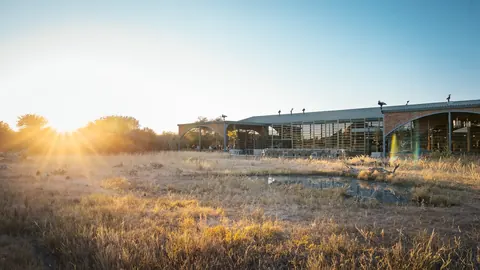 HotelPlains Campokonjima.com
- 20.85°S 16.67°EHotelBush Suite
- 20.84°S 16.65°ECampsiteCampsite Chilala
- 20.84°S 16.65°ECampsiteCampsite Chimelo
- 20.84°S 16.65°ECampsiteCampsite Kendi
- 20.84°S 16.65°ECampsiteCampsite Koshi
- 20.80°S 16.68°EHotelOkonjima African Villa
Sights 3
- Giraffe TrailAttraction
- Plains Camp terraceViewpoint
- Reserve OverviewViewpoint
Quick answers
How much is the entry fee for Okonjima Nature Reserve?
Everyone pays N$350 per adult per night, from 1 January 2026 to 31 December 2026. From 1 January 2027 to 31 December 2027 everyone pays N$385 (about US$23, €21 or £17.50) per adult per night.
When were these Okonjima Nature Reserve fees last checked?
We last checked them on 12 October 2026 against 3 published sources. We re-check every two weeks, but always confirm with Okonjima Nature Reserve before you travel.
What animals can you see in Okonjima Nature Reserve?
You have a good chance of seeing leopard, giraffe, plains, mountain zebra and oryx (gemsbok), kudu and warthog. Ground pangolin (temminck's) is there but rarely seen.
What are the best hikes in Okonjima Nature Reserve?
Giraffe Trail (4.7 km), Dik-Dik Trail (4.4 km), Lundu's Lane (3.3 km) and Chacma Trail (3 km). See the hikes section for times, difficulty and permits.
Okonjima and the parks nearest it
| Park | International adult | Distance | Where |
|---|---|---|---|
| Okonjima Nature Reserve | US$15 €13 · N$250 | · | Otjozondjupa |
| Waterberg Plateau Park | US$17 €15 · N$280 | 84 km | Otjozondjupa |
| Von Bach Game Park | US$12 €11 · N$200 | 131 km | Otjozondjupa |
| Daan Viljoen Game Park | US$12 €11 · N$200 | 188 km | Khomas |
Where the Okonjima fees come from
Open data: all park fees (CSV) · JSON (CC BY 4.0)
Cite as: Travel Africa Guide, "Okonjima Nature Reserve fees 2026", checked 12 October 2026, https://travelafrica.guide/namibia/okonjima-nature-reserve/
Map of Okonjima Nature Reserve
See every place on this map as a list