Town · Erongo, Namibia
Omaruru
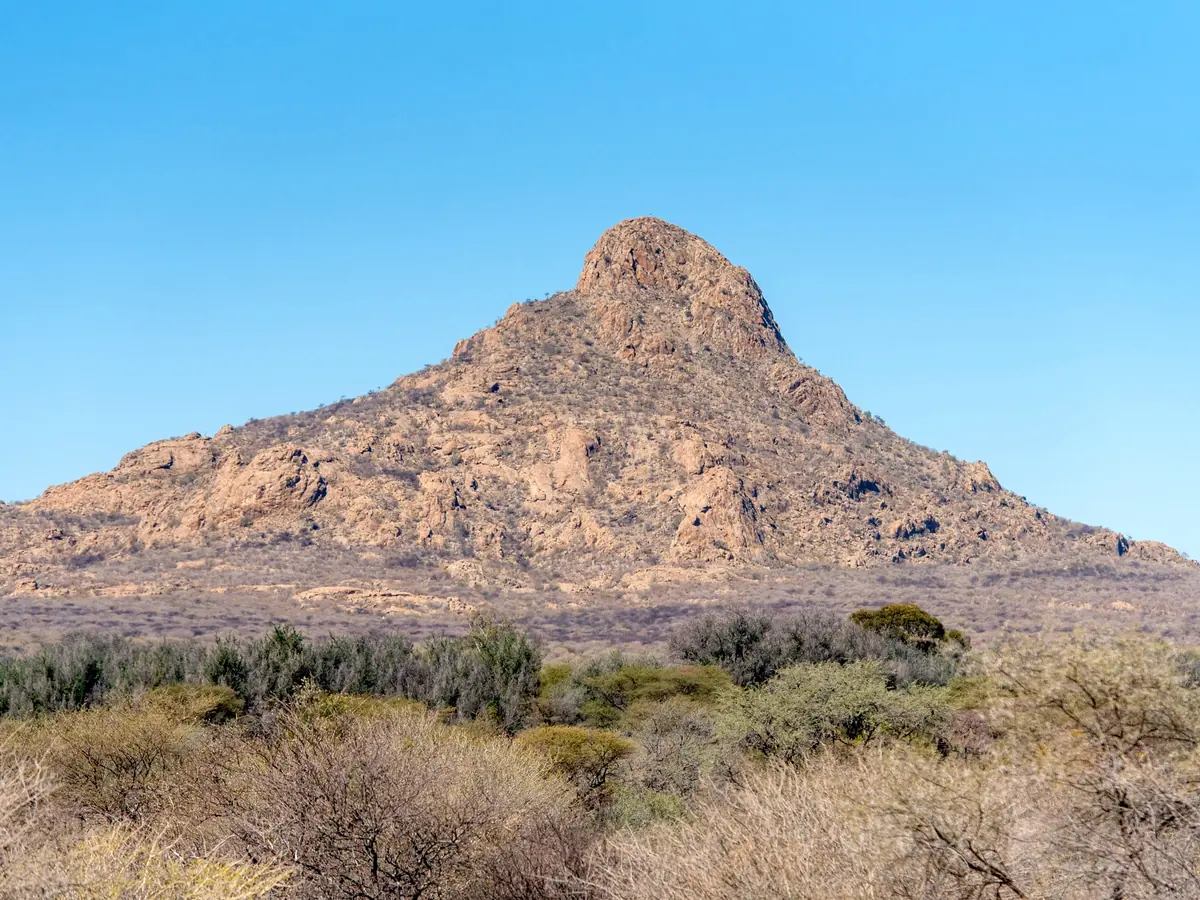
Small Herero and mission town on the usually dry Omaruru River and the tarred C33, with the Franke Tower, an old mission house museum, root carvers and Namibia's first winery.
Short answer
Omaruru is in Erongo, Namibia. This page lists 15 places to stay, 6 places to eat and drink and 2 sights. The nearest park with an entry fee on this site is Okonjima Nature Reserve, about 94 km away, where international adults pay from N$250.
- Places to stay
- 15
- Eat and drink
- 6
- Sights
- 2
- Park fee nearby: Okonjima Nature Reserve
- US$15 €13 · N$250about 94 km away
In and around Omaruru
24 places listedWhere to stay in Omaruru 15
- 21.42°S 15.96°EHotelCentral HotelWilhelm Zeraua Road, Omaruru+264 64 570 030centralhotelomaruru.wordpress.com
 HotelNamib Guestfarm Onduruquea+264 64 570 832
- 21.23°S 16.00°EHotelEpako Safari Lodge+264 64 570 551epako.com.na
- 21.53°S 15.76°ECampsiteErongo Plateau Camp+264 81 277 1668
- 21.46°S 15.88°EHotelErongo Wild Lodgeerongowild.com
- 21.24°S 16.05°EHotelKassandara Hunting & Safari Ranchkassandara.com
- 21.33°S 16.08°EHotelOmaruru Game Lodgeomaruru-game-lodge.com
- 21.42°S 15.96°EGuest houseEva‘s Guesthouse+264 81 356 1103
- 21.42°S 15.96°EGuest houseEvenig Shade+264 81 124 6184
Show all 15 places to stay
- Camp Mara · Campsite
- Evergreen Camping · Campsite
- Naomi's Palm Garden Guesthouse · Guest house
- Omaruru guesthouse · Guest house
- Omaruru Rest Camp · Campsite
- River-Guesthouse · Guest house
Sights 2
- Omaruru MuseumMuseum
- Paula's CaveCave
Restaurants and cafes 5
- Central Hotel RestaurantRestaurant · Wilhelm Zeraua Road, Omaruru+264 64 570 030centralhotelomaruru.wordpress.com
- Ongwari CaféCafe · Wilhelm Zeraua Road, Omaruru
- KashanaRestaurant
- Sand DragonCafe
- The JewelRestaurant
Bars and pubs 1
- AP LoungeBar
Wineries, breweries and distilleries 1
- Kristall KellereiWinery+264 64 570 083kristallkellerei.com
Omaruru is a small town on the usually dry Omaruru River in the Erongo Region, on the tarred C33 between Karibib and Otjiwarongo. It began in the 1860s as the home of a Herero chief, grew up around a Rhenish mission and Swedish traders, and was besieged in the 1904 war. Today it is a quiet farming town known for art, wine and spirits, and to my mind a better overnight stop than most on the road north. The 2023 census counted 10,767 people.
Getting there
The C33 turns north off the B2 just east of Karibib, and Omaruru is a little over 60 km up it. The road carries on via Kalkfeld to Otjiwarongo, 196 km in all and tarred throughout, which makes it the usual short cut from Swakopmund to the north.
The gravel C36 meets the C33 just south of town. Eastwards it runs 67 km to the B2 near Wilhelmstal, a shorter way from Windhoek that can take longer, and westwards it heads for the Brandberg. Gravel C roads in Erongo are usually fine in a normal saloon car. The D roads are another matter, with corrugations and soft sand that get worse after rain.
When to go
Most rain falls from January to March, February is the wettest month and July is close to dry. In June and July nights drop to around 8°C, so campers need a warm sleeping bag.
The Omaruru Artist Trail, with open studios and workshops around town, runs in late September. On the weekend closest to 10 October the Zeraua Herero hold White Flag Day for their chiefs and for those who died fighting colonial rule. It is a commemoration first, so watch quietly and ask before taking photographs.
What to do
The Franke Tower, 20 m high and finished in 1908, stands on the battlefield where Captain Victor Franke’s men broke the Herero siege of the German garrison on 4 February 1904. About 100 Herero and 7 Germans died. The old Rhenish mission house, the oldest building in town, is now the museum; Gottlieb Viehe translated the New Testament into Otjiherero there in 1874. I could not find published opening hours, so ask in town.
At Tikoloshe Afrika, just across the river as you come in from the south, Kavango carvers turn old mopane roots into animals. Kristall Kellerei on the edge of town has grown Colombard since 1989 and also makes brandy and fruit spirits, with tastings and lunch.
The Erongo Mountains rise to the south west. From Erongo Wild, a lodge about 10 km west, excursions go to Paula Cave, a national monument since 1951 for its San paintings. The dinosaur tracks at Otjihaenamparero lie further off, 23 km east of Kalkfeld.
Good to know
There are two fuel stations, Standard Bank, Bank Windhoek, an FNB cash machine, a SuperSpar and a district hospital. Malaria risk in Omaruru is very low, so bite avoidance is enough, but the dinosaur tracks are over the line in the Otjozondjupa Region, where the risk is high from December to April. Omaruru is not on the national NamWater pipeline and gets its water from municipal boreholes along the river, so go easy on it.
History and culture
Omaruru grew up in the 1860s around a Herero chief's homestead, a Rhenish mission and Swedish traders, and it was in the mission house here that the New Testament was translated into Otjiherero. In January 1904 the Omaruru Herero rose against German rule and besieged the garrison, part of the war that turned into genocide. The Franke Tower, the old mission house and the Herero White Flag Day each October all come out of that history.
- 1868
Herero from Otjimbingwe and Otjikango (Gross Barmen) settled at the place they called Okozondje, and the Damara who had been living there left for Okombahe. This source gives 1868; others give 1863. source
- 1870s
The Swedes Axel Eriksson and Anders Ohlsson set up a brewery here in 1871. Eriksson's trading business did well, and by 1878 some forty white staff worked for him, running goods over long distances between southern Angola and the Cape Colony. source
- 1894
In November 1894 Theodor Leutwein, head of the German colonial administration, brought Samuel Maharero and Zacharias Zeraua to Omaruru to meet its chief, Manasse Tyiseseta. The show of German power ended Manasse's independence, and a German garrison was placed in the town. Four days later Leutwein made Cornelius Goreseb paramount chief of the Damara at Okombahe, partly to weaken Manasse. source
- 1904
The Omaruru Herero under Chief Michael Tyiseseta rose on 17 January 1904 and besieged the German post. Captain Victor Franke relieved it after a hard fight on 4 February, and on 25 February he defeated the Omaruru Herero again at Otjihinamaparero. source
- 1904 to 1908
After their defeat at the Waterberg in August 1904 the Herero fled into the Omaheke desert, where most died, and General Lothar von Trotha's order of 2 October declared that every Herero within the colony would be shot. Survivors were held in concentration camps where about half died, all Herero land was confiscated, and laws of 1907 banned Herero from owning land or cattle. Germany acknowledged in 2015 that this was genocide. source
- 1915
In the First World War, armistice talks between General Louis Botha and Governor Seitz at the farm Giftkuppe near Omaruru failed on 20 to 22 May 1915. On 19 June about 35,000 South African troops advancing north reached Omaruru, and on 9 July the Schutztruppe, by then commanded by the same Victor Franke, surrendered near Khorab. source
- 1943
In 1943 Eliaser Tuhadeleni, born in the north of Namibia, took part in a workers' strike at the Kranzberg mine near Omaruru, and he went on to write petitions against the ill treatment of migrant workers. He later became a SWAPO leader, fought at Omugulugwombashe, the first battle of the liberation war, and spent 18 years in prison, sentenced to Robben Island, before his release in 1985. source
- 1966 to 1990
SWAPO's armed wing began its guerrilla war against South African rule in 1966, with its first battle at Omugulugwombashe on 26 August, and in October that year the United Nations General Assembly ended South Africa's mandate over the territory. South African rule went on until Namibia became independent on 21 March 1990. source
- Language
- The 2023 census gives home languages for the Omaruru constituency, which includes the town and the farms and villages around it. Of 3,768 households, 865 speak Otjiherero, 780 Khoekhoegowab (the Damara and Nama language), 545 Oshikwanyama, 425 Afrikaans, 202 English and 83 German. Counted by people rather than households, Khoekhoegowab (2,908) is just ahead of Otjiherero (2,861). source
- White Flag Day
- Over the weekend closest to 10 October, Herero gather in Ozondje, Omaruru's former township, for White Flag Day, to remember those who died fighting colonial rule. source
- Art
- The first Omaruru Artist Trail was held in May 2007 as part of the centenary of Wronsky Haus. It became a yearly event, organised from 2008 by the Omaruru Cultural Association, with studios open to visitors, demonstrations and exhibitions across town. source
- Root carving
- At Tikoloshe Afrika, opened in 1995, carvers from the Kavango work weathered mopane roots into animals, letting the shape of the root decide what it becomes. source
For German visitors: Gottlieb Viehe, the missionary who translated the New Testament into Otjiherero in Omaruru, was born in Mennighüffen, now part of Löhne in Westphalia, and trained at the Rhenish Mission's seminary in Barmen. source
For American visitors: Viehe's family emigrated to Indiana in 1844 and he spent about fifteen years there before going back to Germany to train as a missionary. source
For German visitors: In October 2007 descendants of General Lothar von Trotha came to Omaruru at the invitation of Herero royal chiefs and publicly apologised for his part in the genocide. source
For German visitors: Omaruru gave its name to a German television series of 1976, starring Walter Giller, about the lives of German farmers there and the Herero uprising. source
For German visitors: The Erongo Mountain Rhino Sanctuary Trust, set up by farmers in the mountains near Omaruru in 2009 to bring black rhino back, has a supporters' association founded in 2013 with its seat in Bielefeld. source
Main sights in Omaruru
6- Franke Tower and battlefield
A 20 m tower with an inner wooden stair, unveiled on 4 February 1908 to mark the relief of the German garrison exactly four years earlier. The plaques name only the German dead; more than 100 Herero died in the same fight. The tower has been a national monument since 1964 and the battlefield around it since 1972.
Wikipedia (German): Franketurm - Old Rhenish Mission House (Omaruru Museum)
The first part, built by Daniël Cloete in 1868, collapsed in heavy rain in 1934, but Gottlieb Viehe's house of unbaked clay bricks, finished in 1872, still stands. It served as a school, as a hospital for those wounded in the 1881 Nama and Herero war, and in the First World War it was used by South African troops and war refugees. The town bought it in 1984, it was declared a national monument in 1985 and it now holds the town museum.
National Heritage Council of Namibia: heritage places register - Tikoloshe Afrika
The root carvers' workshop and shop at the western end of the main street, where you can watch carvers at work.
Rough Guides: central northern Namibia (Omaruru) - Kristall Kellerei
The founders planted Colombard here in 1989, and the Weder family, owners since 2007, also distil brandy and spirits from Namibian fruit such as prickly pear and the Kavango orange.
Kristall Kellerei (the winery's own site) - Paula Cave
A San rock painting site in the Klippdachs hills, the north eastern foothills of the Erongo Mountains, visited on excursions from Erongo Wild, a lodge about 10 km west of town. Henri Breuil described its long bodied red haired figures, elephant and rhino, and it was proclaimed a national monument in 1951.
Travel News Namibia: Embracing the wild side of the Erongo - Otjihaenamparero dinosaur tracks
Three toed tracks of two legged dinosaurs in Etjo sandstone on a farm 23 km east of Kalkfeld, north east of Omaruru, first described in 1925 and a national monument since 1951.
Wikipedia: Otjihaenamparero dinosaur tracks
Did you know?
- The name comes from Otjiherero and means bitter milk: cattle grazing a bush in the riverbed gave milk with a bitter taste. source
- When Christian Wilhelm Zeraua died in Omaruru on 29 November 1876 he was the first of his people to be buried in a coffin, and Herero still call 1876 the year of the coffin. source
- In 1874, in the mission house, Gottlieb Viehe translated the New Testament, the liturgical prayers and the catechism into Herero. He also set up a weather station beside the house. source
- The Omaruru River comes down in flood more often than any other of Namibia's dry western rivers, thanks to the higher rainfall around Mount Etjo where it rises. source
- Richard Kaupuka, a postal runner in the late 1800s whose story the town museum tells, once ran from Omaruru to Walvis Bay and back in eight days. source
- Axel Eriksson, the Swedish trader and bird collector known to the Herero as Karuwapa Katiti (the small white person), came from Vänersborg in Sweden, and most of his collection of southern African birds went to the town museum there. source
Checked 7 October 2026.
The Omaruru trader whose birds fill a Swedish museum
In the museum at Vänersborg, a small town on Lake Vänern in Sweden, there is a room that has hardly changed since it opened in November 1888. It holds close to a thousand mounted birds from south-west Africa, the collection of one man who traded out of Omaruru. Axel Eriksson, a butcher’s son from Vänersborg, gave the town his birds in 1883, and the gift did much to get the museum built.
Forty hunters on the north bank
Eriksson came out in 1866, aged 19, to work for the explorer Charles John Andersson, who died the following year. Around 1870 he set up at Omaruru, and from 1871 his partner was another Swede, Anders Ohlsson, a brewer by trade. A third, the seaman Thure Een, had landed at Walvis Bay in the same month as Eriksson. The Herero chief Christian Wilhelm Zeraua is said to have put the traders and the missionaries on the north bank of the river and kept the south bank for himself.
The firm kept a depot at Walvis Bay and dealt in ivory, ostrich feathers, guns and cattle. By 1878 it had about forty white hunters in the field. Klaus Dierks, in his biographies of Namibian personalities, was blunt about the result: this one Omaruru business did a great deal to wipe out the big game of central Namibia. The elephant and rhino painted in the Erongo caves were real animals here until hunters like Eriksson’s shot them out.
Ohlsson did not stay for the end. The partnership ran until 1886, but around 1881 he had already started a brewery at Newlands in Cape Town. Ohlsson’s Cape Breweries was one of the two rivals bought out in 1956 when South African Breweries took its present name, so one root of SAB runs back to a trading firm on a dry Namibian river. Eriksson went the other way, across the Kunene into Angola in 1882. He died in 1901 on a farm called Urupupa in the north, and his grave is at Rietfontein, about 30 km from Grootfontein.
Rhino that belong to the state, on farms without fences
The last black rhino in the Erongo Mountains was caught in 1972 and moved to a national park, for fear of poachers. Around the turn of the century farmers in the mountains between Omaruru, Karibib and Usakos began taking down the fences between their properties. By 2018 the Erongo Mountain Rhino Sanctuary covered about 180,000 hectares, with 24 member farmers and a dozen supporting neighbours. Its chairman that year, Kai-Uwe Denker, put the game at around 10,000 head, some of it built up from nothing. Black rhino came back under the government’s custodian scheme (the animals stay state property), and the black-faced impala released here are said to be the biggest free herd outside Etosha.
Do not come to Omaruru expecting to see a rhino. The sanctuary will not say how many it has or where, there are gyrocopter patrols and cameras on the gates, and the reason is plain. In 2013 a cow called Solo died in a wire snare set on a rhino path, and her horns were hacked off. In October 2025 a black cow and a white cow were found killed on a farm in the Omaruru district, and a decomposed black bull turned up on another, shot in the head some time in the months before.
What lives on the farms and lodges towards the mountains, and what visitors have a fair chance of seeing, is smaller: Damara dik-dik, kudu, gemsbok, mountain zebra and klipspringer. Birders come for the rock country. About 10 km west of Omaruru nearly 200 species have been recorded, with Hartlaub’s spurfowl, rockrunner, white-tailed shrike, Monteiro’s hornbill and Rüppell’s parrot the ones they travel for. Verreaux’s eagles nest in the mountains and are seen often.
Eight years of sand
The Omaruru runs about 330 km from the Etjo hills to the sea just north of Henties Bay, and for most of most years none of that is water. When it does come it is quick. On a Friday evening in February 2008 people at Etemba, downstream of town, saw the flood peak at 2.2 m. By the Sunday it was under a metre. In March 2017 a 19-year-old pupil, Ronald Tjipundi, was swept off a flooded bridge over a side stream between Ozondje and town, and divers were brought up from Walvis Bay to search for him. Then the sand took over. A reporter in 2025 was told the river had been dry for eight years before it came down properly at the start of that year and held water for a few months.
Dung smoke, frost fires and a series shot somewhere else
Smoky whisky usually gets its smoke from peat, and Namibia has none. Erongo Mountain Winery’s answer, for the whisky it sells as Ondjaba, is to smoke its grain, mahangu among it, over elephant dung from the nearby Omaruru Game Lodge. One of the staff calls it “the story of the poo”. At Kristall Kellerei, which Helmut Kluge started, the vines needed shade net against the heat and also, less obviously, fires lit in drums under them against frost. These days the gin is flavoured with devil’s claw.
The old mission house, now the museum, has doors about 1.75 m high and a cow-dung roof held together with reeds. Dierks credits Viehe’s weather station there, which he dates to 1885, as the first in the country.
Two things about Omaruru are not quite what they seem. The 26-part television series that carried the town’s name into West German living rooms in 1976 was made in South Africa by a Johannesburg film company. And the eleven von Trothas who came to White Flag Day in 2007 were relatives of the general, not his direct descendants. The six Herero royal houses invited them, and the paramount chief, Kuaima Riruako, told them to bring their own security.
Map of Omaruru
See every place on this map as a list