Town · Erongo, Namibia
Usakos
Old railway town on the Khan River and the tarred B2, and the place to fuel up before Spitzkoppe or the rock paintings of Ameib in the Erongo Mountains.
Short answer
Usakos is in Erongo, Namibia. This page lists 12 places to stay, 6 places to eat and drink and 3 sights. The nearest park with an entry fee on this site is Dorob National Park, about 137 km away, where international adults pay from N$280.
- Places to stay
- 12
- Eat and drink
- 6
- Sights
- 3
- Park fee nearby: Dorob National Park
- US$17 €15 · N$280about 137 km away
In and around Usakos
21 places listedWhere to stay in Usakos 12
- 21.79°S 15.51°EHotelHohenstein Lodgeondili.com
- 21.99°S 15.60°EGuest houseISSA GuesthouseUsakosissa-guest-house.business.site
- 22.08°S 15.55°EGuest houseAchab Camp+264 81 243 3412achabcamp.com
- 21.78°S 15.61°ECampsiteLeadwood Explorer Camp
- 21.78°S 15.62°ECampsiteLeadwood Umbretta Campsite
- 22.00°S 15.59°EGuest houseNubeb Self-Catering Accommodation+264 81 128 6422nubeb.biz
- 21.99°S 15.60°ECampsiteISSA CampingUsakos
- 21.79°S 15.63°EGuest houseAmeib Guesthouse
Show all 12 places to stay
- Hotel Pension Bahnhof · Guest house
- Okambishi‘s Rest · Chalet
- Usakos Camp Site and Accommodation · Campsite
Sights 3
- Bull's PartyAttraction
- Phillips CaveArchaeological site
- Rhino LookoutAttraction
Restaurants and cafes 3
 Usakos BistroRestaurant · Usakos
- Khan Village CaféCafe
- Namib Wüste FarmstallRestaurant
Bars and pubs 3
- Oupatjies BarBar · Bahnhof St, Usakos
- Tree HouseBar · Victoria Street, Usakos
- BeergardenPub
Usakos is a small railway town on the banks of the Khan River in the Erongo Region, on the tarred B2 between Windhoek and the coast. Most people stop for fuel and drive on, which is a pity, because it is the closest town to Spitzkoppe and the way in to the rock paintings of Ameib in the Erongo Mountains. The 2023 census counted 5,094 people.
Getting there
The town sits on the B2 just west of Karibib, roughly 140 to 150 km from Swakopmund and a little over 200 km from Windhoek, tar all the way. The B2, the main road between Walvis Bay and Johannesburg, runs through the middle of town, and runaway trucks with failing brakes crashed through Usakos in 2004 and 2008. Drive the main street slowly.
Leave the B2 and you are on gravel. Ameib is 27 km north, up the D1935 and D1937, about 40 minutes’ drive. For Spitzkoppe, OpenStreetMap shows the D1918 leaving the B2 west of town and heading for Henties Bay. Wikivoyage reckons an ordinary car copes with gravel C roads, while D roads are often sandy and badly corrugated, more so after rain.
When to go
What rain there is comes in summer and is unreliable, and the Khan is a dry riverbed most of the time. Expect summer afternoons above 30°C. Winter days are pleasant, but nights are cold with the odd frost, so campers need a warm layer. For the walks I would pick winter.
What to do
In town, look at the station. Usakos grew up as a workshop and watering stop on the narrow gauge Otavi railway, which ran from Swakopmund to the copper mines at Tsumeb, and when the line was rebuilt to a wider gauge between 1958 and 1961 its station building was one of only two kept. Locomotive No. 40, a German Henschel engine of 1912, stood in front of it until trucks hit it more than once and it was moved further west. The Roman Catholic church dates from 1905.
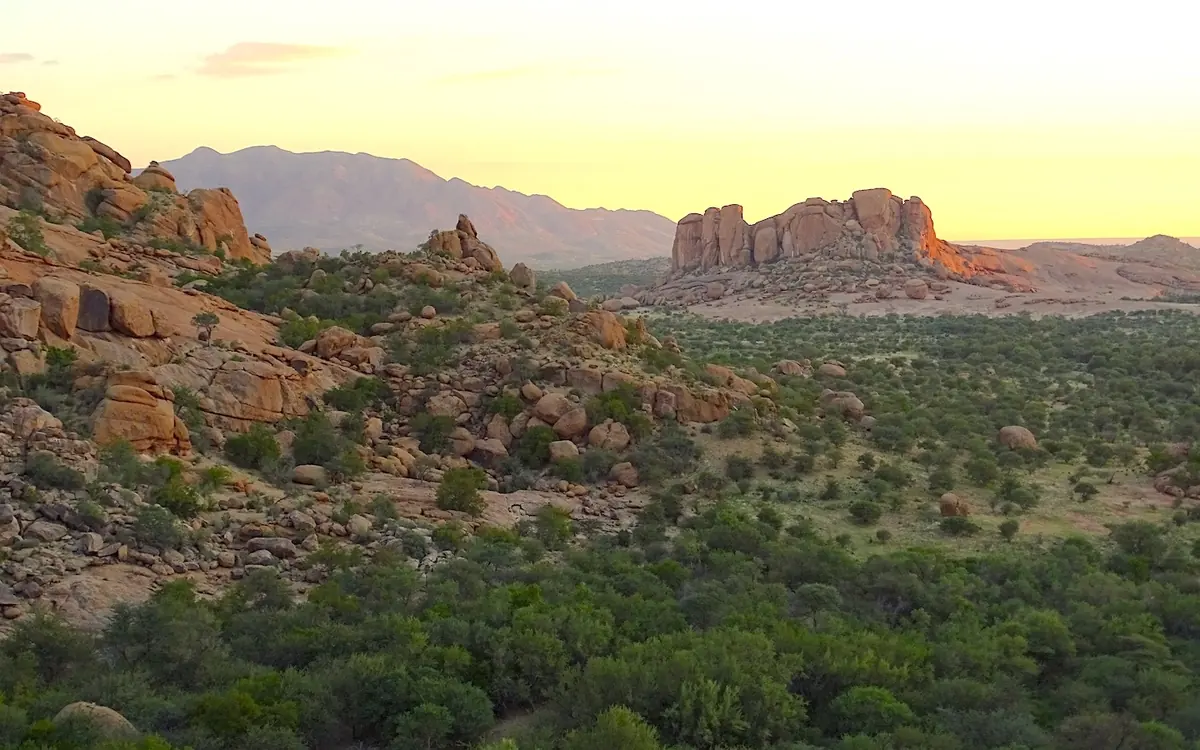
Then go to Ameib. The walk to Phillips Cave takes at least 40 minutes each way from the car park, or at least an hour from the guesthouse, and the last bit needs sure feet. Inside is the painted white elephant that made it famous. Bull’s Party, a field of huge rounded granite boulders, is almost a drive up. The farm says it is open daily from 08:00 to 18:00. Black rhino, returned to the Erongo in 2008, sometimes wander onto the farm.
Hikes to Hohenstein (2,319 m), the highest peak of the Erongo about 50 km north, are offered from Usakos.
Good to know
Malaria risk here is very low according to TravelHealthPro: tablets are not advised, but you should still avoid bites. OpenStreetMap maps three fuel stations, an FNB bank with an ATM and a few supermarkets. Fill up before the gravel. Ameib takes no cards, so carry cash or pay by bank transfer before you arrive.
History and culture
Usakos grew up around a watering stop and workshop for the narrow gauge railway that a German mining company drove from Swakopmund to the copper of Tsumeb, and it faded once the mines wound down and the road to the coast was tarred. Around it are older layers: San rock paintings in the Erongo Mountains thousands of years old, a Rhenish mission at Ameib, Herero land sold away in the colonial years, and a son of the town who helped write Namibia's constitution.
- Thousands of years ago
Ancestors of today's San and Damara used the Erongo Mountains north of town, sleeping in caves and rock clefts such as Phillips Cave on the farm Ameib and relying on granite pans that fill with rain. Rock paintings and stone tools survive from this time. source
- 1864
The Rhenish Mission, a German Protestant mission society, set up a station at Ameib at the foot of the Erongo, on the spot where the Ameib guesthouse now stands. source
- Late 1800s
Early in German colonial rule the Herero (Ovaherero) leader Maharero sold Usakos as a farm to the Jansen brothers. In 1903 they sold it on to the Otavi Minen- und Eisenbahn-Gesellschaft (OMEG), which wanted it for a station and railway buildings. source
- 1903 to 1906
The OMEG built its own line from Swakopmund towards the copper mines at Tsumeb, starting in October 1903. The Herero and Nama war held up the work, but the first 177 km, with a branch to Karibib, opened on 8 May 1905 and the whole line on 12 November 1906. source
- 1904 to 1908
After the Herero rose against German rule in January 1904, the German commander Lothar von Trotha pursued a policy of driving them out and exterminating them, and survivors were held in concentration camps, including one at nearby Karibib. Prisoners were forced to work, mainly building roads, railways and harbours, on so little food that many died of malnutrition and disease. source
- 1915
South African troops occupied the German colony in the First World War. In 1915 units guarding the railway between Swakopmund and Usakos against German sabotage laid out their regimental badges in stone on two farms along the line, and both sets are now national monuments. source
- 1914 to 1960s
Large tourmaline deposits were found north of Usakos in 1914, and tin as well, so under South African rule the town became a busy mining centre. It declined from the 1960s as the mines wound down, and the tarring of the Windhoek to Swakopmund road in 1969 took away most of the railway's importance. source
- 1966 to 1990
South Africa kept ruling the territory, and extending apartheid to it, after the United Nations ended its mandate in October 1966. SWAPO's armed wing began its guerrilla war that year, and Namibia became independent on 21 March 1990. source
- Names
- In Khoekhoegowab, the language of the Damara and Nama, the town is ǃŪsaǃkhōs, and in Otjiherero it is Okanduu. The name is usually translated as grab the heel. source
- Language
- The 2023 census gives home languages for the Erongo Region as a whole, not for Usakos alone: Oshikwanyama in 20.2% of households, Afrikaans 19.9%, Khoekhoegowab 15.6%, Oshindonga 11.1%, Otjiherero 9.4% and English 6.2%. source
- Population
- The town grew from 3,583 people in 2011 to 5,094 in 2023, more slowly than Karibib next door, which went from 5,132 to 8,434. source
- Local politics
- Usakos was downgraded from a municipality to a town in 2010 and is run by a seven seat town council. In the 2020 local election SWAPO still won the most votes but lost its majority of seats. source
For German visitors: The railway that made Usakos was built for a German company, the Otavi Minen- und Eisenbahn-Gesellschaft, which gave the construction to the firm of Arthur Koppel. Its engines included Henschel & Sohn locomotives from Kassel. source
For German visitors: The Rhenish Mission missionary Carl Gotthilf Büttner was the first to find the paintings in Phillips Cave, in the 1880s, and in 1909 the German colonial botanist Kurt Dinter identified a flowering shrub near Ameib as Strophanthus amboensis. source
For German visitors: Hans Karl Diehl, born in Usakos in 1911 to a Rhenish missionary family and schooled in Germany, became head of the Evangelical Lutheran Church in South West Africa. He first accepted apartheid but turned critic in his last years in office, and in 1972 handed over to Johannes Lukas de Vries, the church's first leader who was not white. source
For American visitors: Theo-Ben Gurirab, born in Usakos in 1938, went into exile in 1962 and studied political science at Temple University in Pennsylvania. He represented SWAPO at the United Nations in New York for over 20 years, helped draft Namibia's constitution, and was later foreign minister, prime minister and President of the UN General Assembly. source
Main sights in Usakos
5- Usakos railway station
The station of the old Otavi railway. When the line was rebuilt to a wider gauge between 1958 and 1961, Usakos and Kalkfeld were the only stations whose original buildings were kept.
Wikipedia (German): Otavibahn - Locomotive No. 40
A German built narrow gauge steam engine of 1912 that stood in front of the station for years. After trucks ran into it more than once, it was moved further west in the 2010s.
Wikipedia (German): Bahnhof Usakos - Roman Catholic church
Built in 1905, in the town's first years. With the station building and the old hotel, it is one of the historic buildings Usakos still has.
Wikipedia: Usakos - Phillips Cave
A rock shelter on Ameib about 15 m deep, 35 m wide and 7 m high, named after a former owner of the farm, Emil Phillip, and protected for its paintings. The best known is a white elephant with a red antelope inside it that researchers think was added later.
Wikipedia (German): Phillips-Höhle - Bull's Party and Elephant's Head
Giant rounded granite boulders on Ameib, with the rock called Elephant's Head beside them. You can drive almost up to them, and a climbing route on Elephant's Head starts beside more rock paintings.
Ameib Gästehaus & Camping: sights and walks
Did you know?
- The OMEG line had no water at all between Swakopmund and Usakos, so steam engines hauled their water up from the coast in tank wagons. source
- Locomotive No. 40, one of three built by Henschel in 1912 for the Swakopmund to Karibib run, was fitted with dust covers against Namib sand. It was retired when the line was widened in 1960 and later put on show at Usakos station. source
- In December 2008 a truck coming from Swakopmund, reportedly with failed brakes, knocked No. 40 and its coal tender off their plinth. In 2004 another runaway truck had crashed into the old railway master's building nearby, killing a passenger and badly injuring two children. source
- A radiocarbon date published by the French priest and archaeologist Henri Breuil in 1957 put finds from Phillips Cave at around 3368 BC, give or take 200 years. source
- The last black rhino in the Erongo Mountains was moved to Etosha in 1974. Rhino came back to the conservation area there in 2008, and calves have since been born. source
- Hohenstein, at 2,319 m, is the highest peak of the Erongo Mountains and one of the highest in Namibia. source
Checked 7 October 2026.
The engineer's crates and the albums the women kept
At the end of 1905 a Swiss railway engineer called Victor Solioz and his wife Marie went home from Usakos to the Bernese Jura. The following year eleven packages reached the history museum in Bern. Among the contents were the headdress a Herero woman wears, a tortoise shell used for keeping ointment, finger rings, perfume containers and a knife of the kind carried by a man of rank in the far north: nearly three hundred things that had belonged to the people building his railway.
Solioz was chief engineer of the line to the copper at Tsumeb. It was he who picked this spot, about 150 km in from the coast, as the base for the work, because it had water. The workshops went up here, so did the workers’ quarters and the company offices, and the couple were living in Usakos in 1904, the year the war against the Herero began. Nobody has been able to show how they came by so much in two years. The museum’s own annual report for 1906 remarked that it had been high time to collect, since the war had all but destroyed the culture the objects came from.
What the workers’ descendants made of it
For decades at a stretch the collection sat in store under the engineer’s name. Then, in July 2023, the Bern curators and the Museums Association of Namibia held a three-day meeting in the Town Hall, and about 35 residents turned up. They doubted the museum’s working theory, that these were things abandoned by families fleeing the fighting, because the objects come from all over the country: Herero, Damara, Nama, Ovambo, Himba and San. That mix looked to them like the workforce, and historians who met in Bern that October agreed. As many as 2,000 people at a time built the line. Ovambo men came down from the north as migrant labour, Herero prisoners were sent up from the camps on the coast, and Damara women found work around the yards. One man at the Usakos meeting, Robert Gawanab, said his great-grandmother used to talk about working in the house of “the Swiss”.
At that October meeting the collection was renamed for the railway workers. In June 2026 Bern signed ownership of 286 pieces over to the town. Twenty-eight are already home. The rest are in an exhibition in Bern called “Destination: Usakos” until July 2027 and are due back by the end of that year, to a museum in the old Town Hall that has so far opened only now and then.
Four women and the old location
The museum holds a second thing worth the stop. In 2012 a small team that included the Basel historians Giorgio Miescher and Lorena Rizzo came to interview residents about the town’s past and met Cecilie //Geises, Wilhelmine Katjimune, Gisela Pieters and Olga //Garoes. Partway through the talking the women fetched their photographs.
Between about 1920 and 1960 Usakos was one of the busiest railway centres in the country, and the old location, where black residents lived, drew travelling African photographers. The albums hold bands, football teams, church congregations, school classes and a great many posed portraits. In the early 1960s the residents were forced out to new townships on the far side of the Onguati riverbed, the railway boom ended in the same years, and the old houses are ruins now. The women kept the pictures. An exhibition built from the albums opened in the municipality building on 27 June 2015 and copies have hung in Paris, Basel, Cape Town and Maputo. The originals stay in the women’s homes.
Champagne out, rum in the bottles
Two Reuters correspondents, W.S. Rayner and W.W. O’Shaughnessy, followed the South African army through here in 1915 and published their account in 1916. Until the troops got past Ebony siding, some 110 km up the line from Swakopmund, every drop of drinking water came by train from the coast. After that it came from Usakos. On 26 April 1915 a German force attacked the camp at Trekkopjes and was driven off with the help of armoured cars. Prisoners’ water bottles turned out to hold rum, and local people told the reporters the officers had set out from Usakos on champagne.
One of them later left Usakos at night perched on a locomotive tender, bound for Ebony and the coast. He called the little engine a coffee-pot. It stopped every few miles on the moonlit desert to get its breath while the crew drew the fire and boiled up again. Nine years on, in the locust plague of 1924, engines on the same narrow gauge were fitted with steam jets to blow the insects off the rails.
Blue stones and a bird you will probably only hear
A few kilometres out of town is an open pit that gem dealers know better than travellers do. By one account it began when a tin prospector’s dynamite opened a pocket holding about a tonne of tourmaline crystals. The pegmatite is more than 600 m long and pays out rarely. Pockets found between 2005 and 2007 gave neon blue stones so close to Brazilian Paraíba that a Swiss laboratory tested them for copper (there was none), then almost nothing came out until March 2016.
For animals you go north to Ameib, on the edge of the Erongo. The farm says giraffe turn up almost anywhere on it and that game comes to the dam late in the afternoon. The prize for birders is Hartlaub’s spurfowl, the smallest spurfowl in Africa, which lives among the granite boulders and nowhere outside Namibia and Angola. Pairs call in duet, mostly just after sunrise, and otherwise keep hidden. Ameib itself promises it only with luck on the walk to Phillips Cave, and birders at lodges elsewhere in the Erongo tell the same story. One, in 2013, heard it at dawn, lost it in the undergrowth, and saw a pair the next morning strolling past a lodge deck at breakfast. A guided group in November 2023 drew a blank four times over two days before finding a pair on their last morning. So be at the boulders before the sun is, and count hearing it as a fair result. The 2023 group also watched a female leopard drag a rock hyrax up the boulders beside their lodge early one evening.
Map of Usakos
See every place on this map as a list