Town · Oshikoto, Namibia
Tsumeb
Copper town of 34,960 people at the top of the Otavi Triangle, 110 km from Namutoni in Etosha, with a museum of guns pulled from Lake Otjikoto and a mine famous for its minerals.
Short answer
Tsumeb is in Oshikoto, Namibia. This page lists 10 places to stay, 10 places to eat and drink and 4 sights. The nearest park with an entry fee on this site is Waterberg Plateau Park, about 137 km away, where international adults pay from N$280.
- Malaria
- The CDC lists Oshikoto, Tsumeb's region, among the Namibian regions with malaria transmission and recommends prescription tablets there.
- Places to stay
- 10
- Eat and drink
- 10
- Sights
- 4
In and around Tsumeb
24 places listedWhere to stay in Tsumeb 10
- 19.26°S 17.71°ECampsiteKupferquelle ResortKupferstrasse, Tsumeb+264 67 220 139kupferquelle.com
- 19.24°S 17.72°EHotelMinen HotelOmeg Allee, Tsumeb+264 67 221 071minen-hotel.com
 Guest houseTeaterHuis TsumebTsumebteaterhuis.com
- 19.25°S 17.71°EGuest houseTravel North+264 67 220 728travelnorthguesthouse.com
- 19.47°S 17.75°ECampsiteGhaub Campsiteghaub-namibia.com
- 19.23°S 17.66°EHotelConductor's Inn
- 19.24°S 17.71°EHotelMakalani Hotel
- 19.25°S 17.71°EHotelMartins Africa Accommodation
Show all 10 places to stay
- Mousebird Backpackers · Hotel
Sights 4
 Tsumeb MuseumMuseum+264 67 220 447
- Helvi Mpingana Kondombolo Cultural VillageAttraction · Tsumebhmkcv.business.site
- Lake OtjikotoAttraction
- Lion King RockViewpoint
Restaurants and cafes 8
- Etosha Cafe & BeergardenCafe · President Avenue, Tsumeb
- Lilly's CaféCafe+264 81 859 3826
- RamworxCafe
- Sonja's KitchenRestaurant
- Wells SpringCafe · coffee shop
- Cosmos Coffee ShopRestaurant
- Minen Hotel RestaurantRestaurant
- Sindano Court CafeCafe
Bars and pubs 2
- Etosha Club BarBar
- GrooviesBar
Tsumeb is the last proper town before Etosha’s eastern gate, and it was built on copper. A company founded in Berlin started mining here in 1900, and the ore pipe under the town turned out to hold one of the richest mixes of minerals anywhere. Mining underground stopped in 1996, but the town kept growing, to 34,960 people at the 2023 census. Its streets are planted with jacarandas, so it looks its best in spring.
Getting there
Tsumeb is about 430 km north of Windhoek by road, on the B1 through Otjiwarongo and Otavi. Namibia Wildlife Resorts puts Namutoni camp in Etosha 110 km away. The B1 carries on north to Ondangwa and the C42 runs east to Grootfontein. Without a car, minibus taxis to Windhoek and the north leave from the Engen garage on the B1.
When to go
Rain falls mainly from November to March, January being the wettest month with about 130 mm. May to September is close to dry. July nights average around 5°C, and October to December afternoons run near 33°C. The jacarandas flower in the Namibian spring, when the town is at its prettiest.
What to do
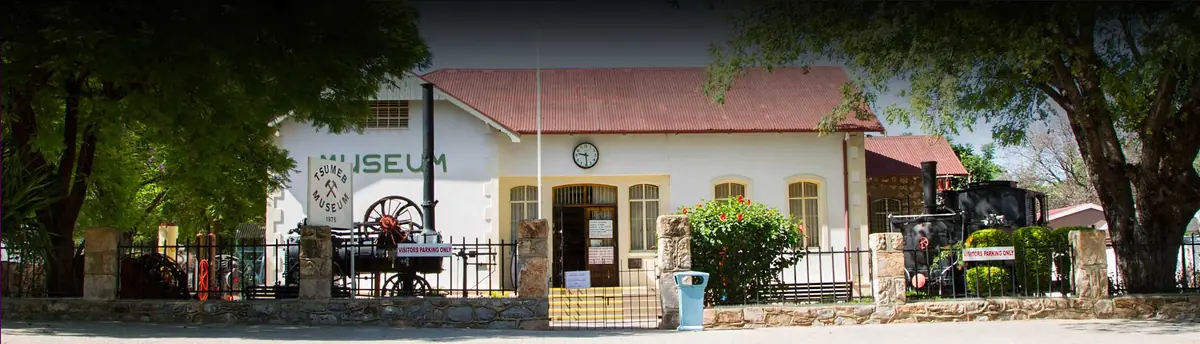
Start at the Tsumeb Museum on President Avenue, opposite United Nations Park. It sits in the German private school of 1915 and shows the field guns the Schutztruppe (the German colonial army) threw into Lake Otjikoto before they surrendered that year. Collectors should also see the Tsumeb Mineralogic and Mining Museum, with minerals and old machines from the mine. It opens weekday mornings only.
The Helvi Mpingana Kondombolo Cultural Village, 3 km south of the centre, is an open-air museum of traditional homesteads from Namibia’s different communities, with guided tours. It is closed on Sundays.
Lake Otjikoto, a sinkhole lake 20 km north-west of town, is only about 100 m off the B1, an easy stop on the way to Etosha. At least two cannons are still on the bottom. For a night out of town, Ghaub in the Otavi Mountains to the south is a farm and nature reserve in an old mission station, with white rhino drives and guided trips into a limestone cave where you crawl in places.
The town’s Copper Festival, a big trade fair, is held over the last weekend of October.
Good to know
Oshikoto is one of the regions where the US CDC recommends prescription malaria tablets, so see a travel doctor before you go. Stock up on cash and food here before Etosha. The UK government warns that theft from cars is common at service stations, so stay with the car while you fill up. Many gravel roads get worse in the January to April rains, and it advises carrying two spare tyres and not driving outside towns at night because of livestock and wild animals. Ghaub itself recommends a 4x4 in the November to April rainy season, and day visits there must be booked by email at least two days ahead.
History and culture
Tsumeb exists because of a green hill of copper ore that San people were smelting long before any European arrived. A company founded in Berlin turned it into a mine known worldwide for its minerals, built a railway to the coast with forced Herero and Ovambo labour, and gave the town its German miners' motto, Glück auf. The German Schutztruppe surrendered nearby in 1915, and the mine's later American owners and its striking workers belong to Namibia's road to independence too.
- Before colonial rule
San people, among them the Haiǁom, were the first known inhabitants. They found the copper ore showing at the surface, smelted it using termite mounds as simple furnaces, and traded the metal to the Ovambo in the north, who made rings and necklaces from it. source
- 1851
Charles Andersson, John Allen and Francis Galton were the first Europeans to visit Lake Otjikoto. Galton went on to write a book about his travels in southern Africa. source
- 1893 to 1900
Matthew Rogers, prospecting for the South West Africa Company, made the first European finds at Tsumeb in 1893. On 6 April 1900 the Otavi Minen- und Eisenbahn-Gesellschaft (OMEG, the Otavi Mining and Railway Company) was founded in Berlin to mine the ore, and the first loads went by ox wagon to Swakopmund. source
- 1904 to 1908
OMEG's railway from Swakopmund reached Tsumeb in 1906. Herero and Ovambo workers were forced to build it, and the land for it was taken without the consent of Herero leaders, one of the grievances behind the Herero rising of 1904. The German response became the genocide of the Herero and Nama between 1904 and 1908. source
- July 1915
In the First World War South African columns advanced up the railway towards Otavi and Tsumeb. Beaten at Otavi on 1 July, the German forces surrendered at Khorab on 9 July 1915. South Africa occupied the territory and from 1919 ran it as a League of Nations mandate. source
- 1947 to 1996
Tsumeb Corporation Limited (TCL) took over the mine in 1947. Apart from breaks during the two world wars and the Great Depression, ore kept coming out until 1996, when a long strike and a fall in the copper price led to the end of underground mining. The smelter kept working. source
- 1966 to 1990
The liberation war between South Africa and PLAN, the armed wing of SWAPO, began on 26 August 1966 and ended with Namibia's independence on 21 March 1990. source
- 1971 to 1972
A general strike of about 25,000 contract workers, most of them from Ovamboland, began in Windhoek and Walvis Bay in December 1971 and spread to the Tsumeb mine, which stopped work. The strikers wanted an end to the contract labour system, which many called close to slavery. When the strike was partly broken in 1972, the opposition it had stirred fed into the guerrilla war for independence. source
- Languages
- In the 2023 census Oshindonga was the main home language in 47.5 percent of households in the Oshikoto region, followed by Oshikwanyama (34.8 percent) and Khoekhoegowab, the Damara and Nama language (5.2 percent). Afrikaans and English each come in at about 2 percent. source
- A mixed mining town
- The mine drew people from all over the country, and Nama, Damara, Herero, Ovambo, German, Afrikaner and Portuguese families all live here. The town's names reflect it: Okavisume in Otjiherero, and Tsumeb itself from a Haiǁom word for digging a hole in loose ground that keeps caving in. source
- Copper Festival
- The municipality holds the Tsumeb Copper Festival over four days on the last weekend of October in United Nations Park, a trade fair with more than 200 small businesses and bigger exhibitors. source
- Garden town
- Wikivoyage calls Tsumeb a true garden town. Jacarandas and bougainvilleas give the streets shade and colour, and spring is when they look best. The farms around it grow maize, sorghum, sunflowers and citrus, and run cattle. source
For German visitors: The town is a German creation. The Otavi Minen- und Eisenbahn-Gesellschaft started commercial mining here in 1900, and Tsumeb still has the German miners' greeting Glück auf as its motto. source
For German visitors: OMEG and the German government paid for the German private school of 1915, now the museum. It taught 23 German children at first and 100 by 1930, until the slump in copper prices left German families unable to pay for it. source
For German visitors: In 1911 the Rhenish missionary Heinrich Vedder founded a school at Ghaub, south of Tsumeb, to train local church workers, and discovered its limestone cave while he was there. He was deported to Germany in 1919 and opened a new Augustineum in Okahandja after he returned in 1922. source
For German visitors: The Max Planck Institute for Aeronomy set up the Jonathan Zenneck research station 15 km west of Tsumeb to study the ionosphere. It opened on 31 July 1964 and is now a magnetic observatory run by the South African National Space Agency. source
For American visitors: For decades in the middle of the 20th century the American company Newmont held a controlling interest in the Tsumeb mine, and it managed the Tsumeb and Kombat mines when the 1971 contract workers' strike stopped them. source
Main sights in Tsumeb
8- Tsumeb Museum
Opened in 1975 in the German private school of 1915, the museum covers Tsumeb's mining history and the artillery the Schutztruppe dumped into Lake Otjikoto in the First World War so the Allied forces could not use it. It can also arrange visits to a nearby mine.
Museums Association of Namibia: Tsumeb Museum - Lake Otjikoto
A sinkhole lake about 100 m across where a cave roof fell in, 20 km north-west of town beside the B1. The San called it Gaisis (ugly) and the Herero Otjikoto (deep hole), the name the Oshikoto region now carries. A national monument since 1972, with at least two cannons still on the bottom.
Wikipedia: Otjikoto Lake - OMEG-Minenbüro
The mine office of 1907, probably built by Rudolf Mann and thought to be the oldest building in Tsumeb. It served the mine until 1950, then housed a kindergarten, the public library and a Methodist church, and since 1994 the Tsumeb Gymnasium. A national monument since 1989.
National Heritage Council of Namibia: OMEG-Minenbüro - Roman Catholic church
Built by Rudolf Mann in 1913 under the supervision of Brother Ucken and inaugurated in 1914. The Sisters of the Holy Cross arrived in 1921 and, again with help from OMEG, added a mission school, kindergarten and hostel. A national monument since 1989.
National Heritage Council of Namibia: Roman Catholic Church Building - Second Director's House
The mine director's house of 1912, the second oldest building in town, home to four OMEG directors and their families until 1947 and later a company guest house. A national monument since 1989.
National Heritage Council of Namibia: Second Director's House - Tsumeb Mineralogic and Mining Museum
A museum of Tsumeb minerals, rare specimens among them, with old mining equipment, displays you can touch and guided tours on the geology and the mine's history.
Tsumeb Mineralogic and Mining Museum - Helvi Mpingana Kondombolo Cultural Village
An open-air museum 3 km south of the centre with traditional homesteads of Namibia's communities, an information centre and crafts. It opened in September 1997. The former mayor who opened it had been inspired by the Glomdal folk museum in Elverum, Norway, and Elverum's municipality and a Namibia association there supported the project.
Museums Association of Namibia: Helvi Mpingana Kondombolo Cultural Village - Ghaub mission station
The Rhenish Mission settled at Ghaub in the Otavi Mountains in 1895 to work among the Damara. It was looted in the 1904 war, saw a skirmish between the Schutztruppe and South African troops on 4 July 1915, and is now a lodge and nature reserve in the restored mission buildings.
Ghaub Nature Reserve and Farm: From mission station to nature reserve
Did you know?
- In October 2022 the International Union of Geological Sciences put the Tsumeb ore deposit on its first list of 100 geological heritage sites in the world, for the variety, rarity and beauty of its minerals. source
- Dozens of minerals were first described from the Tsumeb mine, and several carry its name or the area's: tsumebite (first described in 1912), otavite after the Otavi Mountains, ovamboite after Ovamboland, and otjisumeite after the old Herero name for the town. source
- The main shafts went down more than a kilometre. When the deep workings closed they filled with groundwater, and that water was pumped as far as Windhoek. source
- The guns in Lake Otjikoto were not hard to find. According to Günther Walbaum some 30 cannons and 400 to 500 boxes of ammunition went in, but they lay only about 3 m down on a rock, so the South African soldiers recovered them easily. source
- In the Otavi Mountains near Ghaub, scientists found jaw, arm and finger bones of Otavipithecus namibiensis in the early 1990s, a gibbon-sized ape that lived about 13 million years ago and the first extinct ape of this kind found anywhere in southern Africa. source
- Tsumeb grew by more than 80 percent between the last two censuses, from 19,275 people in 2011 to 34,960 in 2023, and it is by far the biggest town in the Oshikoto region. source
Checked 7 October 2026.
Wildlife you might see
7- very likelyWhite rhinoGhaub Nature Reserve in the Otavi Mountains south of Tsumeb, on the afternoon rhino drive or on foot with the reserve's Rhino Patrol trackers. Rhino drives run in the afternoons and tracking on foot in the mornings. Ghaub says the drive almost always finds themsource
- very likelyBirds (more than 250 species)Along the farm roads and nature trails at Ghaub, which are open to overnight guestssource
- possibleGiraffeGhaub Nature Reserve, on the rhino drivesource
- possibleZebraGhaub Nature Reserve, on the rhino drivesource
- possibleElandGhaub Nature Reserve, on the rhino drivesource
- possibleImpalaGhaub Nature Reserve, on the rhino drivesource
- possibleRed hartebeestGhaub Nature Reserve, on the rhino drivesource
Likelihood is for a normal visit of two or three days, from the sources linked. Nothing is guaranteed in the wild.
Hikes and walks
3- Ghaub nature trails
Farm roads and trails through the Otavi Mountains, with more than 250 bird species on the reserve. Beside the road are a cemetery and a stone pulpit, left from the small mission parish and the last fighting between the Schutztruppe and South African troops in the First World War.
Permit: Overnight guests at Ghaub only
Ghaub Nature Reserve and Farm: Activities - Rhino tracking on foot, Ghaub
You walk with the reserve's Rhino Patrol trackers as they look for the white rhinos. Ghaub says fitness is required.
Permit: Guided only, booked with Ghaub, mornings
Ghaub Nature Reserve and Farm: Activities - Ghaub Cave excursion
The limestone cave has about 2.5 km of passages and Ghaub rates it the third largest in Namibia. You crawl and climb in places; helmets and headlamps are provided.
Permit: Guided only, booked with Ghaub. Up to 6 people, mornings
Ghaub Nature Reserve and Farm: Activities
Staying safe in Tsumeb
- Malaria
- The CDC lists Oshikoto, Tsumeb's region, among the Namibian regions with malaria transmission and recommends prescription tablets there. Windhoek has none. Ask your doctor which tablets suit you, and cover up and use repellent in the evenings. source
- Theft at filling stations
- The UK government says theft from vehicles, particularly at service stations, is common in Namibia. Don't leave the car unattended while you refuel on the B1, and keep bags out of sight. source
- Gravel roads and night driving
- Farm roads such as the way in to Ghaub are gravel. The UK government says many gravel roads get worse in the January to April rains, and advises two spare tyres, checking conditions before you set off and not driving outside towns at night, when livestock and wild animals are on the road. source
- The Ghaub cave
- Ghaub warns the cave is not for anyone claustrophobic, and that the air holds less oxygen the deeper you go. Wear sturdy clothes and shoes. source
- Summer heat
- Average highs are around 33°C from October to December. See the lake and the museums in the morning, wear a hat and carry water in the car. source
Tips from travellers
- Time the Tsumeb Museum around its lunch break. It opens 09:00 to 12:00 and 14:00 to 17:00 on weekdays and 09:00 to 12:00 on Saturdays. Saturday afternoons, Sundays and public holidays are by arrangement only, for groups of ten or more. official
- The Tsumeb Mineralogic and Mining Museum opens on weekday mornings only, 08:00 to 13:00. At weekends and on public holidays it is closed unless you ask ahead. official
- The Helvi Mpingana Kondombolo Cultural Village, 3 km south of the centre, opens 07:30 to 16:30 on weekdays and 08:00 to 13:00 on Saturdays. It is closed on Sundays and public holidays. Ask for the guided tour. official
- Book a Ghaub day visit by email at least two days ahead. It does not take phone bookings, and day visitors must join the rhino drive, rhino tracking or the cave trip, as the lodge, campsite and hiking trails are kept for overnight guests. official
- Without a car, minibus taxis to Windhoek and north to Ondangwa leave from the Engen garage on the B1. one source
- Ghaub recommends a 4x4 in the rainy season, November to April. official
Checked 7 October 2026. Conditions change, so confirm with the park or venue before you go.
The day three men swam Otjikoto and frightened a caravan
On 26 May 1851 a trading caravan of about 170 people stopped at Otjikoto. Only 24 of them were the Ovambo traders it belonged to, walking home to Ondonga with some 200 cattle they had bartered for, under a man the travellers called Chik. Half the caravan was Herero women, 86 by Francis Galton’s count, some going north to look for work or a husband and some to sell ostrich-shell bodices. Galton’s own party was 14, among them Charles John Andersson and John Allen. The oxen could not reach the water, so a chain of men passed it up the cliff to a trough. Everyone in the caravan knew one thing about the lake: nothing that went into it came out again.
Galton leaned over the edge with a lead line first and got 180 feet at four different points. Then he, Andersson and Allen stripped and jumped in.
Galton and Andersson each wrote a book afterwards, and they agree on the reaction. Nobody watching had ever seen a person swim. Galton was told the Ovambo stayed out of their own river in the north because of the crocodiles. Chik, friendly until then, turned wary, because it looked like magic. The Herero women made up a song about it on the spot, one matron leading and the rest answering in a chorus Galton wrote down as “tirri-tirri-tirri”. The swimmers paddled into a cave on the waterline full of owls and bats. Andersson reached for some of the bats and found they had been dead for years, dried onto the rock like mummies.
The two books do not agree on the depth. Andersson gives 215 feet. Nobody has settled it since: published figures run from 76 m to more than 140 m, because the hole widens below the surface like an upside-down mushroom and has side caves.
Copper for sale at the water’s edge
San families living around the lake came to greet the caravan and brought “quantities” of copper ore to sell. Andersson says it came from the hills nearby, and Galton noticed later that Ovambo dagger sheaths were plated with copper and bound in copper wire. The obvious source was 20 km away: a hill of green malachite standing in tamboti forest, where the town is now. It took another 42 years before a prospector, Matthew Rogers, stood on that hill in January 1893 and reported that in all his experience he had never seen such a sight.
Both men also describe doves coming to the water in huge numbers morning and evening, with a pale hawk dropping in among them and the whole flock leaving with a noise like a gust of wind.
Two guns from Sandfontein
The cannon story is told higher up this page, but one pair of guns has its own. At Sandfontein, near the Orange River, German troops surrounded a South African force on 26 September 1914 and took its two 13-pounders, guns of the Transvaal Horse Artillery with barrel numbers 288 and 289. Both ended up in Otjikoto in 1915. The South Africans pulled 289 out that same year and put it back into service, and it now stands at the Gunners’ Memorial in Potchefstroom. Number 288 lay in the lake for 68 years. It came up in 1983 and is in the Tsumeb Museum.
How much went in depends on who you read. Against the figure of about 30 cannons, a report on a 2024 diving expedition lists 19 pieces: eight field guns, seven mountain guns and four of 3.7 cm calibre. The Windhoek Diving Club later arranged some of what was left on a ledge, and the shallowest of it lies about 55 m down, far beyond a casual dive. You need a permit to go. There is also a story of a safe holding six million gold marks. People have looked. Nobody has found it.
The fish that came from the other lake
Andersson’s party caught fish “not much larger than one’s finger” and ate several score for dinner. The fish the lake is known for now is a different one, and the Otjikoto tilapia is not from Otjikoto. Its only natural home is Lake Guinas, 38 km west of town on a private farm, and people carried it here. It is critically endangered and grows to about 14 cm. It comes in five colour forms, from plain olive to pale blotched fish that look enough like ornamental carp to be called African koi. Pairs lay their eggs on narrow ledges on the cliff walls and chase everything else away.
In June 2024 a cave-diving team went down 113 m in Guinas. Whether the two lakes join underground is still unproven.
What the green hill left behind
Mineral people cannot agree how many species came out of the Tsumeb pipe. Counts run from about 240 to about 350, with between 56 and 72 of them first described here. One is germanite, identified in 1922, and the mine went on to yield around 80 tonnes of germanium.
The other legacy is less pretty. The smelter outlived the mine by taking arsenic-heavy copper ore from other countries, Bulgaria among them. A Canadian company ran it from 2010 and sold it to the Chinese group Sinomine in August 2024. Former managers put the arsenic waste stored on site at about 300,000 tonnes. In June 2025 the new owner said the smelter would go onto care and maintenance, and it says it wants to rework the old tailings for germanium, gallium and zinc. One resident told The Namibian that many people in town have stopped drinking the tap water and buy filtered water instead. The mayor says the monthly tests show no raised arsenic.
One more thing the town gave the country. Mburumba Kerina was born here on 6 June 1932 and was among the first to petition the United Nations against South African rule. In the early 1960s, while he was in Indonesia, he wrote of a future country called “Namib”. The longer name that stuck is more often credited to Sam Nujoma.
Quick answers
What animals can you see in Tsumeb?
Most visitors see white rhino and birds (more than 250 species).
What are the best hikes in Tsumeb?
Ghaub nature trails, Rhino tracking on foot, Ghaub and Ghaub Cave excursion. See the hikes section for times, difficulty and permits.
Guides for Tsumeb
Map of Tsumeb
See every place on this map as a list