Park · Erongo, Namibia
Spitzkoppe, north-west side
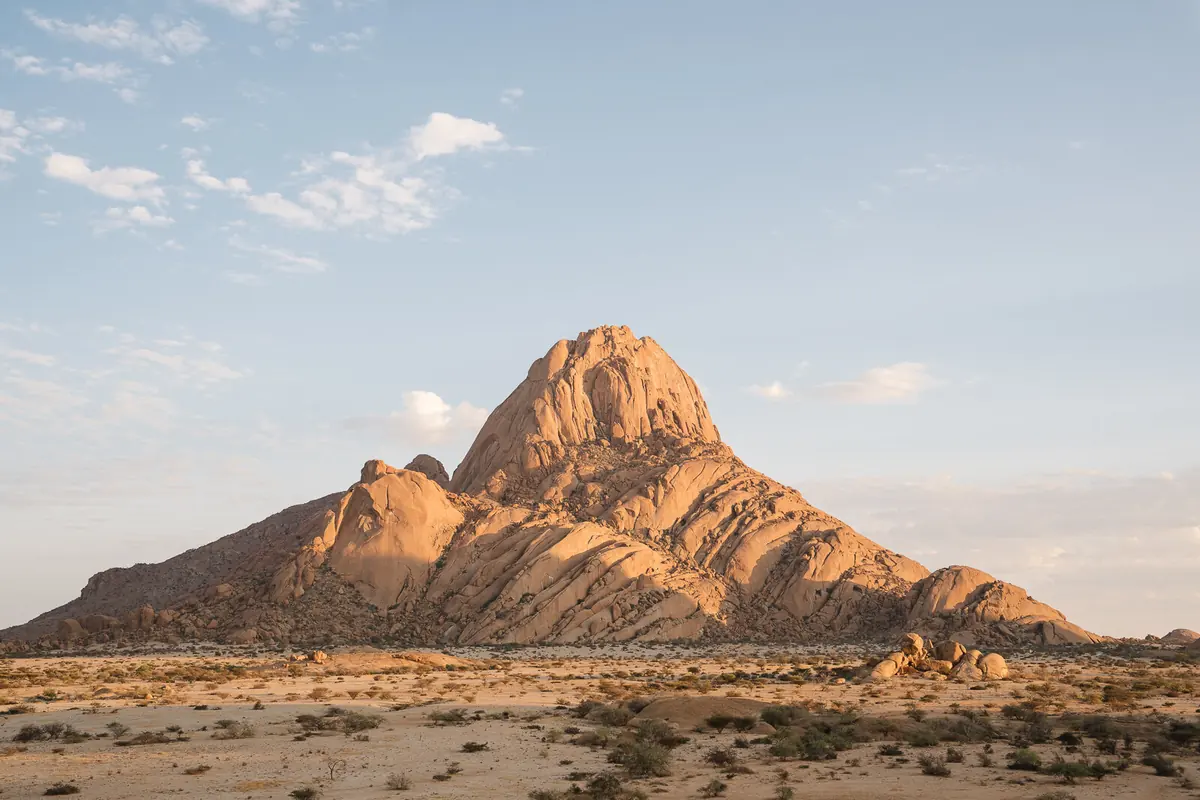
The quieter north-western side of the Spitzkoppe massif, a small reserve around Spitzkoppen Lodge with guided walks to San paintings. Despite the map name, it is not a national park.
Short answer
Spitzkoppe, north-west side is in Erongo, Namibia. This page lists 1 place to stay and 2 sights. The nearest park with an entry fee on this site is Dorob National Park, about 95 km away, where international adults pay from N$280.
- Malaria
- Spitzkoppe is in Erongo, which UK advice puts in the very low risk part of Namibia for malaria.
- Places to stay
- 1
- Park fee nearby: Dorob National Park
- US$17 €15 · N$280about 95 km away
- Where
- Erongo, Namibia21.82°S 15.19°E
Ignore the name on the map. This is not a national park but the north-western corner of the Spitzkoppe massif in Erongo, a small private reserve around Spitzkoppen Lodge inside the community’s ǂGaingu Conservancy. The granite is the same as on the rest camp side: Gross Spitzkoppe at 1,728 m above you, smooth red boulders and San paintings below. What this side adds is a lodge with its own guides, which suits people who want the scenery without a tent.
Getting there
From the B2 between Usakos and the coast, take the D1918 gravel road towards Henties Bay and turn right after about 18 km onto the D3716. Usakos, about 50 km away, is the nearest town, so shop there. Neither the lodge nor the camp lists fuel, so leave the B2 with a full tank. The UK Foreign Office says accidents on gravel are common, that many gravel roads break up in the January to April rains, and that you should not drive outside towns at night because of livestock and wildlife.
When to go
The lodge puts the climbing season at March to the end of September, and that is the sensible window for walking too. Summer days on bare granite are hot and very dry, so carry more water than you think. After summer rain the rock pools fill and the birding gets better. Erongo has a very low malaria risk, and UK and US health advice for it is bite avoidance rather than tablets.
What to do
Every outing leaves from the lodge reception and is booked and paid for at the lodge. The chain walk, with set departures in the morning and afternoon, goes up to the rock art at Bushman’s Paradise, a national monument, with a steel cable to hold on the way up. A guided drive in a game viewer stops at the Golden Snake painting, the paintings at Small Bushman’s Paradise, the Zebra Pool and the big rock arch. There is also a guided bike ride ending with a sundowner at the small rock arch near the lodge, and a guided hike of three to four hours up the third highest peak of the group.
The lodge says rock art has been recorded at more than forty sites around Gross and Klein Spitzkoppe. Climbers have over 100 routes on Spitzkoppe and the Pontok Mountains, but even the easiest way up the main summit, the Normal Route, is a real rock climb with ropes.
Good to know
Spitzkoppen Lodge has 15 chalets and takes no children under six. Its rate includes the conservancy levy. The day fee and camping rates for the rest camp are in the fee table on our Spitzkoppe page. The paintings are protected under the National Heritage Act, so do not touch them, camp or make fires nearby, or use a flash. Snakes and scorpions live among the boulders. Keep your hands out of cracks you cannot see into, and watch your footing on the smooth rock, which is slippery.
Wildlife you might see
12- likelyRock hyrax (dassie)On the boulders and in rock crevices around the lodge and the granite outcropssource
- likelyRosy-faced lovebirdTrees and rocks across the reservesource
- likelyPale-winged starlingAround the granite outcropssource
- likelyRed-eyed bulbulTrees and bushes around the outcropssource
- likelyWhite-browed sparrow-weaverUntidy grass nests in the trees at the foot of the outcropssource
- possibleHerero chatSmall acacia trees, often near the Henties Bay side entrance gate. Early morning and late afternoonsource
- possibleMonteiro's hornbillsource
- possibleGray's larkGravel plains west of Spitzkoppe, on the way to Henties Baysource
- possibleRüppell's korhaansource
- possibleBarking geckoHeard more than seen, calling around camp at nightsource
- rareMartial eaglesource
- rareHorned adderCampsitessource
Likelihood is for a normal visit of two or three days, from the sources linked. Nothing is guaranteed in the wild.
Hikes and walks
4- Bushman's Paradise chain walk
The lodge's chain tour: a guided walk with set morning and afternoon departures to the rock art at Bushman's Paradise, a national monument.
Permit: Guided only. Book and pay at Spitzkoppen Lodge reception
Spitzkoppen Lodge, activities - Guided mountain hike, third highest Spitzkoppe peak
A guided hike up the third highest mountain of the Spitzkoppe group with one of the lodge's trails guides, who brings bottled water.
Permit: Guided only. Book and pay at Spitzkoppen Lodge reception
Spitzkoppen Lodge, activities - Self-guided walking trails, Spitzkoppen Lodge
The lodge guides hand out maps for walks you can do on your own in the reserve. Carry water.
Spitzkoppen Lodge, activities - Gross Spitzkoppe, Normal Route
Not a hike. The easiest route to the 1,728 m main summit is a graded rock climb (grade 17) that needs a basic rack and double 60 m ropes, with abseil anchors in place. Carry Eckhard Haber's guidebook to Spitzkoppe and the Pontoks.
Spitzkoppen Lodge, rock climbing at Spitzkoppe (activity sheet)
Staying safe in Spitzkoppe, north-west side
- Malaria
- Spitzkoppe is in Erongo, which UK advice puts in the very low risk part of Namibia for malaria. Bite avoidance and awareness are advised there rather than tablets. The high risk areas are Kavango and Zambezi all year, and several northern and eastern regions from December to April. source
- Heat and water
- Namibia's hot, dry climate can cause dehydration and skin problems. Carry plenty of drinking water on every walk, even a short one. source
- Gravel roads
- The last stretch in is on gravel (the D1918 and D3716). The UK Foreign Office says accidents on gravel roads are common, that many gravel roads break up in the January to April rains, and that you should not drive outside towns at night because of livestock and wildlife. source
- Snakes, scorpions and slippery rock
- The lodge warns that snakes and scorpions live in the area, so keep your hands out of cracks you cannot see into. The smooth boulders around the lodge are slippery, and the lodge asks parents to stop children climbing and jumping on them. source
- Climbing
- Do not try the main summit without climbing skills and gear. The lodge's climbing sheet says the easiest route needs ropes and a rack, and that bolting or changing bolted routes is not allowed without consent from the Mountain Club (MCSA Namibia Section). source
Tips from travellers
- The lodge's guiding team is small and walks run at set times, so activities are not always flexible or private. Ask about the schedule when you arrive. one source
- The rock paintings are protected under the National Heritage Act. Do not touch them, camp or make a fire near them, and do not use a flash. one source
- Bushman's Paradise can only be visited with a guide, because of past vandalism. one source
- Spitzkoppen Lodge does not take children under six. Its rate sheet says that if you book a second night, lunch and a guided drive on the second day are included. official
- Stay for a night if you can. The lodge runs a self-guided night trip to the big rock arch to see the Milky Way, and maps are available from the guides. official
- If you camp on the rest camp side instead, there is no water or electricity at the campsites, only at reception, so bring what you need to the site. official
Checked 7 October 2026. Conditions change, so confirm with the park or venue before you go.
Sixteen years for a lodge, three hours for 400 feet
I.C. Smith thought Gross Spitzkoppe looked like a giant elephant tusk, and wrote that it was not one of the friendly mountains. He was in the Cape Town party, led by Servie le Roux, that made the first recorded attempt in 1940. They got to within a few hundred feet of the top on the south ridge, where a deep cleft and a smooth block they called the Gendarme stopped them. Climbers from Swakopmund did no better on the same line in 1945.
The north side is where it was finally climbed
In July 1946 three more Capetonians, Les Schaff, Shippy Shipley and Peggy O’Neill, reached the Gendarme, gave up on it and went round to the north side, which looked worse and turned out better. Chimneys took them high before about nine metres of steep, holdless granite ended the day. They went to Usakos, borrowed a hammer and a cold chisel, and came back four days later to cut holds, which is where the steps on our Spitzkoppe page come from. On the way up an abseil rope snapped and Shipley fell nine or ten metres to a ledge. A patch of grass saved him. The other two chiselled on until the weather turned overnight, and they went home with a few metres of the slab still uncut.
That November Hans and Else Wongtschowski arrived with an 18-year-old, Jannie de Villiers Graaff. They sat out two hours of wind before trying to add one more step, and all the effort left little more than a scratch on the rock. They were on top at noon, the last 400 feet having taken three hours. Graaff was a baronet’s son. He went on to write a book on welfare economics that was reprinted six times in ten years, and in 1952 made two first ascents in the Indian Himalaya.
There is a metal box with a book in it on the summit now, and by 2009 the count of ascents had reached about 600. On 27 August 2010 four men from the Kavango who worked on a grape farm at Aussenkehr, Aron Muhoko, Muhuli Mbanje, Nyanda Kampasi and Bethold Muronga, left in the dark at five and, like Graaff, got there at noon. The Namibian’s report added that the only black Namibians up before them were two Damara men from the community at the foot of the mountain.
Kubrick’s apes never came here
The opening of 2001: A Space Odyssey looks like this country, and it is, but only as a photograph. Andrew Birkin, a young assistant promoted to the special effects team, supervised the shooting of the background plates in the Namib in 1967. They were used as 8 by 10 inch transparencies and thrown onto a reflective screen 40 feet high and 110 feet wide in a studio at Borehamwood, with the actors in ape suits in front.
The film that did turn up in person was Roland Emmerich’s 10,000 BC. It shot on the northern side of the mountain in 2006, with the production’s dates running from 19 July to 10 September. The first press statement said Spitzkoppe and three other sights near the coast would be off limits for all of that time. One tour agent called it “totally unreal” in the middle of peak season. A few days later the film people explained that only one area on the north side was involved. The production gave the community N$486,000. By February 2007 Chief Immanuel /Gaseb was demanding receipts, saying two meetings had produced only bank statements.
Why the lodge took so long
A lodge on this side was first planned around 2000. By 2004 one proposal had already been thrown out for intruding on archaeological remains, and the restoration plan drawn up that year for the paintings wanted camping spots moved away from them and any track that came within 100 metres closed. The heritage council later gave the lodge the same figure: find a site 100 metres from the art. In December 2008 The Namibian reported twelve bungalows, opening by the end of 2009. Two years on, the conservancy chairman Ryan Gariseb was complaining that people were still waiting for the jobs. By 2012 the talk was of twenty chalets.
It opened in November 2016 with fifteen. Ronnie Barnard, the architect, was already its project manager in 2008, and the long argument shows in the design: limited concrete, floors and decks raised off the ground, walls made to be taken apart, and power brought in on 5.5 km of buried cable. There is no air conditioning.
Zebra most days, a leopard almost never
Nobody should book this side for game. Expert Africa has collected sightings from its travellers at the lodge since mid-2018: 97 in 100 saw zebra, about one in ten saw oryx, and one in 25 a leopard. A photographer writing for Tracks4Africa calls his one leopard among the rocks a once in a lifetime sighting. His useful point is that the animals here are not used to people and keep their distance. One climbing party in June 2023 shared its campsite with a genet.
Birders come for the Herero chat, a bird science only named in 1931, from a specimen taken at Karibib, in the same region. It drops on ants, termites and beetles from shady perches on rocky hills with scattered trees, which describes the foot of these domes exactly. Finding it is another matter. One birder who wrote up a visit in 2025 searched for three days and left without it.
Rain changes the place. In February 2011 the hollows in the granite filled with clear water and children from the settlement were playing in them. By May 2019 a farmer there told The Namibian her herd of more than 100 goats was down to ten.
One warning comes from a single overlander on the 4x4 Community forum, who likes to sleep out on the rock: it is easy to get lost wandering among the boulders, at night most of all. That party had no handheld GPS, and the post says next time they will bring one and mark the camp.
In and around Spitzkoppe, north-west side
3 places listedWhere to stay in Spitzkoppe, north-west side 1
- 21.81°S 15.17°EHotelSpitzkoppen Lodge+264 81 143 5048spitzkoppenlodge.com
Sights 2
- Daub CaveAttraction
- Golden SnakeAttraction
Quick answers
What animals can you see in Spitzkoppe, north-west side?
You have a good chance of seeing rock hyrax (dassie), rosy-faced lovebird, pale-winged starling, red-eyed bulbul and white-browed sparrow-weaver. Martial eagle and horned adder are there but rarely seen.
What are the best hikes in Spitzkoppe, north-west side?
Bushman's Paradise chain walk, Guided mountain hike, third highest Spitzkoppe peak, Self-guided walking trails, Spitzkoppen Lodge and Gross Spitzkoppe, Normal Route. See the hikes section for times, difficulty and permits.
Map of Spitzkoppe, north-west side
See every place on this map as a list