Village · Erongo, Namibia
Spitzkoppe
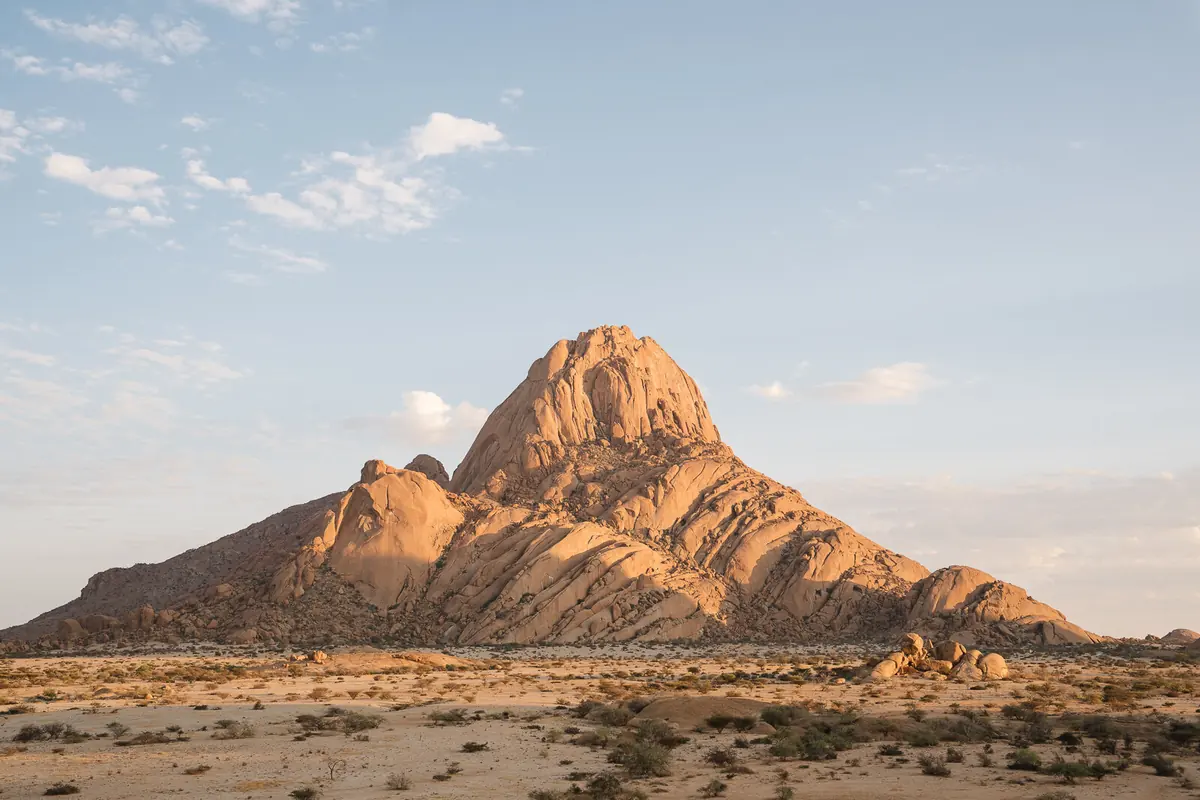
Granite peaks rising about 700 m out of the plains north-west of Usakos, with a community rest camp among the boulders, San rock art, rock arches and some of Namibia's best night skies.
Short answer
At Spitzkoppe, everyone pays N$180 (about US$11, €9.50 or £8) per adult and N$120 per child per day. These rates ran to 31 October 2026, and Spitzkoppe Rest Camp (community campsite, ǂGaingu Conservancy) had not published new ones when we last checked.
- Daily fee, every adult
- US$11 €10 · N$180ran to 31 Oct 2026
- Malaria
- Erongo is not on the CDC's list of regions with malaria transmission, and the CDC calls malaria rare elsewhere in Namibia.
- Places to stay
- 6
- Sights
- 7
Spitzkoppe fees 2025/26
Checked Spitzkoppe Rest Camp tariffValid 1 November 2025 to 31 October 2026, per person per day, in Namibian dollars.
These rates ran to 31 October 2026. Spitzkoppe Rest Camp had not published new ones when we last checked, so these are the latest known. Ask Spitzkoppe Rest Camp before you travel.
| Who | Adult | Child |
|---|---|---|
| All visitors | US$11 €10 · N$180 | US$7 €6 · N$120 |
- Entry to the Spitzkoppe Reserve needs a park fee, and the camp issues one permit per vehicle.
- If you camp at the rest camp the park fee is included in the camping rate (N$300 per adult and N$200 per child per night for 2025/26), so campers do not pay the day fee as well.
- Child rate applies to ages 4 to 11. The rate sheet gives no fee for children under 4.
- The fee includes VAT and the conservancy levy. The camp publishes one rate for all visitors, with no separate rate for international, SADC or Namibian visitors.
- The current rates run to 31 October 2026. New rates from 1 November 2026 had not been published when we checked.
- Fees are set by Spitzkoppe Rest Camp. Official tariff · Seen a new rate? Tell us
US$1 = N$16.64 · €1 = N$18.60 · £1 = N$22.31 (ECB rate, 3 Nov 2026, N$1 = R1). Converted amounts are approximate; you pay in Namibian dollars.
How we got these figures
- The camp's own site and its 2025/26 general reservation policies sheet both give N$180 per adult and N$120 per child for day visitors, valid 1 November 2025 to 31 October 2026. Both are the same publisher, so the figure counts as one source.
- According to the camp's community page, Spitzkoppe lies within the ǂGaingu Conservancy, and a joint venture signed in mid June 2012 between the Spitzkoppe Community Development Association and a private investor leases and manages the campsite.
- Recorded on the Spitzkoppe village hub rather than the Spitzkoppe National Park hub. The camp's site says the park fee is for access to the Spitzkoppe Reserve as a whole, and our data places the rest camp, its campsites, the rock arches and Bushman's Paradise on the village hub. The OpenStreetMap area named Spitzkoppe National Park is a small polygon on the north-west side of the massif around Spitzkoppen Lodge and does not cover the camp or most of the sights, and the operator calls the area the Spitzkoppe Reserve, not a national park.
- Spitzkoppe Rest Camp, camping and rates · official · checked 12 Oct 2026
- Spitzkoppe Rest Camp, general reservation policies 2025/26 · official · checked 12 Oct 2026
- Spitzkoppe Rest Camp, community · official · checked 12 Oct 2026
In and around Spitzkoppe
13 places listedWhere to stay in Spitzkoppe 6
 CampsiteSpitzkoppe Campsite & Restcamp
- 21.84°S 15.19°ECampsiteCamp Site No. 3B
- 21.85°S 15.18°ECampsiteCamp Site No. 5
- 21.85°S 15.18°ECampsiteCamp Site No. 6
- 21.85°S 15.19°ECampsiteSpitzkoppe Tented Camp and Campsites+264 81 805 3178
- 21.83°S 15.16°ECampsiteCamp Site Doepie
Sights 7
 Bushman's ParadiseAttraction
- Natural Arch ViewpointViewpoint
- Old GravesAttraction
- Rock Arch (The Bridge)Attraction
- Rock PoolAttraction
- Small Bushman ParadiseAttraction
- Small Rock ArchAttraction
Spitzkoppe is a cluster of bald granite peaks in the Erongo region, standing alone on the flat plains between Usakos and the coast. The highest, Gross Spitzkoppe, reaches 1,728 m and rises roughly 700 m above the desert floor. Its pointed shape is why people call it the Matterhorn of Namibia. Most visitors come to camp among the boulders, look at San rock paintings, walk to the rock arch and sit under a very dark night sky. A small Damara community lives at the foot of the mountain.
Getting there
You need your own car, or a guided day trip from Swakopmund. From the B2 west of Usakos, turn onto the D1918 gravel road towards Henties Bay, then right after about 18 km onto the D3716, which runs to the gate. Usakos is the nearest town, about 50 km away, and Windhoek is roughly 280 km. The gravel is normally fine for a sedan as far as the rest camp, but the track to Bushman’s Paradise has loose stones and a few deep ditches. There are no proper shops here, so stock up on food and water in Swakopmund or Windhoek before you come.
When to go
May to October is the dry season and the comfortable time, with warm days and chilly nights in camp. From November to March it gets hot, and the bare granite makes it feel worse. The little rain there is falls in summer, and after it the rock pools fill and the birding is at its best. Erongo is not one of the regions where the CDC says malaria is transmitted, and outside those regions it advises bite precautions rather than tablets.
What to do
Stay the night if you can. The rock turns red and orange at sunrise and sunset, and a day trip misses that; if you are only passing through, budget at least four hours. The natural rock arch (The Bridge) frames the sunset and is the picture most people come for. Bushman’s Paradise, a national monument since 1954, has a steel cable to help you up, and you can only go with a local guide. Vandals have destroyed most of its paintings, but some survive there, at Small Bushman’s Paradise and at Rhino Rock. Climbers bring their own gear; the main summit is a technical climb, not a hike. Birders come for the Herero chat, a Namibian endemic.
Good to know
The rest camp sits in the ǂGaingu Conservancy and is run under a joint venture with the local community. The reserve fee is included when you camp (see the fee table). You book a space, not a particular site, and choose your pitch when you get there. Campsites have dry toilets but no water or power; hot showers, flush toilets, a bar, a restaurant and Wi-Fi are at reception. Bring plenty of water. Spitzkoppen Lodge is for its own guests only.
History and culture
Spitzkoppe is a small Damara village at the foot of Namibia's best known granite peaks, inside the ǂGaingu Conservancy. San hunter-gatherers painted its rock shelters for thousands of years, German colonists ran a farm and police post here, and apartheid planners moved Damara families onto the land in the 1970s. Their community now shares in the rest camp most visitors stay at.
- About 4400 BC to AD 100
San hunter-gatherers painted the caves and overhangs around the Spitzkoppe. Archaeologists date the paintings at Bushman's Paradise to roughly this span. source
- 1884
The German Empire declared the territory a protectorate, German South West Africa, which lasted until South African troops took it in 1915 during the First World War. source
- 1896
The German Colonial Society (Deutsche Kolonialgesellschaft) built a trading post called Spitzkopje below the mountain, the centre of a 120,000 hectare farm. By 1899 it held 120 horses, 1,500 cattle and 4,000 sheep and goats. A police station was later built here, and its foundations are still under Pontok 4. source
- 1904 to 1908
German forces carried out the genocide of the Herero and Nama across the colony. Around 80,000 Herero and 10,000 Nama died in the war, in the Omaheke desert and in concentration camps. Germany acknowledged it as genocide in 2015. source
- 1954
Bushman's Paradise was proclaimed a national monument on 1 July 1954. source
- 1964 to early 1970s
Under the Odendaal plan, South Africa's scheme to split South West Africa into ethnic homelands, the Spitzkoppe farm was expropriated in 1964. Damara families were moved here in the early 1970s, and a village with a church and a school grew up. source
- 1966 to 1990
SWAPO (the South West Africa People's Organisation) fought South African rule in a liberation war from 26 August 1966. Namibia became independent on 21 March 1990. source
- 1996 to 2012
The 1996 Nature Conservation Act let communities form conservancies and earn from wildlife and tourism. Spitzkoppe lies in the ǂGaingu Conservancy, and in June 2012 the Spitzkoppe Community Development Association signed a joint venture with a private investor to run the campsite and share the profits equally. source
- The community
- About 500 people live in the Spitzkoppe community, which grew from the Damara families moved here in the early 1970s. It is governed by the ǃOe Gan Traditional Authority, and people live from some livestock, small scale mining of semi-precious stones and crafts sold to visitors. source
- Damara people
- The Damara call themselves ǂNūkhoen and speak Khoekhoe, the same language as the Nama. The 2023 census counted 219,203 Damara, and most live in small towns across the Erongo region or in Windhoek. source
- Stones and crafts
- Stalls at the turn-off onto the gravel sell tourmaline, fluorite, smoky quartz and rough garnets, and a curio shop at the camp sells the community's handmade crafts. source
For German visitors: The name is German for pointed dome. The German Colonial Society (Deutsche Kolonialgesellschaft) ran a 120,000 hectare farm here from 1896, managed by the German settler Carl Schlettwein. source
For German visitors: The colonial Schutztruppe kept a police station at Spitzkoppe; the German Federal Archives (Bundesarchiv) hold a photograph of it from about 1914. source
For German visitors: The German archaeologist Scherz described the individual paintings of Bushman's Paradise in detail after Henri Breuil's study, among them animals and a figure known as the sphinx. source
For American visitors: Photographs of Spitzkoppe were used as backgrounds for the Dawn of Man sequence in Stanley Kubrick's 2001: A Space Odyssey. source
Main sights in Spitzkoppe
5- Bushman's Paradise
Protected caves with San paintings dated to between 4400 BC and AD 100. Because of vandalism you can only go in on a guided tour.
Bradt Guides - Rhino Rock
Good paintings still survive around the foot of Gross Spitzkoppe, and Rhino Rock is the best known of these sites.
Wikipedia: Spitzkoppe - Small Bushman's Paradise and Golden Snake
Two smaller painting sites where a few San paintings have outlasted people and weather. Small Bushman's Paradise sits in the gap between Spitzkoppe and the Pontok Mountains.
Travel News Namibia, Namibia camping journal: Spitzkoppe - Rock Arch (The Bridge)
The natural granite arch is the main sight after the peak itself and frames the view of Gross Spitzkoppe.
Wikipedia (German): Spitzkoppe - Old graves and colonial foundations
The foundations of the German Colonial Society's 1896 station, old graves and water storage reservoirs are among the area's other heritage remains.
Republikein, Spitzkoppe, Namibia's Matterhorn (October 2010)
Did you know?
- Early climbers were stopped by a smooth band of granite only about 3 m high on Gross Spitzkoppe and cut steps into it with a hammer and chisel. In 1971 a University of Cape Town party climbed the peak in four hours without using them. source
- The area around Gross Spitzkoppe is known around the world among mineral collectors for its topaz, along with rose quartz and tourmaline. source
- The archaeologist Ernst Reuning was the first European to find the cave system at Bushman's Paradise, in 1917, and did the first archaeological work on its paintings. Henri Breuil studied the large paintings in the main cave 31 years later. source
- Researchers have identified 397 rock paintings at 37 sites around Spitzkoppe. source
- A legend says a Schutztruppe soldier climbed the main peak alone in 1904 and lit a fire on top, then never came back. Nobody has ever found proof, and there is nothing on the upper mountain that would burn. source
Checked 7 October 2026.
Wildlife you might see
11- likelyRosy-faced lovebirdCommon around the campsource
- likelyPale-winged starlingCommon around the campsource
- likelyRed-eyed bulbulCommon around the campsource
- likelyRock hyrax (dassie)On the rock facessource
- possibleSociable weaverLook in trees for their huge shared nests; the rest camp says a nest can stay in use for close to a hundred yearssource
- possibleHerero chatSmall acacias, often near the Henties Bay side entrance gate. Early morning and late afternoon. A Namibian endemic, and Spitzkoppe is a good place to look for itsource
- possibleRockrunnersource
- possibleHartlaub's spurfowlsource
- possibleMonteiro's hornbillsource
- possibleGray's larkGravel plains west of Spitzkoppe on the road to Henties Baysource
- rareMartial eagleBirding is best after rainsource
Likelihood is for a normal visit of two or three days, from the sources linked. Nothing is guaranteed in the wild.
Hikes and walks
4- Bushman's Paradise and Small Bushman's Paradise guided walks
Two short guided walks to surviving San rock paintings, suitable for most fitness levels.
Permit: Guided only. No booking needed, local guides usually wait at the start of each walk, and a tip is expected
Lizy Travels The World - Rock Arch (The Bridge)
The natural granite arch is the most photographed spot at Spitzkoppe, and you can walk up to it from several sides.
Lizy Travels The World - Guided mountain hike, Spitzkoppen Lodge
A trails guide leads the hike up the third highest peak of the Spitzkoppe group, with bottled water provided.
Permit: Booked at Spitzkoppen Lodge, and all lodge activities start from its reception
Spitzkoppen Lodge, activities - Gross Spitzkoppe summit
Not a hike. Even the easiest route is an exposed technical rock climb, and there is no water anywhere on the mountain.
Wikipedia: Spitzkoppe
Staying safe in Spitzkoppe
- Malaria
- Erongo is not on the CDC's list of regions with malaria transmission, and the CDC calls malaria rare elsewhere in Namibia. Outside the nine listed regions it advises insect bite precautions rather than tablets. source
- Heat and water
- There is no water or electricity at the campsites, only at reception. Carry plenty of water on every walk and for the whole stay. source
- Climbing and scrambling
- The main summit is a serious technical climb, not a walk, and early parties needed two or three days. Climb only with proper gear and experience, and use a guide for the walks to the rock art. source
- Gravel roads
- The D1918 and D3716 are gravel. They are usually fine in a sedan as far as the rest camp, but the track to Bushman's Paradise has loose gravel and a few deep ditches, so drive slowly. source
- Medical help
- The nearest hospital is in Usakos, but for anything serious the better hospital is in Swakopmund. There are no telephones out here; there should be mobile reception, but do not count on it everywhere. source
Tips from travellers
- You cannot book a particular campsite. A booking only confirms there will be space, and you choose your pitch when you arrive. official
- Facilities are basic. Campsites have dry toilets but no water or electricity; hot showers, flush toilets, a bar and the restaurant (which also sells braai packs) are only at reception, so bring plenty of water. official
- Stay at least one night. The rock changes colour at sunrise and sunset, which day visitors miss; if you only have a day, allow at least four hours. one source
- Touching the rock paintings, camping beside them and lighting fires close by are all against the law under the National Heritage Act. Leave the flash off too. one source
- Spitzkoppen Lodge does not take day visitors or campers, so do not plan a meal or a drink there unless you are staying. official
- Keep to the 30 km/h speed limit on the tracks inside the reserve and stay on the marked tracks. one source
Checked 7 October 2026. Conditions change, so confirm with the park or venue before you go.
Clear topaz, glass fakes and the wall visitors kept wetting
In 1889 a German mineralogist called Hintze published a description of some topaz crystals a Baron von Steinäcker had picked up at a place then written as Keins-Berge. They reminded him of Russian topaz, and he called them “water clear”. That hill is Klein Spitzkoppe, the smaller peak a dozen kilometres or so west of the big one, and people have been digging it by hand ever since.
Silver topaz and the glass from Usakos
The stones come out of narrow pegmatite veins, seldom more than a metre wide, and out of the gravel below them. Between 1930 and 1938 some 34.5 kg of cutting-grade topaz was recorded from Namibia, most of it from here, and a crystal reported in 1940 measured 15 cm long and weighed over 2 kg. The trade name is “silver” topaz because nearly all of it is colourless. The geologist Bruce Cairncross and his co-authors give a likely reason: yellow tints in topaz fade in sunlight, and most of these crystals have lain on or near the surface. No gems have come from Gross Spitzkoppe itself, although it is the same granite.
Most of the digging is done by Damara families, informally and by hand. After years of roadside stalls they got an indoor market at the B2 turn-off in 2010, called Ûiba-Ôas, which means “searching for life”. One miner there, George van Staden, told an interviewer he was “born in stones”. That same year, in March, The Namibian reported that tourists at the turn-off had been sold coloured glass as beryl, tourmaline and topaz, and that its reporters found identical pieces in a shop in Usakos. A Swakopmund jeweller who looked at them said the colour and the cut were both too perfect, and that they felt cold in the hand. Crystals picked out of the gravel are usually scuffed, so a flawless one deserves a second look.
What is on the wall at Bushman’s Paradise
Vandals are often said to have ruined most of the paintings. The detail is in a survey by two University of Namibia researchers, Goodman Gwasira and Georgine Katjiuongua, who went along the shelter five metres at a time. It is 45 m long, with paint on 40 m of it, and the archaeologist John Kinahan had recorded more than 200 paintings there in 1990.
Near the left end thirteen people walk in single file, most with bows and quivers, and an elephant is painted above them. Further along are two rhinos in white, a big one ahead of a small one, and giraffes done in red and white. One has only a head and a back line, which Kinahan read as a snake with a giraffe’s head. Both animals belong to San ideas about rain, and some figures sit where water runs down the rock, which the researchers think was deliberate.
The harm is concentrated in the three middle sections, where guides stop. The surveyors found nine spots where visitors had splashed liquid on the paint to make it show up in photographs, plus charcoal scribbles, chipping, and one piece of painted rock cut clean out, with the marks of a second attempt. During their fieldwork the camp caught a visitor who had gone up without a guide and wet the wall, and had to let the culprit go. The sections nobody is shown have escaped the vandals. Some have faded on their own, but the three antelope at the far right are in good condition. An overlander who did the chain walk in 2021 found the art hard to make out, so ask your guide to walk the full length, and leave the water bottle in your bag.
Kinahan identified several animals as cattle, evidence that people here were herding as well as hunting. The guides tell visitors they are buffalo.
Granite from when the Atlantic opened
The rock is between 124 and 137 million years old. It rose as molten granite when Africa and South America were pulling apart, and cooled underground. Everything since has been the softer country around it wearing away. Dating on three similar hills further south in the Namib put their own wear at roughly five metres in a million years, so the outline you see has barely changed for longer than there have been people.
Gross Spitzkoppe and the Pontok Mountains are two separate masses with a flat pass about 100 m wide between them. The Pontoks take their name from the rounded huts the Damara built, which is what the domes look like from the plain. Some of the loose boulders are 10 m across.
Small animals, and one pair of cheetahs
Campers should expect little game. A couple who write as Wilkinson’s World found every regular campsite taken on a July weekend in 2008 and noted that the animals made themselves scarce. A photographer writing for Tracks4Africa makes the same point: nothing here is used to people. He counts his one leopard among the rocks as a once in a lifetime sighting.
What does show is smaller. The rock art surveyors met klipspringer and dassies in the bushy hollow in front of the painted shelter. The Wilkinsons saw a pair of black mongooses at a disused reservoir, and Herero chats at Small Bushman’s Paradise at lunchtime. The black mongoose was only described in 1928. It spends most of its time among granite boulders, from the Erongo north into Angola, and takes the odd dassie, though more often birds and rodents. In a later post the same couple wrote of two cheetahs standing on a small hill close to Spitzkoppe, which moved off as soon as a camera came out. That is one account, and I have found no other.
Lovebirds nest in the rocks above the campsites, and after a summer shower frogs start up in the pools. People who write about the nights keep coming back to the sky. The Wilkinsons, there under a full moon, never needed their torches. On the 4x4 Community forum one regular says the arch looks small from below, so climb up to it, and two of them say two nights is the right stay.
Quick answers
How much is the entry fee for Spitzkoppe?
Everyone pays N$180 per adult and N$120 per child per day, from 1 November 2025 to 31 October 2026.
When were these Spitzkoppe fees last checked?
We last checked them on 12 October 2026 against 3 published sources. We re-check every two weeks, but always confirm with Spitzkoppe Rest Camp (community campsite, ǂGaingu Conservancy) before you travel.
What animals can you see in Spitzkoppe?
You have a good chance of seeing rosy-faced lovebird, pale-winged starling, red-eyed bulbul and rock hyrax (dassie). Martial eagle is there but rarely seen.
What are the best hikes in Spitzkoppe?
Bushman's Paradise and Small Bushman's Paradise guided walks, Rock Arch (The Bridge), Guided mountain hike, Spitzkoppen Lodge and Gross Spitzkoppe summit. See the hikes section for times, difficulty and permits.
Where the Spitzkoppe fees come from
- Spitzkoppe Rest Camp, camping and rates
- Spitzkoppe Rest Camp, general reservation policies 2025/26
- Spitzkoppe Rest Camp, community
Open data: all park fees (CSV) · JSON (CC BY 4.0)
Cite as: Travel Africa Guide, "Spitzkoppe fees 2025/26", checked 12 October 2026, https://travelafrica.guide/namibia/spitzkoppe/
Map of Spitzkoppe
See every place on this map as a list