Village · Hardap, Namibia
Sesriem
A park gate, a filling station and a cluster of lodges and campsites in the Namib, and the way in to Sossusvlei, Deadvlei and the Sesriem Canyon.
Short answer
Sesriem is in Hardap, Namibia. This page lists 8 places to stay. The nearest park with an entry fee on this site is Namib-Naukluft National Park, about 65 km away, where international adults pay from N$150.
- Malaria
- Sesriem is in the Hardap Region, which is not on the CDC's list of Namibian regions where malaria tablets are advised.
- Places to stay
- 8
- Park fee nearby: Namib-Naukluft National Park
- US$9 €8 · N$150about 65 km away
- Where
- Hardap, Namibia24.49°S 15.80°E
In and around Sesriem
8 places listedWhere to stay in Sesriem 8
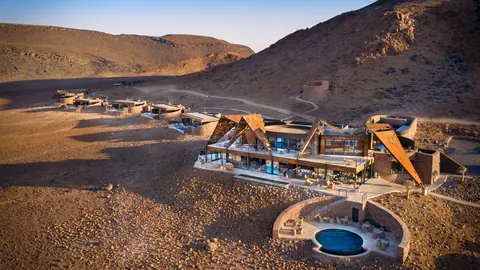
 HotelDesert Hills Glamping Camp17 km south of the Sesriem turnoff on the C19, Sesriem, Namibia+264 64 416 820
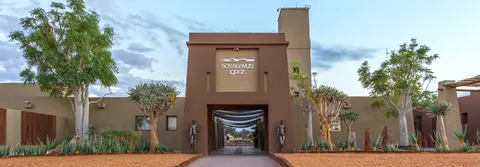
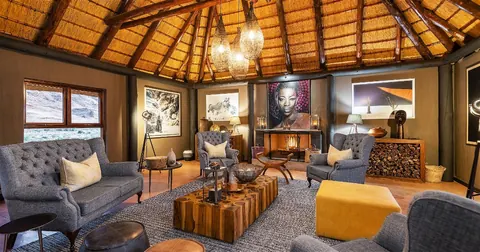
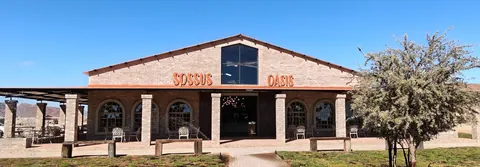
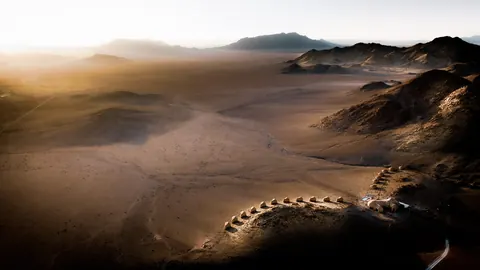
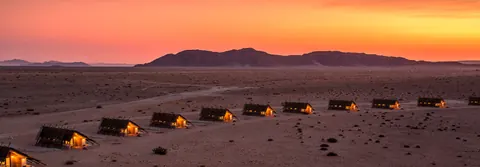
Sesriem is less a village than a park gate with a filling station, a small shop and a scatter of lodges and campsites near the southern end of the Naukluft mountains. Almost everyone is here because this is the way in to Sossusvlei and Deadvlei, some 60 to 65 km west. The Sesriem Canyon is a short drive from the gate. The name is Afrikaans for six thongs, after early travellers who tied six rawhide straps together to draw water from the pools in the canyon.
Getting there
Namibia Wildlife Resorts (NWR) puts Sesriem 334 km from Windhoek. Travellers say to allow about five hours from Windhoek or Swakopmund, and the roads in are gravel. From the north the C19 comes down from Solitaire, roughly 85 km away. From the south the C27 runs 237 km past the NamibRand Nature Reserve to the C13 near Helmeringhausen. It is untarred and often badly corrugated.
When to go
Weather records kept at Sesriem from 2010 to 2017 show average highs of 33 to 35°C from November to March and about 25°C in June and July, when nights drop to around 8°C. Rain is rare. May to October, the dry winter, is easier on the sand, but pack a warm jacket for sunrise.
What to do
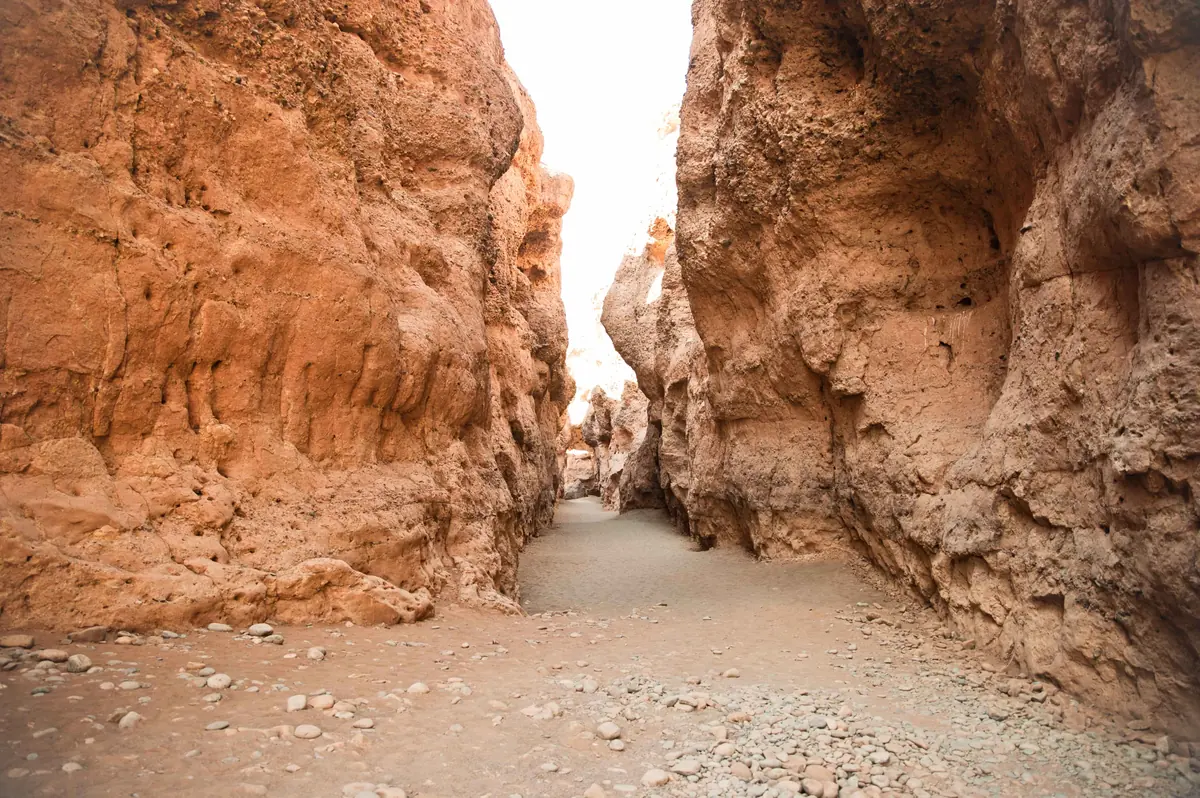
The canyon first. It lies about 4 km from Sesriem, roughly 1 km long and 30 to 40 metres deep by NWR’s figures, and only two metres wide in places. You can climb down and walk the dry riverbed. Elim Dune, on a side road 5 km past the gate, is about 100 metres high and a quieter place for early light or sunset than Dune 45, which stands 45 km in. Hot air balloons take off from Sesriem at dawn, and Namib Sky has flown in the area since 1991. The tar road ends at a car park about 60 km from the gate, and the last 5 km to Sossusvlei and Deadvlei is deep sand. Take the NWR shuttle unless you have a 4x4 and know how to drive sand.
Good to know
The main gate opens at sunrise and closes at sunset. Times shift monthly in half-hour steps, so ask at your camp. Guests at NWR’s Sesriem Campsite and Sossus Dune Lodge, both inside the gate, can reach the dunes before sunrise and stay out after sunset. Dead Valley Lodge, a privately run tented lodge that is also inside the park, says its guests get the same early start for sunrise. Lodges outside, however close, use the main gate, which tends to queue in the morning. Sesriem Campsite has 44 sites and is popular in high season, so book early.
Sossus Oasis at the gate sells fuel and has a tyre workshop and a shop. Fill up, because the next fuel to the north is at Solitaire. For the January to April rains the UK government advises no more than 80 km/h on gravel, two spare tyres and no driving outside towns at night. Sesriem is in Hardap, which is not on the CDC’s list of regions for malaria tablets, so the advice is just to avoid bites. Park fees are on our Namib-Naukluft National Park page.
History and culture
Sesriem is named after the rawhide straps early travellers needed to reach the water in its canyon, and today it exists for one reason: it is the gate to Sossusvlei. Before the park this was farming country, and the Naukluft mountains close by were where Hendrik Witbooi and his Nama people held out against German troops in 1893 and 1894. Knowing that makes the drive in more than a race to the dunes.
- Stone Age onwards
People have lived in and around the Namib for a very long time. Stone Age remains along the Kuiseb River, inside today's park, go back some 200,000 years, and later finds show semi-nomadic herders using the area when rain brought enough grazing. source
- 1893 to 1894
After German troops attacked his stronghold at Hornkranz in 1893, the Nama leader Hendrik Witbooi and his people fled into the Naukluft mountains, whose southern end lies close to Sesriem. German troops fought them there in August 1894, and after heavy losses Witbooi gave in and signed a protection treaty with the Germans on 19 September. source
- 1904 to 1908
The Nama, who had at first fought alongside the Germans, rose against them in 1904, months after the Herero. The war that followed is now recognised as genocide: up to 80,000 Herero and about 10,000 Nama, half the Nama people, died. source
- 1907
Governor Friedrich von Lindequist proclaimed Game Reserve No. 3 in the Namib, the oldest part of today's park, partly as a buffer to hold British rule to the enclave at Walvis Bay. source
- 1915 to 1940s
South African forces ended German rule in 1915. The League of Nations gave South Africa the territory, then called South West Africa, as a mandate in 1920, and from the late 1940s South Africa applied apartheid there, with pass laws and curfews for black residents. source
- 1966 to 1990
SWAPO (the South West Africa People's Organisation) launched an armed struggle against South African rule in 1966, and its army, PLAN, fought on through the Border War. Namibia became independent on 21 March 1990. source
- 1979
The Namib-Naukluft Park was proclaimed, joining the Namib Desert Park, the Naukluft Mountain Zebra Park of 1968 and state land. Sesriem Canyon and the Sossusvlei dunes are among its best-known sights. source
- 2006 to 2013
The tar road from Sesriem towards Sossusvlei was renewed in 2006, and on 21 June 2013 Sossusvlei became part of the Namib Sand Sea UNESCO World Heritage Site. source
- Language
- The 2023 census reports home languages by region. Across the Hardap Region, Khoekhoegowab (the Nama and Damara language, with its click sounds) was the main home language in 41.9% of households and Afrikaans in 39.4%. source
- Place names
- The names here mix languages. Sossus is usually given as a Nama word for no return or dead end, because the Tsauchab River has no outlet and ends there in the sand; vlei is Afrikaans for a marsh or pan. source
- A tourism settlement
- Sesriem is not a town in the usual sense. It is a fuel stop with a small shop or two at the park gate, with lodges and campsites spread over the plain around it. source
For German visitors: Friedrich von Lindequist, who proclaimed the game reserve that grew into today's park, was born on Rügen in 1862 and was governor of German South West Africa from 1905 to 1907. He also brought karakul sheep farming to the colony's settlers. source
For German visitors: The first geological mapping of the Naukluft mountains was done from 1935 by two German geologists, Henno Martin and Hermann Korn. source
For German visitors: Germany acknowledged in 2015 that a genocide was committed against the Herero and Nama, and in a disputed 2021 agreement with Namibia offered 1.1 billion euros in development aid while rejecting legal responsibility. source
Main sights in Sesriem
4- Sesriem Canyon
The gorge that gave Sesriem its name, near the entry to Sossusvlei. It is about 1 km long and 30 to 40 metres deep, with pools at the bottom that fill again after good rains.
Namibia Wildlife Resorts: Sesriem Campsite - Elim Dune
A fairly isolated dune about 100 metres high, 5 km past the gate, named after a farm that was here before the park. It is the closest dune to Sesriem Campsite.
Stingy Nomads: Sossusvlei and Dune 45 - Sossusvlei and Deadvlei
The clay pans at the end of the road, about 60 km from Sesriem, where the Tsauchab ends. Deadvlei was cut off from the river long ago and is full of dead trees that the dry air has kept from rotting for centuries.
Wikivoyage: Sossusvlei (Sesriem) - Naukluft mountains
The range rises about 1,000 metres above the plain at the latitude of Sesriem. Its springs flow all year, which made it a refuge for many groups, among them Hendrik Witbooi's Nama in 1893 and 1894.
Wikipedia (German): Naukluft
Did you know?
- The name means six thongs. The story is that early travellers had to tie six lengths of rawhide together to draw water from the pools in the canyon. source
- The Tsauchab River took about two million years to cut the canyon into sedimentary rock, old river gravels about five million years old, and it is still cutting. source
- The canyon is only two metres wide in places. One stretch of it never dries out, and animals come down to drink there. source
- Sossusvlei only holds water when the Tsauchab floods, which happens every five to ten years. Even then the river never gets to the Atlantic: the dunes stop it and the water dries up where it lies. source
- Most of the sand in the Namib's dune sea came down the Orange River, far to the south, which is why the Namib Sand Sea has been called the wind-displaced delta of the Orange River. source
- Namib Sky started flying hot air balloons over the dunes in 1991. Eric and Nancy began it, and the second generation, Denis and Andreia, has carried it on. source
- Dune 45 got its name simply from its distance: it stands beside the road 45 km from the gate. source
Checked 7 October 2026.
Wildlife you might see
10- likelyGemsbok (oryx)source
- likelySpringboksource
- likelyOstrichsource
- possibleBlack-backed jackalHeard calling at night around Sesriemsource
- possibleNamib desert beetle (collects water from the morning fog)source
- possibleDune larksource
- possibleLappet-faced vulturesource
- possibleLudwig's bustardsource
- possibleRüppell's korhaansource
- rareBrown hyaenasource
Likelihood is for a normal visit of two or three days, from the sources linked. Nothing is guaranteed in the wild.
Hikes and walks
4- Sesriem Canyon
A narrow gorge about 1 km long and 30 to 40 metres deep at the entry to Sossusvlei. The pools at its foot fill again after good rains.
Permit: Park entry fee. NWR also runs a canyon drive from Sesriem Campsite and guided canyon walks from Sossus Dune Lodge.
Namibia Wildlife Resorts: Sesriem Campsite - Elim Dune
A fairly isolated dune about 100 metres high on a side road 5 km past the Sesriem gate, and the closest dune to Sesriem Campsite. Most people drive on to Dune 45, so it is quieter for morning light or sunset.
Stingy Nomads: Sossusvlei and Dune 45 - Dune 45
Beside the tar road 45 km from the gate, which is how it got its name, and one of the easiest dunes to reach.
Permit: Park entry fee
Wikivoyage: Sossusvlei (Sesriem) - Deadvlei from the 2x4 car park
If you have no 4x4 and skip the NWR shuttle, you can walk the 4 km sand track from the end of the tar road, about 60 km from Sesriem, to the Deadvlei car park, then about 1 km more to the pan. It is hot, soft going, you still have to walk back, and there is no water for sale, so start early and carry plenty.
Stingy Nomads: Sossusvlei and Dune 45
Staying safe in Sesriem
- Malaria
- Sesriem is in the Hardap Region, which is not on the CDC's list of Namibian regions where malaria tablets are advised. The CDC says malaria is rare outside those regions and advises insect bite precautions only. source
- Desert heat
- Temperatures recorded at Sesriem from 2010 to 2017 reached 40.6°C, with average highs of 33 to 35°C from November to March. Carry plenty of water, do the walking early or late, and rest in the middle of the day. source
- Gravel roads
- The roads to Sesriem are gravel. The UK government says accidents on gravel and dirt roads are common. For the January to April rains, when many gravel roads deteriorate, it advises no more than 80 km/h, two spare tyres, plenty of water and no driving outside towns at night because of wildlife and livestock. source
- Flash floods in the canyon
- The Tsauchab carries water only when rain falls in the Naukluft mountains, but then it can turn into a strong, fast river in a few hours. Keep out of the canyon when storms are building over the mountains. source
- Sand at Sossusvlei
- The last 5 km to Sossusvlei is deep, soft sand, and rental cars driven by people new to sand get stuck there. Unless you have driven sand before, leave the car where the tar ends and take the shuttle. source
Tips from travellers
- Sleep inside the park if sunrise on the dunes matters to you. Guests at NWR's Sesriem Campsite and Sossus Dune Lodge can set off before the main gate opens (the campsite has its own inner gate), and Dead Valley Lodge, a private lodge inside the park, says the same of its guests. Everyone staying outside waits for the main gate, which opens at sunrise and usually has a queue. several sources
- Lodges outside the park that say they are closer to Sossusvlei still have to go through the same gate at the same time as everyone else. several sources
- Gate times change every month in half-hour steps, so ask at your camp. one source
- Book Sesriem Campsite well ahead for the busy season. It has 44 sites and is popular because it is inside the park. several sources
- Go to Dune 45 late in the afternoon. Most day visitors have left by then to get out before the gate closes at sunset. one source
- Top up at Sossus Oasis by the gate before heading into the park or onto the C27 or C19. It has fuel, a tyre workshop and a shop with takeaway food. one source
Checked 7 October 2026. Conditions change, so confirm with the park or venue before you go.
Quick answers
What animals can you see in Sesriem?
You have a good chance of seeing gemsbok (oryx), springbok and ostrich. Brown hyaena is there but rarely seen.
What are the best hikes in Sesriem?
Sesriem Canyon (1 km), Elim Dune, Dune 45 and Deadvlei from the 2x4 car park (4 km). See the hikes section for times, difficulty and permits.
Guides for Sesriem
Map of Sesriem
See every place on this map as a list