Place to stay · Sesriem
Desert Hills Glamping Camp
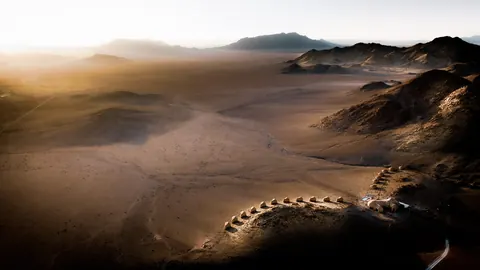
Small tented camp on a ridge on a private farm, off the C19 17 km south of the Sesriem turnoff. Ten twin tents and a family unit, a pool, and guided trips into Sossusvlei.
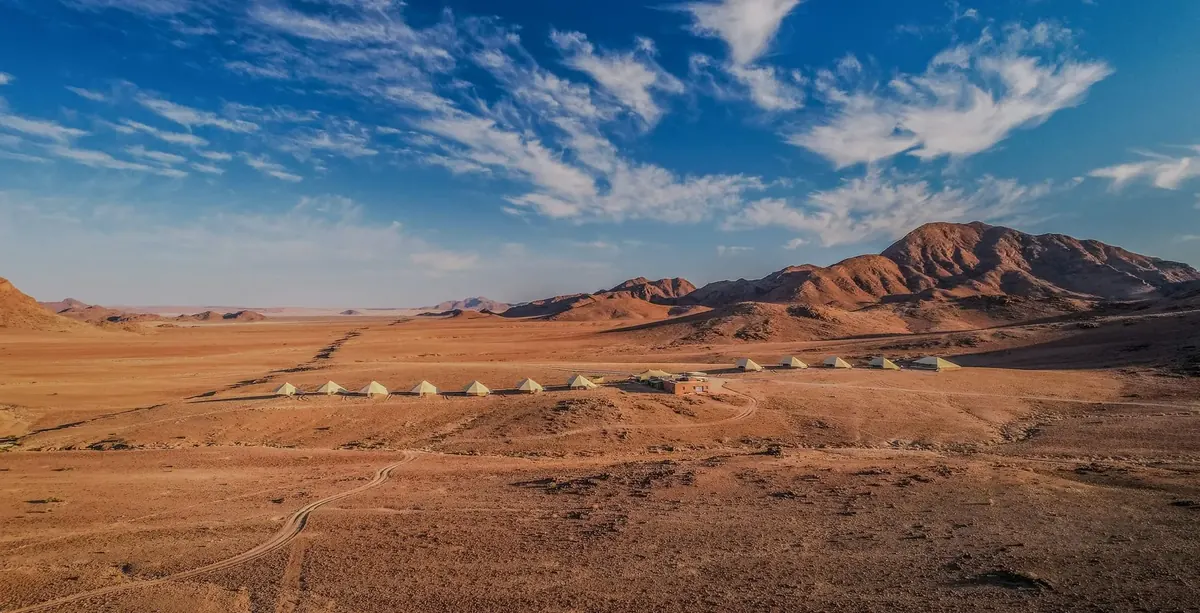
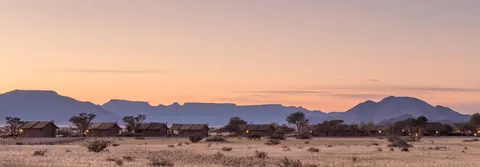
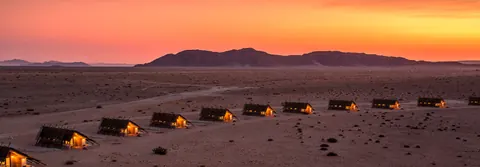
Desert Hills Glamping Camp is run by the tour operator Namibia Tracks and Trails and opened in May 2018. Look for its signboard on the C19 about 17 km south of the Sesriem turnoff. The camp is in a quiet valley on a private farm, roughly 1.5 km from Desert Hills Lodge, with the tents strung along a ridge above the valley. It suits people who want a small camp near the dunes rather than a big lodge at the gate.
What to expect
There are ten twin tents and one family unit, each about 43 m² by Info-Namibia’s figures, spaced well apart. They’re built on wooden frames with canvas walls and a wide flysheet over the top for shade, with aluminium sliding doors. Each has an en-suite shower, basin and flush toilet, 220V power, and a solar-powered air conditioner, according to the operator.
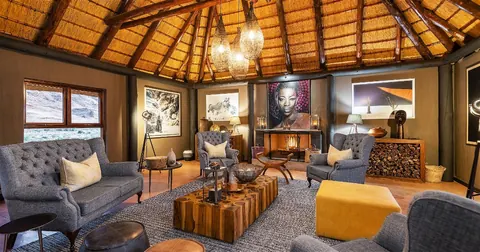
The main tent holds a lounge, a small bar and the dining area, opening onto a shaded patio. There’s a fire pit out front for evenings under the stars and a pool nearby for hot afternoons. Guided trips go into the park to Sossusvlei and the surrounding sights.
Practical details
- Bookings: Namibia Tracks and Trails, +264 64 416 820 (Swakopmund) or +264 61 252 197 (Windhoek).
- Breakfast and dinner are included. Drinks, other meals and activities are extra.
- There’s cellphone signal across the camp, and limited wifi in the main area.
- Coordinates: S 24° 35.709’, E 15° 57.991’, at 968 m above sea level.
Good to know
Expert Africa says the last stretch of track needs a 4x4, so check with the camp if you’re in a sedan. The camp is 17 km down the C19 from the Sesriem turnoff, plus the farm track, so if you want the dunes at first light, plan a very early start.
Last updated 7 October 2026. Sources: Namibia Tracks and Trails, Desert Hills Glamping Camp, Info-Namibia, Desert Hills Glamping Camp, Expert Africa, Desert Hills Glamping Camp.
Karakul country, mountain zebra and a rough last five kilometres
On 24 September 1907 a freighter put twelve sheep ashore at Swakopmund: two rams and ten ewes. They were karakul, shipped out from Germany after a Leipzig furrier called Thorer advised the colonial government to try the breed in the dry south, and Governor von Lindequist backed the idea. Within two generations the lamb pelts were being called the country’s “black diamonds”, and in the 1960s and 70s about five million of them left Namibia every year.
Hebron, bought as the pelt trade fell apart
That is the past of the hills behind this camp. The lodge next door, which shares the Desert Hills name, gives its own history as a karakul farm called Hebron, with the Porteus family buying a portion of it in 1981. The timing was awful for sheep. Anti-fur campaigns and a change in fashion gutted the trade from about 1980, the national flock fell from some 4.5 million animals to under 200,000, and in 1997 pelt exports hit their lowest figure on record.
Tourism came a generation later. The tented camp took its first guests in the middle of May 2018 and the lodge followed that June. An Italian trade magazine reported early in 2019 that the tour brand Il Diamante had conceived and built the camp for its own small groups, along with a sister camp in Damaraland.
Oryx for certain, zebra with luck
The zebra of this country is Hartmann’s mountain zebra. The Naukluft, now part of the national park, was first protected in 1964 as a mountain zebra park for exactly this animal. Tell it from the plains zebra of Etosha by the white belly, the stripes running right down to the hooves and the small dewlap under the throat. They keep to family groups of three to a dozen.
How likely are you to see them? The only counted record is thin. Two sets of guests filled in Expert Africa’s wildlife survey after stays in August and late September 2019. Both logged oryx (eight and ten) and zebra (three and ten). One party also ticked giraffe and wildebeest, which nobody else has backed up, so I would not plan around either. Nobody recorded a cat, a hyena or an aardvark. Expect oryx, hope for zebra, and treat anything else as a bonus. This is scenery country, not game country.
The track, the cold and the kitchen
Both of those guests brought up the road in. The trade press puts the private track at five kilometres. A British couple called it six, with one very steep part, and an American visitor got a flat tyre on the potholed last stretch in August 2019. It is 4x4 ground. One trade article gives about 35 minutes from the camp to Sesriem, which matters when you are racing the sunrise.
The same American visitor found the tent roomy and modern and the stars remarkable once the dark came down, but the August night was cold and the tent had extra blankets and no heater. Older descriptions list only fans, and the operator now lists solar air conditioning, so summer has been dealt with. Winter is a matter of packing a warm layer.
Both parties praised the food, which is more than you would expect this far out. One description has dinner cooked outside over an open fire, and a 2026 trade article says oryx turns up on the menu and the nearest shop is about an hour’s drive away. A travel writer has built a whole piece around watching a storm come in over the plains from the camp, which in a place this dry is the luckiest evening you can have.