Park · North-West District, Botswana
Nxai Pan National Park
A grassy fossil pan north of the Maun to Nata road where thousands of zebra arrive with the summer rains, plus Baines' Baobabs, seven old trees on the edge of a salt pan. Deep sand, 4x4 only.
Short answer
At Nxai Pan National Park, international visitors pay P190 (about US$14, €12.50 or £10.50) per adult and P95 per child per day. The rates apply from 1 April 2022 to 31 March 2027.
- Daily fee, international adult
- US$14 €13 · P190
- Malaria
- Nxai Pan is in Ngamiland (North-West District), one of the districts where the CDC says malaria is transmitted and recommends prescription antimalarials.
- Places to stay
- 9
- Park fee nearby: Makgadikgadi Pans National Park
- US$14 €13 · P190about 66 km away
Nxai Pan National Park fees 2026
Checked Department of Wildlife and National Parks (DWNP), Ministry of Environment and Tourism tariffValid 1 April 2022 to 31 March 2027, per person per day, in pula.
| Who | Adult | Child |
|---|---|---|
| International visitorsUS, Europe and everyone else | US$14 €13 · P190 | US$7 €6 · P95 |
| SADC nationals | P145 | P72.5 |
| Botswana citizens | P20 | P10 |
- Children under 8 enter free. From 8 they pay half the adult rate, which is the child figure shown. Where the half rate stops is not settled: one guide says it runs to 17, three others say 15, so a 16 or 17 year old may be charged as an adult.
- Vehicle fee per day, on top of the per person fee: P75 for a foreign-registered private vehicle under 3,500 kg and P20 for a Botswana-registered one. A trailer or caravan is P40 foreign, P10 local. From 3,500 to 7,000 kg it is P1,000 foreign and P500 local.
- The SADC rate is also what foreigners living in Botswana pay. The resident row here is the rate for Botswana citizens.
- On a trip run by a licensed Botswana tour operator the entry fee is lower: P135 for non-residents, P100 for residents and SADC nationals, P15 for citizens.
- South Camp and the Baines' Baobabs sites are run by Xomae, who charge separately for camping. You still pay DWNP for entry and the vehicle.
- A rise was due on 1 April 2026 and the ministry put it off the day before. Gabz FM reported in May that it had been pushed out by two years, and a July report had the existing fees still in place. No new date had been published when I checked on 12 October 2026.
- The fees started on 1 April 2022 and have no end date. I show them as valid to 31 March 2027, the end of Botswana's financial year, and will re-check then.
- Fees are set by Department of Wildlife and National Parks (DWNP), Ministry of Environment and Tourism. Official tariff · Seen a new rate? Tell us
US$1 = P13.47 · €1 = P15.06 · £1 = P18.07 (ECB rate and the Bank of Botswana rand rate, 3 Nov 2026). Converted amounts are approximate; you pay in pula.
How we got these figures
- The child ages are not in the ministry's 2022 schedule. ChobeNationalPark.co.za gives half price for 8 to 17. Tawana Self Drive says under 16, and Cheetah Safaris and Ostrich Trails say 8 to 15. The FAOLEX copy of the 2000 regulations leaves out the footnotes to the fee schedule, so I could not settle it from the law. The child figures are half the adult rate.
- This falls in Category B of the 2022 schedule, the band for every DWNP park and reserve except Chobe and Moremi.
- SafariFind lists P500, P300 and P50 for parks in this band. Those are the proposed fees that were postponed on 31 March 2026, not what the gate charges.
- The minister described the proposal as moving the non-resident fee from P380 to P500 and the citizen fee from P30 to P50. P380 matches no entry fee in the 2022 schedule, so I have not tied the proposal to a particular park.
- Ministry of Environment, Natural Resources Conservation and Tourism, Revised User Fees and Services (the 2022 schedule, copy linked from Tourism Update) · official · checked 12 Oct 2026
- Tourism Update (23 February 2022) · one source · checked 12 Oct 2026
- travelnews.africa (2022 report of the DWNP announcement) · one source · checked 12 Oct 2026
- Tawana Self Drive, Maun (page updated 16 April 2026) · one source · checked 12 Oct 2026
- Africa Travel Essentials (24 March 2026) · one source · checked 12 Oct 2026
- ChobeNationalPark.co.za (independent park guide, updated 13 May 2026, child ages only) · one source · checked 12 Oct 2026
- Cheetah Safaris (page updated 15 January 2026, child ages only) · one source · checked 12 Oct 2026
- Ostrich Trails, Mabuasehube guide (updated 27 June 2025, child ages only) · one source · checked 12 Oct 2026
- National Parks and Game Reserves Regulations, 1 April 2000 (the fee schedule before 2022), copy hosted by FAOLEX · official · checked 12 Oct 2026
- Botswana Daily News, government news agency (24 February 2026, the proposed increase) · official · checked 12 Oct 2026
- TravelComments.com (1 April 2026, increase postponed) · one source · checked 12 Oct 2026
- Gabz FM News (5 May 2026, increase put off by two years) · one source · checked 12 Oct 2026
- Travel and Tour World (29 July 2026, existing fees stay) · one source · checked 12 Oct 2026
Nxai Pan is a 2,578 square kilometre park on the northern edge of the Makgadikgadi pans, just north of the Maun to Nata road. The pan it is named for is the bed of a dead lake, now short grass with islands of umbrella thorn. Two things bring people here. One is the summer rain, when zebra arrive in their thousands to foal. The other is Baines’ Baobabs, seven enormous trees beside a white salt pan, looking much as Thomas Baines painted them in 1862.
Getting there
The park has one gate, right on the tarred A3, 65 km west of Gweta and roughly 130 km east of Maun. Let your tyres down there, because thick sand starts about 10 km in and keeps going most of the way to South Camp. Nothing less than a 4x4 will do.
The baobabs are about 30 km from the gate, an hour or so of sandy driving. South Camp, on Nxai Pan itself, takes a little over an hour.
When to go
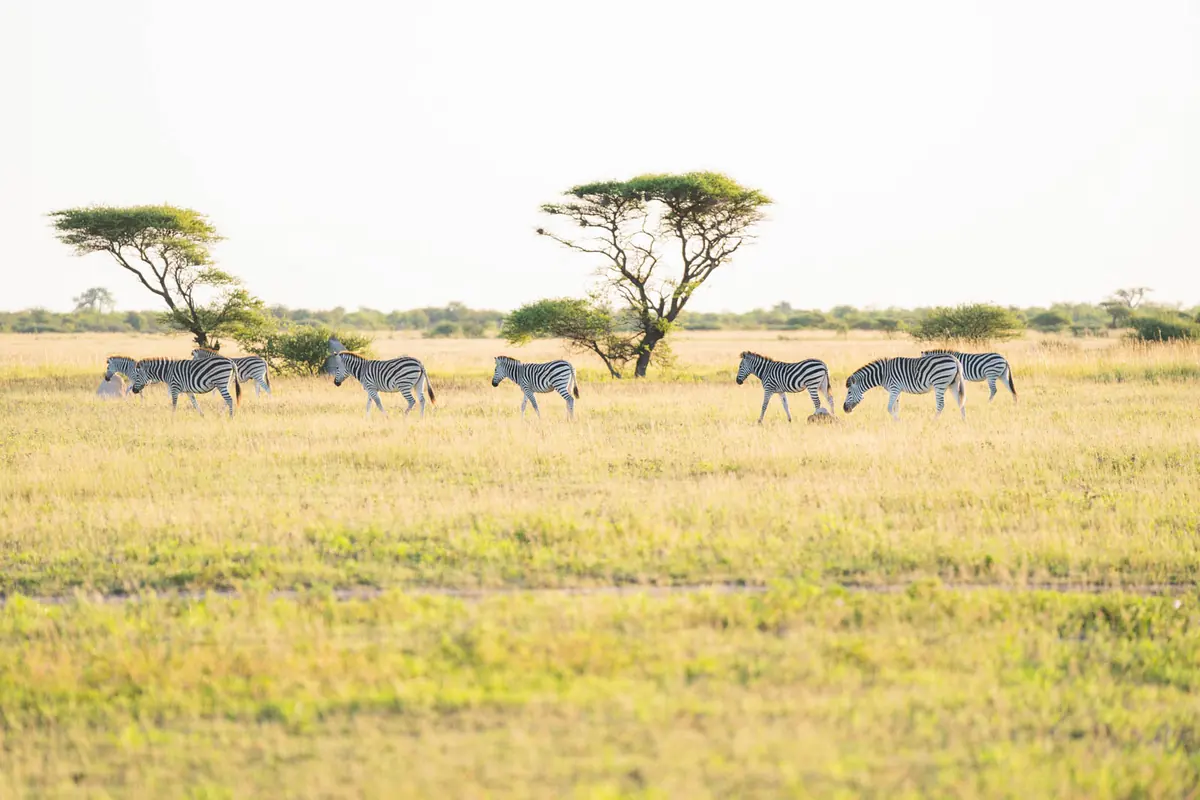
From December to April the rain turns the pan green and the zebra come, with wildebeest, springbok and the lion and cheetah that follow them. The tracks turn to mud and some become impassable, so regulars say to travel with a second vehicle.
May to September is dry and far easier to drive. There is less game, but the permanent water on Nxai Pan pulls in elephant. Winter days reach about 28°C. Nights can drop below freezing.
What to do
Sit at the waterhole near South Camp, late afternoon for choice. Elephant, giraffe, wildebeest and ostrich come in to drink. This is also the one place in Botswana where springbok and impala live side by side.
Then go south to Baines’ Baobabs on the edge of Kudiakam Pan. Day visitors are mostly gone by late afternoon, which is when the light is best. Three campsites sit around the pan, a couple of kilometres apart. In the rains the pan holds water and the route in changes with the mud.
Kwando’s Nxai Pan Camp, the only lodge, runs short walks with San guides.
Good to know
Nxai Pan is in Ngamiland, which the US CDC lists as a malaria area where tablets are recommended. See a travel clinic first.
There is no fuel in the park. Gweta has a filling station that sometimes runs dry, so fill up in Maun or Nata. Book and pay for a campsite with Xomae, who run South Camp and the Baines’ sites, before you arrive. Park entry is paid separately to DWNP, and it is wise to carry pula for it. South Camp has running water. The Baines’ sites have none.
No campsite is fenced, and elephants walk through South Camp on their way to drink. Gates open 06:00 to 18:30 from April to September and 05:30 to 19:00 from October to March. The limit is 40 km/h, you stay in the vehicle outside the camps, and drones are banned. Fees are in the table on this page.
History and culture
Nxai Pan National Park covers part of the bed of Lake Makgadikgadi, a lake that once filled much of northern Botswana and dried out thousands of years ago. This was San country, then a cattle droving route, and it has been protected since 1970. Its best-known sight, a group of seven baobabs beside a salt pan, has hardly changed since the English artist Thomas Baines painted it in 1862.
- About 10,000 years ago
Lake Makgadikgadi, which had existed for some two million years and was fed by the Okavango, Cuando and upper Zambezi rivers, was in the last stages of drying up. Nxai Pan and Kudiakam Pan are pieces of its old bed. source
- Before the 1800s
The land that is now the park was part of the country of the San (also called Basarwa in Botswana), the hunter-gatherer peoples of the Kalahari. source
- 1862
Thomas Baines, an English artist, came through with the trader James Chapman on the way to the Victoria Falls. In May 1862 he painted the group of baobabs on the edge of Kudiakam Pan that now carries his name. source
- 1885
Britain declared the Bechuanaland Protectorate on 31 March 1885. The area stayed under British rule until Botswana became independent on 30 September 1966. source
- 1950 to 1963
A cattle trail known as the old trek crossed what is now the park. It took herds from Ngamiland to Kazungula on the Zambezi. The trail ended when veterinary fences went up against foot-and-mouth disease. source
- 1970
The country around Nxai Pan was declared a game reserve. source
- 1992
The reserve was enlarged to take in Kudiakam Pan and Baines' Baobabs and was made a national park. It now covers 2,578 square kilometres. source
- 2012 to 2014
Researchers fitted GPS collars to eight zebra mares on the Chobe River floodplain. In December 2012, and again in December 2013, the animals walked due south to Nxai Pan and stayed about ten weeks. The study, published in 2014, called it the longest large mammal migration recorded in Africa. source
- The name
- Some say Nxai is the name of a hooked metal rod once used to pull springhares out of their burrows. Others say it simply means a pan. source
- The click
- The x in Nxai stands for a click. Click sounds are typical of the Khoisan languages and of some southern Bantu languages. source
- San guides
- The park's one lodge works with San guides and trackers, who lead short walks on survival skills and medicinal plants, knowledge handed down over generations. source
- Who runs what
- The Department of Wildlife and National Parks manages the park. The public campground is run by Xomae Group and the lodge by Kwando Safaris, and the Hospitality and Tourism Association of Botswana (HATAB) and the Botswana Guides Association manage campsites of their own. source
For American visitors: Roar: Lions of the Kalahari, a giant-screen film produced by National Geographic and Tim Liversedge Productions and released in December 2003, follows lions at a waterhole in Botswana. Liversedge spent more than two years with them. ATI Holidays, a southern African operator, says much of it was shot at Nxai Pan. source
Main sights in Nxai Pan National Park
4- Baines' Baobabs
Seven huge baobabs on the edge of Kudiakam Pan, about 30 km from the main entrance, named after Thomas Baines, who painted them in 1862. They are the reason many people come to the park at all.
Botswana Daily News, government news agency (23 March 2026, interview with the park manager) - Kudiakam Pan
The salt pan beside the baobabs. It fills with water in the rainy season, when it is a good place to watch birds.
Botswana Daily News, government news agency (23 March 2026, interview with the park manager) - The Nxai Pan waterhole
The waterhole on Nxai Pan is the focus in the dry season and worth an afternoon. ATI Holidays says much of the giant-screen film Roar: Lions of the Kalahari was shot here.
ATI Holidays, Nxai Pan South Campsite - Chapman's Baobab and Green's Baobab (near Gweta)
Outside the park, south of Gweta, are two more trees tied to the same era. Green's Baobab, 27 km south of Gweta, was carved with the names of 19th-century hunters and traders. Chapman's Baobab, once a landmark and a post office for people crossing the pans, fell on 7 January 2016.
Wikipedia, Gweta
Did you know?
- Zebra that spend the dry season on the Chobe River floodplains walk roughly 250 km in a straight line to Nxai Pan in December and back again, a 500 km round trip. The migration was unknown to science until eight of them were collared in 2012. source
- This is the one place in Botswana where springbok, an antelope of the dry south-west, and impala, an antelope of the wetter woodland, live side by side. source
- The seven Baines' Baobabs are put at about 1,000 years old and stand up to 20 metres tall. source
- The trees are also called the Sleeping Sisters. One had already fallen when Baines painted them, and it was still putting out leaves in 2004. source
- The park gets a little over 20,000 visitors a year, the park manager said in 2026, far fewer than Moremi. source
- A 2019 genetic study proposed that modern humans first emerged around the wetlands of the old Lake Makgadikgadi some 200,000 years ago. Other researchers dispute the conclusion. source
Checked 12 October 2026.
Wildlife you might see
14- very likelySpringbokThe open grass of Nxai Pan and around the waterhole near South Camp. All year. They are permanent residentssource
- very likelyPlains (Burchell's) zebraThe grass of Nxai Pan. December to April, when thousands arrive with the rains and foal here. Few outside those monthssource
- very likelyElephantThe waterhole near South Camp and the one in front of the lodge. They also walk through South Camp to get to water. Dry season, June to Octobersource
- very likelyOstrich, kori bustard and Namaqua sandgrouseThe waterhole near South Camp, where all three are regulars. All yearsource
- likelyGiraffeThe woodland around the pan and at the waterhole. Herds of more than 30 have been seen. All yearsource
- likelyImpalaAround Nxai Pan. This is the one place in Botswana where impala and springbok live together. All yearsource
- likelyBlue wildebeestNxai Pan and its waterhole. Most in the rains, December to Aprilsource
- likelyGemsbok (oryx)The open pans. Lone animals turn up at Kudiakam Pan near Baines' Baobabssource
- likelyGreater kuduThe mopane woodland. All yearsource
- likelyLionAround the Nxai Pan waterholes, where they wait for game coming to drink. All yearsource
- likelyBlack-backed jackal and bat-eared foxAround Nxai Pan, where both are resident in good numbers. All yearsource
- possibleCheetahThe open pan, which is good cheetah countrysource
- rareLeopardThe woodland around the panssource
- rareAfrican wild dogSeen occasionallysource
Likelihood is for a normal visit of two or three days, from the sources linked. Nothing is guaranteed in the wild.
Hikes and walks
1- San-guided walk from Nxai Pan Camp
Park rules do not let you walk or get out of your vehicle away from the camps, so there are no trails for self-drivers. The lodge runs short walks with San guides. The guides do not carry rifles.
Permit: For guests of Nxai Pan Camp only, with the camp's guides
Expert Africa, Nxai Pan Camp
Staying safe in Nxai Pan National Park
- Malaria
- Nxai Pan is in Ngamiland (North-West District), one of the districts where the CDC says malaria is transmitted and recommends prescription antimalarials. See a travel clinic well before you fly. source
- Unfenced camps
- None of the campsites is fenced. Elephants walk through South Camp on their way to the waterhole and have broken into the ablution block and the water tower looking for fresh water. Give them room. source
- Sand and mud
- The park is 4x4 only. Thick sand starts about 10 km north of the gate and runs to the Baines' Baobabs turn-off and most of the way to South Camp, so let your tyres down at the gate. In the rains the pans flood and the mud can be impassable. Travel with a second vehicle if you can. source
- Park rules
- The speed limit is 40 km/h. You may not drive between sunset and sunrise, and you may not walk or get out of your vehicle except at camps and other marked facilities. Gates open 06:00 to 18:30 from 1 April to 30 September and 05:30 to 19:00 from 1 October to 31 March. source
- Water
- There is borehole water at the gate and water at South Camp but none at Baines' Baobabs, and no phone signal there either. Carry all the water you need for the nights you spend at the trees. source
- Cold nights
- Winter days are mild, around 28°C, but once the sun goes down the temperature can fall below freezing. Pack properly warm clothes and bedding for June to August. source
Tips from travellers
- There is no fuel in the park. Gweta, 65 km east of the gate, has a filling station but it does not always have fuel. Fill up in Maun if you are coming from the west and Nata from the east. one source
- Book and pay for your campsite with Xomae before you get to the gate. Staff there want to see the booking before they let you pay the DWNP entry fee and go in. one source
- Bring enough pula in cash for the park fees. one source
- At Baines' Baobabs, day visitors crowd the trees in the middle of the day. Wait at your campsite until they leave and go across for the last light. one source
- For game, sleep at South Camp. For quiet, sleep at Baines' Baobabs. The South Camp pitches are close together, while the three Baines' sites are a couple of kilometres apart, each taking up to three vehicles and 12 people. one source
- The waterhole on Nxai Pan is at its best late in the afternoon, so plan to be parked there before sunset and still make camp before the gate hours end. several sources
Checked 12 October 2026. Conditions change, so confirm with the park or venue before you go.
The week Chapman's camera failed beside Baines' Baobabs
On Monday 19 May 1862 Thomas Baines got his wagon across a salt pan by threatening the driver and the oxen in turn. The wagon behind followed too closely in the broken crust and went down to the axles. The dogs spent the day chasing sheets of water that were not there, from one shore of the pan to the other.
Two days later he walked a long circuit with his gun, shot nothing, and came to a clump of baobabs he had seen from the wagon.
A week of bad water and a camera that would not work
Everyone knows the painting. Fewer know that the party sat beside the pan for a week, and why. The water lay on the salt and it made them ill, so they sent men nearly three miles for a cleaner pool and waited for the sick to mend.
James Chapman, whose expedition it was, had a camera with him. He spent that week trying to photograph the mirage and a giant baobab, and on the 28th wrote that he would probably have to give it up, beaten by a cold cutting wind and fog off the plain. Some Bushmen watched him point the camera at a troop of wildebeest and then shoot one at long range. They took him by the buttonhole and asked whether God was in the box.
So the picture that survives is a painting. Baines counted five full-sized trees, two or three younger ones and one giant lying flat and still pushing out leaves. Where the old bark had peeled he saw the coppery red and yellow that, he noted, Livingstone had always objected to in his pictures. Baines had worked for Livingstone on the Zambezi. He took star sights from the camp and decided that the doctor’s position for the next waterhole, Kamma-Kamma, was miles out. Livingstone, he wrote, treated his miles as “small change”. The Royal Geographical Society holds an 1862 watercolour of the group, on a sheet it shares with a study of a blue wildebeest.
Chapman found a fallen baobab limb hollowed out and full of bats, barn owls and wild cats. Two days after the wagons left, some twenty miles on, Baines followed a rhinoceros path to a pool, and Chapman counted eight white rhino coming to drink there that night. The rhino are the part that has changed.
Lionesses that eat tortoises
The guides at the park’s one lodge publish what they see every month, and seven years of it gives a fair picture of the Nxai Pan pride. From December 2021 to March 2022 it was eleven strong. By late 2025 it was five lionesses, three cubs and two males. Giraffe are a habit: the guides found the pride on giraffe carcasses along West Road in December 2021, December 2023 and twice in 2025.
Then there are the tortoises. A lioness was found eating a leopard tortoise on Middle Road in December 2023, and another lone lioness was doing the same in January 2026. The lions also drink from the lodge swimming pool, sometimes at dinner time.
The road to the trees is where the leopard is
Leopard at Nxai Pan are mostly footprints. The sightings that do get logged are oddly consistent though: on or beside the sandy main road down to Baines’ Baobabs, often lying up in shade, and mostly in the green months (March 2022, December 2024, January and March 2025).
Cheetah used to be easier. One territorial male was seen regularly on the pan from 2019 to 2022, sometimes on Middle Road. Since then, a few sightings a year. Wild dog are a small pack of four that turned up in at least six months of 2025.
The park is better for small animals than anyone tells you. Aardwolf have had dens beside West Road, Baobab Loop and Middle Road. Honey badgers dig for mice in daylight with a pale chanting goshawk behind them to grab whatever bolts. And two things nobody expects: buffalo herds of 100 to 200 at the lodge waterhole in the dry months, and, in January and March 2026, hippo. The guides logged one resting at the main waterhole, then two males seen several times and another near the South Camp gate. Theirs is the only report.
Counting zebra, and missing them
The zebra do not all come from the Chobe. Many come up from the Boteti in Makgadikgadi, and a second migration runs from the Okavango to the Makgadikgadi grasslands just south of here. Hattie Bartlam-Brooks found that one. A veterinary fence had cut the route from 1968 untill it came down in 2004, and within four years zebra were walking it again.
Guides counted about 2,000 near Baines’ Baobabs at the very end of November 2019 and about 5,000 around the pan by the first week of January 2020. The June before, the lodge’s regular zebra were down to four. Then again, in August and September of 2024 and 2025 there were herds on the pan in months usually written off for zebra.
Sit still, and drive the sand early
Sit still. One party who spent three nights at South Camp in the winter of 2011 saw very little on the first day. Once they parked and waited, 21 elephants in several groups came down to the waterhole in one afternoon and a leopard showed, too far off to photograph.
On the sand, the forums agree. In 2015 one driver called it probably the worst he had driven in Botswana and another called the road diabolical. A third put the worst of it between the Baines’ turn-off and South Camp. A couple travelling in 2018 wrote that it was the hardest sand road they had met up to then. Go early, one regular advises, while the sand is cold. Rain changes it: a driver writing in January 2008 found the track hard and Kudiakam Pan full of water, with a Land Cruiser and trailer stuck in it.
At the trees, people write about the quiet. A camper there in May 2025 described no engines and no voices, only a jackal barking a long way off. Mariska Ford camped in midsummer and found the silence almost frightening at first. Then a storm came over, and she woke in the rain to a lion calling in the dark. In the morning she had to drive out across wet crust.
In and around Nxai Pan National Park
18 places listedWhere to stay in Nxai Pan National Park 9
- 19.88°S 24.71°EHotelKwando Nxai Pan Lodge
- 19.94°S 24.78°ECampsiteNxai South Camp
- 20.14°S 24.77°ECampsiteBaines Baobab (Campsite 2)
- 20.15°S 24.77°ECampsiteBaines Baobab (Campsite 3)
- 20.12°S 24.76°ECampsiteBaines Baobabs (Campsite 1)
- 19.93°S 24.73°ECampsiteBoga Site Nxai Pan
- 19.93°S 24.82°ECampsiteHatab Camp
- 20.09°S 24.75°ECampsiteHatab Campsite
- 19.88°S 24.79°ECampsiteNorth Camp
Sights 9
- Baines BaobabsViewpoint
- BoababAttraction
- Look out point and hideViewpoint
- waterholeViewpoint
- waterhole #1Viewpoint
- Waterhole #1Viewpoint
- Waterhole #2Viewpoint
- Waterhole #3Viewpoint
- Waterhole #4Viewpoint
Quick answers
How much is the entry fee for Nxai Pan National Park?
International visitors pay P190 (about US$14, €12.50 or £10.50) per adult and P95 per child per day. These rates apply from 1 April 2022 to 31 March 2027 and are set by Department of Wildlife and National Parks (DWNP), Ministry of Environment and Tourism.
Do Botswanans and SADC citizens pay less at Nxai Pan National Park?
Botswana citizens pay P20 per adult and SADC nationals pay P145 per adult per day. You need ID or a passport to get the lower rate.
When were these Nxai Pan National Park fees last checked?
We last checked them on 12 October 2026 against 13 published sources. We re-check every two weeks, but always confirm with Department of Wildlife and National Parks (DWNP), Ministry of Environment and Tourism before you travel.
What animals can you see in Nxai Pan National Park?
Most visitors see springbok, plains (burchell's) zebra, elephant, ostrich, kori bustard and namaqua sandgrouse. You have a good chance of seeing giraffe, impala, blue wildebeest, gemsbok (oryx), greater kudu and lion. Leopard and african wild dog are there but rarely seen.
Nxai Pan and the parks nearest it
| Park | International adult | Distance | Where |
|---|---|---|---|
| Nxai Pan National Park | US$14 €13 · P190 | · | North-West District |
| Makgadikgadi Pans National Park | US$14 €13 · P190 | 66 km | Central District |
| Chobe National Park | US$20 €18 · P270 | 158 km | Chobe District |
| Moremi Game Reserve | US$20 €18 · P270 | 172 km | North-West District |
Guides for Nxai Pan National Park
Where the Nxai Pan fees come from
- Ministry of Environment, Natural Resources Conservation and Tourism, Revised User Fees and Services (the 2022 schedule, copy linked from Tourism Update)
- Tourism Update (23 February 2022)
- travelnews.africa (2022 report of the DWNP announcement)
- Tawana Self Drive, Maun (page updated 16 April 2026)
- Africa Travel Essentials (24 March 2026)
- ChobeNationalPark.co.za (independent park guide, updated 13 May 2026, child ages only)
- Cheetah Safaris (page updated 15 January 2026, child ages only)
- Ostrich Trails, Mabuasehube guide (updated 27 June 2025, child ages only)
- National Parks and Game Reserves Regulations, 1 April 2000 (the fee schedule before 2022), copy hosted by FAOLEX
- Botswana Daily News, government news agency (24 February 2026, the proposed increase)
- TravelComments.com (1 April 2026, increase postponed)
- Gabz FM News (5 May 2026, increase put off by two years)
- Travel and Tour World (29 July 2026, existing fees stay)
Open data: all park fees (CSV) · JSON (CC BY 4.0)
Cite as: Travel Africa Guide, "Nxai Pan National Park fees 2026", checked 12 October 2026, https://travelafrica.guide/botswana/nxai-pan-national-park/
Map of Nxai Pan National Park
See every place on this map as a list