Park · Central District, Botswana
Makgadikgadi Pans National Park
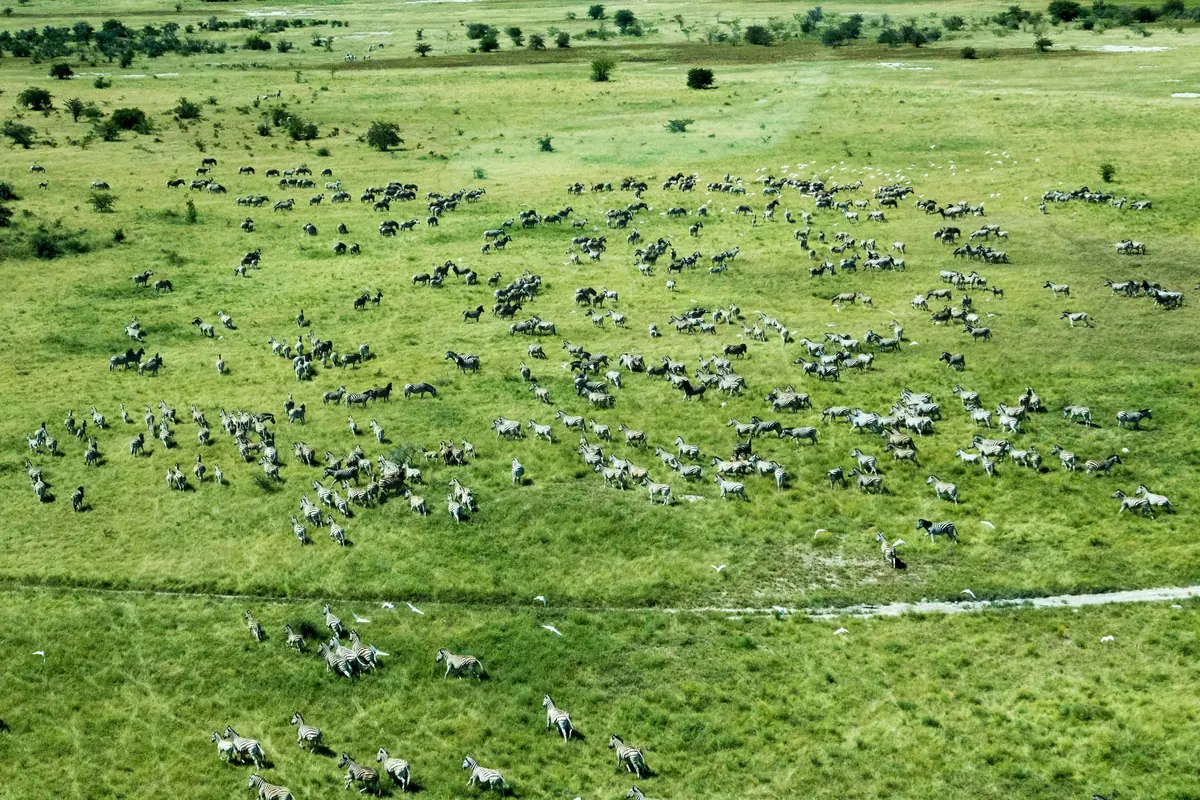
Grassland, palm islands and a corner of Ntwetwe Pan, with the Boteti River down the western edge where zebra and elephant drink in the dry months. Deep sand, 4x4 only.
Short answer
At Makgadikgadi Pans National Park, international visitors pay P190 (about US$14, €12.50 or £10.50) per adult and P95 per child per day. The rates apply from 1 April 2022 to 31 March 2027.
- Daily fee, international adult
- US$14 €13 · P190
- Malaria
- The park is in Boteti, one of the districts where the CDC says malaria is transmitted and recommends prescription antimalarials (atovaquone-proguanil, doxycycline, mefloquine or tafenoquine).
- Places to stay
- 10
- Park fee nearby: Nxai Pan National Park
- US$14 €13 · P190about 66 km away
Makgadikgadi Pans National Park fees 2026
Checked Department of Wildlife and National Parks (DWNP), Ministry of Environment and Tourism tariffValid 1 April 2022 to 31 March 2027, per person per day, in pula.
| Who | Adult | Child |
|---|---|---|
| International visitorsUS, Europe and everyone else | US$14 €13 · P190 | US$7 €6 · P95 |
| SADC nationals | P145 | P72.5 |
| Botswana citizens | P20 | P10 |
- Makgadikgadi Pans and Nxai Pan are separate parks with the same fee. I have found nothing in the schedule about one payment covering both, so plan on paying for each day in each.
- Children under 8 enter free. From 8 they pay half the adult rate, which is the child figure shown. Where the half rate stops is not settled: one guide says it runs to 17, three others say 15, so a 16 or 17 year old may be charged as an adult.
- Vehicle fee per day, on top of the per person fee: P75 for a foreign-registered private vehicle under 3,500 kg and P20 for a Botswana-registered one. A trailer or caravan is P40 foreign, P10 local. From 3,500 to 7,000 kg it is P1,000 foreign and P500 local.
- The SADC rate is also what foreigners living in Botswana pay. The resident row here is the rate for Botswana citizens.
- On a trip run by a licensed Botswana tour operator the entry fee is lower: P135 for non-residents, P100 for residents and SADC nationals, P15 for citizens.
- Khumaga campsite is run by SKL and charged at their rate, separate from the park fee. A campsite DWNP runs itself costs non-residents P40 a person a night.
- A rise was due on 1 April 2026 and the ministry put it off the day before. Gabz FM reported in May that it had been pushed out by two years, and a July report had the existing fees still in place. No new date had been published when I checked on 12 October 2026.
- The fees started on 1 April 2022 and have no end date. I show them as valid to 31 March 2027, the end of Botswana's financial year, and will re-check then.
- Fees are set by Department of Wildlife and National Parks (DWNP), Ministry of Environment and Tourism. Official tariff · Seen a new rate? Tell us
US$1 = P13.47 · €1 = P15.06 · £1 = P18.07 (ECB rate and the Bank of Botswana rand rate, 3 Nov 2026). Converted amounts are approximate; you pay in pula.
How we got these figures
- The child ages are not in the ministry's 2022 schedule. ChobeNationalPark.co.za gives half price for 8 to 17. Tawana Self Drive says under 16, and Cheetah Safaris and Ostrich Trails say 8 to 15. The FAOLEX copy of the 2000 regulations leaves out the footnotes to the fee schedule, so I could not settle it from the law. The child figures are half the adult rate.
- This falls in Category B of the 2022 schedule, the band for every DWNP park and reserve except Chobe and Moremi.
- SafariFind lists P500, P300 and P50 for parks in this band. Those are the proposed fees that were postponed on 31 March 2026, not what the gate charges.
- The minister described the proposal as moving the non-resident fee from P380 to P500 and the citizen fee from P30 to P50. P380 matches no entry fee in the 2022 schedule, so I have not tied the proposal to a particular park.
- Ministry of Environment, Natural Resources Conservation and Tourism, Revised User Fees and Services (the 2022 schedule, copy linked from Tourism Update) · official · checked 12 Oct 2026
- Tourism Update (23 February 2022) · one source · checked 12 Oct 2026
- travelnews.africa (2022 report of the DWNP announcement) · one source · checked 12 Oct 2026
- Tawana Self Drive, Maun (page updated 16 April 2026) · one source · checked 12 Oct 2026
- Africa Travel Essentials (24 March 2026) · one source · checked 12 Oct 2026
- ChobeNationalPark.co.za (independent park guide, updated 13 May 2026, child ages only) · one source · checked 12 Oct 2026
- Cheetah Safaris (page updated 15 January 2026, child ages only) · one source · checked 12 Oct 2026
- Ostrich Trails, Mabuasehube guide (updated 27 June 2025, child ages only) · one source · checked 12 Oct 2026
- National Parks and Game Reserves Regulations, 1 April 2000 (the fee schedule before 2022), copy hosted by FAOLEX · official · checked 12 Oct 2026
- Botswana Daily News, government news agency (24 February 2026, the proposed increase) · official · checked 12 Oct 2026
- TravelComments.com (1 April 2026, increase postponed) · one source · checked 12 Oct 2026
- Gabz FM News (5 May 2026, increase put off by two years) · one source · checked 12 Oct 2026
- Travel and Tour World (29 July 2026, existing fees stay) · one source · checked 12 Oct 2026
The name oversells the salt. Only about a fifth of this park is pan, a corner of Ntwetwe broken into many small ones. The rest is Kalahari grassland, with palm groves in the east and thick woodland along the Boteti River, which is the western boundary. It became a game reserve in 1970 and a national park in 1992. People come for the zebra and wildebeest that crowd the river in the dry months.
Getting there
The tarred A3 between Maun and Nata runs along the northern edge. Phuduhudu Gate, the main one, is about 100 metres off the tar, roughly 160 km east of Maun and 45 km west of Gweta. Khumaga Gate is on the west, across the Boteti from Khumaga village. When the river is dry you drive over. When it flows there is a one-car pontoon ferry, and now and then the water suits neither, which means about 80 km round by tar to Phuduhudu.
When to go
From about June the herds drift west to the Boteti, and September to November is the peak on the riverfront. The rains, which start around November or December, pull them back to the eastern grasslands and north towards Nxai Pan, and the tracks get muddy. Summer is hot and winter nights are freezing.
What to do
Drive the river road either side of Khumaga. The hippo pools hold water when little else does, and zebra, kudu, giraffe and elephant come down the steep banks to drink. Lion follow the herds. Out east it is a different trip, with springbok, gemsbok, ostrich and almost nobody else. Tree Island has three wilderness sites run by DWNP. Older guides also list two sites at Njuca Hills, on a low fossil dune about 38 km east of Khumaga, but those were reported closed in 2021.
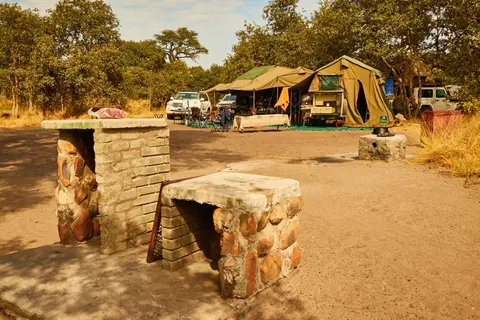
Khumaga camp, run by SKL, has ten sites above the river and two ablution blocks. Its borehole water smells of sulphur and is not for drinking.
Good to know
You need a 4x4. The sand is deep in places, worst near Khumaga gate and on the tracks between the river and the east. There is no fuel in the park, so fill up in Maun or Nata. Rakops has a pump, but regulars treat it as a top-up because it runs out. Carry all your drinking water. Tree Island has none, and a breakdown in the east can go unnoticed for days.
The Boteti is not a sure thing. It stopped flowing here in the late 1980s, came back in 2009 and almost dried up again in 2016.
Gates open 06:00 to 18:30 from April to September and 05:30 to 19:00 from October to March. The limit is 40 km/h. Camps are unfenced and elephants walk through Khumaga. This is a malaria area: the CDC lists Boteti among the districts where it recommends antimalarials. Do not drive onto a pan that looks dry, because the crust is thin and the clay underneath is wet. Fees are in the table on this page.
History and culture
The park lies on the bed of a lake that no longer exists. Lake Makgadikgadi once filled this part of the Kalahari, and people lived beside it for a very long time before the water went. What is left is salt pan, grass and one unreliable river, the Boteti, and the history here is mostly about who followed that river: herds, San hunters, cattle keepers, Victorian travellers and, lately, elephants.
- About 200,000 years ago
A 2019 paper in Nature used mitochondrial DNA from people living in southern Africa to argue that the oldest maternal line of modern humans arose on the shores of Lake Makgadikgadi about 200,000 years ago, and that people began moving out roughly 70,000 years later. Other researchers, among them Chris Stringer of the Natural History Museum in London, dispute the conclusion, so treat it as a claim, not a settled fact. source
- Stone Age
Stone tools are found in quantity on the pans, some of them old enough to predate our own species. Later, when there was more water about, herders grazed livestock here. source
- Before 10,000 years ago
Lake Makgadikgadi may have covered anywhere between 80,000 and 275,000 square kilometres, fed by the Okavango, the upper Zambezi and the Cuando. By about 10,000 years ago it had all but dried up, leaving the pans. source
- 4 July 1849
David Livingstone, travelling with William Cotton Oswell and Mungo Murray, reached the Boteti, which he called the Zouga, opposite a village of people he names as Bakurutse. Shortly before, a San woman who at first thought she was being captured had led the party to water at Nchokotsa and was given meat and beads for it. There they saw their first salt pan and took it for the lake they were looking for. They followed the river and reached Lake Ngami on 1 August. source
- 1861
James Chapman and the painter Thomas Baines came through together. The huge baobab on Ntwetwe Pan that travellers steered by, and left letters in, took Chapman's name. source
- 1967
De Beers geologists found the Orapa diamond pipe, south-east of the park, on 1 March 1967, a year after Botswana's independence. Orapa is now the largest diamond mine in the world by area. source
- 1968 to 2007
From 1968 a veterinary cordon fence (a disease-control barrier) cut the zebra's route between the Okavango Delta and the Makgadikgadi grasslands. It came down in 2004. Researchers who fitted GPS collars to zebra in 2007 found that more than half of those collared on the delta's south-eastern edge were already walking to the Makgadikgadi and back, a round trip of 588 km. source
- 1970 and 1992
The area around the pans was declared a game reserve in 1970. In 1992 it was enlarged and became a national park. source
- People on the park's edge
- The 2022 census counted 1,016 people in Kumaga (the census spelling of Khumaga), the village across the river from the western gate, 679 in Phuduhudu by the northern gate and 5,548 in Gweta. Central Boteti, the census district that takes in the river villages, had 74,553. source
- Communities
- The villages around the pans are home to Bakalanga, Bayei and San (Basarwa) families. source
- Living next to elephants
- The elephants that came back with the river are mostly bulls, and Khumaga village on the far bank has had to learn to live with them. The research charity Elephants for Africa moved its base to the Makgadikgadi in 2012 and works with the Khumaga community on reducing conflict between people and elephants. source
- The river's name
- Livingstone heard the river called Noka ea Batletli, the river of the Batletli, a cattle-keeping people with a click language who lived along it. source
- Gweta's name
- Gweta is said to be named for the croaking of the bullfrogs that lie buried in the sand until the rains. source
For American visitors: American viewers may know these pans from Great Zebra Exodus, an episode in season 31 of the PBS series Nature. It follows zebra families from the saltpans west to the Boteti River when the dry season starts. source
Main sights in Makgadikgadi Pans National Park
6- Boteti riverfront and hippo pools
The western boundary of the park and the reason the herds come. The steep, wooded banks and the width of the sandy bed show how big the river once was, and a few pools hold water all year.
Chris McIntyre, Botswana (Bradt Travel Guides), online edition, Makgadikgadi Pans National Park - Khumaga ferry
A pontoon that carries one vehicle at a time across the Boteti from Khumaga village to the park gate when the river is flowing. In dry years people simply drive across the bed.
Ostrich Trails, Makgadikgadi Pans National Park (updated 2 July 2025) - Njuca Hills
A low fossil dune, no more than about 20 metres high, in the middle of the park. In country this flat that is enough for a wide view over the grasslands.
Chris McIntyre, Botswana (Bradt Travel Guides), online edition, Makgadikgadi Pans National Park campsites - Ntwetwe Pan edge
The park takes in one corner of Ntwetwe Pan, broken into many small pans. This is the salt in the park's name.
Chris McIntyre, Botswana (Bradt Travel Guides), online edition, Makgadikgadi Pans National Park - Chapman's Baobab (outside the park)
South of Gweta, not in the national park. It was about 25 metres round, served as a beacon for travellers crossing the pans, and passing traders left letters in it and carved their names on the trunk. The tree fell on 7 January 2016.
Wikipedia, Gweta - Baines' Baobabs (Nxai Pan National Park)
North of the Maun to Nata road in the neighbouring park, the cluster of very old baobabs named after Thomas Baines, who first described them for Western botany.
Wikipedia, Nxai Pan National Park
Did you know?
- Only about a fifth of the park is salt pan. The rest is grassland on Kalahari sand, with low fossil dunes that mark old shorelines of the lake. source
- NASA's Terra satellite photographed the pans on 10 June 2018. NASA puts the whole Makgadikgadi system at roughly 30,000 square kilometres and calls it one of only two places in southern Africa where flamingos breed. source
- The Boteti stopped reaching Leroo La Tau, the lodge on the park's western boundary, in 1988 and did not flow past it again until 2009. A small pod of hippos sat out those two decades in the last waterholes. source
- Several ostrich hens lay in one nest, which can hold more than 30 eggs. The dark male sits at night and the drab female by day. source
- The Boteti nearly dried up again in 2016. The water came back on 19 August, and a group of elephants arrived to drink as it did. source
- The lower Boteti was channelled below Rakops to feed Mopipi Dam, which supplies the diamond mines around Orapa. The diversion left many people along the river short of fresh water. source
Checked 12 October 2026.
Wildlife you might see
14- likelyBurchell's zebraAlong the Boteti River on the western edge in the dry months, out on the eastern grasslands after rain. On the river from about June, at their thickest September to November. They leave when the rains come in December or Januarysource
- likelyBlue wildebeestWith the zebra herds, on the Boteti in the dry season and the eastern grasslands in the wet. Same pattern as the zebrasource
- likelyElephantThe Boteti riverbed and the woodland on its banks. Mostly bulls, which moved back in once the river flowed again after its 20 dry years. Fewer when the river is lowsource
- likelyHippoThe permanent pools in the Boteti near Khumaga. A pod sat out the river's dry years in these poolssource
- likelyGreater kuduThe woodland along the Boteti, where kudu, bushbuck and grey duiker live all yearsource
- likelySpringbokAround the pans and open grassland in the east of the parksource
- likelyOstrichCommon on the eastern grasslands, and often visible from the Nata to Maun roadsource
- possibleGiraffeSmall numbers in the woodland along the riversource
- possibleGemsbok (oryx)Eastern grasslands and pan edges. Some join the dry-season move to the Botetisource
- possibleLionThey follow the herds, so the Boteti in the dry season is the best bet. They sometimes walk through the campsites. Most often seen while the herds are on the river, September to Novembersource
- possibleFlamingos and pelicansOn the park's pans when they hold water. Summer, and only after good rainsource
- rareLeopardLives all year in the thick bush along the Botetisource
- rareCheetahCould turn up wherever there are springbok, which are commonest around the panssource
- rareBrown hyenaThe park's eastern side and the pan fringes. It hunts and scavenges at night, so few visitors see onesource
Likelihood is for a normal visit of two or three days, from the sources linked. Nothing is guaranteed in the wild.
Staying safe in Makgadikgadi Pans National Park
- Malaria
- The park is in Boteti, one of the districts where the CDC says malaria is transmitted and recommends prescription antimalarials (atovaquone-proguanil, doxycycline, mefloquine or tafenoquine). See a travel clinic before you leave, and cover up and use repellent from dusk. source
- Malaria after heavy rain
- Risk follows the rain. The WHO reported more than 2,300 confirmed cases and 8 deaths across Botswana by the end of May 2025 after unusually heavy rainfall, and named Boteti among the hardest-hit districts. Take the tablets seriously in and just after a wet summer. source
- Unfenced camps
- None of the campsites is fenced. The operator's rules at Khumaga are to stay inside the campground, keep children with you at all times and never feed or disturb an animal. Walking in the park is not allowed. source
- Staying in the vehicle
- Park regulations forbid walking, and you may only get out along a track where you have a clear view around you, no dangerous animal is within 100 metres, and you stay within 25 metres of the vehicle. Gates are open 06:00 to 18:30 from April to September and 05:30 to 19:00 from October to March, and the limit is 40 km/h. Swimming is banned too. source
- Remoteness
- The east of the park is a long way from help. A couple who broke down at Njuca Hills told the Bradt guide's author they were not found until the third morning, and then only by chance. Carry spare water and food for a wait like that. source
- Pan surfaces and grass
- A pan that looks dry is often a thin crust over deep wet clay. Stay on the existing tracks and steer clear of dark patches, which mean damp ground. In tall grass, seeds block the radiator and dry stalks pack in under the car near the exhaust, so fit netting in front of the radiator, check underneath and carry a fire extinguisher. source
Tips from travellers
- There is no fuel in the park. Fill up in Maun or Nata, and allow for fuel economy 15 to 20 per cent worse than usual in the sand, which is thickest near Khumaga gate and on the tracks between the river and the east. one source
- Khumaga's tap water comes from a borehole and is not for drinking or cooking. Tree Island has no water at all. Bring everything you will drink. several sources
- At Khumaga the river decides how you cross. When the bed is dry you drive over, and when it flows a pontoon ferry takes one car at a time. If the level suits neither, it is about 80 km round by tar to Phuduhudu Gate, so ask locally before you commit to that side. several sources
- Khumaga is booked through SKL and Tree Island through DWNP, and you still pay park fees on top, at the gate if you have not paid ahead. Book early. Tracks4Africa says up to a year ahead for Botswana's park camps. one source
- Elephants walk through and around Khumaga camp, and hippos leave tracks there overnight. Give them room and stay close to your vehicle after dark. one source
Checked 12 October 2026. Conditions change, so confirm with the park or venue before you go.
The lions that go seven months without water
Some of the Boteti’s big crocodiles sat out the river’s worst years in holes in its banks. Chris McIntyre, who writes the Bradt guide to Botswana, saw one of these lairs a good four or five metres above the water, and that was in May, months before the pools reached their lowest. A documentary filmed here over two years as the water came back, Boteti: The Returning River, shows crocodiles lying up in bank caves out of the sun and coming out, reluctantly, when big flocks of quelea came down to drink. One couple camping at Khumaga in early February, with the river down to pools again, photographed a crocodile by the hippo pools.
Twenty kilometres out and back again
The zebra are put at somewhere between 20,000 and 25,000, depending on who is counting, and in the dry months they depend on a single line of water down the park’s western edge. So they commute. Researchers from the Royal Veterinary College and the Okavango Research Institute put collars on 26 mares for 18 months, two dry seasons, and found them grazing more than 20 km from the Boteti and walking back to drink only every three to five days.
They do not follow one worn road to do it. The collared mares headed fairly directly between grass and water without sticking to set routes.
It costs them. PBS’s Great Zebra Exodus, filmed here by Adrian Bailey and Robyn Keene-Young, says only about half the foals see out their first year. One overlander who camped at Khumaga at the turn of October and November 2010 reported lots of carcasses among the herds and did not wait long to watch a kill.
Lions that drink from a gemsbok
These are not the big sprawling prides of the Okavango. Some follow the herds back to the river. Others stay out on the eastern plains, 50 km from the Boteti, and the Bradt guide’s account of those is the strangest thing written about this park. It has lionesses living in pairs over more than 1,000 square kilometres, and a male dividing his time between two or more pairs and walking up to 50 km in a night. Surface water can be missing for as long as seven months. So when they pull down a gemsbok, the guide says, they open the belly and stomach and drink what is inside before the sand takes it. In lean months they eat aardvark and porcupine. That detail rests on the one book, though Kalahari lions further south are known to get by on the fluids of their prey.
Graham Hemson of Oxford’s WildCRU and his colleagues put GPS collars on Makgadikgadi lions and found something awkward. When the herds moved, most of the collared lions did not go with them. They stayed on one edge of the park or the other and turned to cattle, mostly strays caught out at night, while keeping clear of the cattle posts themselves and of the hours when people were about. People at the cattle posts told the team they were not prepared to change how they kept their stock and would kill lions instead.
For a visitor, lions here are a maybe. The Bradt guide says they can be common on the riverfront while the herds are in, from September to November, and that they sometimes walk through the campsites.
A fence nobody can keep closed
The government’s answer was an electrified fence along the Boteti, put up in the mid-2000s on the bed of what was then a dry river. Problem-animal reports show fewer livestock killed while it stood intact. It did not stay intact. A survey published in 2015 found lions, elephants and digging animals going through mostly in the dry season, and cattle crossing in numbers in the rains.
On 11 August 2015 the wildlife minister, Tshekedi Khama, told a kgotla meeting in Khumaga that the solar panels that powered the fence kept being stolen, and that the ministry could pay for a new fence but not for refurbishing the old one. He proposed putting it on the village side of the river. People at the meeting asked what that would do to their fields, grazing and boreholes. When you cross on the pontoon you are crossing that argument.
Bulls by day, cows after dark
Almost every elephant you see along the river will be a bull. Elephants for Africa, whose camp is inside the park opposite Khumaga, records more than 95 per cent males and tells them apart by ear notches and tusks. The few breeding herds seem to drink at night, so the researchers think their daytime counts miss them. A day visitor will too.
What people who camp at Khumaga say
Not everyone gets the show. Two parties came a week apart in April 2012. The first stayed four nights, found almost no game and heard donkey and cow bells the whole time. The second saw plenty along the river on the drive in, then found the camp facing a busy village and full of trainee rangers, and did not stay. Reports from August through to early November are different: large zebra herds on the river in August, zebra and wildebeest crossing in late October.
The zebra are loud. The Bradt guide calls it hiccuping, and one camper described the calling going on all night, with something killed behind the tents at about nine. That was in late March, well outside the usual season, and it is one traveller’s account.
The east is the opposite. One traveller who took a Tree Island site in mid-April drove in past thousands of zebra around the small pans, heard lions after dark and preferred the feel of it to Khumaga, while saying the river is the better bet for animals. In the wet months the herds are out there or north in Nxai Pan, and the riverfront is quiet.
In and around Makgadikgadi Pans National Park
10 places listedWhere to stay in Makgadikgadi Pans National Park 10
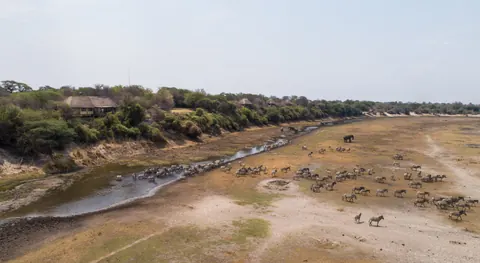
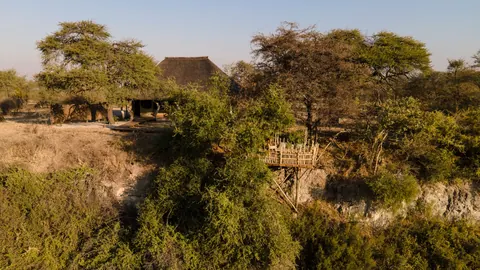
- 20.45°S 24.52°ECampsiteKumaga Campsite
- 20.46°S 24.52°ECampsiteCampsite #1
- 20.42°S 24.52°ECampsiteLeroo La Tau
- 20.43°S 24.87°ECampsiteNjuca Camp
- 20.49°S 24.92°ECampsiteTree Island Camp 1
- 20.49°S 24.92°ECampsiteTree Island Camp 2
Show all 10 places to stay
- Tree Island Camp 3 · Campsite
Quick answers
How much is the entry fee for Makgadikgadi Pans National Park?
International visitors pay P190 (about US$14, €12.50 or £10.50) per adult and P95 per child per day. These rates apply from 1 April 2022 to 31 March 2027 and are set by Department of Wildlife and National Parks (DWNP), Ministry of Environment and Tourism.
Do Botswanans and SADC citizens pay less at Makgadikgadi Pans National Park?
Botswana citizens pay P20 per adult and SADC nationals pay P145 per adult per day. You need ID or a passport to get the lower rate.
When were these Makgadikgadi Pans National Park fees last checked?
We last checked them on 12 October 2026 against 13 published sources. We re-check every two weeks, but always confirm with Department of Wildlife and National Parks (DWNP), Ministry of Environment and Tourism before you travel.
What animals can you see in Makgadikgadi Pans National Park?
You have a good chance of seeing burchell's zebra, blue wildebeest, elephant, hippo, greater kudu and springbok. Leopard, cheetah and brown hyena are there but rarely seen.
Makgadikgadi Pans and the parks nearest it
| Park | International adult | Distance | Where |
|---|---|---|---|
| Makgadikgadi Pans National Park | US$14 €13 · P190 | · | Central District |
| Nxai Pan National Park | US$14 €13 · P190 | 66 km | North-West District |
| Moremi Game Reserve | US$20 €18 · P270 | 208 km | North-West District |
| Central Kalahari Game Reserve | US$14 €13 · P190 | 213 km | Ghanzi District |
Guides for Makgadikgadi Pans National Park
Where the Makgadikgadi Pans fees come from
- Ministry of Environment, Natural Resources Conservation and Tourism, Revised User Fees and Services (the 2022 schedule, copy linked from Tourism Update)
- Tourism Update (23 February 2022)
- travelnews.africa (2022 report of the DWNP announcement)
- Tawana Self Drive, Maun (page updated 16 April 2026)
- Africa Travel Essentials (24 March 2026)
- ChobeNationalPark.co.za (independent park guide, updated 13 May 2026, child ages only)
- Cheetah Safaris (page updated 15 January 2026, child ages only)
- Ostrich Trails, Mabuasehube guide (updated 27 June 2025, child ages only)
- National Parks and Game Reserves Regulations, 1 April 2000 (the fee schedule before 2022), copy hosted by FAOLEX
- Botswana Daily News, government news agency (24 February 2026, the proposed increase)
- TravelComments.com (1 April 2026, increase postponed)
- Gabz FM News (5 May 2026, increase put off by two years)
- Travel and Tour World (29 July 2026, existing fees stay)
Open data: all park fees (CSV) · JSON (CC BY 4.0)
Cite as: Travel Africa Guide, "Makgadikgadi Pans National Park fees 2026", checked 12 October 2026, https://travelafrica.guide/botswana/makgadikgadi-pans-national-park/
Map of Makgadikgadi Pans National Park
See every place on this map as a list