Park · Ghanzi District, Botswana
Central Kalahari Game Reserve
A reserve bigger than the Netherlands in the middle of Botswana: fossil river valleys, black-maned lions and unfenced campsites. No fuel, water or phone signal inside, so it is for well-prepared 4x4 parties.
Short answer
At Central Kalahari Game Reserve, international visitors pay P190 (about US$14, €12.50 or £10.50) per adult and P95 per child per day. The rates apply from 1 April 2022 to 31 March 2027.
- Daily fee, international adult
- US$14 €13 · P190
- Malaria
- The reserve lies in Ghanzi District, which the CDC lists among Botswana's malaria transmission areas, and it recommends prescription antimalarials for travel there.
- Places to stay
- 37
- Where
- Ghanzi District, Botswana22.19°S 23.82°E
Central Kalahari Game Reserve fees 2026
Checked Department of Wildlife and National Parks (DWNP), Ministry of Environment and Tourism tariffValid 1 April 2022 to 31 March 2027, per person per day, in pula.
| Who | Adult | Child |
|---|---|---|
| International visitorsUS, Europe and everyone else | US$14 €13 · P190 | US$7 €6 · P95 |
| SADC nationals | P145 | P72.5 |
| Botswana citizens | P20 | P10 |
- Children under 8 enter free. From 8 they pay half the adult rate, which is the child figure shown. Where the half rate stops is not settled: one guide says it runs to 17, three others say 15, so a 16 or 17 year old may be charged as an adult.
- Vehicle fee per day, on top of the per person fee: P75 for a foreign-registered private vehicle under 3,500 kg and P20 for a Botswana-registered one. A trailer or caravan is P40 foreign, P10 local. From 3,500 to 7,000 kg it is P1,000 foreign and P500 local.
- The SADC rate is also what foreigners living in Botswana pay. The resident row here is the rate for Botswana citizens.
- On a trip run by a licensed Botswana tour operator the entry fee is lower: P135 for non-residents, P100 for residents and SADC nationals, P15 for citizens.
- Most campsites here (Passarge, Sunday Pan, Letiahau, Piper Pan, Motopi among them) are run by Bigfoot Tours at their own rate. The few DWNP still runs cost non-residents P40 a person a night, residents and SADC nationals P30, citizens P15.
- A rise was due on 1 April 2026 and the ministry put it off the day before. Gabz FM reported in May that it had been pushed out by two years, and a July report had the existing fees still in place. No new date had been published when I checked on 12 October 2026.
- The fees started on 1 April 2022 and have no end date. I show them as valid to 31 March 2027, the end of Botswana's financial year, and will re-check then.
- Fees are set by Department of Wildlife and National Parks (DWNP), Ministry of Environment and Tourism. Official tariff · Seen a new rate? Tell us
US$1 = P13.47 · €1 = P15.06 · £1 = P18.07 (ECB rate and the Bank of Botswana rand rate, 3 Nov 2026). Converted amounts are approximate; you pay in pula.
How we got these figures
- The child ages are not in the ministry's 2022 schedule. ChobeNationalPark.co.za gives half price for 8 to 17. Tawana Self Drive says under 16, and Cheetah Safaris and Ostrich Trails say 8 to 15. The FAOLEX copy of the 2000 regulations leaves out the footnotes to the fee schedule, so I could not settle it from the law. The child figures are half the adult rate.
- This falls in Category B of the 2022 schedule, the band for every DWNP park and reserve except Chobe and Moremi.
- SafariFind lists P500, P300 and P50 for parks in this band. Those are the proposed fees that were postponed on 31 March 2026, not what the gate charges.
- The minister described the proposal as moving the non-resident fee from P380 to P500 and the citizen fee from P30 to P50. P380 matches no entry fee in the 2022 schedule, so I have not tied the proposal to a particular park.
- Ministry of Environment, Natural Resources Conservation and Tourism, Revised User Fees and Services (the 2022 schedule, copy linked from Tourism Update) · official · checked 12 Oct 2026
- Tourism Update (23 February 2022) · one source · checked 12 Oct 2026
- travelnews.africa (2022 report of the DWNP announcement) · one source · checked 12 Oct 2026
- Tawana Self Drive, Maun (page updated 16 April 2026) · one source · checked 12 Oct 2026
- Africa Travel Essentials (24 March 2026) · one source · checked 12 Oct 2026
- Cheetah Safaris (page updated 15 January 2026) · one source · checked 12 Oct 2026
- ChobeNationalPark.co.za (independent park guide, updated 13 May 2026, child ages only) · one source · checked 12 Oct 2026
- Ostrich Trails, Mabuasehube guide (updated 27 June 2025, child ages only) · one source · checked 12 Oct 2026
- National Parks and Game Reserves Regulations, 1 April 2000 (the fee schedule before 2022), copy hosted by FAOLEX · official · checked 12 Oct 2026
- Botswana Daily News, government news agency (24 February 2026, the proposed increase) · official · checked 12 Oct 2026
- TravelComments.com (1 April 2026, increase postponed) · one source · checked 12 Oct 2026
- Gabz FM News (5 May 2026, increase put off by two years) · one source · checked 12 Oct 2026
- Travel and Tour World (29 July 2026, existing fees stay) · one source · checked 12 Oct 2026
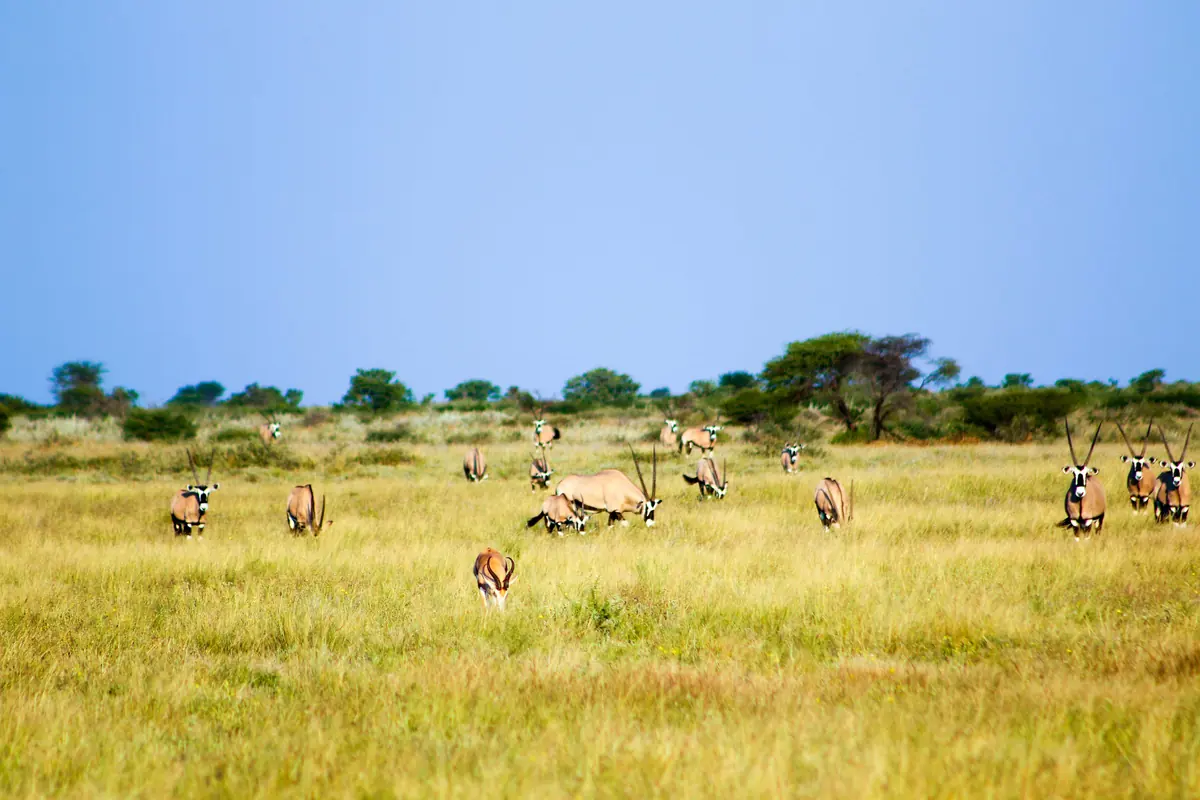
The Central Kalahari Game Reserve covers 52,800 square kilometres in the middle of Botswana, more than the whole of the Netherlands, and very few people are ever in it. It was set up in 1961 and takes up over 40 percent of Ghanzi District: flat sandveld cut by fossil river valleys and salt pans. People come for black-maned lions, cheetah on the open pans, big herds of springbok and gemsbok after rain, and camping with no fence and no neighbours.
Getting there
Most visitors come in from the north-east. From Rakops a corrugated sand track runs 45 km to Matswere Gate. Xade Gate is the western way in, about 170 km from Ghanzi (Gantsi) by way of New Xade. Tsau Gate is in the north-west, and a long southern route comes up through Khutse Game Reserve. All of them need a proper 4x4. Tau Pan Camp, the one lodge open inside the reserve, also takes fly-in guests.
When to go
The rains, December to March, are the best time for game here. Fresh grass pulls the herds onto the valley floors of Deception and Passarge and the cats follow. The price is mud. In February 2025 the ministry closed flooded tracks around Deception, Sunday, Leopard, Tau and Piper pans. April and May are a fair compromise. From June the game spreads out. July nights can freeze, and October days pass 40°C.
What to do
You drive the valleys and pans: Deception Valley, Sunday and Leopard pans, Passarge Valley, Tau Pan and Piper Pan. In the dry months the solar-pumped waterholes at Sunday Pan and Piper Pan are where to sit and wait.
A campsite here is a clearing with a pit latrine, a bucket shower and a fireplace. You bring the water. The Department of Wildlife and National Parks (DWNP) runs some sites (Deception, Kori, Leopard Pan, Xade and others) and Bigfoot Tours runs Passarge, Sunday Pan, Piper Pan, Letiahau, Lekhubu and Motopi. Book before you travel, because the gate wants to see a campsite booking. Kalahari Plains Camp, the second lodge, is closed with no reopening date.
Good to know
There is no fuel, no shop, no firewood and no phone signal inside, and most of the reserve has no water. Fill up at Letlhakane or Rakops, the nearest pumps, and carry jerry cans, because deep sand pushes fuel use well up. One party in 2024 ran dry 30 km short of the gate. The speed limit is 40 km/h and driving after dark is not allowed. Gates open from 06:00 to 18:30 from April to September and from 05:30 to 19:00 from October to March. South of Deception Valley, go in convoy, never as a single vehicle.
The CDC lists Ghanzi District as a malaria transmission area and recommends antimalarials, so ask a travel clinic. Lions and hyenas do walk through the camps at night.
This is also the home of the Gǁana and Gǀwi San, most of whom the government moved out in 1997 and 2002. Fees are in the table on this page.
History and culture
The Central Kalahari Game Reserve was not set up only for animals. It was created in 1961 so that the San who lived here could go on hunting and gathering, and from 1997 most of them were moved out. Their fight to come home went through Botswana's courts for years, and some families live in small settlements inside the reserve today. Knowing that changes how the empty pans look.
- For thousands of years
The Gǁana, Gǀwi and Tsila, San peoples who lived by hunting and gathering, used this part of the Kalahari long before it had a boundary. Their neighbours here were the Bakgalagadi. source
- 1961
In 1958 the government of the Bechuanaland Protectorate (the British-ruled territory that became Botswana) asked George Silberbauer to study the position of the San, who are called Basarwa in Botswana. Out of his work came the reserve, declared in 1961 to protect the wildlife and to give about 5,000 people, most of them San, a place to keep their way of life. He had wanted a reserve for people, but no law allowed one. source
- 1986
A government white paper of 15 July 1986 set a new policy: the people living in the reserve were to be settled somewhere else. The government argued that hunting was reducing the game and that schools, hospitals and police could not be provided inside a game reserve. source
- 1997
The government moved 1,739 San and Bakgalagadi residents out, 1,239 of them to a new settlement about 70 km from their old one at Xade, which became known by its official name, New Xade, and 500 to Kaudwane on the southern edge. People were paid for huts and livestock but not for the land. The government said the move was needed to conserve the reserve and to provide health care and schooling. source
- 2002
The government stopped all services to those still living in the reserve and capped the borehole that supplied their water. Residents, with the group First People of the Kalahari, took the government to the High Court. Survival International and others blamed the diamonds found in the reserve. President Festus Mogae said the removals had nothing to do with mining. source
- 13 December 2006
The High Court ruled, by two judges to one, that the residents had been deprived of their land "forcibly or wrongly and without their consent", and that refusing them entry without a permit and refusing them hunting licences was unlawful and unconstitutional. It did not order the government to bring back water or other services, and the government let only limited numbers return. source
- 2011
After a second case, Botswana's Court of Appeal ruled that the residents could reopen their borehole or drill new ones for household water. The judges found the government guilty of degrading treatment and ordered it to pay the costs of the appeal. source
- 10 December 2024
Pitseng Gaoberekwe, who died in December 2021, was buried at Metsiamanong inside the reserve after almost three years in which the courts had barred his family from burying him there. President Duma Boko, in office for six weeks and once a lawyer for the residents, attended and promised to restore their rights. source
- Languages
- Gǀwi (also written Gǀui) belongs to the Gǁana group of Khoe languages and is closely related to Naro. It has the largest known set of click sounds of any Khoe language. The ǀ and ǁ in the names are clicks. It had about 1,500 speakers in 2013. source
- What people call themselves
- San is the usual word in English, but Africa Geographic notes that the Gǁana, Gǀwi and Tsila of the reserve have said they prefer to be called Bushmen. Many cultural visits are sold around the Kalahari. Before you book one, ask how much of the money goes to the guides. source
- Walking with a tracker
- At Tau Pan Camp, guests can take a nature walk with a San tracker who explains which plants lead to water and which were used as medicine. Because the camp is inside the reserve, guides on the walk are not allowed to carry firearms. source
- Roy Sesana
- The best-known voice of the reserve's people was born at Molapo, a settlement inside it, and trained as a traditional healer after coming home from work in South Africa in 1971. He helped found First People of the Kalahari in 1991 and received the Right Livelihood Award in 2005 for resisting the removals. source
For American visitors: Two young American zoologists, Mark and Delia Owens, lived for seven years in Deception Valley from the mid-1970s, studying lions, brown hyenas and jackals. Their book about it, Cry of the Kalahari (1984), was an international bestseller and won the John Burroughs Medal in 1985. source
For American visitors: Delia Owens, who grew up in Georgia and met Mark at the University of Georgia, later wrote the novel Where the Crawdads Sing (2018). The couple had arrived in Africa in 1974. They were expelled from Botswana after campaigning against its cattle industry. source
For American visitors: A 2005 cable from the US ambassador to Botswana, Joseph Huggins, made public in 2011, criticised the removals and said people had been "dumped in economically absolutely unviable situations without forethought, and without follow-up support" at New Xade. source
Main sights in Central Kalahari Game Reserve
5- Deception Valley
The best-known part of the reserve, a fossil river valley in the north. In the rains and just after, December to May, its short grass draws springbok and gemsbok in large numbers, with lion, cheetah and leopard behind them.
Expert Africa, Central Kalahari Game Reserve (seasons, wildlife, camps) - Sunday Pan
A pan with a waterhole fed by a solar-powered borehole. In the dry months gemsbok, springbok and jackal come in to drink, and one party wrote of spending hours parked beside it.
Tracks4Africa blog, The Kalahari is not for sissies (Karin Theron, 30 September 2016) - Tau Pan
Springbok gather in dense herds on the short grass here. Sunday and Leopard pans get more visitors, but one writer who made the trek calls Tau Pan her best memory of the reserve.
Tracks4Africa blog, Why you should visit the remotest park in Botswana (Romi Boom, 8 June 2021) - Piper Pan
A big pan about 140 km of soft sand from Matswere Gate, with a waterhole that pulls in plains game, elephant now and then, and the lions that hunt them.
Evening Standard, Wild camping in Botswana's Central Kalahari (David Cohen, 20 May 2024), copy on Yahoo News - Passarge Valley
Another fossil valley in the north where springbok and gemsbok collect on new grass from December to May.
Expert Africa, Central Kalahari Game Reserve (seasons, wildlife, camps)
Did you know?
- At 52,800 km² the reserve is larger than the Netherlands and is usually ranked the second largest game reserve in the world. It takes up over 40 percent of Ghanzi District. source
- Ghanzi District, which holds the whole reserve, had 56,555 people at the 2022 census, fewer than any other district in Botswana, on 117,910 km² of land. source
- Kalahari comes from the Setswana kgala, "the great thirst", or Kgalagadi, "a waterless place". source
- Deception Valley is a fossil riverbed. It is said to get its name from the mirage that shimmers over its pan and looks like water. source
- There is a diamond mine inside the reserve. Gem Diamonds bought the deposit, then called Gope, from De Beers in 2007 and spent more than US$85 million on an underground mine, Ghaghoo, beneath 80 metres of sand. It was commissioned early in 2015 and put on care and maintenance in March 2017. In June 2019 Gem agreed to sell it to a Botswana company. source
- The presiding judge in the 2006 case was Unity Dow, the first woman appointed to Botswana's High Court. The case was brought by Roy Sesana and Keiwa Setlhobogwa on behalf of 241 others. source
Checked 12 October 2026.
Wildlife you might see
12- very likelySpringbokThe short-grass pans and valley floors, above all Deception Valley and Passarge Valley. All year, in herds of more than a hundred during and just after the rains (December to May)source
- very likelyGemsbok (oryx)Open plains and around the pans. All year. They can go long periods without surface watersource
- very likelyBlack-backed jackal and bat-eared foxOn the pans and at the waterholes. One overlander wrote that she had never seen as many in any other parksource
- very likelyOstrich and kori bustardOut on the pans and grass plains. All yearsource
- likelyGiraffe, kudu, red hartebeest and blue wildebeestAll year. Wildebeest gather in large herds in the rains, December to Marchsource
- likelyGround squirrelAround the campsites, along with the hornbillssource
- likelyLionMost often reported from Deception Valley and the north of the reserve. The males here have dark manes. Best in and just after the rains, when prey gathers in the valleyssource
- likelyBirds of prey: pale chanting goshawk, bateleur, tawny eagle, secretary birdAround the pans and open plains in the north of the reservesource
- possibleCheetahThe wide open pans. The reserve is counted among the better places in Botswana to find themsource
- rareBrown hyenaMore common here than in northern Botswana, but still seldom seensource
- rareLeopard and African wild dogBoth live in the reserve, but in low numbers compared with northern Botswanasource
- rareElephantThey do move through, but sightings are few and far between. This is not an elephant parksource
Likelihood is for a normal visit of two or three days, from the sources linked. Nothing is guaranteed in the wild.
Staying safe in Central Kalahari Game Reserve
- Malaria
- The reserve lies in Ghanzi District, which the CDC lists among Botswana's malaria transmission areas, and it recommends prescription antimalarials for travel there. Some travel writers call the Central Kalahari malaria-free. I would go with the CDC and ask a travel clinic before you leave. source
- Lions and hyenas in camp
- No campsite has a fence and the operator says plainly that wild animals can walk in. Stay in your site after dark, keep quiet between 20:00 and 06:00 as the camp rules ask, and never feed anything. source
- Remoteness
- When the government organised a large gathering deep in the reserve in December 2024, the Ghanzi District Commissioner told people driving in to carry extra fuel and travel in groups. That is sound advice for any visitor. The reserve has no phone network of its own, and one had to be brought in for the event. source
- Mud and flooded tracks
- After heavy rain the pans and clay stretches become impassable. In February 2025 the Ministry of Environment and Tourism closed tracks around Motopi, Passarge, Deception Pan, Kukama, Lekhubu, Letiahau, Piper Pan, Phokoje, Tau Pan, Sunday Pan and Leopard Pan because of flooding. Ask at the gate which routes are open before you commit to one. source
- Dry grass and fire
- Dry grass lines the narrow tracks and grows on the hump between the wheel ruts. Stopping a hot vehicle over it can start a fire, and one party passed three burnt-out vehicles on a single trip. source
- Park rules
- The speed limit in Botswana's parks and reserves is 40 km/h. You may not drive between gate closing and opening time: gates open from 06:00 to 18:30 from 1 April to 30 September and from 05:30 to 19:00 from 1 October to 31 March. Riding on the roof or roof rack is banned, and so is feeding or giving water to any animal. Where there is no approved bin, your litter has to leave the reserve with you. source
Tips from travellers
- Carry every litre of water you will need. Campsites have a bucket shower and a pit latrine but no water, and the borehole at Matswere Gate has been known to run dry. One party found drinking water and showers at Xade Gate, but I would not plan around it. several sources
- Fill the tank and the jerry cans before the sand track from Rakops to Matswere Gate, and let your tyres down at Rakops. Deep sand and stop-start driving in the heat push fuel use up sharply. One group of seven vehicles in 2024 had a car run dry 30 km short of the exit gate, and the same group took ten hours over the 235 km from Piper Pan to Bape. one source
- Keep the daily distances short. Gate staff told one party that the 233 km from Deception to Xaka was too far for a day. one source
- Check who runs each campsite before you book. DWNP handles Deception, Kori, Leopard Pan, Phokoje, Xade, Bape and Xaka. Bigfoot Tours handles Passarge, Piper Pan, Sunday Pan, Lekhubu and Letiahau. The entry fee is paid to DWNP separately from a Bigfoot campsite booking. one source
- Have a fallback for the far-flung sites. A party that had booked Phokoje Pan in 2021 found no usable campsite there and had to push on to San Pan before dark, which was overgrown with thorns. one source
- Fit a seed net over the radiator when the grass is high and check it often. One party in April 2021 stopped every 5 km to clear theirs, even with nets on. one source
Checked 12 October 2026. Conditions change, so confirm with the park or venue before you go.
Deception Valley, a lion called Bones and the fence
In January 1974 two graduate students from the University of Georgia got off a plane in Johannesburg with one-way tickets. Mark Owens was 29 and Delia was 24. They had auctioned nearly everything they owned and had about US$6,000 left. They wanted a place where the animals had never learned to be afraid of people, and they ended up driving a third-hand Land Rover into Deception Valley. They stayed seven years.
Seven gallons of water a week
Water came in drums and each of them got seven gallons a week (about 26 litres) for drinking, cooking and washing. The dishwater did for a wash and then went into the Land Rover’s radiator. Summer days reached 49°C. Winter nights went to ten below. Early on, when money and supplies were nearly gone, an old-timer and a banker kept them going.
Then the Frankfurt Zoological Society paid for a single-engine Cessna, and they followed collared animals from the air by day and from the truck by night.
The lions got names. Chary kept her distance and Sassy came to look. The Blue Pride were the camp’s neighbours. Bones was a starving male with a broken leg. They nursed him and he recovered, only to be killed by hunters later. The more lasting science was on brown hyenas, which were thought to be solitary scavengers. The Owenses found a communal den, and when lions killed one mother her three cubs were suckled and fed by the other females of the clan. That went into Nature in 1984, the same year as their book, Cry of the Kalahari.
People still go looking for the camp. One party in April 2009 tracked the site down from GPS co-ordinates and at sunrise watched a pair of cheetah sitting close to it.
The valley north of Deception is called Passarge. Siegfried Passarge was a German geologist who worked across the middle Kalahari between 1896 and 1898 for the British West Charterland Company and published Die Kalahari in 1904. In 1933 he signed the German professors’ pledge of loyalty to Hitler, which makes his an awkward name to have on the map.
The wire on the northern boundary
The Kuke fence was started in 1954 and finished in 1958, three years before the reserve existed. It is a five-foot wire fence running from the Namibian border along what became the reserve’s northern edge, built to keep foot-and-mouth disease out of cattle. Botswana sold its beef to Europe.
Wildebeest walked north to water in a drought, and die-offs at Lake Xau were recorded in 1964 and 1970. Mark Owens met a later one from the Cessna: a migration that ended at the wire, carcasses along it, and the survivors pushed along the fence to a lakeshore where poachers were killing them. Counts of the dead differ so widely that I will not give one. What is on record is Clive Spinage’s paper in the journal Oryx in 1992, which put the loss of Kalahari wildebeest after 1979 at perhaps 90 percent.
The Owenses took the story abroad when nobody in Gaborone would act on it. In 1985 they were called to a meeting in the capital and told to leave Botswana.
You do still see wildebeest, and nearly every guest who reports from Tau Pan Camp lists them. The great migration is gone. When researchers later collared wildebeest and gemsbok in the south-western Kalahari, the wildebeest walked about twice as far in a drought year, after water, while the gemsbok stayed put.
What the collars say about the lions
Kevin MacFarlane collared 13 lions in six prides across the north of the reserve for a doctorate finished in 2014. Their home ranges averaged 2,116 km², and the largest was 4,244 km². Prides in the 1970s, the Owenses’ years, used about 337 km². His estimate for the northern study area, nearly 10,000 km² of it, was roughly 307 adult lions.
So lions are thin on the ground here, and yet people see them. Of 42 traveller reports from Tau Pan Camp since August 2018, 88 percent include lion. The reason is the permanent waterhole below the camp, which a resident pride uses. A guest in January 2026 reported seeing that pride again and again, with a cub about two weeks old. One guest in April 2023 found the open-air sleeping platform closed after what the camp called a lion incident. Later guests have slept on it.
Self-drivers hear more than they see. A 2011 party had roaring close to their Deception campsite on the last night and found the tracks in the morning. Another heard lions every night at Motopi. The 2009 party heard roaring at night and saw two young lionesses only on the drive out.
Badgers by day, hyenas at last light
Honey badgers are the surprise. A zoologist writing in 2015 counted 15 in three days, all in daylight. Watch the birds too. On a morning drive in Deception Valley in September 2015 one safari party saw a young pale chanting goshawk land beside a digging badger, waiting to grab whatever ran. Up to six goshawks have been recorded trailing a single badger.
Brown hyena turn up in about one in seven of the Tau Pan reports. The same zoologist missed them and found only old tracks. The sightings I can find both come at dusk: on the drive back from Sunday Pan in 2009, and on the last night of a mobile safari written up in March 2019. Cheetah are in under a quarter of those reports and wild dog in very few, though one group found eight dogs at the Sunday Pan waterhole.
Do not count on the waterholes. One party, writing in January 2021, found the Letiahau waterhole dry, and Sunday Pan has been written up as both the best pan of a trip and a disappointment with only jackals and springbok on it.
At sundown the barking geckos start. They call from burrows in the ground, which amplify the sound, and the 2009 party at Deception spent their evenings searching the bushes for them and never found one.
In and around Central Kalahari Game Reserve
38 places listedWhere to stay in Central Kalahari Game Reserve 37
- 21.33°S 23.69°ECampsiteSunday Pan Campsite
- 21.16°S 24.01°ECampsiteCKMAT
- 21.43°S 23.80°ECampsiteKori Campsite 1 (CKKOR-01)
- 21.42°S 23.80°ECampsiteKori Campsite 2 (CKKOR-02)
- 21.42°S 23.79°ECampsiteKori Campsite 3 (CKKOR-03)
- 21.42°S 23.79°ECampsiteKori Campsite 4 (CKKOR-04)
- 21.61°S 23.56°ECampsiteLetiahau Campsite (CKWIL-06)
- 21.59°S 23.22°ECampsitePhokoje Pan (CKTAU03)
- 21.55°S 23.19°ECampsiteSan Pans (CKTAU02)
Show all 37 places to stay
- Xaxa (CKWIL04) · Campsite
- Bape Campsite · Campsite
- BOGA CKGR R · Campsite
- Central Kalahari Campsite · Campsite
- Central Kalahari Campsite · Campsite
- CKMOB 01 Campsite · Campsite
- Ckmob.03 Exclusive camping · Campsite
- CKWIL-08 - Kukama · Campsite
- Deception Camp · Campsite
- Kalahari Plains Camp · Hotel
- Khankhwe Campsite · Campsite
- Khankhwe Campsite · Campsite
- Kori Campground · Campsite
- Kori Campsite 3 (CKMOB-03) · Campsite
- Lekhubu Camp (CKWIL-07) · Campsite
- Maharushele Campsite KHMAH 01 · Campsite
- Maharushele Campsite KHMAH 02 · Campsite
- Maharushele Campsite KHMAH 03 · Campsite
- Matswere Campsite Ckwil-09 · Campsite
- Piper Pan 1 (CKPIP-01) · Campsite
- Piper Pan 2 (CKPIP 02) · Campsite
- Qwee Campsite · Campsite
- Tau Pan Camp · Hotel
- Tau Pan CS 1 · Campsite
- Xade Camp Ckxad03 · Campsite
- Xade Camp Ckxad04 · Campsite
- Xade Campsite · Campsite
- Xade Gate Restcamp · Campsite
Sights 1
- Burned out vehicleAttraction
Quick answers
How much is the entry fee for Central Kalahari Game Reserve?
International visitors pay P190 (about US$14, €12.50 or £10.50) per adult and P95 per child per day. These rates apply from 1 April 2022 to 31 March 2027 and are set by Department of Wildlife and National Parks (DWNP), Ministry of Environment and Tourism.
Do Botswanans and SADC citizens pay less at Central Kalahari Game Reserve?
Botswana citizens pay P20 per adult and SADC nationals pay P145 per adult per day. You need ID or a passport to get the lower rate.
When were these Central Kalahari Game Reserve fees last checked?
We last checked them on 12 October 2026 against 13 published sources. We re-check every two weeks, but always confirm with Department of Wildlife and National Parks (DWNP), Ministry of Environment and Tourism before you travel.
What animals can you see in Central Kalahari Game Reserve?
Most visitors see springbok, gemsbok (oryx), black-backed jackal, bat-eared fox, ostrich and kori bustard. You have a good chance of seeing giraffe, kudu, red hartebeest, blue wildebeest, ground squirrel and lion. Brown hyena, leopard, african wild dog and elephant are there but rarely seen.
Central Kalahari and the parks nearest it
| Park | International adult | Distance | Where |
|---|---|---|---|
| Central Kalahari Game Reserve | US$14 €13 · P190 | · | Ghanzi District |
| Khutse Game Reserve | US$14 €13 · P190 | 157 km | Kweneng District |
| Makgadikgadi Pans National Park | US$14 €13 · P190 | 213 km | Central District |
| Nxai Pan National Park | US$14 €13 · P190 | 273 km | North-West District |
Guides for Central Kalahari Game Reserve
Where the Central Kalahari fees come from
- Ministry of Environment, Natural Resources Conservation and Tourism, Revised User Fees and Services (the 2022 schedule, copy linked from Tourism Update)
- Tourism Update (23 February 2022)
- travelnews.africa (2022 report of the DWNP announcement)
- Tawana Self Drive, Maun (page updated 16 April 2026)
- Africa Travel Essentials (24 March 2026)
- Cheetah Safaris (page updated 15 January 2026)
- ChobeNationalPark.co.za (independent park guide, updated 13 May 2026, child ages only)
- Ostrich Trails, Mabuasehube guide (updated 27 June 2025, child ages only)
- National Parks and Game Reserves Regulations, 1 April 2000 (the fee schedule before 2022), copy hosted by FAOLEX
- Botswana Daily News, government news agency (24 February 2026, the proposed increase)
- TravelComments.com (1 April 2026, increase postponed)
- Gabz FM News (5 May 2026, increase put off by two years)
- Travel and Tour World (29 July 2026, existing fees stay)
Open data: all park fees (CSV) · JSON (CC BY 4.0)
Cite as: Travel Africa Guide, "Central Kalahari Game Reserve fees 2026", checked 12 October 2026, https://travelafrica.guide/botswana/central-kalahari-game-reserve/
Map of Central Kalahari Game Reserve
See every place on this map as a list