Town · Ghanzi District, Botswana
D'kar
A San village on church farmland 35 km up the Maun road from Ghanzi, home of the Kuru Art Project. Come on a weekday, when the studio is open, and fill up in Ghanzi first.
Short answer
D'kar is in Ghanzi District, Botswana. This page lists 3 places to stay and 1 sight.
- Places to stay
- 3
- Sights
- 1
- Where
- Ghanzi District, Botswana21.52°S 21.94°E
In and around D'kar
4 places listedWhere to stay in D'kar 3
- 21.57°S 21.77°EHotelGhanzi farmhouse+267 74 960 192
- 21.50°S 21.84°EHotelEdos Camp
Sights 1
- San Cultural MuseumMuseum · D'kar
D’kar is a village of Naro San on a church mission farm, a kilometre off the tar road between Ghanzi and Maun. Maps sometimes call it Dekar. The 2022 census counted 2,814 people. Travellers turn in for one reason, and it is a good one: the Kuru Art Project, where San artists paint and make prints that have been shown in more than 15 countries. It fits into the drive between Ghanzi and Maun.
Getting there
The village is 35 km from Ghanzi on the A3 towards Maun. Coming the other way it is roughly 245 km from Maun, through Sehithwa. The highway is tar and fine in an ordinary car. Inside the village the streets are mostly gravel and dust. The art project is next to Reënboog Butchery.
Buses run between Maun and Ghanzi on this road, though I have found no timetable that lists a D’kar stop. Without a car, arrange it in Ghanzi.
When to go
Weekdays. The Kuru Art Project opens Monday to Friday from 09:00 to 17:00 and is closed on Saturday and Sunday.
Winter is the comfortable time for the Kalahari. July days reach about 22°C around Ghanzi and nights can drop below freezing. January is hot, well into the 30s.
The Kuru Dance Festival used to be held each August, timed to the full moon, on the Dqae Qare farm. The organisers paused it in 2019 and said they meant to move it into the village itself. Ask the art project whether it is on before you build a trip around it.
What to do
Go to the studio. About twenty Naro and Dcui San artists work there in oils, lithographs, linocuts and etchings. Nobody teaches them how to paint. The project supplies the space and the materials and leaves the rest to them. Women in the village also sell embroidered cushion covers and crocheted bags through the project, and there are postcards and a yearly calendar if a painting is beyond your luggage.
Our map shows a San Cultural Museum in the village. I could not confirm that it keeps regular hours, so ask at the studio.
Dqae Qare, a 7,500 hectare game farm owned and run by San people, is south-west of the village towards Ghanzi. It has a 16-room lodge, a campsite, a pool, game drives and guided bush walks with San guides.
Good to know
- Fill up in Ghanzi. The village has a shop, a school and a clinic. One source mentions a garage, but I would not count on fuel here.
- This is church land. The farm belongs to a church council made up of San leaders, and alcohol was banned at the Dqae Qare festival site.
- The CDC lists Ghanzi District as a malaria transmission area and recommends tablets. Ask a travel clinic.
- Do the drive in daylight. The CDC’s road advice for Botswana is to stay off rural roads after dark.
History and culture
D'kar (Dekar on some maps and in the census) is a Naro San village that grew up around a Reformed Church mission started on a farm here in the 1960s. The farm belongs to a San church council, so this is one of the few places where San people hold the title deed to a piece of the country they once had to themselves. Out of the mission came a school, a Naro Bible translation and the Kuru Art Project, which is why people stop here.
- Before 1898
People speaking Khoe and San languages have lived in what is now Botswana for many thousands of years, long before the Bantu-speaking farmers who came later. source
- 1898
Boer families from South Africa were invited by Cecil Rhodes to settle around Ghanzi as a buffer against German South West Africa (now Namibia). D'kar was one of the first farms handed out to them, on land the San had lived on. source
- 1964 to 1966
The Reformed church at Aranos, in what is now Namibia, decided in principle on 18 January 1964 to start mission work in Botswana, and began among the San on the Ghanzi farms. It bought a small plot with a house and a borehole. Then Henry Lück of Aranos swapped one of his own farms for D'kar, the farm around the plot, and gave it to the church on condition that it be used only for mission work. The D'kar congregation dates from 1966. source
- 1966
Bechuanaland became the Republic of Botswana, with Seretse Khama as its first president. source
- 1982 to 1990
Braam le Roux took up the post of minister in 1982 and built on what the mission had started: a tannery, sewing classes and a preschool. In 1990 the D'kar church became independent of its South African parent. Around the same time the Christian Reformed Churches in the Netherlands sent Hessel and Coby Visser to translate the Bible into Naro. source
- 1986
The Kuru Development Trust was set up to help San communities run their own organisations and earn their own living. A 1998 account gives San representatives from village organisations 80 per cent of the seats on its board, with the founding church organisations in the Netherlands holding the rest. source
- 1990 to 1997
The trust started the Kuru Art Project in 1990. Seven years later a design by the D'kar artist Cg'ose Ntcõx'o was flying on British Airways planes. source
- 1997 to 2006
East of here, the government moved three quarters of the San living in the Central Kalahari Game Reserve out of it in 1997, and more from October 2005. In 2006 a Botswana court ruled the evictions illegal and upheld the residents' right to go back, though in 2015 most were still being kept from their land. source
- Naro language
- Naro is a Khoe language with click sounds, spoken by roughly 10,000 people, about 8,000 of them in Botswana. Speakers of other Khoe languages in Ghanzi District use it as a trade language. It is written in the Latin alphabet, with c, q, x and tc standing for the four basic clicks. source
- Bible translation
- The Naro Language Project works from D'kar through the Reformed Church. It began in the 1980s, teaches Naro speakers to read and write their own language, and had translated 70 per cent of the Bible by 2007. Hessel Visser's Naro and English dictionary came out in 2001. source
- Church village
- The church council has the say over land in the village. That explains the argument over alcohol at the Kuru festival: it was banned at the old site on Dqae Qare farm, and when the organisers paused the festival in 2019 to move it into D'kar they had to ask the council for a piece of land. The plan was to allow drinking only in set areas so as not to clash with the council. source
- Painting and printmaking
- About twenty Naro and Dcui San artists work at the Kuru Art Project in oils, lithographs, linocuts and etchings. The project does not teach art. It gives the artists materials and room to work, and their pictures of animals, plants and stories have been shown in more than 15 countries. source
- Dance
- The Kuru festival, started in 1997 and held in August at full moon, shows three kinds of San dance: hunting dances in which men act out the hunt while women sing and clap, dances that welcome girls into adulthood, and the trance healing dance, performed at dusk and into the night. source
- Craft
- Women in D'kar embroider cushion covers and crochet bags by hand, sold through the art project. The project has also printed a colour art calendar every year since 1994. source
For American visitors: Kuru artists from D'kar have shown at the DuSable Museum in Chicago (1995), in Santa Fe, New Mexico (1999 and 2006) and at the Museum of Art and History in Santa Cruz, California (2017). Their artists' book Qauqaua was exhibited by the Smithsonian in 2011. source
For American visitors: In 1999 Cg'ose Ntcõx'o and Dada took part in an exchange with the University of New Mexico, making lithographs with New Mexico artists. One of Ntcõx'o's prints hangs in the City and County Government Building in Albuquerque, and the Portland Museum of Art holds work by both women. source
For German visitors: Work from D'kar was shown at the Iwalewa-Haus in Bayreuth in 1994, in Berlin in 1999 and in Cleebronn in 2007. source
Main sights in D'kar
3- Kuru Art Project
The artists' studio and gallery, next to Reënboog Butchery in the village, 35 km from Ghanzi on the Maun road. Open Monday to Friday, 09:00 to 17:00, and closed at weekends. This is the reason to come.
Kuru Art Project: contact - San Cultural Museum
OpenStreetMap marks a San Cultural Museum in the village. We could not confirm its opening hours, so ask at the art project when you arrive.
OpenStreetMap: San Cultural Museum, D'kar - Dqae Qare San Lodge
A 7,500 hectare game farm owned and run by San people, south-west of the village towards Ghanzi, with a 16-room lodge and camping. Visitors come for the bush walks and fire making with San guides.
Botswana Travel Info: Dqae Qare San Lodge
Did you know?
- The 2022 census counted 2,814 people in D'kar, which the census tables list as Dekar: 1,382 men and 1,432 women. source
- British Airways bought a painting by Cg'ose Ntcõx'o of D'kar for its aircraft tail designs. She could not read or write and, by her own account, was handed a piece of paper and told to make a cross. That was held to have signed away her rights to the picture. source
- Hessel Visser first wrote the Naro palatal clicks with the letter ç, then changed it to tc so the language could be typed on an ordinary English keyboard. source
- The Kuru artist known as Dada (Coex'ae Qgam) joined the project in 1990 as a translator and then started making pictures herself. She had three months of schooling and spoke five African languages. source
- The first mission school here had no building and no paper. A church helper who arrived at the end of 1964 held lessons under a tree, and the children wrote on scraps of cardboard and tin. By the late 1970s the school had about 200 pupils, 65 of them San. source
- Wikipedia gives D'kar as the nearest inhabited place to the point on the globe exactly opposite Honolulu. It cites no source for that, so treat it as a pub fact. source
Checked 12 October 2026.
Seven cows and a jumbo jet tail: the painters of D'kar
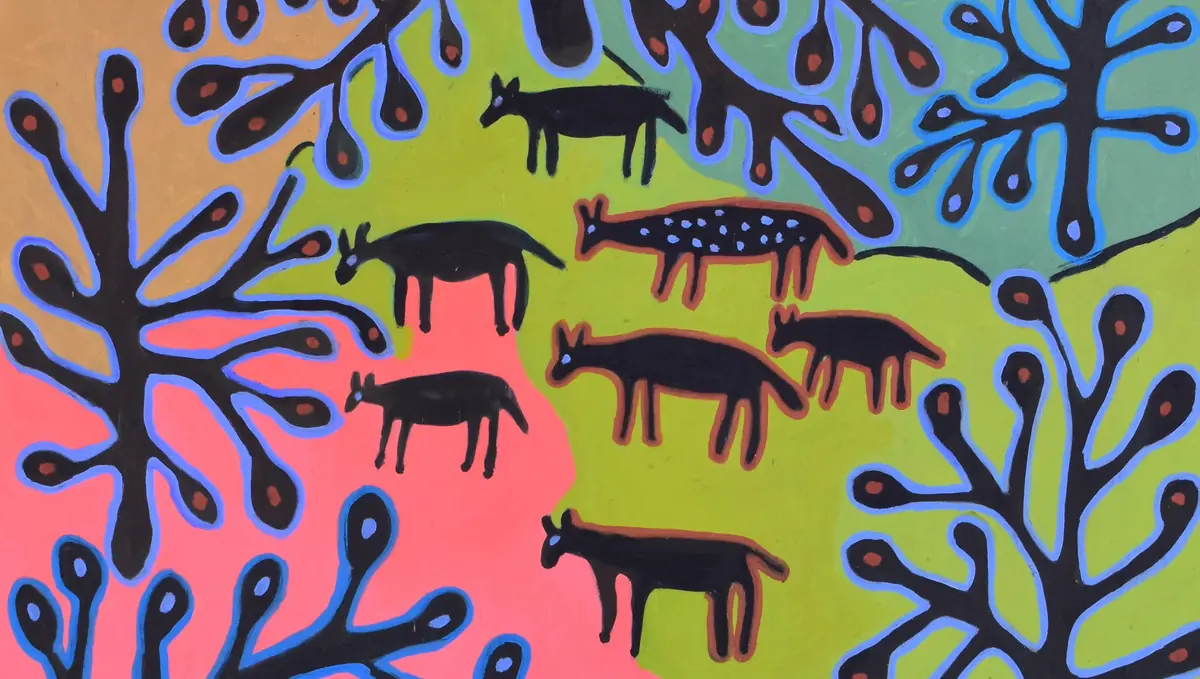
In February 1997 a man from British Airways came to see a painter called Cg’ose Ntcox’o. She was in her forties, spoke Naro and could not read. He had a paper with him. She put a cross on it. A few months later her picture of animals among trees was on the tail of a Boeing 747, one of the fifteen “world image” tails the airline launched that June in place of the Union flag. Eight jumbos carried it.
What the cross on the paper bought
The fee was 12,000 pula. Half went to the Kuru Development Trust, which ran the studio, and half to her. Luke Harding, reporting for the Mail & Guardian in July 1998, found out where her share went: seven cows, a shack on the edge of the Kalahari, and the rest handed round her relatives. Her husband had tuberculosis and her daughter had no work.
She only understood what had been sold when the airline held a ceremony for the design. Her word for the aeroplane was “a big fly”. She took her complaint to the Botswana Guardian, and by Harding’s account the trust’s disciplinary committee called her in for it. She told him she might be illiterate but she was “not stupid”, and that she knew what her work was worth. The airline’s man in South Africa said she had got a fair deal.
Nobody can even agree what the animals are. Harding’s report said hyenas. Later descriptions of the livery say jackals, seven of them. The airline’s own title was simply Animals and Trees.
The design had a second moment of fame that October, when Margaret Thatcher was shown a model jumbo in the new colours, covered its tail and said “we fly the British flag, not these awful things”. The usual account has the model wearing the D’kar picture. She got her way in the end. In May 2001 a new chief executive, Rod Eddington, ordered the whole fleet back to the flag.
Ntcox’o’s work went on a Botswana postage stamp in 2004 and she was given a Presidential Certificate of Honour in 2011. She died of a stroke in 2013 and left next to nothing.
Three women and a house
Her only child died in 1999 and her husband in 2003. A neighbour took her in: Dada, the painter whose proper name was Coex’ae Qgam. Dada was born in 1934, had worked as a nanny and house servant across the border in Namibia, and learned her needlework there. In 1996 she told the old story of Qauqaua for an artists’ book printed at the Artists’ Press in Johannesburg. It has eleven colour plates, most running across two pages, each signed by the D’kar artist who made it. A biography by Ann Gollifer and Jenny Egner came out in 2011. The project sells it as I Don’t Know Why I Was Created.
Dada died in October 2008. Ntcox’o drifted between friends and relatives for a while, then another painter gave her a home for the rest of her life: Qgocgae Cao, known as Sara, born in 1931. Sara’s parents still lived by hunting and gathering, and she has recalled wearing skin clothes in the years when she became one of the first of her generation to earn a wage on the freehold farms around Ghanzi. The project still lists her among its artists.
So is Thamae Kaashe, who joined as a teenager in 1990 and is the one to look for if you prefer prints to canvases. His linocuts took first prize in Botswana’s national competitions in five of the ten years from 2013 to 2022.
Why the dancing keeps stopping
James Morris, an elder of the village, was one of the people who started the Kuru festival. They took it out of D’kar on purpose. The healing dance is a ritual and the noise from the village’s night spots was spoiling it, so it went to the Dqae Qare farm to the south.
Then the Kuru trust in D’kar and its sister body, the Letloa Trust, fell out over who controlled the event and who answered for the sponsors’ money. Debswana, the diamond company, withdrew a three-year sponsorship because of the row. The government magazine Kutlwano recorded Morris’s verdict in Setswana: educated people had ruined everything for them. The village also refused to see the festival moved to Ghanzi town. By August 2014 Mmegi was counting a third year without dancing.
It came back on 28 and 29 August 2015, by which time the tannery, the sewing room, the T-shirt printing and a cactus plot had all closed, leaving the studio and the game farm as the two Kuru ventures still running. In 2016 groups came from Kgalagadi, the Okavango, Namibia and South Africa. The 2017 line-up included, oddly, a Zulu troupe from South Africa. The twentieth-anniversary festival was held on 24 and 25 August 2018, with the healing dances on the Friday evening.
It has not recovered from the pause that followed. In 2022 the trust’s own coordinator said an administration crisis had paralysed it. In August 2026 Cynthia Soso, a University of Botswana graduate from D’kar, put on a Saturday evening of Naro culture in the village with a grant from the American organisation Cultural Survival. The district’s deputy council chairperson called it a stepping stone to getting the big festival back.
Animals, on canvas and off
Do not come to D’kar for game. This is cattle country and the wildlife is in the paintings. One of the project’s catalogues is titled Of Elands and Giraffes and Helicopters and Tea Cups, which is a fair list of what turns up on the canvases. Dqae Qare is stocked with game, giraffe and zebra among them, and one listing for the lodge promises “secretive predators” without naming one. I have found no sighting records for the farm worth repeating. For the real thing the Central Kalahari lies to the east.
Map of D'kar
See every place on this map as a list