City · Ghanzi District, Botswana
Ghanzi
Cattle town in the western Kalahari and the one proper town between the Namibian border and Maun: fuel, banks, beds and San art nearby. You will see it spelt Gantsi too.
Short answer
Ghanzi is in Ghanzi District, Botswana. This page lists 14 places to stay and 2 places to eat and drink.

- Places to stay
- 14
- Eat and drink
- 2
- Where
- Ghanzi District, Botswana21.70°S 21.65°E
In and around Ghanzi
16 places listedWhere to stay in Ghanzi 14
- 21.72°S 21.64°EGuest houseSesigo BnBGhanzi+267 659700
- 21.69°S 21.65°EHotelKalahari Arms Hotel+267 659 6298kalahariarms.co.bw
- 21.77°S 21.61°EHotelGhanzi Trail Blazers
- 21.73°S 21.70°EGuest houseAirbnb Dirk
- 21.69°S 21.65°ECampsiteKalahari Arms
- 21.69°S 21.65°EHotelKali Guesthouse
- 21.79°S 21.61°ECampsiteKorabi Lodge & Game Farm
- 21.78°S 21.69°ECampsitePalm Afrique
Show all 14 places to stay
- Tautona · Campsite
- Tautona Lodge · Hotel
- Tautone Lodge Campsite · Campsite
- Thakadu Camp · Hotel
- The Spot at Ghanzi · Hotel
Restaurants and cafes 2
- Ghanzi Town BarRestaurant · Ghanzi
- Hollandia TradingRestaurant
Ghanzi is the main town of Botswana’s far west, a cattle place of about 19,000 people that gets called the capital of the Kalahari. You will also see it spelt Gantsi, which is closer to Setswana. People stop because it is the only real town on the Botswana stretch of the long tar road between Windhoek and Maun, and because San artists at D’kar, just up the road, make work that has been shown in more than 15 countries.
Getting there
From Maun the A3 runs 280 km south-west through Sehithwa and D’kar. From Namibia it is 165 km on the A2 from the border at Buitepos to the A3 junction, then 45 km north. From Gaborone you follow the A2 through Kang to the same junction. All of it is tar and fine in an ordinary car.
Buses come from Gaborone and Maun. None crosses the border, so without a car you pick up the bus at Charles Hill on the Botswana side, about three and a half hours away with all its stops. The airport is a kilometre from the centre and handles charters and private planes only.
When to go
Winter is dry. June to August get next to no rain, June and July days reach about 24°C and July nights average 4°C. The record low is -8.5°C, which matters in a roof tent. October to December is the hottest stretch, with average highs of 33°C. Most rain falls from December to March. The Ghanzi agricultural show, first held in 1974, is usually in August.
What to do
Drive 35 km up the Maun road to D’kar and the Kuru Art Project, where about twenty Naro and Dcui San artists paint and print. It opens Monday to Friday, 09:00 to 17:00, and is shut at weekends. Off the same road is Dqae Qare, a game farm with a lodge run by San people.
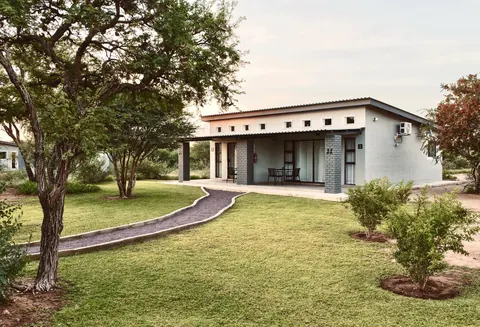
In town the Kalahari Arms Hotel, one of Ghanzi’s first businesses, has a restaurant, a bar, a pool and a campsite. Tautona Lodge and Thakadu Camp are each about 6 km out, and Sympõnia has rooms and camping 7 km up the A3.
For the western side of the Central Kalahari Game Reserve this is the nearest town. New Xade is about 100 km east, and Xade, inside the reserve, is 70 km beyond that.
Good to know
- Fill up here. Ghanzi is the main fuel stop on the roughly 500 km between Kang and Maun.
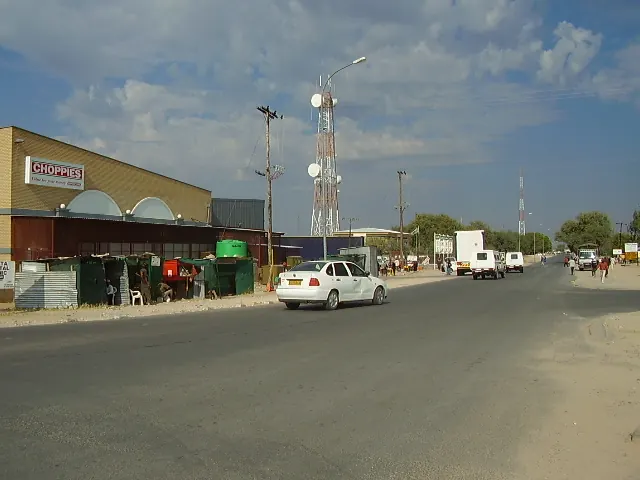
- Absa, First National Bank, Stanbic and Bank Gaborone have ATMs here, and there is a Spar, a Shoprite and a Choppies. The town has a hospital.
- Tracks into the reserve are sand and need a 4x4 with good clearance. British government advice for remote areas is spare fuel and water, and a convoy or a satellite phone.
- The CDC lists Ghanzi among Botswana’s malaria transmission areas and recommends tablets. Ask a travel clinic.
- Cattle and donkeys sleep on the road after dark. Plan to be parked by sunset.
History and culture
Ghanzi (also spelt Gantsi) was San country that became an ivory hunter's base in the 1870s and then a block of farms offered to Boer settlers under British rule in 1898. It is still a ranching town, shared by San, Afrikaner, Bakgalagadi and Herero families. One of the best-known voices in the long argument over who may live in the Central Kalahari was a cattle farmer from here.
- Before the 1870s
For a long time the only people living around Ghanzi were San (called Basarwa in Botswana). source
- 1870s
Hendrik van Zyl, a former politician from the Transvaal (the Boer republic north of the Vaal River), crossed the Kalahari and set up a hunting and trading post at Ghanzi. He was the first Afrikaner to settle here and grew rich on ivory. He is said to have shot more than 400 elephants. source
- 1875
The first party of the Dorsland Trek (Thirstland Trek), ten Boer families who had left the Transvaal with their wagons, came through after reaching Lake Ngami in September. They stayed about two months at Ghanzi and then moved on to Rietfontein in the sandveld. source
- 1885 and 1890
Britain declared the Bechuanaland Protectorate over the Tswana kingdoms in 1885, partly to stop German South West Africa and the Transvaal joining hands across the Kalahari. In 1890 the protectorate was pushed north to take in the Tawana country and the Chobe River. source
- 1895
Three Tswana kings travelled to London and stopped the protectorate being handed to Cecil Rhodes's British South Africa Company. The territory stayed under the British crown and white settlement was kept to a few border areas. source
- 1898
The British South Africa Company offered land at Ghanzi to settlers, and Boer families trekked in to take up farms. Afrikaners have lived in the area ever since. source
- 1966
Bechuanaland became the Republic of Botswana, with Seretse Khama as its first president. Diamonds were found at Orapa soon afterwards, and mining and beef exports took the country from one of the poorest in the world to lower-middle income. source
- 1986 to 1997
The Kuru Development Trust was set up in 1986 to work with the San at D'kar, up the Maun road, with San village representatives holding most of the seats on its board and Dutch church organisations the rest. It started a San dance and music festival in 1997. source
- 1997 to 2006
In 1997 the government moved 1,739 San and Bakgalagadi residents out of the Central Kalahari Game Reserve, 1,239 of them to New Xade, about 100 km from Ghanzi. More were moved in 2002. The residents went to court and won their case in December 2006, though many say they are still kept from going home. source
- Languages
- People in Ghanzi speak Setswana, Sekgalagadi (Shekgalagari), Naro and other San languages, Afrikaans, Herero and English. source
- Naro
- Naro is a Khoe language with click sounds, spoken by roughly 10,000 people, about 8,000 of them in Botswana. San groups in Ghanzi District who speak other Khoe languages use it as a trade language. A church project in D'kar has been translating the Bible into Naro since the 1980s. source
- Communities
- The town is shared by Basarwa (San), Bakgalagadi, Baherero and Afrikaners. A 1973 study found the Kalahari Boers made up about a tenth of Ghanzi's population, and Afrikaner families still run many of the cattle ranches. source
- Cattle
- Ghanzi is known across Botswana for beef. The agricultural show, first held in 1974 and usually in August, began as a livestock show and has added crops in recent years. source
- San art
- The Kuru Art Project started in D'kar in 1990. About twenty Naro and Dcui San artists work there in oils, lithographs, linocuts and etchings. The project gives them materials and space but does not teach them how to paint. Their work has been shown in more than 15 countries. source
- Kuru Dance Festival
- For years San dance groups gathered each August at Dqae Qare farm for the Kuru Dance Festival. The organisers paused it in 2019 and said they wanted to move it into D'kar village, so ask the trust whether it is on before you travel for it. source
For American visitors: In 1999 Cg'ose Ntcõx'o was one of four Kalahari artists who worked with four artists from New Mexico on a set of lithographs at the University of New Mexico. One of her prints hangs in the City and County Government Building in Albuquerque, and the Portland Museum of Art holds her work. source
For American visitors: John Hardbattle, a Ghanzi cattle farmer with a part-San mother and an English father, co-founded First People of the Kalahari with Roy Sesana. He took the case against the removals to Britain, the United States and the United Nations in the mid 1990s, where Gloria Steinem and the group Cultural Survival were among his supporters. He died in 1996. source
Main sights in Ghanzi
4- Kuru Art Project, D'kar
The studio and gallery of the San artists, 35 km from Ghanzi on the Maun road, next to the butchery in D'kar. Open Monday to Friday, 09:00 to 17:00, closed at weekends. If you make one stop near Ghanzi, make it this.
Kuru Art Project: contact - Kalahari Arms Hotel
One of the first businesses in Ghanzi. It is in the middle of town, and the restaurant and bar are open to people who are not staying.
Wikipedia: Ghanzi - Dqae Qare San Lodge
A lodge run by San people on the Dqae Qare Game Farm, off the A3. It has a pool, and there is wildlife on the farm.
Wikivoyage: Ghanzi - Ghanzi gat
A water-filled hole about 40 m deep. The local story is that road builders blasting rock for the tar road opened an underground water vein by accident. Gat is Afrikaans for hole.
Wikipedia: Ghanzi
Did you know?
- About 19,000 people lived in Ghanzi at the 2022 census, a third of everyone in Ghanzi District. The district covers 117,910 km² and had 56,555 people, which is less than one person for every two square kilometres. source
- The settlement was first called Kamp. The first big group of Boers arrived in 1897 and 1898. Gantsi, a spelling you will also see, is closer to Setswana. source
- Van Zyl and his sons are recorded as killing 103 elephants in a single day. With the ivory money he built a two-storey house with stained glass windows and furniture brought from France. source
- When a Los Angeles Times reporter visited in 1988 the town had no radio or television, and the Kalahari Arms Hotel had the only bar and disco in the area. Its fence was nine feet high to keep lions out. source
- Telephones reached Ghanzi in 1989, carried by solar-powered towers, and the paved road to Gaborone, the capital, was finished only in 1999. source
- British Airways bought a painting by the Kuru artist Cg'ose Ntcõx'o and used it as one of its aircraft tail designs. Her work also appeared on a Botswana postage stamp in 2004. source
- In 1935 Ghanzi's airstrip was picked as a stop on a planned fortnightly air service around the region and lined up for a wireless telephone link. The deal collapsed for lack of money. The airport today is an official port of entry with a 1,500 m runway and no scheduled flights. source
Checked 12 October 2026.
Death metal cowboys, a banished king and a kidnap on the Lobatse road
In August 2016 a band from Ghanzi played Wacken Open Air in northern Germany, one of the biggest heavy metal festivals in the world. They went on in leather jackets and trousers, cowboy boots and hats. They were Overthrust, and they come from a town where the main business is beef.
Leather and Stetsons in cattle country
Overthrust started in Ghanzi in late 2008. The frontman, Tshomarelo Mosaka, plays bass, growls the vocals and goes by Vulture Thrust. He was born in Rakops, came to Ghanzi in 2007 and was a policeman for about ten years, which he says is where the songs about death and brutality come from.
Botswana’s metal fans call themselves MaRock, and the uniform has two parents. One is Lemmy and the cover of Motörhead’s Ace of Spades. The other is the cattle post. A German metal magazine reported in 2016 that most of the fans work in farming and see the leather as work clothes taken a step further. Mosaka goes back another generation, to forefathers who herded cattle on horseback and made their riding gear, hats and shoes from cowhide.
Every May since 2010 the band has put on Winter Metal Mania in town. It has no sponsors, by the band’s account. In 2015 twelve bands played, and what the festival raises goes to children in and around Ghanzi as food, clothes and toiletries, passed on through the district’s social development office. In 2014 religious groups petitioned to have the band and its shows banned for playing satanic music. That is Mosaka’s telling, and he says the government turned them down. If you are passing in May, ask at your lodge whether the festival is on that weekend.
The king the British parked here
Colonial Bechuanaland used Ghanzi as a place to put people it wanted out of the way. In June 1931 the Resident Commissioner, Charles Rey, called Sebele II, king of the Bakwena, to Mafeking for what was said to be a meeting about water, and told him there that he was banished. There was no trial. A train took Sebele round to Gobabis in South West Africa, where a crowd turned out to cheer him, and he was driven the rest of the way.
It did not work as planned. The historian Jeff Ramsay, who has written most about the affair, records that Sebele became so well liked in Ghanzi that the white residents grew nervous of him. Back home many Bakwena stayed away from the meetings of the brother installed in his place, Kgari, and would not pay tax. In 1933 a petition for Sebele’s return carried 1,407 names. A son, Moruakgomo, was born in Ghanzi during the exile. In 1938 Sebele offered to abdicate formally if he could go home, and Kgari turned that down. Sebele died on 2 October 1939. Only his body went back to Molepolole, where thousands came to the funeral.
Three policemen and an unmarked truck
In July 1963 the security police came to Rehoboth in South West Africa to arrest the town’s doctor, Kenneth Abrahams, who was 26. So many people gathered at his house that they backed off. In August he left anyway, walking over the border into Bechuanaland with Andreas Shipanga, Paul Smit and Hermanus Beukes, a shoemaker who was among the first Namibians to petition the UN against South African rule. They were taken to Ghanzi and given residence permits. Then, on the road towards Lobatse and still inside Bechuanaland, three South African policemen in plain clothes stopped them, held a gun to Abrahams’s head, loaded them into an unmarked truck and drove them back to the cells at Gobabis.
Kidnapping people out of a British protectorate caused a row well beyond the Kalahari. Abrahams was flown to Cape Town on a sabotage charge. British officials brought a habeas corpus case in the South African Supreme Court, and South Africa sent the four back. Abrahams went on to Dar es Salaam and a seat on SWAPO’s central committee. Beukes had meant to carry on to New York and the UN. He went home to Rehoboth instead.
Whose water it was
The ivory hunter Hendrik van Zyl, who turns up in every history of the town, controlled the wells. When the first Thirstland trekkers asked to use them in 1875 he refused before he gave in. The Afrikaans historian Nicol Stassen records a far bigger party in 1893: 63 families with 66 wagons under Commandant J.M. Lombard came by way of Lake Ngami and were joined at Ghanzi by another 28 wagons that had crossed the south through Lehututu and Kang. About 70 families went on to Angola and the rest to South West Africa. Ghanzi families were still following a generation later: nine left in October 1921 and reached Sacanjimba in the Angolan highlands the next year.
A Ghanzi farmer of a later generation, Martinus Drotsky, was the first European to be shown the Gcwihaba caves, in 1932. They are far to the north, hard against the Namibian border, and the main cavern has carried his name since. There is an old story, never proved, that van Zyl hid a fortune in there.
The cheetahs are on the farms
Botswana has about 1,700 cheetahs, one of the largest populations anywhere, and Cheetah Conservation Botswana says more than 70% of them live outside protected areas. The western farmlands are where the clash with farmers is worst, which is why the project keeps a camp and a demonstration farm at Ghanzi. Do not plan on seeing one from the road. The researchers themselves find them with camera traps, collars and San trackers reading spoor.
The project’s diet studies put livestock at under 6% of what these farmland cheetahs eat. In May 2012 four cats carried collar cameras and were filmed hunting kudu. Moving “problem” cheetahs somewhere else mostly fails: only 18% were alive a year later, and some walked back. So the project places guard dogs with farmers instead, more than 130 since 2013. Its own study found the dogs cut stock losses by about three quarters.
For animals you can count on, the game farms outside town are the place. Thakadu describes plains game on its land and a floodlit water hole next to its restaurant.
Guides for Ghanzi
Map of Ghanzi
See every place on this map as a list