Park · North-West District, Botswana
Moremi Game Reserve
The protected core of the eastern Okavango Delta, with lion, leopard and wild dog on the Mopane Tongue. Self-drivers need a real 4x4, booked campsites and all their own fuel and water.
Short answer
At Moremi Game Reserve, international visitors pay P270 (about US$20, €18 or £15) per adult and P135 per child per day. The rates apply from 1 April 2022 to 31 March 2027.
- Daily fee, international adult
- US$20 €18 · P270
- Malaria
- Moremi is in Ngamiland, which the CDC lists with the Okavango among Botswana's malaria transmission areas, and it recommends prescription antimalarials for travellers there.
- Places to stay
- 33
- Park fee nearby: Chobe National Park
- US$20 €18 · P270about 143 km away
Moremi Game Reserve fees 2026
Checked Department of Wildlife and National Parks (DWNP), Ministry of Environment and Tourism tariffValid 1 April 2022 to 31 March 2027, per person per day, in pula.
| Who | Adult | Child |
|---|---|---|
| International visitorsUS, Europe and everyone else | US$20 €18 · P270 | US$10 €9 · P135 |
| SADC nationals | P205 | P102.5 |
| Botswana citizens | P30 | P15 |
- Moremi is charged at the same top rate as Chobe. The other DWNP parks and reserves cost P190 a day for non-residents.
- Children under 8 enter free. From 8 they pay half the adult rate, which is the child figure shown. Where the half rate stops is not settled: one guide says it runs to 17, three others say 15, so a 16 or 17 year old may be charged as an adult.
- Vehicle fee per day: P75 for a foreign-registered private vehicle under 3,500 kg, P20 for a Botswana-registered one. Trailers and caravans pay P40 foreign, P10 local.
- The SADC rate is also what foreigners living in Botswana pay. The resident row here is the rate for Botswana citizens.
- Guests of a licensed Botswana tour operator pay less: P190 for non-residents, P145 for residents and SADC nationals, P20 for citizens.
- The campsites are not run by DWNP. Third Bridge is with Xomae, Khwai with SKL, Xakanaxa and South Gate with Kwalate Safaris. You book and pay each operator for camping and pay DWNP for entry.
- A rise was due on 1 April 2026 and the ministry put it off the day before. Gabz FM reported in May that it had been pushed out by two years, and a July report had the existing fees still in place. No new date had been published when I checked on 12 October 2026.
- The fees started on 1 April 2022 and have no end date. I show them as valid to 31 March 2027, the end of Botswana's financial year, and will re-check then.
- Fees are set by Department of Wildlife and National Parks (DWNP), Ministry of Environment and Tourism. Official tariff · Seen a new rate? Tell us
US$1 = P13.47 · €1 = P15.06 · £1 = P18.07 (ECB rate and the Bank of Botswana rand rate, 3 Nov 2026). Converted amounts are approximate; you pay in pula.
How we got these figures
- The child ages are not in the ministry's 2022 schedule. ChobeNationalPark.co.za gives half price for 8 to 17. Tawana Self Drive says under 16, and Cheetah Safaris and Ostrich Trails say 8 to 15. The FAOLEX copy of the 2000 regulations leaves out the footnotes to the fee schedule, so I could not settle it from the law. The child figures are half the adult rate.
- The ministry's 2022 vehicle table has a higher column headed Chobe National Park only (P115 foreign, P30 local) and a lower one for all other parks and reserves. Tawana Self Drive and Africa Travel Essentials both give P75 for Moremi, so I used the lower column.
- Africa Travel Essentials gives the SADC rate as P220. The ministry schedule and three other sources give P205.
- SafariFind says higher fees took effect on 1 April 2026. They did not: the ministry postponed them on 31 March 2026, so I left that page out.
- The minister described the proposal as moving the non-resident fee from P380 to P500 and the citizen fee from P30 to P50. P380 matches no entry fee in the 2022 schedule, so I have not tied the proposal to a particular park.
- Ministry of Environment, Natural Resources Conservation and Tourism, Revised User Fees and Services (the 2022 schedule, copy linked from Tourism Update) · official · checked 12 Oct 2026
- Tourism Update (23 February 2022) · one source · checked 12 Oct 2026
- travelnews.africa (2022 report of the DWNP announcement) · one source · checked 12 Oct 2026
- Tawana Self Drive, Maun (page updated 16 April 2026) · one source · checked 12 Oct 2026
- Africa Travel Essentials (24 March 2026) · one source · checked 12 Oct 2026
- ChobeNationalPark.co.za (independent park guide, updated 13 May 2026, child ages only) · one source · checked 12 Oct 2026
- Cheetah Safaris (page updated 15 January 2026, child ages only) · one source · checked 12 Oct 2026
- Ostrich Trails, Mabuasehube guide (updated 27 June 2025, child ages only) · one source · checked 12 Oct 2026
- National Parks and Game Reserves Regulations, 1 April 2000 (the fee schedule before 2022), copy hosted by FAOLEX · official · checked 12 Oct 2026
- Botswana Daily News, government news agency (24 February 2026, the proposed increase) · official · checked 12 Oct 2026
- TravelComments.com (1 April 2026, increase postponed) · one source · checked 12 Oct 2026
- Gabz FM News (5 May 2026, increase put off by two years) · one source · checked 12 Oct 2026
- Travel and Tour World (29 July 2026, existing fees stay) · one source · checked 12 Oct 2026
Two ways to do Moremi
A couple, two nights at Third Bridge, two at Khwai, five days of park fees, an eight-day Hilux hire with a rooftop tent and diesel: about US$2,356.
Plan it yourselfCamps in and around the delta, from the value end of the guide's table to Mombo in high season. Some include park fees, some add them.
Get lodge prices for your datesFigures from our safari cost guide, updated 14 October 2026, in US dollars at the ECB rate of 13 October 2026.
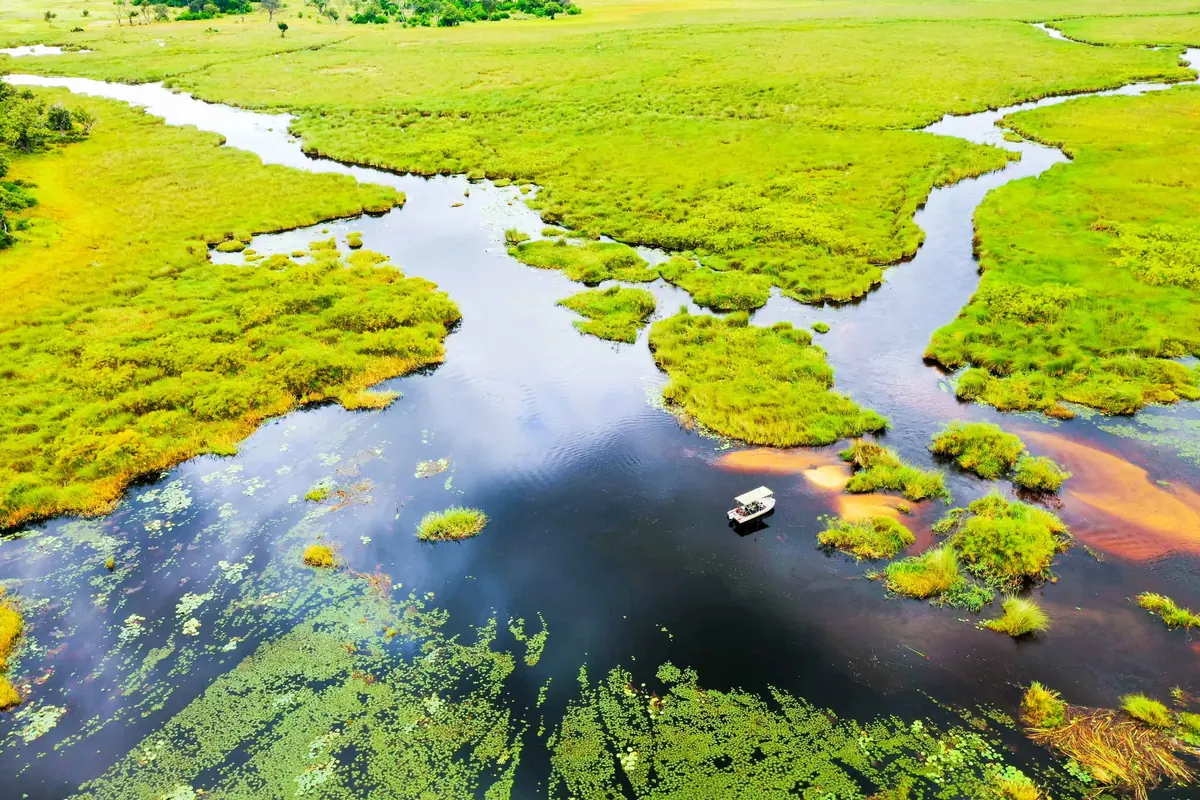
Moremi takes in the eastern Okavango Delta. Botswana Tourism puts it at about 3,900 square kilometres and Wikipedia at just under 5,000, and only about 30% of it is dry land. The BaTawana people proclaimed it in 1963 under their regent, Elizabeth Pulane Moremi, and named it after her late husband, Chief Moremi III. Botswana Tourism calls it the first reserve in Africa set up by local residents. People come for the predators on the Mopane Tongue, the dry peninsula you can drive.
Getting there
Maun is the base. South Gate (also called Maqwee) is 90 to 100 km north of town (sources differ). The tar gives out partway and the rest is gravel with deep sandy patches. North Gate is on the Khwai River, about 30 km from South Gate, and is the way in if you are coming down from Chobe. You need a proper 4x4. Chief’s Island has no public road, so lodge guests fly in from Maun by light aircraft, 30 to 45 minutes.
When to go
July to October is the peak for game, when the seasonal pans dry up and animals crowd onto permanent water. The Okavango flood arrives from Angola around May and is at its height in August. June nights can drop to freezing. October is very hot. Rain comes from late November to April: green bush and the best birding, but tracks turn to mud and some go under water.
What to do
The usual self-drive route runs from South Gate over First Bridge and Second Bridge to Third Bridge, on to Xakanaxa, then east along the Khwai River and out at North Gate. At Mboma boat station, before Third Bridge, you can swap the car for a mokoro (the delta’s poled canoe) or a motorboat.
There are four public campsites: South Gate, Third Bridge, Xakanaxa and Khwai at North Gate. Private operators run them, and you book each one ahead on top of the entry permit. Night drives, walks and off-road driving are not allowed inside the reserve. For those, stay in the Khwai community area across the river.
Good to know
This is malaria country. The CDC lists Ngamiland and the Okavango as transmission areas and recommends tablets, and the UK advice rates the risk as high from October to May.
There is no fuel in the reserve. Fill up in Maun and carry extra, because a 4x4 forum regular reported in 2020 that the next pump towards Kasane was at Muchenje. Bring drinking water too, as the campsite taps are not safe untreated.
Expect no fence around your campsite. Hyenas come through after dark, so pack food away. The speed limit is 40 km/h, you may not get out of the car except at camps and marked stops, and swimming is banned (crocodiles live in every flowing channel). Gates open at 06:00 and close at 18:30 from April to September, and run 05:30 to 19:00 for the other six months. Fees are in the table on this page.
History and culture
Moremi is the part of the Okavango Delta that the BaTawana, the Tswana people whose chiefs ruled Ngamiland, set aside for wildlife in 1963, three years before Botswana's independence. It was done through a tribal assembly under a woman regent, against the wishes of local colonial officials, and at a cost to the San families who lived on the Khwai floodplain. Knowing that makes the place more than a list of sightings.
- 18th century
The BaYei moved into the delta from the Lozi kingdom to the north and lived alongside the river San (Basarwa) who were already there. Oral tradition credits the BaYei with bringing canoe building to Ngamiland. source
- Early 1800s
The BaTawana, a Tswana people, arrived in Ngamiland and became its rulers. Many BaYei became batlhanka, serfs attached to Tawana households. source
- 1946
Kgosi (chief) Moremi III of the BaTawana died in a car crash. His widow, Elizabeth Pulane Moremi, a trained nurse born in the Orange Free State in 1912, became regent for their young son and held the post until 1964, under the British Bechuanaland Protectorate. source
- 1963
Worried by uncontrolled hunting and by cattle pushing into the delta, the BaTawana under Mrs Moremi proclaimed the game reserve and named it after her late husband. Botswana Tourism describes it as the first reserve in Africa established by local residents. source
- 1960s
The Bugakhwe, river San who lived on the Khwai floodplain, gave up land for the reserve. The historian Maitseo Bolaane writes that they were persuaded to do so for the wider good and lost the most in access to its resources. One of their leaders told her in 1997 of watching foreign tourists enjoy 'the fruits of our land' while his people 'sit on the fence'. source
- 1970s
Chief's Island, until then the royal hunting ground of the Tawana chiefs, was added to the reserve. source
- October 1979
The Fauna Conservation Society of Ngamiland, the local body that had run Moremi since its founding, had lost its leaders to the new district council and central government after independence in 1966 and could no longer pay wages. The government took the reserve over. source
- 2014
On 22 June 2014 the Okavango Delta, with Moremi on its eastern side, became the 1,000th site on UNESCO's World Heritage List. source
- The kgotla
- A kgotla is the public assembly where a Tswana community debates and decides under its kgosi (chief). Bolaane's history of Moremi gives a whole chapter to the part the kgotla played in founding the conservation society behind the reserve, which had members of several races at a time when that was unusual in southern Africa. source
- Khwai village
- Khwai, on the north bank of the river just outside North Gate, is home to about 400 people, mostly Bugakhwe San with some BaYei. Wikipedia's account is that they first settled inside what is now the reserve and were forcibly moved out. The village is building a community-run safari business, and you will hear Bugakhwe, Setswana, English and Afrikaans. source
- The mokoro
- A mokoro (plural mekoro) is a dugout canoe poled from the stern through shallow water, the way a punt is. They were cut from big straight trees such as ebony and sausage tree. Most on the water today are fibreglass, which spares the old trees. source
- The BaYei
- The BaYei speak ShiYeyi, a Bantu language that picked up click sounds from long contact with the San. Their tradition is that a skilled fisherman and hunter called Hankuzi led them into Ngamiland and married a woman of the baKhakwe, the people he met there. source
For American visitors: The wild dog research here was started by an American. John 'Tico' McNutt, born in Seattle, began the Botswana Wild Dog Research Project in 1989, with part of his funding from the National Geographic Society, and took a doctorate in animal behaviour at the University of California in 1995. He went on to study the delta's other large predators too. source
Main sights in Moremi Game Reserve
5- Third Bridge
The campsite Botswana Tourism picks out as a favourite with self-drive campers. It sits near the Sekiri River, which is lined with papyrus, and the tourism board talks up its sunsets.
Botswana Tourism Organisation, Moremi Game Reserve (archived copy of 14 January 2026; the live page returned a server error on 12 October 2026) - Xakanaxa Lagoon
A lagoon near the tip of the Mopane Tongue, at the point where the permanent swamp gives way to plains that flood only in season. Expert Africa rates the game around here and Third Bridge among the densest in the reserve.
Expert Africa, Moremi Game Reserve (sighting rates reported by its travellers, seasons and areas) - Chief's Island
An island more than 60 km long on the edge of the permanent swamp, raised just enough by a fault line to stay dry through the flood. It was the Tawana chiefs' hunting ground before the 1970s. There is no public vehicle access, so you see it only from a fly-in camp.
Expert Africa, Moremi Game Reserve (sighting rates reported by its travellers, seasons and areas) - Khwai River and North Gate
The river is the northern boundary. North Gate is reached over a pole bridge, with the campsite just inside on the south bank and loops of track through riverine forest and floodplain to east and west.
Tracks4Africa blog, North Gate or Khwai community camp (2021) - Mboma boat station
A boat station on the road between Second Bridge and Third Bridge where you can take a mokoro or motorboat trip into the channels. It is an easy way for a self-driver to see the wet side of Moremi.
Sun Destinations, Moremi self-drive from Tuskers Bush Camp (2017)
Did you know?
- Only about 30% of Moremi is dry land. The rest lies inside the delta's swamps, lagoons and floodplains, which is why most of it cannot be reached by car. source
- Robert and June Kay, who arrived in 1958 and led the campaign for the reserve, were called 'dangerous agent provocateurs' by the local colonial official. Local officials opposed both the conservation society and the reserve. source
- Wild dogs in the Moremi area have been the subject of a research project since 1989, which is why you sometimes see one wearing a tracking collar. source
- Rhino have been lost here twice. White rhino released in Moremi and Chobe between 1967 and 1980 were poached out, and after a 1992 survey found only about 27 left in the north, the survivors were caught for the new Khama Rhino Sanctuary. From 2003, 33 white and five black rhino were released at Mombo on Chief's Island. In the nine months to January 2020 poachers killed 22 rhino on the island. source
- In 2008 Moremi was voted best game reserve in Africa by the African Travel and Tourism Association at Indaba, South Africa's main tourism fair. source
Checked 12 October 2026.
Wildlife you might see
15- very likelyElephantAll over the drivable part, with big herds along the Khwai River and around Xakanaxa Lagoon. All year, with the biggest gatherings in the dry season, May to Octobersource
- very likelyHippoLagoons and channels throughout. Every one of Expert Africa's travellers reported seeing hipposource
- very likelyZebra and giraffeGrasslands and floodplains. Nearly all of Expert Africa's travellers saw bothsource
- very likelyLionKhwai River, Xakanaxa and Third Bridge. Nine in ten of Expert Africa's travellers to the Moremi area reported seeing lion. All year, easiest in the dry season, May to Octobersource
- likelyRed lechweFloodplains around Xakanaxa and Third Bridgesource
- likelyBuffaloKhwai River and around Xakanaxa Lagoon, in large numbers by September. About three in four of Expert Africa's travellers saw them. All year, best in the dry season, May to Octobersource
- likelyLeopardRiverine forest along the Khwai and the woodland around Xakanaxa and Third Bridge. About three in four of Expert Africa's travellers saw onesource
- likelySpotted hyenaThroughout. Three in four of Expert Africa's travellers saw onesource
- possibleNile crocodileEvery flowing channel in the reservesource
- possibleAfrican wild dogOpen grassland and woodland around Xakanaxa and Third Bridge. Packs cover a lot of ground, so it comes down to luck. About two thirds of Expert Africa's travellers saw themsource
- possibleWattled crane and slaty egretWetlands. Expert Africa calls the slaty egret raresource
- possibleSouthern carmine bee-eaterSeen in flocks at Third Bridge campsite. Rainy season (a February visit)source
- rareCheetahOpen grasslands. Fewer than one in five of Expert Africa's travellers saw onesource
- rareSitatungaReed beds along the channels. About one in seven of Expert Africa's travellers saw onesource
- rareWhite and black rhinoAbout 150 lived in the northern delta in 2019. Poachers killed 92 in 2020 and 2021 and the government moved the 40 or so that were left out of the delta. Do not plan a trip around seeing one heresource
Likelihood is for a normal visit of two or three days, from the sources linked. Nothing is guaranteed in the wild.
Staying safe in Moremi Game Reserve
- Malaria
- Moremi is in Ngamiland, which the CDC lists with the Okavango among Botswana's malaria transmission areas, and it recommends prescription antimalarials for travellers there. See a travel clinic well before you fly, because some tablets have to be started days ahead. source
- Malaria season
- The UK's travel health service rates the risk in the northern half of Botswana, the Okavango Delta included, as high from October to May and low for the rest of the year. Cover up and use repellent from dusk in any month. source
- Park rules
- The speed limit is 40 km/h. You may not get out of your vehicle or walk except inside campsites, lodges, hides and picnic sites, and you may not drive or leave your campsite between closing and opening time. Gates open at 06:00 and close at 18:30 from April to September, and run 05:30 to 19:00 from October to March. Feeding animals is an offence. source
- Open campsites
- South Gate campsite has no fence, and campers at North Gate report hyenas coming through after dark and lions calling close by at night. Pack food and rubbish away. source
- Channels and lagoons
- Crocodiles live in all the flowing channels and swimming is prohibited. source
- Remote driving
- Botswana Tourism warns campers that these are remote areas reached only by four-wheel drive, with heavy sand and rough ground, where water, petrol and food may not be on sale. Carry what you need for the whole stay, and take out medical insurance that covers evacuation. source
Tips from travellers
- Fill the tank and the jerry cans in Maun. There is no fuel in Moremi. A regular on the 4x4 Community forum wrote in January 2020 that the Puma station at Muchenje was the only pump between Maun and Kasane on the route through Savuti. one source
- The four public campsites are run by private companies, not the wildlife department: Third Bridge by Xomae, Khwai (North Gate) by SKL, and Xakanaxa and South Gate by Kwalate Safaris. Book each with its operator well ahead, then pay the reserve entry fee to DWNP at the gate, where a Maun self-drive agency says cash and cards are both taken. one source
- Treat a water crossing with suspicion even when it looks shallow. Two brothers in a Land Cruiser in 2025 began to sink in soft mud on a 10 metre crossing on the way from Xakanaxa to North Gate, and had to back out and take another road. one source
- Roads around Khwai and Xakanaxa often go under water when the delta rises, so check conditions before you set out and have a second route in mind. one source
- Bring all your drinking water. The campsites have standpipes, but the water needs boiling and treating before you drink it. one source
- Mboma boat station, on the road to Third Bridge, is the place to break the drive with a mokoro or motorboat trip into the channels. one source
Checked 12 October 2026. Conditions change, so confirm with the park or venue before you go.
Ten to one on a Friday: the meeting that made Moremi
At ten minutes to one on Friday 15 March 1963, under the big tree outside the BaTawana offices in Maun, the regent Elizabeth Moremi stood up and said the reserve could go ahead. June Kay was sitting a few chairs away in jeans, with the minutes on her lap, and wrote the scene up for the conservation journal Oryx that August.
For two hours before that the objectors had the floor. Wait for the crown prince to come home from England, they said. Give it another year. Then Montso Mogalakwe, who had walked from village to village arguing for the reserve, got up and spoke, and after him the councillors gave their verdicts one after another, for the reserve. Jack Ramsden, the society’s chairman, a hunter with a Herero mother and a white father, told June she had worried for nothing. The opposition always speaks first in a kgotla.
The hunting season opened a fortnight later, and without a reserve the whole Okavango, the Khwai valley included, would have been open to the safari firms. What the kgotla set aside was a triangle of about 700 square miles between the Khwai and a river to the south, less than half of today’s reserve. In May tribesmen went up unpaid to mark the boundary and put up “No Shooting” signs. The next March the same assembly banned wire snares across Ngamiland.
The couple in the wartime duck
The Kays are an odd pair to have started it. They drove into the delta at the end of 1958 for a few months’ holiday in a DUKW, the amphibious truck built for wartime beach landings, and it became their only home. Their pets, lions among them, rode along. They hunted crocodiles and ran safaris, which the Oryx reviewer of June’s book Okavango found hard to swallow: a book dedicated to preservation with so much crocodile shooting in it, and a claim that a crocodile’s ears are hidden gills. The introduction, by Gerald Durrell, got no kinder treatment.
The BaTawana called Robert “Ra Tau”, father of lions. His argument to cattle people was a cattleman’s one: kill the cow that bears the calf and tomorrow there is no meat. It caught on, but the Kays did not last. Maitseo Bolaane’s history of the reserve, Chiefs, Hunters and San, has their loose way with money colliding with a society that was trying to keep proper books. In the end they gave up the thing they started.
The fly that did the fencing
One reason there was still so much game to protect is a biting fly. Tsetse carry a parasite that kills cattle, and June Kay lists them in 1963 among the reasons the BaTawana could not live by ranching. Aircraft sprayed the delta 18 times without finishing the job.
Then one campaign did. The northern half of the delta was sprayed between June and September 2001 and the southern half the following winter, some 16,000 square kilometres in all. Surveys ran until November 2005 and did not catch a single fly.
Dogs in June, storks in September
Wild dogs are what many people come to Moremi hoping for, and winter is when the odds are best. They den in June, July and August, and for those weeks a wide-ranging pack has to keep coming back to one hole in the ground. In July 2017 researchers tracking the Mula pack, whose range ran from Xakanaxa along the Khwai to North Gate, followed its footprints to a den in thick mopane and found twelve pups.
In June 2012 a safari guide near Third Bridge watched three lions go for a den just after sunrise, the two males holding the pack off while the lioness tried to dig the pups out. The pups lived. Disease is worse. The researcher Tico McNutt saw rabies wipe out four Okavango packs in 1996, and their ranges stood empty for about six months before other dogs moved in, as if the old scent marks still said “taken”.
Moremi’s best-known leopard lived at Mombo. Dereck and Beverly Joubert found her as a cub of eight days in about 2003 and filmed her for three years for Eye of the Leopard. They named her Legadema, lightning, because as a cub she hid under their vehicle in thunderstorms. Mombo’s guides named her daughters Pula and Maru, rain and clouds. Self-drivers cannot reach Mombo. In the part you can drive, the same 2012 guide had leopards near the Xakanaxa airstrip and on the road to Bodumatau.
Herons, marabou and yellow-billed storks nest on tree islands in Gcodikwe lagoon, a boat ride from Xakanaxa. Operators put the busy months at September to November, and one stretches it to December.
Three sets of lions and one bold hyena
What campers agree on is the nights. A group at South Gate in July 2010, told it was the dull camp, lay listening to lions, elephants at the edge of the site and a hyena cracking an impala skull beside their fireplace. A traveller at Xakanaxa in March 2012 saw little by day and at night counted three sets of lions calling across the swamp. Third Bridge has a history with hyenas. In September 2008 a camper who arrived the next day reported that one had pulled a man off his chair by the neck at the fire and let go when his companions made a noise.
By day the trouble at Third Bridge is baboons, which sit in the sausage trees and go for anything left out. The bridges come up again and again: loose logs one driver rearranged by hand, logs under water that shook as another crossed. In the big flood of 2011 one driver reported bonnet-deep stretches on the track from Third Bridge to Xakanaxa, and Dead Tree Island was cut off. That loop is named for a lagoon ringed with dead trunks. One traveller’s account from 2019 is that the trees grew while the ground was dry and drowned when the water came back. The Okavango does that.
In and around Moremi Game Reserve
55 places listedWhere to stay in Moremi Game Reserve 33
- 19.24°S 23.35°EHotelThird Bridge Tented Camp
- 19.26°S 23.33°ECampsiteRestricted site MGR 12
- 19.50°S 23.51°ECampsiteTawana Lodge
- 19.24°S 23.35°ECampsiteThird Bridge Campground
- 19.18°S 23.41°ECampsiteXakanaxa Camp Site
- 19.49°S 23.54°ECaravan parkBlack Pool BOGA
- 19.23°S 23.40°ECampsiteBoga Camp Site Magweqwana
- 19.37°S 23.50°ECampsiteBoga site 1
Show all 33 places to stay
- Boga site second bridge · Campsite
- Camp Okuti · Hotel
- Eagle · Chalet
- entrance channel north · Campsite
- HATAB · Campsite
- Hatab 9 · Campsite
- Hatab Camp Mgr 13 Hidden Lagoon Closed · Campsite
- Hatab MGR 15 · Campsite
- Hatab MGR 2 · Campsite
- Hippo · Chalet
- Hyena · Chalet
- Kudu · Chalet
- Kwai North Gate Camp · Campsite
- Lion · Chalet
- Nxagara · Campsite
- Nxaraga Campsite · Campsite
- Sanctuary Chiefs Camp · Hostel
- South Gate Campsite · Campsite
- XA-reserve · Campsite
- Xakanaxa Camp · Hotel
- Xigera Safari Camp · Hotel
- Xini Lagoon Campsite Mgr 14 · Campsite
- Xini Restricted Site · Campsite
- Yompy's Tent · Chalet
Sights 22
- 1st T junction from Black Pool to Gomoti riverAttraction
- Baobab TreeAttraction
- Crossing to T junction Gomoti riverAttraction
- Eastern PanAttraction
- Far Eastern PanAttraction
- First BridgeAttraction
- Fourth BridgeAttraction
- Hippo poolViewpoint
- Hippo PoolViewpoint
- Hippo viewViewpoint
- Little Mombo RutandaAttraction
- Lookout PointViewpoint
Show all 22 sights
- Magwxexhlana Pools · Viewpoint
- Makoba Viewpoint · Viewpoint
- Paradies Pools · Viewpoint
- Third Bridge Boat Station · Attraction
- Tully Tully Bridge · Attraction
- two Baobab Trees · Viewpoint
- View Point · Viewpoint
- View Point · Viewpoint
- Vulture's Baobab Pan · Attraction
- Wild Dog Den · Viewpoint
Quick answers
How much is the entry fee for Moremi Game Reserve?
International visitors pay P270 (about US$20, €18 or £15) per adult and P135 per child per day. These rates apply from 1 April 2022 to 31 March 2027 and are set by Department of Wildlife and National Parks (DWNP), Ministry of Environment and Tourism.
Do Botswanans and SADC citizens pay less at Moremi Game Reserve?
Botswana citizens pay P30 per adult and SADC nationals pay P205 per adult per day. You need ID or a passport to get the lower rate.
When were these Moremi Game Reserve fees last checked?
We last checked them on 12 October 2026 against 13 published sources. We re-check every two weeks, but always confirm with Department of Wildlife and National Parks (DWNP), Ministry of Environment and Tourism before you travel.
What animals can you see in Moremi Game Reserve?
Most visitors see elephant, hippo, zebra, giraffe and lion. You have a good chance of seeing red lechwe, buffalo, leopard and spotted hyena. Cheetah, sitatunga, white and black rhino are there but rarely seen.
Moremi and the parks nearest it
| Park | International adult | Distance | Where |
|---|---|---|---|
| Moremi Game Reserve | US$20 €18 · P270 | · | North-West District |
| Chobe National Park | US$20 €18 · P270 | 143 km | Chobe District |
| Nxai Pan National Park | US$14 €13 · P190 | 172 km | North-West District |
| Makgadikgadi Pans National Park | US$14 €13 · P190 | 208 km | Central District |
Guides for Moremi Game Reserve
- First Safari: South Africa, Namibia or Botswana?
- Malaria on Safari: Kruger, Etosha, Okavango, Malaria-Free Parks
- How Much Does a Safari Cost? South Africa, Namibia, Botswana
- How Much Does a Safari Cost from the UK? Prices in Pounds
- Safari in the UK School Holidays: Which Break, Which Park
- Best Time to Visit the Okavango Delta: Flood, Game and Prices by Month
- Self-Drive Botswana: Sand, Fuel, Vet Fences and Campsites
- Botswana Travel Essentials: Money, Driving, Malaria
Where the Moremi fees come from
- Ministry of Environment, Natural Resources Conservation and Tourism, Revised User Fees and Services (the 2022 schedule, copy linked from Tourism Update)
- Tourism Update (23 February 2022)
- travelnews.africa (2022 report of the DWNP announcement)
- Tawana Self Drive, Maun (page updated 16 April 2026)
- Africa Travel Essentials (24 March 2026)
- ChobeNationalPark.co.za (independent park guide, updated 13 May 2026, child ages only)
- Cheetah Safaris (page updated 15 January 2026, child ages only)
- Ostrich Trails, Mabuasehube guide (updated 27 June 2025, child ages only)
- National Parks and Game Reserves Regulations, 1 April 2000 (the fee schedule before 2022), copy hosted by FAOLEX
- Botswana Daily News, government news agency (24 February 2026, the proposed increase)
- TravelComments.com (1 April 2026, increase postponed)
- Gabz FM News (5 May 2026, increase put off by two years)
- Travel and Tour World (29 July 2026, existing fees stay)
Open data: all park fees (CSV) · JSON (CC BY 4.0)
Cite as: Travel Africa Guide, "Moremi Game Reserve fees 2026", checked 12 October 2026, https://travelafrica.guide/botswana/moremi-game-reserve/
Map of Moremi Game Reserve
See every place on this map as a list