Park · Zambezi, Namibia
Mudumu National Park
An unfenced park on the east bank of the Kwando River south of Kongola, with big dry-season elephant herds, rustic riverside camps and two lodges. Few people visit.
Short answer
At Mudumu National Park, international visitors pay N$200 (about US$12, €11 or £9) per adult and N$150 per child per day. The rates apply from 1 April 2026 to 31 March 2027.
- Daily fee, international adult
- US$12 €11 · N$200
- Malaria
- Mudumu is in the Zambezi Region, a malaria transmission area, and MEFT calls the park high risk.
- Places to stay
- 6
- Park fee nearby: Nkasa Rupara National Park
- US$12 €11 · N$200about 37 km away
Mudumu National Park fees 2026/27
Checked Ministry of Environment, Forestry and Tourism tariffValid 1 April 2026 to 31 March 2027, per person per day, in Namibian dollars.
| Who | Adult | Child |
|---|---|---|
| International visitorsUS, Europe and everyone else | US$12 €11 · N$200 | US$9 €8 · N$150 |
| SADC nationals | N$130 | N$80 |
| Namibian citizens | N$40 | Free |
- Children aged 8 and under enter free. The child rate is for ages 9 to 15; Namibian children in that age group pay nothing. From 16 the adult rate applies.
- Vehicle fee per day, on top of the per person fee: N$60 for 10 seats or less, N$150 for 11 to 25 seats, N$600 for 26 to 50 seats and N$1,000 for 51 seats or more.
- The Namibian rate is for Namibian citizens. The gazette sets fees by nationality, so a foreigner living in Namibia pays the rate for their nationality.
- Each fee is half park entrance fee and half conservation fee; the figures shown are the two added together.
- These fees were gazetted with effect from 1 April 2026 and have no end date. I show them as valid to 31 March 2027, the end of Namibia’s financial year, and will re-check then.
- Fees are set by Ministry of Environment, Forestry and Tourism. Official tariff · Seen a new rate? Tell us
US$1 = N$16.64 · €1 = N$18.60 · £1 = N$22.31 (ECB rate, 3 Nov 2026, N$1 = R1). Converted amounts are approximate; you pay in Namibian dollars.
How we got these figures
- SafariFind prints N$60, N$40 and N$20 for these parks and lower child rates, which match neither the gazette nor the other reports; I went with the gazette.
- Government Gazette No. 8877 of 1 April 2026, Government Notice No. 115 (MEFT fee schedule), copy hosted by the Legal Assistance Centre · official · checked 7 Oct 2026
- Namibian.org (19 January 2026) · one source · checked 7 Oct 2026
- TravelComments.com (29 January 2026) · one source · checked 7 Oct 2026
- SafariFind · one source · checked 7 Oct 2026
Mudumu sits on the east bank of the Kwando River in the Zambezi Region (the old Caprivi), with Botswana on the far side of the water. It was proclaimed in 1990, shortly before independence. MEFT gives the proclaimed area as 1,010 square kilometres, though its 2020 management plan works with 737. There is no fence, only a graded cutline between the park and the conservancies around it, so elephants move freely to and from Botswana, Angola and Zambia. Few visitors come, which is much of the appeal.
Getting there
The tarred C49 leaves the B8 at Kongola, 112 km south-west of Katima Mulilo, and runs south through the park towards Sangwali. The park starts about 35 km south of Kongola. You can drive the C49 itself without a park permit, but every other road and track needs one. MEFT’s plan lists park entry facilities at Ngenda, the headquarters, and at Shuno. Off the tar the tracks are sand and signed for 4x4s only. Forum regulars warn of deep sand and a high middle ridge in places.
When to go
Game viewing is best in the dry season, when the elephants keep close to the Kwando. Info Namibia suggests August to November. Most rain falls in January and February, between 550 and 700 mm a year, and in wet months much of the game moves east into the mopane woodland. The rains run from about November to April, and in that season MEFT recommends travelling with at least two 4x4s.
What to do
Spend your time west of the C49, on the floodplain with its reed islands and oxbow channels. Elephant, buffalo, hippo, crocodile and red lechwe are the regulars. Sable and roan live here too. Lion, leopard and wild dog are on MEFT’s list, but do not plan a trip around seeing them. MEFT has recorded 430 bird species, including African skimmer and western banded snake eagle, and carmine bee-eaters nest in the riverbanks. Inland, the Mudumu Mulapo, a fossil river course, runs through some of the best-preserved tall mopane woodland in Namibia.
Self-drivers can camp at Nakatwa, on a lagoon off the Kwando. The plan lists four rustic, unserviced sites, campers report no water, toilets or electricity, and regulars rate site 3 the best of them. The same plan earmarks Nakatwa for a future lodge concession, so check they are still open. The other option is Lianshulu Lodge or Lianshulu Bush Lodge in the north of the park, which run game drives, guided walks and boat trips. Night drives are allowed only with a guide.
Good to know
This is a high-risk malaria area and the CDC recommends prescription antimalarials for the Zambezi Region, so see a travel clinic before you leave. There are no shops or fuel in the park. MEFT tells visitors to bring their own water, food and fuel. Kongola has a Shell filling station on the B8, still on OpenStreetMap in its 2025 edits, and forum posts call it reliable, though those date from 2014. Fill up there on the way in. Do not swim in the river. Take your rubbish out with you. Park rules also bar bringing in any live fish, water creatures or water plants.
Wildlife you might see
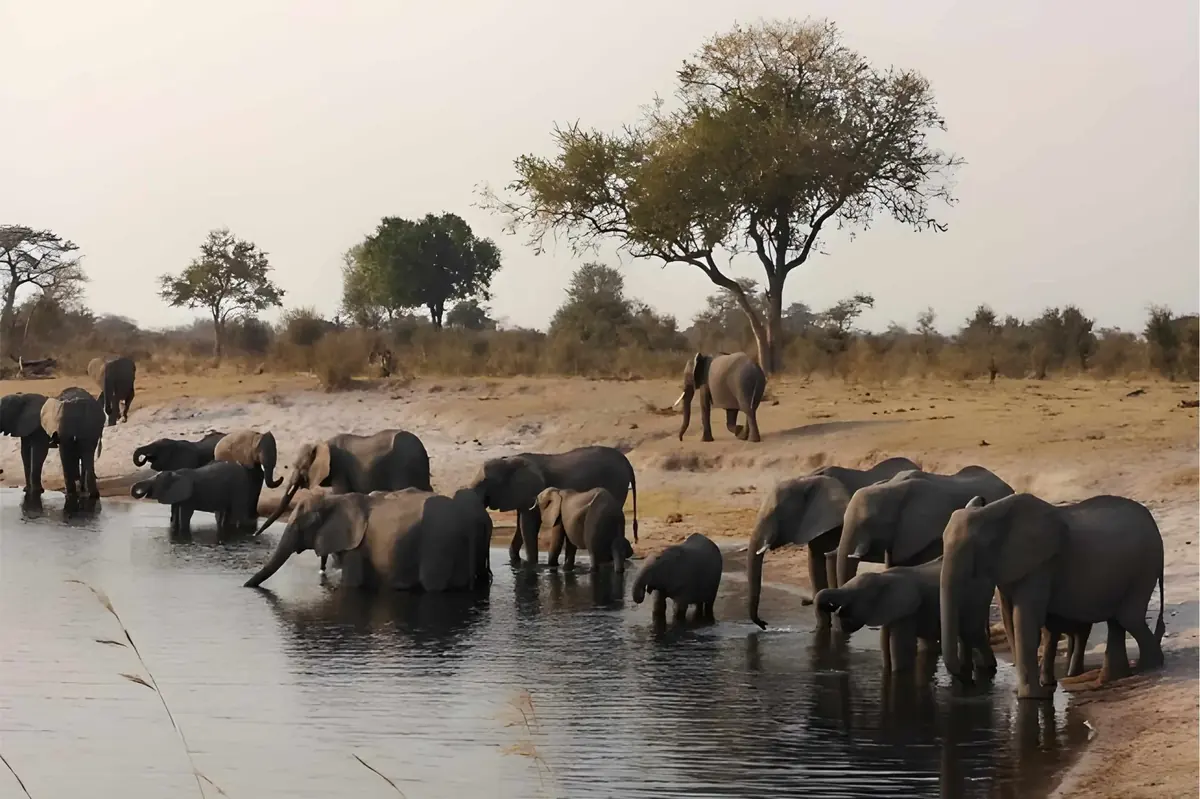
15- very likelyElephantAlong the Kwando, where breeding herds come to drink. Dry season, when herds keep close to the riversource
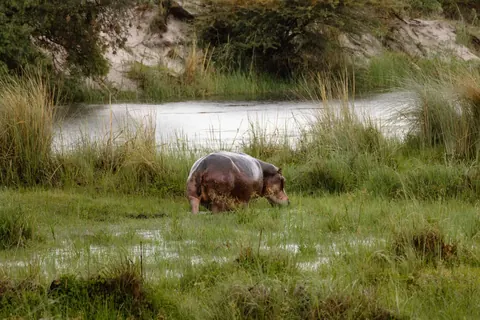
- very likelyHippoThe Kwando and its backwaters. All yearsource
- likelyRed lechweFloodplains and grassland along the river. All yearsource
- likelyCape buffaloRiverfront and floodplainsource
- likelyImpala and kuduWoodland and riverine bush. All yearsource
- likelyNile crocodileThe Kwando and its channels. All yearsource
- likelyBirds: 430 species recorded, including African skimmer, African fish eagle and western banded snake eagleThe Kwando floodplain and riverine woodlandsource
- likelySouthern carmine bee-eaterNesting colonies in the banks of the Kwandosource
- possibleSable and roan antelopeTall grass and woodland away from the riversource
- possiblePlains zebra, blue wildebeest and giraffeWoodland and open ground; giraffe, sable and eland were reintroducedsource
- rareLionOn MEFT's species list for the parksource
- rareLeopardsource
- rareAfrican wild dogsource
- rareSitatungasource
- rareSpotted-necked otterThe riversource
Likelihood is for a normal visit of two or three days, from the sources linked. Nothing is guaranteed in the wild.
Staying safe in Mudumu National Park
- Malaria
- Mudumu is in the Zambezi Region, a malaria transmission area, and MEFT calls the park high risk. The CDC recommends prescription antimalarials for the Zambezi Region, so see a travel clinic well before you leave, and cover up and use repellent from dusk. source
- Sand tracks and the rains
- Away from the tarred C49 the tracks are sand and signed for 4x4s only. In the rainy season MEFT recommends at least two 4x4s travelling together. source
- River
- Hippos and crocodiles live in the Kwando and its backwaters. Do not swim or wade, keep well back from the water's edge after dark, and never get between a hippo and the river. source
- Unfenced camps
- The Nakatwa camps sit on the riverbank with no water, toilets or electricity, and the park has no fence, so wild animals can walk through camp. Keep food locked in the vehicle and stay close to camp at night. source
- Night driving
- Night drives are allowed only with a guide on routes the park approves, so be back in camp or out of the park by dark if you are driving yourself. source
Tips from travellers
- Bring everything. MEFT tells visitors to bring their own water, food and fuel. Kongola, on the B8 north of the park, has a Shell filling station (OpenStreetMap, edited in 2025), and forum posts from 2014 call it reliable, so fill up there and wherever else you can. several sources
- You can drive the C49 through the park without a permit, but every other road and track needs one, so sort out your permit before turning off the tar. several sources
- For game, go in the dry season. Info Namibia suggests August to November as the best time to visit. one source
- Of the Nakatwa riverside camps, forum regulars rate site 3 the best, then 2. The access road to the camps is fine for a 4x4, but deeper sand elsewhere in the park needs care. several sources
- Check that the Nakatwa camps are still open before you plan around them. The 2020 park plan earmarks Nakatwa Island for a new lodge and camping concession and the closure of the old ranger station there. official
- Take all rubbish out with you, as there are no bins at picnic spots inside the park, and do not bring live fish, water creatures or water plants in. Both are park rules. official
Checked 7 October 2026. Conditions change, so confirm with the park or venue before you go.
Puku ghosts, a cheetah called Mudumu and elephants at the river
On paper, Mudumu is not where it is. The notice that created the park, AG 18 of 1 March 1990, is dated three weeks before independence, and the boundary it describes takes in a string of villages. Nobody was going to move them. So the cutline was graded somewhere else, and the ministry’s own management plan, thirty years on, admits that the park on the ground differs “dramatically” from the park in the Gazette and that the legal wording has never been corrected. The same notice puts the western edge in the middle of the Kwando. The actual border with Botswana follows the deepest channel.
Mafwe and Mayeyi families used this ground until 1945, when tsetse fly pushed people off the low-lying parts. After that much of it was a traditional hunting area, and it stayed one until 1987, when the Mafwe Traditional Authority signed an agreement to have it proclaimed. Lianshulu Lodge was already on the riverbank when the proclamation came, which is how it got a site no planner would hand out now. In 1992 the lodge built Lizauli Traditional Village and handed it to the community to run a year later.
The antelope that are not on the list any more
Older ministry staff remember the odd puku here in the 1980s. Nobody has recorded one for twenty years or more and the species is presumed extinct in Namibia. Oribi went the same way: the last report from this ground is a single sighting by the warden Jo Tagg in the early 1990s. The independence war did for much of the rest, between the South African military plundering game and villagers hunting for the pot. Helge Denker, writing in The Namibian in 2014, gives 1991 as the year the last giraffe in the eastern Caprivi was seen. Blue wildebeest and eland were already gone.
What you see today is partly a restocking job. Between 1999 and 2013 more than 2,200 animals were trucked into the Zambezi Region. One load, in September 2005, was sixteen wildebeest caught on a game farm south of Etosha. By July 2009 zebra caught in Mudumu were going the other way, to conservancies in the Kavango. Buffalo are the big recovery: fewer than a thousand were counted across Mudumu and Nkasa Rupara in the 1980s, and 6,000 or more in 2009 and again in 2017. Roan are the quiet success. The ministry calls Mudumu their stronghold in this corner of the country, with at least 300 to 400 animals, and a couple of hundred sable alongside them.
Afternoons on the Kwando
The elephants are a dry-season event, July to October, when they have to drink at the river. A camper at Nakatwa in late August 2024 woke to dozens of them walking to the water within a few hundred metres, and more than twenty were drinking below site 1. Another, there for a week in September 2014, wrote of thousands crossing the river right past the camps. One forum regular says the afternoon is the time to be at the water. Lodge guests on the boat describe elephants in and out of the river too. The 2019 aerial survey put roughly 3,500 elephants in the Kwando zone around the two parks, though they come and go. Some walk out through the state forest to Sioma Ngwezi in Zambia.
Expert Africa keeps a tally of what its travellers see from Lianshulu. It is a small sample, so read it as a hint: everyone saw hippo, most saw elephant, about two thirds saw giraffe and roan, a third saw sitatunga, under a third saw lion, and nobody saw leopard or wild dog. Sitatunga is the one to ask the boat guides about. A guest who stayed four nights in February 2020 saw them three times.
Lions you hear, and a cheetah that left
Campers hear far more than they see. One, who spent five nights at site 4, wrote in 2026 of lion and leopard very close in the dark, with the spoor there next day to prove it. Predator numbers are low and the research says why. Lise Hanssen, whose Kwando Carnivore Project started work in 2010, estimated about a hundred spotted hyaenas in the whole Zambezi Region in 2014. Her collars showed one clan of five to eight using the western half of Mudumu, and she thought trophy hunting in the conservancies next door was probably upsetting clans inside the park. Hyaena came off most local quotas that year. Lions had it worse. Farmers in the region killed twenty between 2012 and 2014 after losing nearly 200 cattle, and one pride fell from fifteen animals to three.
A profile in a 2008 conservation yearbook describes Matambo Singwangwa, then the Khwe ranger at Ngenda, who started with the ministry as a labourer in 1990. He had been shot at by UNITA and once woke to find a black mamba in his tent. He was the first person to get the ministry’s Welwitschia Award.
Then there is Mudumu the cheetah. Three males, probably brothers, were first picked up in Nkasa Rupara and named Rupara, Nkasa and Mudumu by the project. In March 2020 the coalition crossed the Kwando and took ten days to reach the Okavango Delta. Only two were identified there that May. Mudumu had disappeared somewhere on the way.
After dark, and off the tar
Driving here at night is a bad idea. One evening in October 2017 a bakkie carrying builders from the police station at Sangwali hit an elephant inside the park at about nine o’clock. Two men and the elephant died. In daylight it is sand that gets people. The 2024 camper who counted those elephants went exploring the plains across the tar road from the river and was stuck for seven hours, until help arrived on a John Deere tractor.
That camper also grumbled that an anti-poaching patrol setting fishing nets scared the game off the bank. People who write about Nakatwa keep coming back to how empty it is. One camper at site 3 thought the Caprivi felt more remote than Moremi and hardly saw another vehicle. Both lodges shut in 2010 and did not reopen until 2012.
In and around Mudumu National Park
10 places listedWhere to stay in Mudumu National Park 6
 HotelLianshulu Bush Lodgenaankusecollection.com
- HotelLianshulu Lodgenaankusecollection.com
- 18.17°S 23.42°ECampsiteNakatwa #1
- 18.17°S 23.43°ECampsiteNakatwa #2
- 18.18°S 23.45°ECampsiteNakatwa #3
- 18.18°S 23.45°ECampsiteNakatwa #4
Sights 4
- UitkijkhutjeViewpoint
- Buffalo TrailAttraction
- Hippo PoolViewpoint
- Maziba WaterholeViewpoint
Quick answers
How much is the entry fee for Mudumu National Park?
International visitors pay N$200 (about US$12, €11 or £9) per adult and N$150 per child per day. These rates apply from 1 April 2026 to 31 March 2027 and are set by Ministry of Environment, Forestry and Tourism (MEFT).
Do Namibians and SADC citizens pay less at Mudumu National Park?
Namibian citizens pay N$40 per adult and SADC nationals pay N$130 per adult per day. You need ID or a passport to get the lower rate.
When were these Mudumu National Park fees last checked?
We last checked them on 7 October 2026 against 4 published sources. We re-check every two weeks, but always confirm with Ministry of Environment, Forestry and Tourism (MEFT) before you travel.
What animals can you see in Mudumu National Park?
Most visitors see elephant and hippo. You have a good chance of seeing red lechwe, cape buffalo, impala, kudu, nile crocodile and birds: 430 species recorded. Lion, leopard, african wild dog and sitatunga are there but rarely seen.
Mudumu and the parks nearest it
| Park | International adult | Distance | Where |
|---|---|---|---|
| Mudumu National Park | US$12 €11 · N$200 | · | Zambezi |
| Nkasa Rupara National Park | US$12 €11 · N$200 | 37 km | Zambezi |
| Bwabwata National Park | US$12 €11 · N$200 | 108 km | Zambezi |
| Popa Falls Game Park | US$12 €11 · N$200 | 210 km | Kavango East |
Where the Mudumu fees come from
- Government Gazette No. 8877 of 1 April 2026, Government Notice No. 115 (MEFT fee schedule), copy hosted by the Legal Assistance Centre
- Namibian.org (19 January 2026)
- TravelComments.com (29 January 2026)
- SafariFind
Open data: all park fees (CSV) · JSON (CC BY 4.0)
Cite as: Travel Africa Guide, "Mudumu National Park fees 2026/27", checked 7 October 2026, https://travelafrica.guide/namibia/mudumu-national-park/
Map of Mudumu National Park
See every place on this map as a list