Park · Zambezi, Namibia
Nkasa Rupara National Park
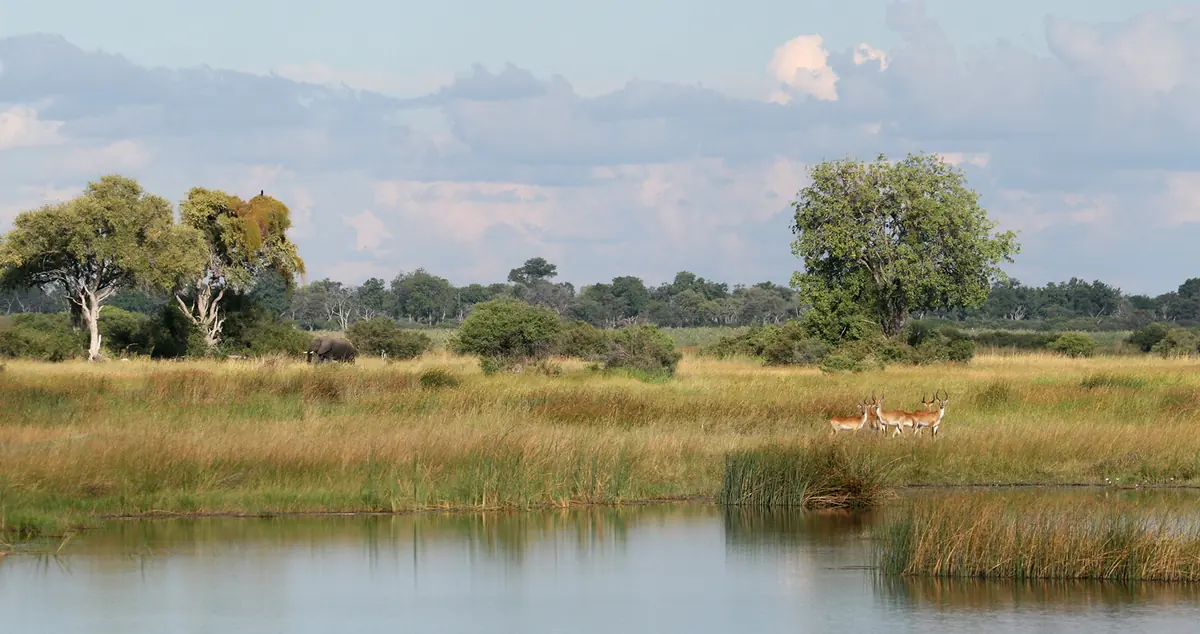
Namibia's largest protected wetland, a maze of reed beds, channels and islands on the Kwando and Linyanti rivers, with the country's biggest buffalo herd. 4x4 only, and you must be self-sufficient.
Short answer
At Nkasa Rupara National Park, international visitors pay N$200 (about US$12, €11 or £9) per adult and N$150 per child per day. The rates apply from 1 April 2026 to 31 March 2027.
- Daily fee, international adult
- US$12 €11 · N$200
- Malaria
- The Zambezi Region is a malaria area and the CDC recommends antimalarial tablets for it.
- Places to stay
- 5
- Park fee nearby: Mudumu National Park
- US$12 €11 · N$200about 37 km away
Nkasa Rupara National Park fees 2026/27
Checked Ministry of Environment, Forestry and Tourism tariffValid 1 April 2026 to 31 March 2027, per person per day, in Namibian dollars.
| Who | Adult | Child |
|---|---|---|
| International visitorsUS, Europe and everyone else | US$12 €11 · N$200 | US$9 €8 · N$150 |
| SADC nationals | N$130 | N$80 |
| Namibian citizens | N$40 | Free |
- Children aged 8 and under enter free. The child rate is for ages 9 to 15; Namibian children in that age group pay nothing. From 16 the adult rate applies.
- Vehicle fee per day, on top of the per person fee: N$60 for 10 seats or less, N$150 for 11 to 25 seats, N$600 for 26 to 50 seats and N$1,000 for 51 seats or more.
- The Namibian rate is for Namibian citizens. The gazette sets fees by nationality, so a foreigner living in Namibia pays the rate for their nationality.
- Each fee is half park entrance fee and half conservation fee; the figures shown are the two added together.
- These fees were gazetted with effect from 1 April 2026 and have no end date. I show them as valid to 31 March 2027, the end of Namibia’s financial year, and will re-check then.
- Fees are set by Ministry of Environment, Forestry and Tourism. Official tariff · Seen a new rate? Tell us
US$1 = N$16.64 · €1 = N$18.60 · £1 = N$22.31 (ECB rate, 3 Nov 2026, N$1 = R1). Converted amounts are approximate; you pay in Namibian dollars.
How we got these figures
- SafariFind prints N$60, N$40 and N$20 for these parks and lower child rates, which match neither the gazette nor the other reports; I went with the gazette.
- Government Gazette No. 8877 of 1 April 2026, Government Notice No. 115 (MEFT fee schedule), copy hosted by the Legal Assistance Centre · official · checked 7 Oct 2026
- Namibian.org (19 January 2026) · one source · checked 7 Oct 2026
- TravelComments.com (29 January 2026) · one source · checked 7 Oct 2026
- SafariFind · one source · checked 7 Oct 2026
Nkasa Rupara (formerly Mamili, and sometimes written Nkasa Lupala) sits at the southern tip of the Zambezi Region, with Botswana across the water on three sides. MEFT, which runs the park, gives 320 square kilometres (Travel News Namibia says 285) and calls it the largest wetland with conservation status in Namibia. Most of it is reed beds, lagoons and islands that grew on old termite mounds. About 1,000 buffalo live here, more than anywhere else in the country. People come for the wilderness, not for comfort.
Getting there
Leave the B8 at Kongola and take the tarred C49 south to the turn-off for Sangwali, the village just north of the park. The entrance at the Shisintze ranger station (you will see it spelt several ways) is about 11 km south of Sangwali. The lodge beside the gate puts it at roughly 75 km from Kongola and 130 km from Katima Mulilo. Inside the park you need a 4x4 with recovery gear. MEFT insists on it, and Travel News Namibia says to go with at least two vehicles.
When to go
The river flood decides this. The Kwando usually peaks at Kongola in May or June and takes several weeks more to reach Nkasa Rupara. In big flood years up to 80% of the park goes under, and after the 2008/9 flood deep channels kept people off Nkasa Island for years. No two seasons are alike. Wikivoyage says the end of the dry season is usually the time to go, and in the cool dry months the elephant come onto the islands in big numbers. Temperatures range from about 5°C to around 35°C.
What to do
Game drives on the tracks round Rupara Island are the main thing. One couple who drove it found the elephant in the south, near the river. Lion (two resident prides), red lechwe, sitatunga in the papyrus and hippo are all here. Birders rate it highly: more than 400 species, including wattled crane, slaty egret and southern ground hornbill. On the way in, stop at the small David Livingstone Museum in Sangwali, the village where he once lived.
Good to know
This is a malaria area. The CDC recommends antimalarial tablets for the Zambezi Region, so see a travel clinic before you leave home. There are no shops, fuel or facilities in the park. Fill up at Kongola or Katima Mulilo and carry water and food. Hippos and crocodiles are common, so stay out of the water. MEFT names two designated camping areas, Mparamura (also called Nzalu) and Lyadura, on the Kwando, but Travel News Namibia reported in 2022 that camping in the park was not allowed, so check with the MEFT office in Katima Mulilo first. Rupara Rest Camp is 3 km north of the gate, and a new camp, Nkasa Linyanti, was reported open on Nkasa Island in August 2026. Pay fees in advance at MEFT in Katima Mulilo or Windhoek, or on arrival. They are in the table on this page.
Wildlife you might see
15- very likelyHippoThe Kwando River, oxbow lakes, backwaters and pools. All yearsource
- likelyNile crocodileThe rivers, channels and pools. All yearsource
- likelyCape buffaloAbout 1,000 live in the park, the biggest concentration in Namibia. All yearsource
- likelyElephantNkasa and Rupara islands. Large herds gather on the islands in the dry winter monthssource
- likelyRed lechweFloodplains. All yearsource
- likelySouthern ground hornbillAll yearsource
- likelyAfrican pygmy gooseThe water by the camping area just before the park entrancesource
- possibleReedbuck and waterbuckFloodplains. All yearsource
- possibleLionFollows the buffalo herds on Nkasa and Rupara islands. All yearsource
- possibleWattled craneBreeding pairs live in the parksource
- possibleSlaty egretsource
- possibleSaddle-billed storkSeasonal pans. Rainy season, when the pans fillsource
- rareSitatungaDense papyrus beds. All yearsource
- rareLeopardsource
- rareAfrican wild dogsource
Likelihood is for a normal visit of two or three days, from the sources linked. Nothing is guaranteed in the wild.
Staying safe in Nkasa Rupara National Park
- Malaria
- The Zambezi Region is a malaria area and the CDC recommends antimalarial tablets for it. See a travel clinic before you leave home and use insect repellent. A fever up to a year after your trip needs a doctor straight away, and tell them where you travelled. source
- 4x4 only, two vehicles
- You need a 4x4 here, with recovery gear, and it is wise to travel as two vehicles so one can pull the other out. After a big flood whole sections of the park cannot be reached. source
- Be self-sufficient
- MEFT says there are no facilities in the park, so you must be self-sufficient. Bring enough fuel, water and food for your whole visit. source
- Hippos and crocodiles
- Hippos and crocodiles are common in the rivers, channels and pools. Do not swim, and keep a safe distance from the water's edge. source
- Floods
- In big flood years up to 80% of the park is under water and large areas cannot be reached. The Kwando flood arrives here several weeks after it peaks at Kongola in May or June, so high water can come in the dry season too. Ask the MEFT office in Katima Mulilo about conditions before you go. source
Tips from travellers
- Get a park map before you go in, because it is easy to get lost among the channels. Travel News Namibia rates the Kavango-Zambezi National Parks map, which covers the tracks around Rupara Island, as the one to have. several sources
- Pay park fees in advance at the MEFT offices in Katima Mulilo or Windhoek, or on arrival at the gate. official
- Head south towards the river, and expect water on the way. One couple on a day visit found the north quiet and the southern plains full of elephant, past a channel crossing that came up to their thighs. An ordinary SUV that had passed them earlier was already coming back. one source
- Stop at the small David Livingstone Museum in Sangwali on the way in. The explorer lived here, and the museum tells his story with maps and pictures. several sources
- A 2016 trip report found a fuel station and small shop at Kongola, where the C49 to Sangwali leaves the B8, with an ATM and card payment for fuel. Fill up there or in Katima Mulilo. one source
- Without a 4x4 you can still stay at Nkasa Lupala Tented Lodge on the park boundary: the lodge keeps other cars at the Wuparo Conservancy office and fetches guests by arrangement. one source
Checked 7 October 2026. Conditions change, so confirm with the park or venue before you go.
Tarzan, cotton mud and a swamp that dries for a decade
In October 2011 a hunter shot a black-maned lion called Tarzan in Wuparo Conservancy, the community land that runs up to this park’s northern boundary. It was legal. The conservancy had asked the ministry for a male lion on its hunting quota and was paid for the trophy. The trouble was that Wuparo had just gone into business with a tented lodge on the park’s doorstep, and its manager, Simone Micheletti, had a full house at breakfast on the morning four lionesses chased buffalo across the grass in front of it. Micheletti called the committee and the headmen to a meeting. Steve Felton, who reported the row for The Namibian a month later, wrote down how the acting deputy chair, Lameck “Shine” Limbo, put it: “at the end of the day we don’t have a lion”. Wuparo decided to leave lion off the next year’s quota.
Trophy hunters were not what came closest to finishing the lions, though. The killing that followed was done by people who had lost cattle, and it is told on our Mudumu page. The answer started here. In 2013 Lise Hanssen’s Kwando Carnivore Project began its lion work in the conservancies round Nkasa Rupara, where things were worst and lions were taking cattle at night out of makeshift kraals. By 2020 the project had made 170 kraals lion-proof, losses from those kraals had fallen by nine tenths, and from 2015 to 2019 only one or two lions a year were killed in revenge. I’d say the lions here owe a good deal to those kraal walls.
Named for a chief, then for two islands
The park was proclaimed on 1 March 1990, three weeks before independence, as Mamili National Park. Mamili is not a place. It is the title the chiefs of the Mafwe have carried since Kabende Simata, whose reign is dated from 1864. That is the year Makololo rule collapsed, and the Makololo capital, Linyanti, stood where Sangwali village is now. When David Livingstone brought his wagons in on 23 May 1853 the whole town came out to watch, and he put it at six or seven thousand people. (His wade through the reeds to get there is on our Linyanti page.)
The Mamili of 1990 was Boniface Bebi Mamili. After the army raided a secessionist camp in October 1998 he fled to Botswana with the Caprivi rebels, and was later given asylum in Denmark. In 2012 the government renamed the park after its two islands. The spelling never settled: the ministry’s own older brochure prints “Nkasa Lupala”, the lodge still does, and Expert Africa blames the L and the R on the local accent.
Sangwali remembers a different set of visitors. The one-room museum there, four metres by four under marula trees, was built by a local farmer, Linus Limbo Mukwata, in memory of the Helmore and Price mission party that came to grief at Linyanti in 1860. In 1999 he was put in touch with Stella Kilby, a great-great-granddaughter of Holloway and Anne Helmore, and she paid for it. It opened in 2001 and her daughter Petrina came out from Sussex to see it.
Wet for ten years, dry for ten
Every description of this park is true for the years it was written in. The Kwando ran low from 1991 to 2000. The floodplains had dried out completely by 1994 and saw little water again before 2005. Felton, going on what Beavan Munali of IRDNC told him, has 1994 to 1997 as the years the area was full of lions and farmers were losing livestock. Those were exactly the dry years. Then came the 2008/9 flood, and big stretches of the park did not start to drain until 2014.
It has swung back. A member of the 4x4 Community forum who drove in one August wrote in 2018 that there was no water for the first 15 to 20 km. In August 2024 the same man remarked that all the upgraded Rupara camp needed now was some water in its channel. Expert Africa’s staff have seen the lodge’s channel drop very low late in the dry season too. So ask what the river is doing before you believe anyone’s report, this one included.
The ground has its own tricks. The ministry’s old brochure warns of black mud so soft that people call it cotton, and of lightning that sets the earth itself alight, with fires burning under the surface as well as over it.
What the odds really are
Expert Africa keeps a tally of what its travellers see while staying at the lodge, going back to the middle of 2018. Hippo 89%. Elephant 84%. Lion 44%, leopard 19%, sitatunga 6%. And buffalo 56%. This park holds more buffalo than anywhere else in Namibia and nearly half the guests go home without seeing one. Elephant sometimes save you the drive. On one of the company’s own visits a herd of more than twenty walked into camp after breakfast and kept everyone from their rooms.
Self-drivers report less. That forum member’s dry August gave him more than three hours inside for a stray herd of elephant, a few kudu and some warthog, and no other vehicle. A second member, also there in an August, was the only party in the campsite and met nobody in a whole day in the park. Even the ministry’s brochure says you seldom see another tourist, and for a lot of people that is the reason to come.
Rupara rest camp, outside the gate, is unfenced. A Tracks4Africa writer lists elephant and the resident hippos among the camp’s visitors, and a camper who posted in September 2024 about an August night found elephants there on arrival and again after dark.
Pompie Burger, who has written up the birds here for Travel News Namibia and others, says to set out well before sunrise. He reckons the raptors outnumber Mudumu’s almost ten to one. Carmine bee-eaters are a summer bird and the hornbills are commoner in winter. At sunset the painted reed frogs start up first and the pearl-spotted owlets follow. He adds that a lion sounds a lot closer when you are lying in a small tent at the community camp.
In and around Nkasa Rupara National Park
5 places listedWhere to stay in Nkasa Rupara National Park 5
- 18.40°S 23.76°EHotelJackalberry Tented Camp+264 81 675 9490jbcamp.com
- 18.43°S 23.72°ECampsiteLyadura camp #1
- 18.43°S 23.71°ECampsiteLyadura camp #2
- 18.43°S 23.71°ECampsiteLyadura camp #3
- 18.40°S 23.77°ECampsiteMamili camp
Quick answers
How much is the entry fee for Nkasa Rupara National Park?
International visitors pay N$200 (about US$12, €11 or £9) per adult and N$150 per child per day. These rates apply from 1 April 2026 to 31 March 2027 and are set by Ministry of Environment, Forestry and Tourism (MEFT).
Do Namibians and SADC citizens pay less at Nkasa Rupara National Park?
Namibian citizens pay N$40 per adult and SADC nationals pay N$130 per adult per day. You need ID or a passport to get the lower rate.
When were these Nkasa Rupara National Park fees last checked?
We last checked them on 7 October 2026 against 4 published sources. We re-check every two weeks, but always confirm with Ministry of Environment, Forestry and Tourism (MEFT) before you travel.
What animals can you see in Nkasa Rupara National Park?
Most visitors see hippo. You have a good chance of seeing nile crocodile, cape buffalo, elephant, red lechwe, southern ground hornbill and african pygmy goose. Sitatunga, leopard and african wild dog are there but rarely seen.
Nkasa Rupara and the parks nearest it
| Park | International adult | Distance | Where |
|---|---|---|---|
| Nkasa Rupara National Park | US$12 €11 · N$200 | · | Zambezi |
| Mudumu National Park | US$12 €11 · N$200 | 37 km | Zambezi |
| Bwabwata National Park | US$12 €11 · N$200 | 126 km | Zambezi |
| Popa Falls Game Park | US$12 €11 · N$200 | 221 km | Kavango East |
Where the Nkasa Rupara fees come from
- Government Gazette No. 8877 of 1 April 2026, Government Notice No. 115 (MEFT fee schedule), copy hosted by the Legal Assistance Centre
- Namibian.org (19 January 2026)
- TravelComments.com (29 January 2026)
- SafariFind
Open data: all park fees (CSV) · JSON (CC BY 4.0)
Cite as: Travel Africa Guide, "Nkasa Rupara National Park fees 2026/27", checked 7 October 2026, https://travelafrica.guide/namibia/nkasa-rupara-national-park/
Map of Nkasa Rupara National Park
See every place on this map as a list