Park · Zambezi, Namibia
Bwabwata National Park
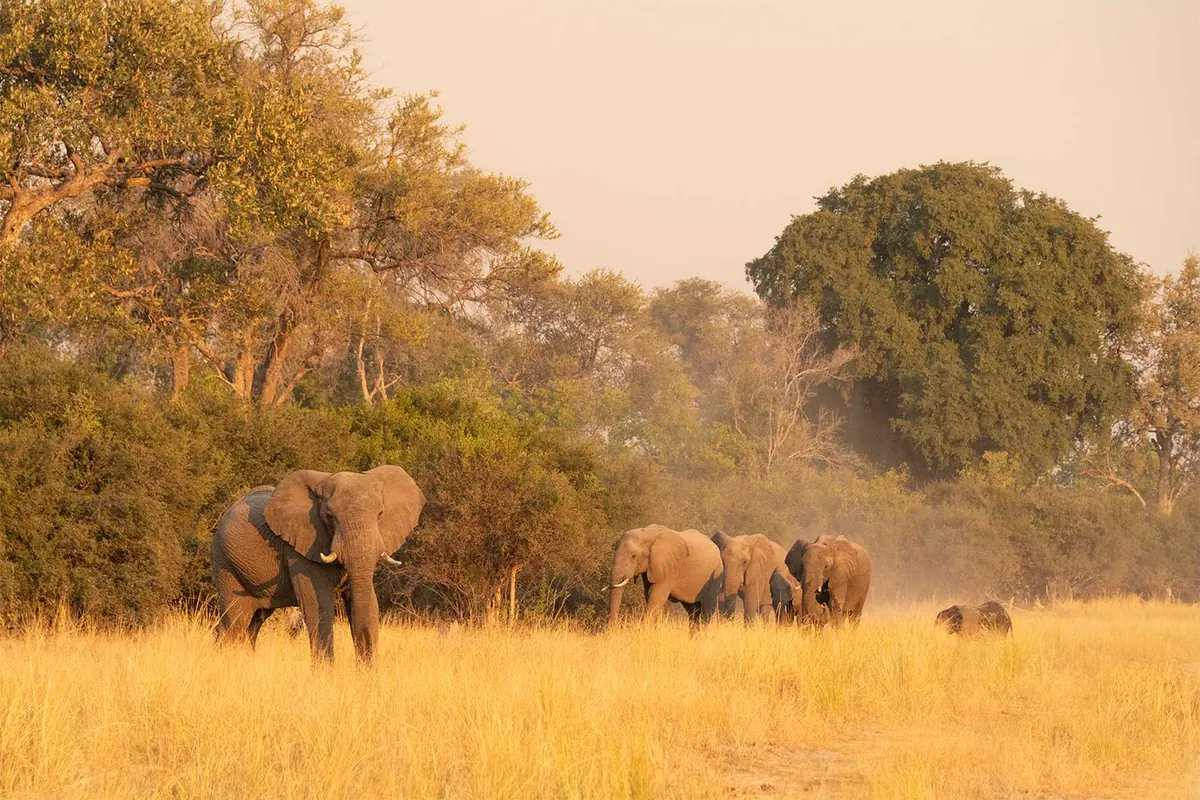
A long, unfenced park across the Caprivi Strip where elephant and buffalo come down to the Okavango and Kwando rivers. Mahango and the Kwando core area are the parts visitors drive.
Short answer
At Bwabwata National Park, international visitors pay N$200 (about US$12, €11 or £9) per adult and N$150 per child per day. The rates apply from 1 April 2026 to 31 March 2027.
- Daily fee, international adult
- US$12 €11 · N$200
- Malaria
- Bwabwata is in the Zambezi and Kavango East regions, both malaria transmission areas.
- Places to stay
- 6
- Park fee nearby: Popa Falls Game Park
- US$12 €11 · N$200about 105 km away
Bwabwata National Park fees 2026/27
Checked Ministry of Environment, Forestry and Tourism tariffValid 1 April 2026 to 31 March 2027, per person per day, in Namibian dollars.
| Who | Adult | Child |
|---|---|---|
| International visitorsUS, Europe and everyone else | US$12 €11 · N$200 | US$9 €8 · N$150 |
| SADC nationals | N$130 | N$80 |
| Namibian citizens | N$40 | Free |
- Children aged 8 and under enter free. The child rate is for ages 9 to 15; Namibian children in that age group pay nothing. From 16 the adult rate applies.
- Vehicle fee per day, on top of the per person fee: N$60 for 10 seats or less, N$150 for 11 to 25 seats, N$600 for 26 to 50 seats and N$1,000 for 51 seats or more.
- The Namibian rate is for Namibian citizens. The gazette sets fees by nationality, so a foreigner living in Namibia pays the rate for their nationality.
- Each fee is half park entrance fee and half conservation fee; the figures shown are the two added together.
- These fees were gazetted with effect from 1 April 2026 and have no end date. I show them as valid to 31 March 2027, the end of Namibia’s financial year, and will re-check then.
- Fees are set by Ministry of Environment, Forestry and Tourism. Official tariff · Seen a new rate? Tell us
US$1 = N$16.64 · €1 = N$18.60 · £1 = N$22.31 (ECB rate, 3 Nov 2026, N$1 = R1). Converted amounts are approximate; you pay in Namibian dollars.
How we got these figures
- SafariFind prints N$60, N$40 and N$20 for these parks and lower child rates, which match neither the gazette nor the other reports; I went with the gazette.
- New Era reported in 2025 that the draft schedule kept Bwabwata free for Namibians. The gazetted schedule charges Namibian adults N$40.
- Government Gazette No. 8877 of 1 April 2026, Government Notice No. 115 (MEFT fee schedule), copy hosted by the Legal Assistance Centre · official · checked 7 Oct 2026
- Namibian.org (19 January 2026) · one source · checked 7 Oct 2026
- TravelComments.com (29 January 2026) · one source · checked 7 Oct 2026
- SafariFind · one source · checked 7 Oct 2026
- New Era (report on the 2025 draft fee schedule) · one source · checked 7 Oct 2026
Bwabwata covers a little over 6,000 square kilometres of the Caprivi Strip, the narrow arm of Namibia between Angola and Botswana, now split between the Zambezi and Kavango East regions. It was proclaimed in 2007 from the old Caprivi Game Park and Mahango. Several thousand people, mostly Khwe San, live inside it, most in Omega and smaller villages. The reason to stop is the two rivers at either end, the Okavango in the west and the Kwando in the east, where elephant and buffalo come to drink.
Getting there
The tarred B8 from Rundu to Katima Mulilo runs straight through the park. Divundu, about 200 km east of Rundu, sits at the western end. Kongola, 112 km south-west of Katima Mulilo, is at the eastern end. For Mahango, take the C48 gravel road south from Divundu; Popa Falls is about 14 km north of the Mahango gate. The Kwando core area is at the eastern end, on the river of the same name, and you need a 4x4 for it.
When to go
July to November is the season for game. The pans in the interior dry out and the animals move to the rivers. Rain falls from November to March, often in big thunderstorms, and the Okavango is usually at its highest around April. For birds, November to February is better.
What to do
Mahango is the easy part. A river road of about 15 km runs east of the C48 along the Okavango floodplain, past big baobabs, and a normal car manages it, best in the dry season. The usual plan is to drive it south to the Kwetche picnic spot and come back the same way, and gate staff say this is where most of the game is. A longer western loop of about 30 km runs through thicker woodland, is very sandy and needs a 4x4. Look for sable and roan here, which are hard to find elsewhere in Namibia. More than 450 bird species have been recorded at Mahango, the most of any park in the country.
In the east the track is sand and badly signposted, and it is about 10 km in to Horseshoe, an oxbow bend of the Kwando where elephant herds gather in the afternoon and hippos sit in the water. Carmine bee-eaters nest in the riverbanks from August to November. Lodges outside the park run guided drives if you would rather not tackle the sand.
Good to know
This is a malaria area and the CDC recommends antimalarials for both the Zambezi and Kavango East regions, so see a travel clinic before you go. Do not swim in the rivers or pans: hippos, crocodiles and bilharzia are all present. Fill up at Divundu or Kongola, the fuel stops at each end of the park. The B8 is unfenced and animals, cattle and goats cross it, so avoid driving it after dark. Off the main road you need a park permit and must keep to marked tracks. Mahango is for day visits only. Fees are in the table on this page.
Wildlife you might see
14- very likelyElephantAlong the Kwando and Okavango rivers. Dry season, when they come to the rivers in large numberssource
- very likelyHippoHorseshoe and the Kwando, and the Okavango along the Mahango river road. All yearsource
- very likelyKudu and impalaAll three core areas. All yearsource
- likelyNile crocodileBoth rivers. Some are very large. All yearsource
- likelyCape buffaloMahango and the Buffalo core area, which hold over 1,000 buffalo between themsource
- likelySable and roan antelopeMahango, grazing on the floodplain near the river road; also the Kwando side. All yearsource
- likelyRed lechwe and reedbuckFloodplains and reed beds along both rivers. All yearsource
- likelyBirds: over 450 species, including wattled crane, African skimmer and Pel's fishing owlMahango and the Okavango floodplain, the richest bird area of any Namibian parksource
- likelySouthern carmine bee-eaterNesting colonies in the banks of the Kwando. August to Novembersource
- possibleTsessebe and waterbuckMahango, where both have been released to restock the areasource
- rareSitatungaReed beds and swamp along the riverssource
- rareLionThroughout, but numbers are lowsource
- rareLeopard and spotted hyenaThroughout, seen now and thensource
- rareAfrican wild dogThe park is one of the last refuges for wild dogs in Namibia, but there are few of themsource
Likelihood is for a normal visit of two or three days, from the sources linked. Nothing is guaranteed in the wild.
Hikes and walks
1- Popa Falls walkways
Raised wooden walkways and viewpoints over the rapids on the Okavango, about 14 km north of the Mahango gate. Inside Mahango itself you may only leave your vehicle at the picnic sites.
Permit: Popa Falls Game Park is a separate reserve next to Bwabwata with its own entry fee
Rough Guides, Namibia's northeast
Staying safe in Bwabwata National Park
- Malaria
- Bwabwata is in the Zambezi and Kavango East regions, both malaria transmission areas. The CDC recommends prescription antimalarials for travellers there, and the park authority also says to see a doctor before you visit, so book a travel clinic well before you leave. source
- Rivers and pans
- Do not swim in the rivers, pans or backwaters. Hippos and crocodiles are common and bilharzia is present. Never stand between a grazing hippo and the water. source
- Elephants
- Elephants have right of way. If a herd is on the road, stop and let it pass, and do not try to drive between elephants and the river, where they can feel trapped. Ear flaring, screaming and mock charges are warnings to back off. source
- The B8 at night
- The B8 through the park is tarred and unfenced, with a 120 km/h limit. Many animals are killed on it every year, wild dogs among them. Do not drive it after dark if you can help it. source
- Sand tracks
- The Kwando side is 4x4 country. The operator of Nambwa campsite says the sand is thick enough that you need one, and puts the drive from the park gate to the campsite at about 45 minutes. source
- Wild camping
- At Nambwa campsite in the Kwando core area, local and migrating wildlife walks through camp, and the operator suggests a rooftop tent if hippos and elephants coming through worry you. Treat any camp in the park the same way. source
Tips from travellers
- Fill up at Divundu or Kongola, at either end of the park. OpenStreetMap shows two filling stations at Divundu, a TotalEnergies and an Engen, both mapped in 2024. one source
- At the eastern end, the Kongola service station applied in 2025 to renew its environmental clearance to keep operating, so it was still selling fuel then. one source
- At Mahango, most of the game is on the river road east of the C48, according to the gate staff one writer spoke to. It suits slow driving with plenty of stops and can easily fill a morning. one source
- Elephants often come down to drink at Horseshoe on the Kwando. On one guided drive a writer watched three herds, about 150 animals, come and go while waiting there. one source
- Mahango is for day visits only, with no overnight accommodation in the park, so you drive in from a camp outside. one source
- If you are staying on the river, July to November is the best time for game, once the rain pans inland have dried and animals move to the water. one source
- Mahango and the Kwando core area each need their own permit, even though both are part of Bwabwata. one source
Checked 10 October 2026. Conditions change, so confirm with the park or venue before you go.
One hippo, one sable: the park the army left behind
In 1978 somebody surveyed the game of what was then the Caprivi Game Park. The whole result fits in a sentence: one breeding herd of 35 elephants, a single sable, a small herd of red lechwe and one hippo. The ministry prints those figures in its own fact sheet next to its later counts: at least 340 resident elephants with thousands more passing through, 277 sable and about 350 hippos.
The gap between those two sets of numbers is the story of this park. It had been a reserve on paper since 1963 and a game park since 1968, but nobody managed any wildlife in it. It was a closed security zone, first under the South African police and then the army.
Buffalo, Omega and a lion called Teddy
On the Okavango side was Buffalo, home of 32 Battalion, which Colonel Jan Breytenbach put together in 1975 out of Angolan soldiers. The headquarters sat 200 km west in Rundu, but the men trained and lived at Buffalo, with a village called Pica Pau for their families. Halfway along the strip was Omega, base of 31 Battalion, raised in 1974 by Colonel Delville Linford from Khwe and !Xun men, many of whom had already served with the Portuguese in Angola.
On the Kwando side the special forces had Fort Doppies, and Fort Doppies had a lion. Teddy was the Recces’ mascot, and a photograph from about 1980 shows him playing in the Kwando with an operator named Obie Oberholster. A man whose father held the Caprivi concession until 1978 wrote on an overlanding forum that Teddy “was ours” until about 18 or 20 months old. That is one man’s account. The military history writer who published the photograph was asked by a reader what became of the lion and did not know.
When the army pulled out ahead of independence in 1990, several thousand San soldiers and their families went with it and were resettled at Schmidtsdrift in South Africa’s Northern Cape. The ones who stayed are the people you pass on the B8 today: about 4,000 Khwe in ten villages, as The Namibian put it in 2006. Their chief, Kippi George, died in December 2000 and they went more than five years without one, until Ben Ngobara was elected at Omega 1 in May 2006.
The bases are still there, more or less. In the Buffalo core area the ruins of the old station stand in the bush, and impala and kudu wander through them. The lodge at Nambwa was built on army ground and keeps the small relics its builders turned up on show in its library. In October 2026 guides at Divundu told The Namibian that the ministry had closed tracks along the Okavango, some of them in use for more than 25 years. The ministry says only illegal tracks were shut.
A highway you can cross without noticing the park
One overlander wrote that you can drive the B8 and never realise you are in a national park. The road signs warning of elephants, and one of wild dogs, are the main clue. In 2013 a pack denned 500 metres from the tar and lost six pups to traffic. Lise Hanssen, who has studied the big carnivores here since 1999, put the spotted hyenas at one full clan and parts of three others: 15 to 25 animals in the entire park, all tied to the two rivers.
The road has darker dates. On 3 January 2000, during the last years of the Angolan war, gunmen ambushed a French family’s car on it and killed their three children. At least five such ambushes were recorded between 1999 and 2002. And on 29 November 2013 a Mozambican airliner on its way from Maputo to Luanda came down in the park with 33 people on board. A helicopter search was called off in heavy rain, there were no proper roads to the place, and the burnt-out wreck was only found the next day. Investigators later concluded the captain had flown it into the ground deliberately.
Lions by ear, wild dogs by luck
Be realistic about cats. One magazine writer at Mahango in 2015 reported a roar close enough to send her companions running for the car, and no lion to go with it. A photographer who worked with Hanssen across the wider Zambezi region that year wrote that even she had never seen its lions except on her research cameras. His own five camera traps ran for three months and caught lions twice.
Numbers have been topped up by hand. In June 2017 two young males caught on farmland in Omaheke were sent some 1,400 km by road for release in the Buffalo core area. It does not always take: two lionesses and four cubs moved into the park in May 2025 after killing cattle were back within days, having crossed the B8 near the Kwando gate. One magazine writer did find a lioness and two males in Buffalo, then sat three hours bogged in mud 50 metres from them in the rain.
The Kwando side gives better odds. Among travellers who stayed at Nambwa and reported back to one British operator, about a third saw lion and fewer than a quarter saw wild dog, though one party in May 2024 counted 13 dogs. Nearly everybody saw elephant and hippo. One camper at Nambwa described a cow and her small calf feeding over the campsite while branches and leaves rained down around the awning.
Counted on foot
Game here is counted by walking. On one day in September 2011, teams of ministry rangers and community game guards across the region covered about 800 km between them, on routes of 3 to 25 km, writing down every animal and every track less than a day old. In the park the guards belong to the Kyaramacan association, set up by the park’s residents in 2004.
There is a harder side to the guarding. Between September and December 2016 the park lost 24 elephants to poachers. In February 2018 two German visitors drove on when armed men who did not look official to them tried to stop their hired car. The men were an anti-poaching unit, shots were fired, and police later found a bullet in the canopy. Nobody was hurt.
In and around Bwabwata National Park
12 places listedWhere to stay in Bwabwata National Park 6
- 18.11°S 21.58°EPlace to stayWhite Sands Lodgewhitesands.com.na
- 17.88°S 23.31°ECampsiteNambwa Campsite+264 81 125 2122africanmonarchjourneys.com
- 18.11°S 21.58°EChaletChalet
- 17.78°S 23.34°ECampsiteBum Hill Rest Camp
- 17.88°S 23.32°EHotelNambwa Lodge
- 17.86°S 23.32°EHotelSusuwe Island Lodge
Sights 4
- BaobabAttraction
- Buffalo Tourist Reception & Management StationAttraction
- HorseshoeViewpoint
- Hunting CampViewpoint
Restaurants and cafes 1
- White Sands RestaurantRestaurant · american, curry, german, barbecue, hot dog, chicken, cake, noodle
Bars and pubs 1
- Federal BarBar
Quick answers
How much is the entry fee for Bwabwata National Park?
International visitors pay N$200 (about US$12, €11 or £9) per adult and N$150 per child per day. These rates apply from 1 April 2026 to 31 March 2027 and are set by Ministry of Environment, Forestry and Tourism (MEFT).
Do Namibians and SADC citizens pay less at Bwabwata National Park?
Namibian citizens pay N$40 per adult and SADC nationals pay N$130 per adult per day. You need ID or a passport to get the lower rate.
When were these Bwabwata National Park fees last checked?
We last checked them on 7 October 2026 against 5 published sources. We re-check every two weeks, but always confirm with Ministry of Environment, Forestry and Tourism (MEFT) before you travel.
What animals can you see in Bwabwata National Park?
Most visitors see elephant, hippo, kudu and impala. You have a good chance of seeing nile crocodile, cape buffalo, sable, roan antelope, red lechwe and reedbuck. Sitatunga, lion, leopard and spotted hyena are there but rarely seen.
Bwabwata and the parks nearest it
| Park | International adult | Distance | Where |
|---|---|---|---|
| Bwabwata National Park | US$12 €11 · N$200 | · | Zambezi |
| Popa Falls Game Park | US$12 €11 · N$200 | 105 km | Kavango East |
| Mudumu National Park | US$12 €11 · N$200 | 108 km | Zambezi |
| Nkasa Rupara National Park | US$12 €11 · N$200 | 126 km | Zambezi |
Guides for Bwabwata National Park
Where the Bwabwata fees come from
- Government Gazette No. 8877 of 1 April 2026, Government Notice No. 115 (MEFT fee schedule), copy hosted by the Legal Assistance Centre
- Namibian.org (19 January 2026)
- TravelComments.com (29 January 2026)
- SafariFind
- New Era (report on the 2025 draft fee schedule)
Open data: all park fees (CSV) · JSON (CC BY 4.0)
Cite as: Travel Africa Guide, "Bwabwata National Park fees 2026/27", checked 7 October 2026, https://travelafrica.guide/namibia/bwabwata-national-park/
Map of Bwabwata National Park
See every place on this map as a list