Town · North-West District, Botswana
Shakawe
The main village at the top of the Okavango Panhandle, 15 minutes from the Namibian border at Mohembo. People come to fish for tigerfish, watch birds from a boat and visit Tsodilo.
Short answer
Shakawe is in North-West District, Botswana. This page lists 8 places to stay and 2 places to eat and drink.
- Places to stay
- 8
- Eat and drink
- 2
- Where
- North-West District, Botswana18.36°S 21.84°E
In and around Shakawe
10 places listedWhere to stay in Shakawe 8
- 18.37°S 21.85°EGuest houseAtoma Guest House
- 18.39°S 21.85°EGuest houseDitlhapi Guest House
- 18.35°S 21.83°EGuest houseHawk Guest HouseShakawe
- 18.37°S 21.84°EGuest houseAIR Guest House
- 18.37°S 21.85°EGuest houseEdenWood Guest House
- 18.36°S 21.84°EGuest houseElephant Cove Guest House
- 18.40°S 21.86°EGuest houseKigelia Adventure Lodge
- 18.34°S 21.84°EGuest houseShakawe Sands Lodge
Restaurants and cafes 2
- Kgabo Tracks Club and RestaurantRestaurant
- Kigelia Adventure Lodge RestaurantRestaurant
Shakawe is the main village on the Okavango Panhandle, on the west bank of the river in Botswana’s far north-west, about 15 minutes’ drive from the Namibian border at Mohembo. The 2022 census counted 10,589 people. People come for the river: tigerfish, a bird list of over 400 species, and slow boat trips between walls of papyrus. It is also the last proper stop before Tsodilo Hills.
Getting there
From Maun you take the A3 to Sehithwa, then the A35 north for most of its 296 km. It is tar in name. The government has admitted the stretch from Nokaneng to Shakawe is in a bad state, and in 2026 the Gumare to Sepopa section was being rebuilt half a width at a time, with gravel bypasses and parts that become impassable in the rains. Elephants and stray cattle use the road too, so do it in daylight. Buses leave Maun several times a day and take five to six hours.
From Namibia, the C48 becomes the A35 at the Mohembo border post. The border is open from 06:00 to 18:00. Charter flights use the Shakawe airstrip.
When to go
May to October is dry and clear, and fishing is at its best then. As the water drops, roughly August to November, catfish swarm up the channels hunting smaller fish, with tigerfish and birds after them. This is the barbel run, and September and October are the months to aim for. Carmine bee-eaters nest in the riverbanks from September to December. November to April is warm and wet with thunderstorms, but that is when the migrant birds are in. Winter nights are cold, and the lowest temperature recorded here is minus 6.1 °C.
What to do
Get on a boat. The lodges along the river south of the village all run fishing trips and bird cruises, and there are crewed houseboats for groups. African skimmer and Pel’s fishing owl are the two birds people travel for. This is hippo and crocodile water, not big game country.
The Okavango River Bridge, about 12 km north-west of the village, is 1.2 km long with pylons shaped like crossed elephant tusks. It replaced the Mohembo ferry in 2022.
Tsodilo Hills is the usual day trip: back down the A35, then a dirt road off the tar. Allow nearly two hours each way. Mahango, just over the border in Namibia, has elephants and more than 300 bird species.
Good to know
Shakawe has three filling stations, three banks with ATMs, and Choppies, Sefalana and Fours supermarkets, so fill up and stock up here before Tsodilo or the east bank. The tracks from the tar to many river camps are deep sand or flooded in season, and the single track down the east bank to Seronga needs high clearance. Ask your lodge before turning off in an ordinary car.
This is a malaria area. The US CDC recommends tablets for the Okavango district and UK guidance rates the north of Botswana high risk from October to May. Keep out of the river.
History and culture
Shakawe is a river village at the top of the Okavango Panhandle, a short drive from where the river enters Botswana from Namibia. Its story is one of people arriving along the water: San hunters, Hambukushu farmers moving down from the north, Tswana rulers, colonial border makers and, late on, anglers. It helps to know that when you sit in a boat here and wonder who the fishermen in the dugouts are.
- Earliest inhabitants
Village tradition, as the chief of Shakawe tells it, holds that the first people here were San (called Basarwa in Botswana), who came from what is now Namibia and settled at Shakawe. source
- About 1810
By their own tradition, which historians cannot confirm, the Hambukushu came from south-western Zambia, reached the Kwando River around 1750 and moved on to the Okavango around 1810 under pressure from the Lozi kingdom. The first written record of them in the area dates from 1892. source
- 1850s
The Batawana, a Tswana people whose rulers had held sway over the delta since the late 1700s, made their control complete in these years as the ivory trade took off. Most of them lived on the delta's edges, because tsetse fly threatened their cattle. source
- 1890
On 30 June 1890 Britain pushed the northern edge of the Bechuanaland Protectorate (colonial Botswana, declared in 1885) up from 22 degrees south to take in Ngamiland. No British official actually arrived in the region until 1894. Ngamiland became the protectorate's point of contact with German South West Africa through the Caprivi Strip. source
- Late 1960s to early 1970s
More than 4,000 Hambukushu refugees from Angola were settled around Etsha, further down the west bank of the Panhandle. source
- Late 1970s
A ferry started running across the river at Mohembo, the first time a vehicle could cross the Okavango here. The chief of Shakawe recalls about eight vehicles a day using it in the early years. It ran from 6 am to 6 pm, with no crossing at night, and he remembers a woman who gave birth and spent the night on the bank after the last ferry had gone. source
- By about 1990
Jan and Eileen Drotsky built one of the first lodges in the Shakawe area, on the river south of the village. The family, who still run it, date that to more than 35 years ago. source
- 2022 to 2023
The Okavango River Bridge at Mohembo replaced the ferry. The Minister of Transport opened it for public use in June 2022, and its official opening by President Mokgweetsi Masisi was set for 21 January 2023. source
- Who lives here
- Most people in Shakawe are Hambukushu or Baherero (Herero), with Bayeyi and San families as well. They live mainly from fishing and from tourism. source
- Language
- The Hambukushu speak Thimbukushu, a Bantu language also spoken in Namibia, Angola and Zambia. In 2022 it was one of the mother tongues chosen to be taught in Botswana's primary schools from 2023. source
- Rain-makers and basket weavers
- The Hambukushu are known along the Okavango as rain-makers, and for their baskets. Hambukushu is what they call themselves. One person is a Mbukushu. The women traditionally fish with traps. source
- Fishing from a mokoro
- Men fish the channels for bream and catfish from a mokoro, the dugout canoe of the delta, some of them home made. One fisherman told a government magazine reporter that a good day brings in at least 100 fish. source
- The kgotla
- Shakawe has a kgotla, the traditional meeting place found in Botswana villages, where the chief (kgosi) sits. It was there that the Kutlwano reporters heard the village's story from Kgosi Mutemo Mbambo. source
For German visitors: The cable-stayed span of the bridge at Mohembo was designed by Ingenieurbüro Grassl, a German engineering firm, from its Hamburg office. The firm says the tusk pylons are meant as a gateway to the Okavango Delta and as a nod to Botswana having more elephants than any other African country. source
For German visitors: The border you cross at Mohembo is a German colonial line. Germany acquired the Caprivi Strip from Britain in 1890 under the Heligoland-Zanzibar Treaty, hoping for a route to the Zambezi, and it is named after the Chancellor of the day, Leo von Caprivi. source
Main sights in Shakawe
6- Okavango River Bridge, Mohembo
A cable-stayed bridge about 1.2 km long with a 200 m main span and steel pylons shaped like crossed elephant tusks, the only bridge over the Okavango in Botswana. It stands about 12 km north-west of Shakawe.
Wikipedia (German), Okavango River Bridge - The old Mohembo ferry
The pontoon that carried vehicles across the river for decades. When the bridge opened in June 2022 a retired ferry pioneer, Dikumbiro Makaeko, drove the last pontoon across, and the minister said he hoped it would be kept for business and tourism use. Ask in the village what has become of it.
Botswana Daily News (government press agency), 26 June 2022, Okavango River Bridge opens for public use - Shakawe riverfront
The river beside the village is known for kingfishers, bee-eaters and reed cormorants. From September to December colonies of carmine bee-eaters nest in the banks. A boat is the way to see it.
Expert Africa, North-west Kalahari and Okavango Panhandle - Tsodilo Hills
Botswana's first World Heritage Site, listed in 2001: hills in the Kalahari west of the Panhandle with more than 4,500 rock paintings in about 10 square kilometres. Nxamaseri Island Lodge on the Panhandle runs day trips.
Expert Africa, North-west Kalahari and Okavango Panhandle - Etsha villages
Thirteen villages, numbered Etsha 1 to Etsha 13, founded when refugees from the war in Angola were resettled here. Basket making has been studied here since the 1980s, and palm-frond weaving is one of the crafts sold.
Wikipedia, Etsha - Mahango (Namibia)
Just over the border, a game park proclaimed in 1986 on the Okavango floodplain, now part of Bwabwata National Park. It has very large baobabs, elephants and more than 300 bird species.
Wikipedia, Mahango Game Park
Did you know?
- According to Kgosi Mbambo, Shakawe is the name of a tree that San hunters used as a lucky charm. The tree no longer grows here. In Botswana the village is affectionately known as Shake-away. source
- People in Shakawe call the far bank of the river "overseas". Until the bridge opened, the villages over there could only be reached by the ferry, and not at all after 6 pm. source
- The 2022 census counted 10,589 people in Shakawe village, and 10,891 with its outlying lands and cattle posts. source
- The Okavango Delta is so flat that the ground varies by less than 2 metres across it, and the water drops only about 60 metres between Mohembo, just upstream of Shakawe, and Maun. source
- The rain that makes the flood falls in the Angolan highlands in January and February. It reaches the top of the delta in about a month, then takes another four months to spread through it, which is why the delta is fullest in Botswana's dry winter. source
- Shakawe has recorded both 39.6 °C and minus 6.1 °C. Winter nights on the river are colder than most visitors pack for. source
Checked 12 October 2026.
Counting red eyes: the crocodile river below Shakawe
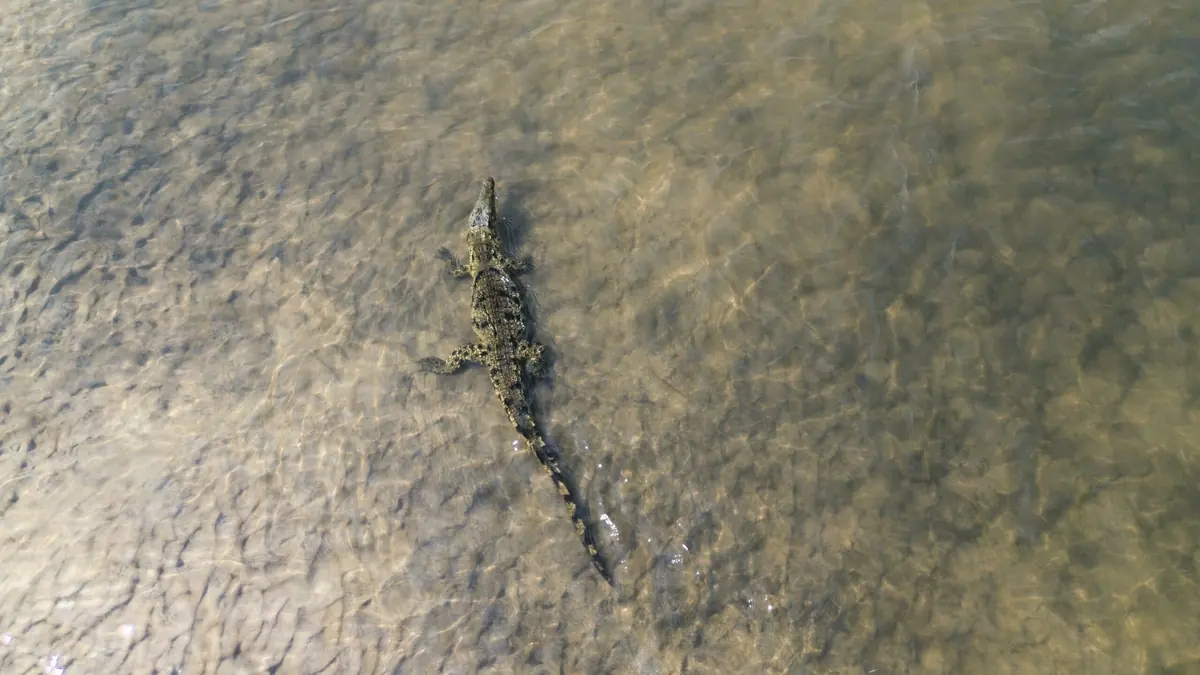
For six nights in late August 2016, three men in a boat worked the Okavango below Shakawe with a spotlight of 1.5 million candlepower. Their survey ran from Etsatsa Island, a little below Seronga, up to the village. They set off each evening at half past seven and kept going until two in the morning, swapping observers every hour so that nobody got tired and missed things. A crocodile’s eyes shine red in the light from more than 100 metres off. By the end they had covered 265 km of channel and counted 433 crocodiles, from youngsters of 35 cm to animals they judged at five metres.
That is about one and a half crocodiles for every kilometre, by spotlight. The team’s own sums, which allow for the ones under water or back in the papyrus, come to 1,931 for the channels they covered. They treat that less as a head count than as a marker to set against the 1,793 worked out the same way in 2008.
Fifty thousand skins
The reason anyone counts them is that the river was once nearly emptied. Between 1956 and 1987 the Okavango’s crocodiles were worked for money, and the researchers put the number shot for their hides at up to 50,000. The belly skins went into handbags and shoes. Maitseo Bolaane, a historian at the University of Botswana, has shown how much the white hunters of the 1940s and 1950s leaned on San trackers, who knew the swamp and could find a nest where an outsider saw only reeds. One of them, Kwere Sereri, is remembered by hunters and villagers alike for his skill. The best known of the hunters, Bobby Wilmot, is said to have kept his northern camp at Sepopa in the late 1960s. The river camp there today tells the story, and I have found it nowhere else.
From 2002 to 2006 a Stellenbosch University project under Alison Leslie caught crocodiles on this water by the hundred: anything under 1.2 metres was grabbed by hand over the side of a 4.8 metre aluminium boat. Sven Bourquin’s doctorate rests on 1,717 animals, each measured, marked and let go. His estimate for the Panhandle was about 2,570, with only some 650 adults among them. Nearly two thirds of those caught a second time were within 500 metres of where they had first been picked up, and a couple have turned up again nine and eleven years later.
Why it matters that this bit is not a park
You see big crocodiles all over the protected delta, yet hardly any nest there. Between 98 and 99 per cent of the known nest sites are in the Panhandle, on the river that runs from Shakawe down to Seronga, past villages, cattle and fishing nets. Bourquin found that nests had fallen by half or more in twenty years, and the monitoring team blames crocodile farming and the growing number of people on the banks.
The detail is in one side channel, the Phillipa. It held 11 nests in 2015 and 11 again in 2016, and the team thinks nine of those were the same females back at the same holes. A female lays about 50 eggs and they take some 90 days to hatch, in early to mid summer. Seasonal fires start in September and burn straight across the nesting months. The 2016 count also turned up something worrying: animals in the middle size class, between 1.3 and 2.3 metres, were down by 74 per cent on 2008. Crocodiles of that size live largely on fish. The team saw far fewer fish in the lagoons than in earlier years, met men working gill nets by lamplight, and suspects the two things are connected.
People on the bank have their own view. In March 2013 a farmer at Samochima, just south of Shakawe, told the Daily News he had lost three goats, two donkeys and a cow in a fortnight. Farmers there had put up barriers of thorn branches, he said, but the animals wandered to where there were none. The wildlife officer at Shakawe had 15 cases on his books for the year by then. A survey of 482 people in 35 villages found half of them afraid of crocodiles, with attacks coming when people fish, swim or fetch water, though by the wildlife department’s records lions and leopards take far more livestock.
The owl that flew off
The other animal people come to Shakawe for is Pel’s fishing owl, ginger, about a metre and a half across the wings, living on fish it lifts off the surface at night. Tim Liversedge, who went on to make wildlife films, studied it in the Panhandle and published in 1980. The figure usually quoted for Botswana is 23 territories along 60 km of river, and one birding company calls the Panhandle around Shakawe the best place on the planet to see it, usually by day, roosting on a big branch.
Usually. Wim Vader, a biologist from Tromsø Museum who came through with a tour in 2008, wrote up what “reliable” can mean. At the first lodge a guide walked them to the roost and all they got was a large owl leaving at speed. Two nights at the next produced wood owls, barred owlets and hippos on the lawn after dark, and no Pel’s. On the way out, acting on a rumour, they took a short boat ride at Shakawe itself and a local man pointed to a huge shape in a tree on the bank. So give it more than one outing. If you are awake before dawn on a moonlit night, listen: the male’s boom carries up to three kilometres.
Vader’s list is a fair guide to the rest. Carmine bee-eaters on the telephone wires minutes after the border, skimmers on the sandbanks, a white-backed night heron only after a long search. As for big animals, records kept by guests at a lodge some 40 km downriver have hippo on about nine stays in ten, elephant on four in ten and the swamp antelope, sitatunga, on about three in ten.
Guides for Shakawe
Map of Shakawe
See every place on this map as a list