Park · Central District, Botswana
Nata Bird Sanctuary
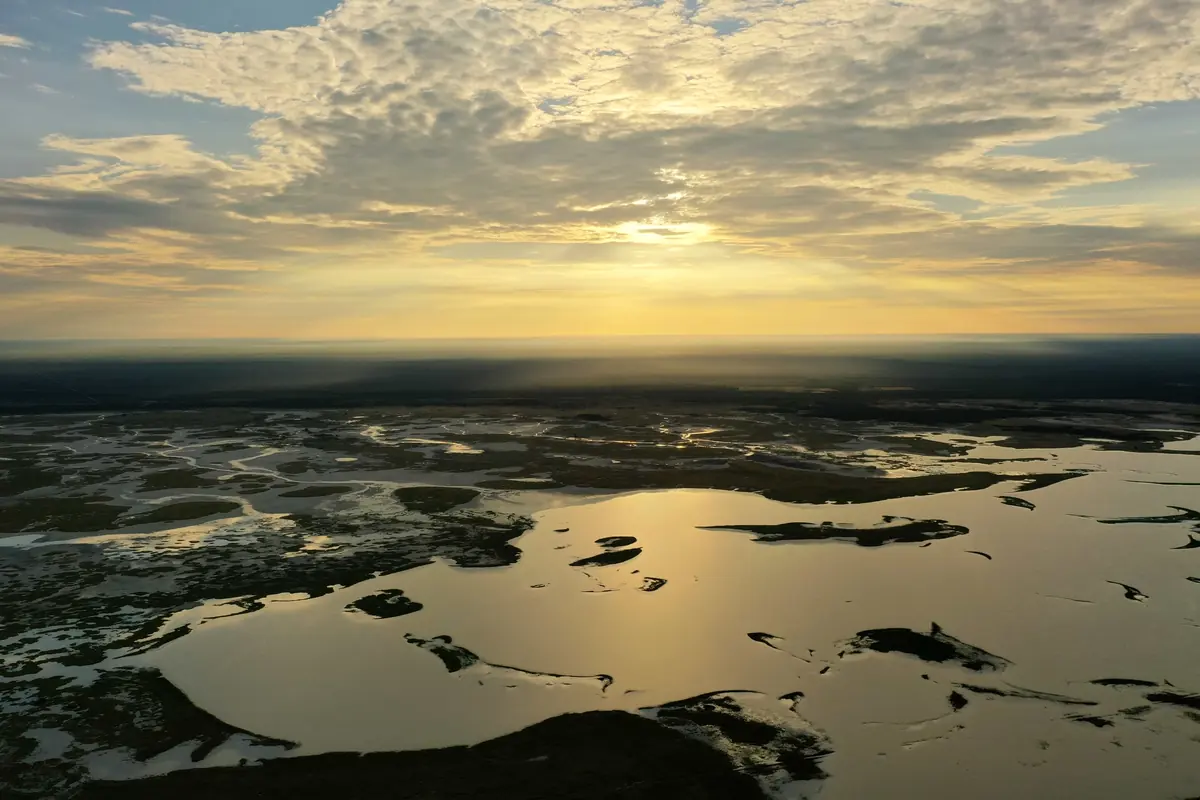
A community-run reserve on the north-east corner of Sua Pan, just off the tarred A3 near Nata. Flamingos and pelicans when the pan holds water, ostrich and wildebeest when it does not.
Short answer
Nata Bird Sanctuary is in Central District, Botswana. This page lists 1 place to stay and 2 sights.
- Malaria
- The CDC lists Tutume, the district that administers Nata, among the areas of Botswana where malaria is transmitted, and recommends prescription antimalarials there (atovaquone-proguanil, doxycycline, mefloquine or tafenoquine).
- Places to stay
- 1
- Where
- Central District, Botswana20.32°S 26.25°E
This is the easy way onto the Makgadikgadi. The sanctuary covers 230 km² where the Nata River runs out into the north-east corner of Sua Pan (Sowa on some maps), and close to half of it is pan. Four villages, Nata, Maposa, Sepako and Manxotae, moved about 3,500 cattle off the land to make it. It opened in 1993. It is not a government park. The communities run it and share the income.
Getting there
The gate is just off the tarred A3 between Nata and Francistown. Sources put it anywhere from 15 to 20 km out of Nata, so it comes up a few kilometres after Nata Lodge, which is 10 km south of the village. Francistown is roughly 180 km down the same road from the lodge. Nata is where the roads to Maun and Kasane split, each a little over 300 km away. Fill up in Nata.
Inside, the tracks are dirt. Outside the rains people get to the pan in an ordinary two-wheel-drive car. In the wet months the black clay turns slippery and you need a 4x4.
When to go
The birds follow the water, not the calendar. Rain falls from about November to March, the river comes down from Zimbabwe, and the pan can hold water until April or May. That is when pelicans, ducks and geese arrive, and flamingos come to breed. UNESCO calls this one of the largest flamingo breeding sites in the world, but in a poor rain year there may be very few. From about April to October the pan is mostly white crust and you come for ostrich, antelope and the sunset. Ask at the gate what is on the pan before you pay.
What to do
Drive out to the raised wooden viewing platform on the edge of the pan. One visitor put the shore about 5 km from the gate. The track along the Nata River towards its mouth is the quieter option. On the grassland look for blue wildebeest, zebra (brought in from the Tuli Block), springbok, black-backed jackal and bat-eared fox. Hippo turn up when there is enough water.
No 4x4? Nata Lodge runs three-hour sunset drives in open vehicles, usually leaving at four.
Good to know
Bring pula in cash for the gate.
There is a community campsite near the entrance, with braai places, hot showers and flush toilets. Its landmark is a baobab that fell over in 1992 and carried on growing sideways. Reports on upkeep are mixed. A 2018 camper praised the showers and a 2021 visitor found the grounds neglected.
Do not drive out onto the pan surface. A thin white crust can sit over deep wet clay, and dark patches mean damp ground.
This is a malaria area. The CDC’s list of districts where it recommends tablets includes Tutume, the district that administers Nata. The track to the pan has almost no shade, so carry water.
Wildlife you might see
13- very likelyOstrichThe grassland between the gate and the pan. All year, and the main sighting in the dry monthssource
- likelyGreat white pelicanOpen water and sandbanks at the edge of the pan. Wet season and for as long as water lasts. Visitors have found them still there well outside the rains, including a dry Septembersource
- likelyBlue wildebeestGrassland around the pan, often in the shade of trees in the heat of the day. All yearsource
- likelyPlains zebraGrassland around the pan. The zebra were brought in from the Tuli Block. All yearsource
- possibleLesser flamingoShallow water on Sua Pan, seen from the viewing platform and the river mouth. Only when the pan holds water, most often after good rains from about November, with the biggest gatherings as the pan dries out. In a dry year there may be nonesource
- possibleGreater flamingoSua Pan. UNESCO describes the sanctuary as one of the largest breeding sites of lesser and greater flamingo in the world. After good rains, while there is water on the pansource
- possiblePink-backed pelicanSua Pan. After good rainssource
- possibleChestnut-banded ploverThe salty margins of the pan. One of the few birds that stays on the pans through the dry seasonsource
- possibleKori bustardOpen ground on the sanctuary marginssource
- possibleSpringbokGrassland around the pansource
- possibleBlack-backed jackalGrasslandsource
- rareBat-eared foxGrassland. Shy, so do not count on onesource
- rareHippoThe Nata River and the flooded edge of the pan. Only when there is enough watersource
Likelihood is for a normal visit of two or three days, from the sources linked. Nothing is guaranteed in the wild.
Staying safe in Nata Bird Sanctuary
- Malaria
- The CDC lists Tutume, the district that administers Nata, among the areas of Botswana where malaria is transmitted, and recommends prescription antimalarials there (atovaquone-proguanil, doxycycline, mefloquine or tafenoquine). See a travel clinic before you leave, and cover up and use repellent from dusk. source
- Malaria after heavy rain
- Risk follows the rain, which is also when the birds are best here. The WHO counted more than 2,300 confirmed cases and eight deaths across Botswana by the end of May 2025 after unusually heavy rainfall, and named Tutume among the hardest-hit districts. source
- Driving on the pan
- Keep off the pan surface. A pan that looks bone dry can be a skin of salt over deep wet clay, and people who know the Makgadikgadi say even a well-equipped 4x4 goes through it. Dark patches are the warning sign of damp ground. Use the tracks other vehicles have already made. source
- Tracks in the rains
- The tracks inside are dirt and manageable in a two-wheel-drive car when dry. In the rainy season the black clay soil in parts of the sanctuary becomes slippery and a 4x4 is essential. source
- Heat and water
- The track from the gate to the pan crosses open ground with a few scrubby bushes and no trees, and you may not meet another vehicle. Carry drinking water. source
- The road in
- Do not drive the A3 after dark. Cattle, donkeys and elephants wander onto the highways around Nata, and the lodge next to the sanctuary tells its guests to avoid night driving. source
Tips from travellers
- Bring pula in cash for the entrance gate. one source
- Ask at the gate what is on the pan before you go in. Flamingo numbers depend entirely on rainfall and water level, and the birds come and go. several sources
- Go on a weekday. The viewing deck is close enough to the tar that it draws a sundowner crowd on Saturdays. If it is busy, drive on to the river mouth. one source
- If you have no 4x4, or it has rained, book the three-hour afternoon drive from Nata Lodge. It uses open vehicles and usually leaves at four. several sources
- The community campsite is near the entrance, with braai places, hot showers and flush toilets. A 2018 camper rated the showers highly, but a 2021 visitor found the grounds run down, so look before you commit to a night. several sources
- One 2021 visitor report gives gate hours of 07:00 to 19:00. We have not found hours published by the sanctuary itself, so check at the gate if you plan a sunset visit. one source
Checked 12 October 2026. Conditions change, so confirm with the park or venue before you go.
The flamingo chicks that walk 50 km to Nata's water
In 2001 thousands of grey flamingo chicks set off on foot across Sua Pan. They were too young to fly. The water around their colony had gone, and the nearest left was more than 50 km to the north, at the end of the pan where the Nata River comes in. That season 19,340 pairs of lesser flamingo had nested. About 3,000 chicks lived.
The figures are Graham McCulloch’s. He worked out of Francistown under the name Makgadikgadi Flamingo Research and counted the colonies from the air for three summers running, work that became a thesis at Trinity College Dublin and a paper with Kenneth Irvine in the journal Ostrich.
The nests are not where you are standing
Most of what gets written about the sanctuary says the flamingos breed here. They don’t, quite. The colonies McCulloch flew over were in the south of Sua Pan, out in the middle, where a good flood puts a moat between the nests and anything that eats eggs. The sanctuary holds the other half of the arrangement. The Nata, which Zimbabweans call the Manzamnyama, runs 330 km from the watershed near Bulawayo, and its delta is the part of Sua that rarely dries out completely. In a bad year this is where the walking chicks are headed.
How bad or good is down to rain. In 1998 to 1999 the pan got 442 mm and 16,430 pairs of lesser flamingo tried. The water went in March, and 8,000 to 10,000 chicks were left stranded in the far south. The next summer brought 851 mm, in the wettest season Botswana had recorded. Rising water washed the lesser flamingos off their usual colony and they moved onto a small sandy island next to the greaters: 64,287 pairs of one and 23,869 of the other, the most ever counted on Sua. Close to 50,000 chicks fledged, and because the north of the pan stayed under water all through 2000, they did not have to walk anywhere. Then came 348 mm and the march.
Two days to the Atlantic
In July 2001 McCulloch and his colleagues fitted satellite tags to five lesser and three greater flamingos, the first time anyone had tracked the birds in southern Africa. They sat tight on the flooded pan until February 2002. Then one greater left and was picked up two days later on the Namibian coast, 1,230 km west. Two of the lessers were logged on the Makgadikgadi on 20 February and at Kamfers Dam outside Kimberley three days after that, 930 km away. Kamfers is filled by Kimberley’s storm water and treated sewage. So the pink line you may see from the platform is on a circuit that takes in the Namibian coast and a municipal dam in the Northern Cape.
It also explains the empty years. Drought in 2002 to 2003 meant nobody was sure a single chick survived, and the following summer late rain washed one colony away.
1988, the big water
The Nata’s flow has been measured since 1967 and the 1987 to 1988 season is the standout. That April somebody counted 25,000 to 26,000 greater flamingo chicks on Sua. It was the same year the Nata Conservation Committee started setting aside the delta end, with help from the Kalahari Conservation Society and the people at Nata Lodge. When the gate opened in 1993 the project won the Tourism for Tomorrow award for the southern hemisphere.
The decades since have been harder. In 2010 a London fund called Hedgerow agreed to pay for two lodges, a gatehouse and a training centre. Farmers at Semowane said the sanctuary’s boundary took in their grazing, the argument went to the High Court and on to an appeal that only ended in 2014, and the fund walked away. Kerileng Garebolelwe, who chaired the trust, told a Botswana paper in 2020 that no lease had ever been signed for a second concession the trust was given around 2009, so nothing was built there either. Nata Lodge had its own bad year: a bushfire in September 2008 left two tents standing. It was trading again by early 2010.
What turns up at the delta end
Pelicans are the dependable ones. A couple who came in a dry September found them roosting on a sandbank in the afternoon sun with openbill storks working the shallows, and campers in June 2018 had great white pelicans, yellow-billed storks, Cape teal and an osprey. One long-standing poster on the 4x4 Community forum puts the best months at the river mouth as July to October, depending on what the previous rains left behind. That is one overlander’s view, and it is later in the year than the November to March most write-ups give.
Flamingos are a gamble in any month. A February 2023 visitor on a lodge drive saw them only as a smear in the distance, though the same drive produced wattled cranes, grey crowned cranes and double-banded coursers with chicks. The wattled cranes are worth a second look. More than 1,000 used the Makgadikgadi in the 1960s and 70s, and later counts put it nearer 100. One blogger who arrived to a dry pan missed the birds altogether and photographed their feathers lying on the crust.
Two smaller things, each from a single traveller. The September couple were more struck by the termite mounds along the road than by the pan: tall and white, like skyscrapers. And the June campers ate lunch at the platform with pied crows gurgling at them from close range.
The zebra herds and lions of the Makgadikgadi are a different trip, further west in Makgadikgadi Pans National Park. From here the nearest beds are around Nata.
In and around Nata Bird Sanctuary
3 places listedWhere to stay in Nata Bird Sanctuary 1
- 20.29°S 26.30°ECampsiteCommunity Camping Site
Sights 2
- HideViewpoint
- Nata Wildlife SanctuaryAttraction
Quick answers
What animals can you see in Nata Bird Sanctuary?
Most visitors see ostrich. You have a good chance of seeing great white pelican, blue wildebeest and plains zebra. Bat-eared fox and hippo are there but rarely seen.
Map of Nata Bird Sanctuary
See every place on this map as a list