Place to stay · Divundu
Mobola Island Lodge
Small self-catering lodge and campsite on the Okavango River about 30 km west of Divundu, with tents on a private island reached by a suspension bridge.
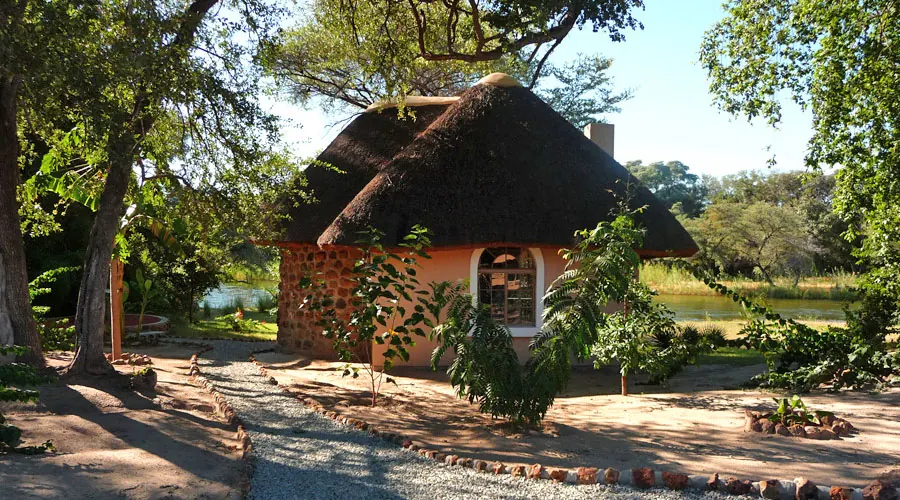
Mobola is a small, privately run lodge on the Namibian bank of the Okavango River, about 30 km west of Divundu on the stretch between Rundu and Divundu. Angola is on the far bank. Most of the accommodation is self-catering, which makes it a good fit for people driving the B8 with a cool box who want a couple of nights by the water before the Bwabwata parks.
What to expect
Five thatched bungalows stand right on the river: two doubles, one larger double set apart from the rest, and two four-bed units with two bedrooms. Each has a full kitchen, an outside shower and a terrace with a braai. Two plainer standard rooms sit further back. On the island, reached on foot over a suspension bridge, are three canvas tents with their own deck kitchens, plus the bar. The tents are roughly 300 m from the car park, so pack a small bag for the walk. There are also riverside campsites with their own braai, power and water and a shared ablution block, and a pool filled with filtered river water. The lodge runs on solar power.
Practical details
- Phone +264 81 230 3281 (for questions only, bookings go by email through the website).
- From Rundu, take the B8 east for 160 km to the Mayara turn-off, then about 15 km of side road to the lodge. A two-wheel-drive car is fine.
- Breakfast and a set dinner can be ordered in advance.
Good to know
Fishing is catch and release only, and only the lodge’s boats may be used for fishing and river trips, so leave your own boat at home. Tiger fish and nembwe are what the lodge’s anglers go after. The Mahango and Buffalo core areas of Bwabwata National Park are each about 40 km away for a self-drive day. Divundu, 30 km off, has fuel, shops and a bank.
Last updated 7 October 2026. Sources: Mobola Island Lodge, Mobola Island Lodge, bungalows, Mobola Island Lodge, island tents, Mobola Island Lodge, camping, Mobola Island Lodge, layout and facilities, Mobola Island Lodge, fishing trips, Mobola Island Lodge, river boat cruises, Mobola Island Lodge, safaris and excursions, Mobola Island Lodge, contact and directions, Wikipedia, Bwabwata National Park.
The island bar you cross to one at a time
Mobola is a tree before it is a lodge. The mobola plum has a grey-green crown shaped like a mushroom and rough bark like cork, and “mobola” is its Tswana name. An overlander who spent four days here in September 2021 wrote that the lodge is named after it and that the trees grow here in numbers. The fruit, he reported, is nutty with a taste of caramel. That naming story is his alone, but the botany is solid: South Africa’s national botanical institute gives the plums as about 50 mm long, up to a year in the ripening, and finishing on the ground between October and January. Somebody once carved a tribute to David Livingstone into one.
A bridge with a warning sign
The bar on the island is what people write home about. Two German parties who stayed in May 2016, on separate trips, both called it a highlight of their stop. One noted that the swaying bridge is crossed one person at a time. The other described it as wobbly but new, and read the warning sign: crocodiles, hippos, snakes. The 2021 overlander’s verdict was that getting to the bar is no trouble and getting back depends on the evening.
Beyond the bar, paths that one of those couples reckoned had been cut with a machete lead to what the lodge calls Mobola Falls. Rapids is the fairer word, and it is the one that couple used. The Okavango is rocky when it drops. A 2012 report on the first winter water bird count along most of this river, a count in which Mobola’s stretch was covered together with a neighbouring lodge’s, says the July river had rocks coming up just under the surface and that boats lost propellers to them.
The hosts are Alexander Both and Maja Jacob. Travellers call them Alex and Maja.
Hippos, honestly
Expect hippos to be a maybe. The 2016 campers had two surfacing now and then to snort for air while they sat at their site. The other couple, the same month, saw none on their island walk and wrote that there were still none in sight from the 5 pm boat, though a very large crocodile left the bank in a hurry when they looked closer. The lodge’s own wording is that hippos are often seen from the boat and that crocodiles depend on the season and the water temperature. Boats go out early and late.
Elephants the lodge labels a rare encounter. Take it at its word and drive to Bwabwata for those. On the island it lists otters and monitor lizards, which nobody I read mentioned seeing.
That couple’s boatman told them a hippo had once tipped a mokoro with three people in it on this stretch, and that all three lived. It is one man’s story, passed on by one blog. Then their engine cut out, and they sat tied to the papyrus of an island at dusk until someone from the lodge came out in a second boat.
May on the river
The same two accounts disagree about mosquitoes, and both are probably right. At the campsite by day: none. Tied up against the papyrus after sunset: thousands. The campers logged 8°C on the morning of 12 May, so pack for cold as well as repellant.
The classroom next door
Since it opened, the lodge says, a share of its income has gone to projects in the neighbouring village. At the end of 2021 it started on a kindergarten building. Until then the children sat under a tree for their lessons.