Place to stay · Divundu
Riverdance Lodge
Small Swiss-run eco lodge on the Okavango River west of Divundu, with seven riverside bungalows, four private campsites and easy access to the Mahango and Buffalo areas of Bwabwata.
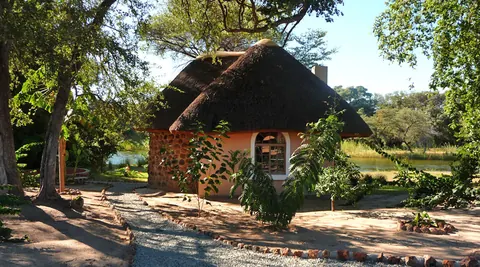
RiverDance is a small lodge on the Okavango River at Mamono Village, upstream of Divundu in Kavango East. It was built in 2011 with local craftsmen on ancestral land the Mamono and Biro villages agreed to share, and since 2018 it has been owned and run by Pascale and Chris, a couple from Switzerland. It suits people driving the B8 between Etosha and Victoria Falls who want a few quiet days by the river before or after the parks.
What to expect
There are seven bungalows on the water, each with a private deck, a small fridge and a bath shaped like a mokoro. Families can ask for two extra beds. Stays are on a dinner, bed and breakfast basis, and dinner is three courses at one long table with the other guests, so it is a sociable place rather than a private one. Campers get four sites with river access, each with its own deck, braai and a private block with kitchen, shower and toilet, for up to four people per site.
Practical details
- Phone: +264 66 258 401. Email reservations@riverdance.com.na.
- From Rundu, follow the B8 east for 175 km and turn left at the Shadikongoro turn-off, 25 km before Divundu. The last 12 km or so is signposted, partly on gravel and then the lodge’s own track.
- The lodge invoices only in Namibian dollars.
- Activities include sunrise and sunset boat trips, village visits, hikes, bike rides, massages and yoga.
Good to know
The Mahango and Buffalo areas, both part of Bwabwata National Park since 2007, are about 40 km away, which makes for easy day drives. The lodge says all its staff come from the nearby villages, and it runs a project called MEYU that has paid for kindergartens and boreholes at local schools. Bring binoculars. The lodge counts around 430 bird species along this stretch of river.
Last updated 7 October 2026. Sources: RiverDance Lodge, RiverDance Lodge, bungalows, RiverDance Lodge, camping, RiverDance Lodge, history, RiverDance Lodge, location and directions, RiverDance Lodge, parks nearby, RiverDance Lodge, river cruises, RiverDance Lodge, Project MEYU, Info-Namibia, RiverDance Lodge, Wikipedia, Bwabwata National Park.
Two names for one turn-off on a river full of crocodiles
The lodge’s directions tell you to leave the B8 at the Shadikongoro turn-off. Going by the chief, there has been no such place since 24 July 2010. That Saturday Fumu Erwin Munika Mbambo, leader of the Hambukushu, was at Rughongo to swear in a senior headman, and he used the occasion to order that Shadikongoro be called Rudhiva, which he said was its original name. The old name, he said, meant nothing. Shadipwera Primary School was to become Rudhiva Primary.
Both names are still alive. The lodge’s own charity page lists a borehole at Rudhiva School and a kindergarten at Shadipuera.
The chief who said yes
Mbambo is in the lodge’s history as well. Tino and Karin Punzul, who built RiverDance, needed his permission to put it on village land, along with that of a headwoman and a headman. Villagers who turned up at that 2010 ceremony to protest against the headman he had picked handed over a petition saying he had been sidelining their elders for 19 years.
Parks are not his favourite use of land. In 2015 he told a government meeting on poverty that Kavango East’s national parks, which are Mahango and Bwabwata, cover ground that should be growing food under irrigation. In 2022 he told a parliamentary committee that Bwabwata is Hambukushu ancestral land and that his authority kept the right to go to court over it.
Of the Punzuls there is less on record. An overlander who stopped in 2014 wrote that they were old campers themselves, and thought it showed in the sites: grass, shade, and washing-up and ablutions for each pitch so nobody shares. That is one traveller’s account.
The July the lodges counted their birds
In July 2012 tourism businesses along the Namibian Okavango counted water birds on more than 50 km of river that had never been counted before. Tino Punzul was the coordinator for the count area that took in RiverDance and Mobola Lodge.
Their route’s flagship bird is the African skimmer. It reaches southern Africa between April and June as rivers start to drop, lays in bare scrapes on big sandbanks and goes north again once the water rises. At Rundu, upstream, the two biggest floods in the gauge’s record both peaked in April. Skimmers feed mostly at dawn and dusk, lower bill in the water, which happens to be when the lodge’s boats go out. Nobody seems to publish how often they are seen on this particular stretch, so treat it as a hope. Mark Paxton, a camp owner upriver who wrote up the count, had complained in 2007 that youths dragging nets were disturbing skimmers nesting on the banks.
Hippos are the safer bet. The lodge itself warns guests that the quiet may be broken by them splashing about. Elephants it promises only sometimes.
Why the villages want boreholes
One estimate printed in The Namibian puts the river’s crocodiles at 11,000. In November 2020 a 30-year-old woman from Shadipwera went down to the river to wash and was taken. Her body was found on an island nearby, and the paper reported that the boat used in the search was sent by the lodge’s owner. The following March a 27-year-old man from Rudhiva was attacked while washing clothes and came away with two deep wounds in his leg. The headman’s secretary asked for taps, so people could stay away from the river.
That is the background to the lodge’s project, MEYU, named for the word for water. Its boreholes are at Biro School and Rudhiva School. Hippos are no gentler: in the year to July 2025 they killed six people in the two Kavango regions. The lodge has a pool. Use that.