Place to stay · Okavango Delta
Camp Okavango
Water-only camp on Nxaragha Island in the permanent Okavango Delta, run by Desert & Delta Safaris. Twelve suites, boats, mokoro and island walks, and no game drives at all.
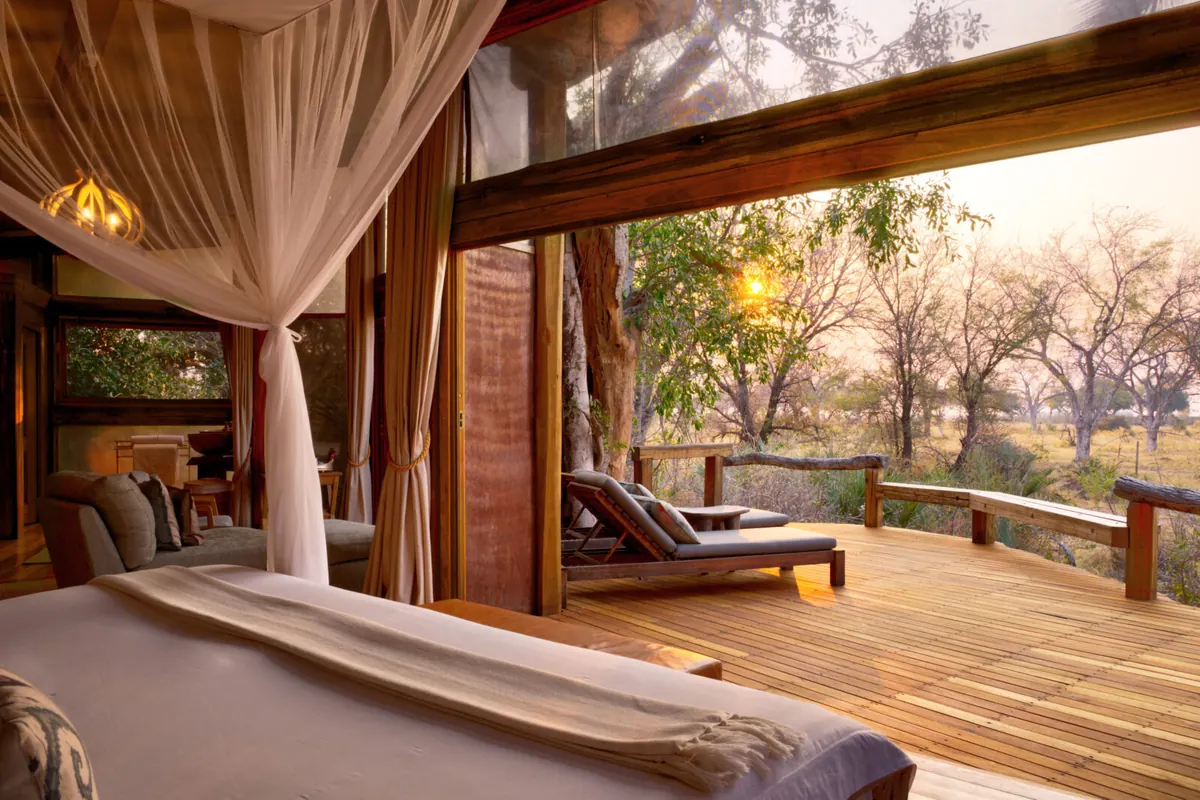
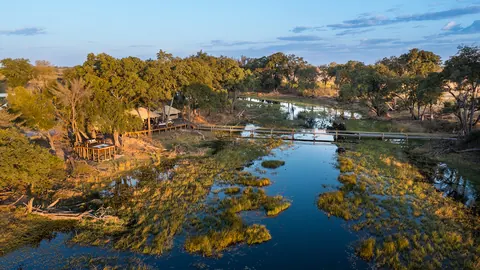
Camp Okavango sits on Nxaragha Island in the permanent part of the Okavango Delta, where there is water all year. Desert & Delta Safaris runs it as a water camp, and they are upfront about what that means: there are no safari vehicles and no game drives. You come here for channels, lagoons and islands, and you pair it with a land camp somewhere else for the big predators.
What to expect
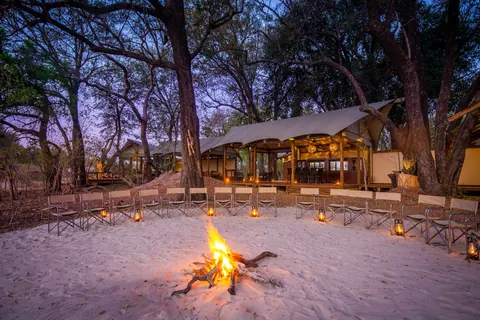
The camp takes 24 guests at most, in eleven suites and one family suite with two en-suite bedrooms. Each stands on its own raised wooden platform under the trees, with a private deck, a double shower and a toilet with a view. Rooms have fans, not air conditioning.
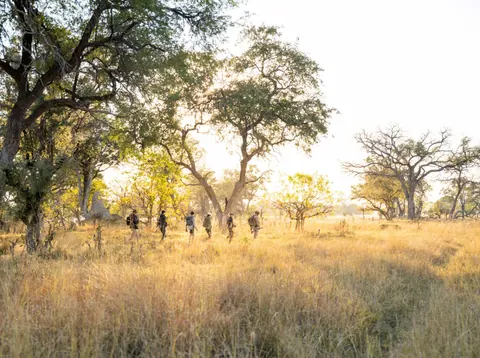
Days are spent on the water. Aluminium motorboats with a canvas roof cover the deeper channels and lagoons, and a mokoro (the traditional dugout canoe, poled by a guide) takes you through the shallows. Walks on the nearby islands go out in small groups with two guides. There is seasonal fishing for bream, with tackle supplied.
Practical details
- Reservations: +267 680 1494 (Desert & Delta Safaris).
- Children are accepted from six years old.
- Power is solar with a generator behind it, running 24 hours, with 220V plugs in the rooms.
- Wi-Fi reaches the rooms by satellite link, so it comes and goes.
Good to know
Stay three nights or more and you can spend one of them on the sleep-out deck, an open platform with a bed, mosquito net and its own bathroom. The delta was added to the UNESCO World Heritage list in June 2014 as the 1000th site. Desert & Delta say it can swell to more than 16,000 square kilometres at the height of the flood, and that the water takes about four months to work its way from Mohembo down to Maun.
Last updated 12 October 2026. Sources: Desert & Delta Safaris, Camp Okavango, Desert & Delta Safaris, Okavango Delta, Wikipedia, Okavango Delta.
The night watchman who stayed forty years
In 1976 some strangers flew in to Nxaragha Island to tell the families living round about that they meant to build a safari camp there. A young man called John Kata asked if there was work going. He was told to come and speak to the woman in charge, so he got into his mokoro and poled across the channel. She hired him as night watchman, for a camp that did not exist yet.
Kata is Bayeyi and grew up on these islands. He told Mana Meadows, for the book Desert & Delta put out in 2022 for its fortieth year, that the delta of his boyhood had more water and no elephants. When he was 22 the government began urging his people to move out to villages like Maun, away from the tsetse fly. His own family were getting ready to leave. He stayed, went from watchman to gardener, left in 1982 to help build Camp Moremi, then came home to work as a poler and afterwards a guide. When Meadows met him he was in his last month in the job. Lempheditse Odumetse, the group’s managing director when the book came out, calls Kata his uncle and the reason he trained as a guide.
A patch of floodplain with markers on it
The woman was Jessie Neil, a rich American. Her old company calls her a Texan in its book and a Californian on its website, and the book says hunting trips first brought her here. The camp was finished in 1980. Before anyone could fly freight in, everything for it was driven to Xakanaxa in Moremi and brought on by boat. Derek Flatt, a charter pilot who ran the company years later, remembers landing on floodplain with markers set out on it. The proper airstrip came with the paying guests.
Neil did not as a rule take children. Jonathan Gibson of Chobe Game Lodge, asked down with his small twin sons, put her camps’ quick reputation down to her eye for detail and her “eccentricities”. His company bought hers in 1992.
The old camp and its clipped gardens came down in 2016. One safari firm that inspects camps wrote that it was glad to see the gardens go. Kata once tended them.
What turns up when nobody is driving
The big trees over the main deck are African mangosteens, motsaudi in Setswana, and bulbuls and mousebirds crowd in when they fruit. Hippos have worn paths under the decking and use them at night. Red lechwe feed out past the tree line, and when the flood arrived in June 2020 the manager, Kabo, reported them running about on the airstrip. The morning Meadows sat with Kata, an elephant bull was wading the channel in front of camp with papyrus dragging behind him.
All of that comes from the operator and its own people. Sitatunga and Pel’s fishing owl are on at least one agent’s list of what to look for, and I could not find a dated sighting of either from this camp. For the owl the better bet is the sister camp at Xakanaxa, where the operator reported in April 2024 that a pair had nested in a tree in the lodge’s public area for three years, breeding between January and June. The inspecting firm admits it has seen little game here itself, and passes on a guest’s tale of a leopard walking past the main building early one morning.
The same firm’s warning is about baboons. Leave a tent open, it says, and they may go in and wreck it.
On foot, and unarmed
If big game is met, it is on the island walks. One guest wrote of long walks every morning with a guide called Banda, learning tracks and dung. Yellow Zebra, a British agent, tells its own clients to skip the walks for now, because the guides carry no rifle in country where lion, leopard, elephant and buffalo all turn up. It says the operator is working on a licence. One agent’s view, but ask before you book.