Place to stay · Okavango Delta
Duba Explorers Camp
Five-tent Great Plains camp on an island in the north-east of the private Duba Concession, with drives, walks, boats and mokoro when the water allows. Never more than ten guests.
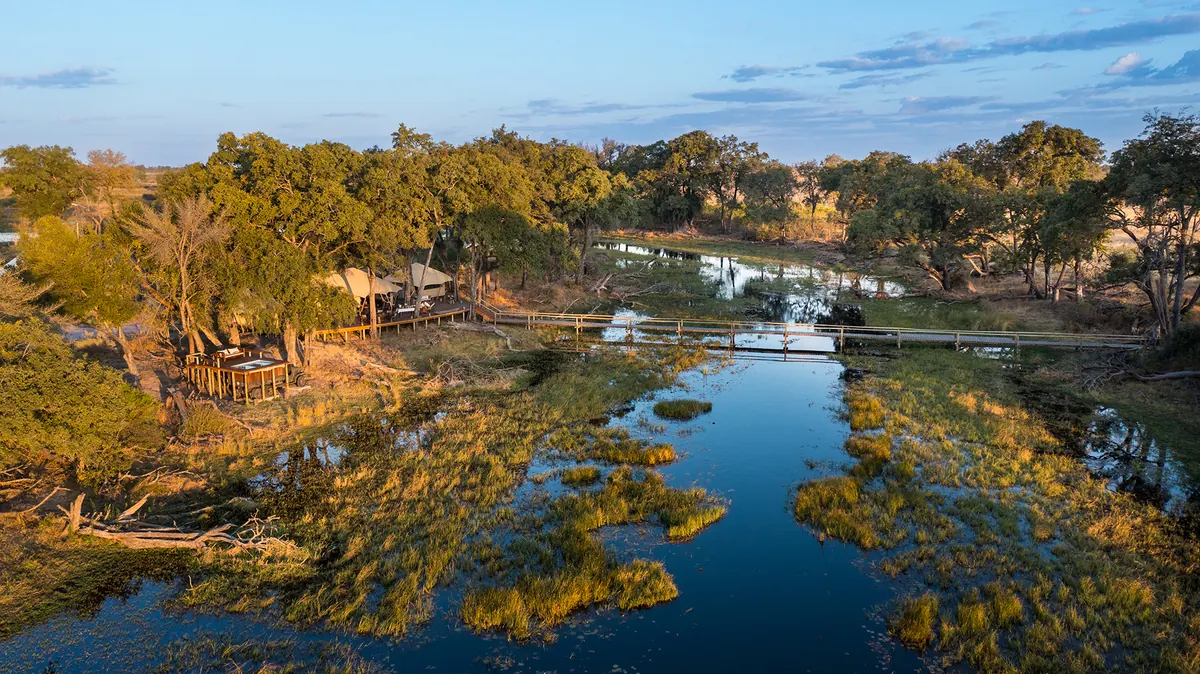
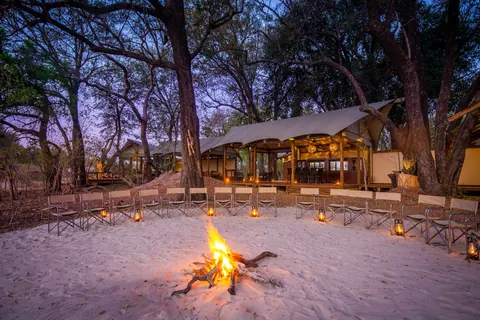
Duba Explorers shares the private Duba Concession, in the northern Okavango Delta, with Duba Plains Camp. It sits in the concession’s north-east corner. Great Plains Conservation runs it, and the camp was designed by Dereck and Beverly Joubert, the National Geographic wildlife film-makers. It has five tents on an island ringed by channels, and its own traversing area, separate from the one Duba Plains uses.
What to expect
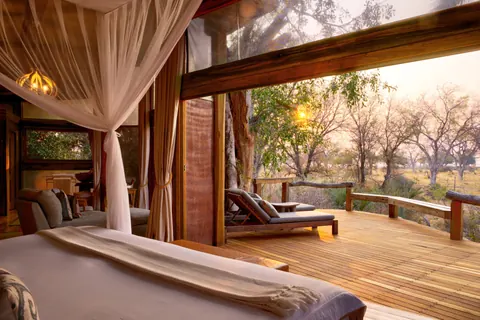
Five canvas tents on raised decks, each with a writing desk, a veranda with a daybed and an en-suite bathroom. A cooling unit is fitted over the bed. Expert Africa counts ten guests at most, so you will not be sharing the island with many people.
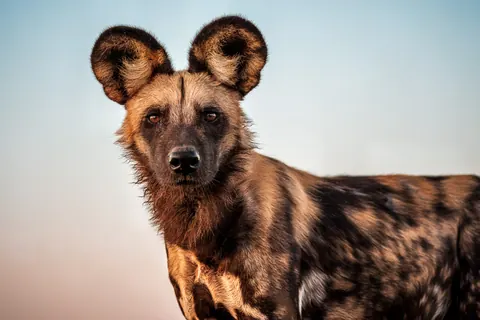
The camp does both land and water. Drives go out across floodplain and grassland, with some mopane and acacia woodland in between. Lion, leopard and wild dog are all in the area, with elephant, buffalo and red lechwe around all year. Boats and mokoro work the channels of the Ngoga River system, and there are guided walks on the islands. Great Plains puts the bird list at over 400 species.
Practical details
- Reservations: +27 87 354 6591, the Great Plains office in South Africa, open 8am to 5pm Monday to Friday, South African time.
- You fly in. Expert Africa gives 45 minutes by light aircraft from Maun to the airstrip, then a three-minute helicopter hop or about 20 minutes by boat.
- Boating, mokoro and the catch-and-release fishing all depend on water levels, so ask what is running in your month before you book around them.
Good to know
The swimming pool is built into the back of a Second World War army truck. Sitatunga, the shy swamp antelope, live in this part of the delta, though you need luck. The camp also hosts the Great Plains Foundation’s student conservation camps for young people from the surrounding communities.
Last updated 12 October 2026. Sources: Great Plains Conservation, Duba Explorers Camp, Expert Africa, Duba Explorers Camp.
The half of Duba that has giraffe
Dereck Joubert, the film-maker behind Great Plains, says the island it stands on was built by termites, and that it has a part in their National Geographic series Okavango: River of Dreams. Most islands in the delta began that way, as a mound that stayed dry long enough for a tree to take. The trees on this one are jackalberry, leadwood, mangosteen and sycamore fig.
The camp used to be called Duba Expedition and stood further south, near Duba Plains. It shut in December 2017 and reopened in the north of the concession the following year under the new name. Roxanne Reid, a South African travel writer who stayed in 2019, was told why: once Duba Plains was enlarged, two camps’ vehicles on one patch was too many.
Giraffe on one side of the concession, none on the other
Duba Plains is known for lions, buffalo and red lechwe, and for having no giraffe, zebra or wildebeest. Up here it is the other way round. Expert Africa has asked its travellers to log what they see since mid-2018, and every one who filed a tally from Duba Explorers saw all three.
Lion and leopard each turn up in 88% of those tallies, wild dog in 68% and sable in 65%. Roan is in about a quarter and cheetah in a fifth.
The leopard on the footbridge
A guest in late May 2024 saw leopard every day for four days, watched wild dogs chase one up a tree, and was sitting at the fire when a leopard walked over the bridge into camp. Joubert mentioned the same habit in October 2025: a leopard uses the walk bridge when nobody is looking. In April 2025 a party watched a female with two cubs lose her kill to the local lion coalition on their first day.
Lions are not here in numbers. Expert Africa’s own writers met a coalition of four males. A couple in November 2024 found only two males and two females in the area, found the game a struggle, and wondered afterwards whether a camp nearer water would have given them more elephant. They still came across two leopards up two trees with two lions asleep on the ground between them.
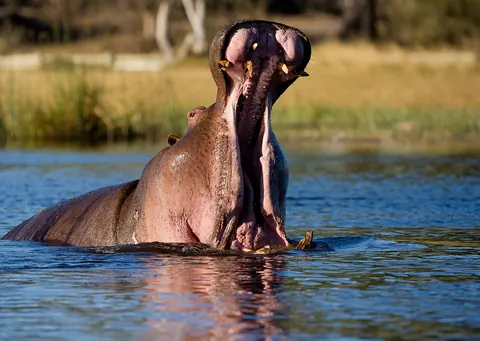
One elephant walked in on a birthday dinner in May 2024, and a guest in June 2025 wrote of a “resident” one wandering about for their whole stay. Hippos are the night noise, on the operator’s word and on several guests’.
Too much water, or too little
Expert Africa’s writers have been in an October when there was not enough water to launch a boat and in a June when there was hardly any dry ground to drive on. In May 2025 Joubert reported airfields and bridges under water across the delta, and a guest the following month found parts of the reserve could not be reached by road. In March 2026, expecting another big flood, he was shoring up the Duba airfield and had ordered two amphibious vehicles. Low water is no easier. The November 2024 couple were flown in by helicopter because the water was down and there was no way in by vehicle.
The rains are the weak months. A guest in December 2024 sat through long drives with little to see in a heatwave and credited the guide for three leopards. Another, in a March 2026 of continuous storms, saw less game than hoped and said she would come back in the dry season. Both are single accounts.
Where the lions go at night
A short way north are Gunotsoga, Eretsha and Beetsha, three of the five villages of the Okavango Community Trust, and cattle. In 2013 about half the lions known in this area were poisoned or shot after cattle losses. Andrew Stein’s CLAWS project has since collared lions that raid, and herders get a message when one crosses a line on the map. Its 2019 paper counted 291 head of livestock, nearly all cattle, lost to lions in two years, about four in five of the attacks after dark, and most between September and February when the water is low. Mathata Tomeletso of Eretsha, known as Pro, was the first person Stein hired, in 2014, and now leads the team that goes out to turn lions back. Stein says the known lion population has more than doubled since the poisonings.