Restaurant · Maun
Marc's Eatery
Garden restaurant, bakery and coffee stop in Maun, opened in 2017 by German-born chef Marc Baar. Lunch and dinner on weekdays, dinner only on Saturday, closed Sunday.
Marc’s Eatery is a garden restaurant and bakery in Maun, opened in 2017 by Marc Baar. He was born in Germany to a German father and a French mother, came to Africa in 1981 at 21 and cooked over open fires while running mobile safaris in Namibia and Botswana. From 2010 he trained lodge chefs around Ngamiland for six years.
What to expect
Tables are outdoors among plants, with mismatched furniture and a kitchen you can see into. Marc calls the place an informal brasserie. The menu covers breakfasts, sarmies, burgers, pastas and snacks, and the daily specials go up on blackboards. Vegetarians and vegans are catered for, and there are gluten-free dishes and a children’s choice.
Everything is made from scratch, with local produce where he can get it. The bread is baked on site: ciabatta rolls, pain à l’ancienne, a Tuscan-style loaf with some rye and a whole wheat loaf raised on a culture that has been in his family for decades. There is also pissaladière, the thin French onion, olive and anchovy tart.
Marc no longer cooks during service. He trained the kitchen team himself, starting each of them in the scullery, and works the floor as host.
Practical details
- Monday to Friday: lunch until 2.30pm, then dinner 5pm to 8.30pm. The website gives the morning opening as both 10am and 10.30am.
- Saturday: 5pm to 8.30pm only. Closed on Sunday.
- The whole menu is available as take-away, ready 30 minutes after the order is confirmed.
Good to know
Demand for the bread is high and loaves are often ordered in advance, which is the thing to do if you want fresh bread for the first days in Moremi or the pans. The kitchen also packs lunch boxes for safari companies and air charter passengers.
Last updated 12 October 2026. Sources: Marc's Eatery, The Eatery, Marc's Eatery, About Marc, Marc's Eatery, contact and opening hours, Marc's Eatery, menu, Marc's Eatery, packed lunch boxes.
A grandmother's table, by way of the Sahara
Marc Baar says he wanted his restaurant to feel like coming home to eat at his grandmother’s table. She was no ordinary home cook. By his account she trained in classical French cooking and was one of the early chefs to come out of Le Cordon Bleu, in the first years of the twentieth century. The Paris school was still young then, started in 1895 by the journalist Marthe Distel and the chef Henri-Paul Pellaprat as an offshoot of Distel’s cookery magazine. His grandmother lived with the family, and he still calls her the most talented cook he has known.
The long way round to Maun
Between her kitchen and this one lie more than thirty years, and a good part of them had nothing to do with restaurants. After kitchens in France and Germany came Africa and the mobile safari years, when the bread was baked in the ground. Later Baar traded African arts and crafts across Ethiopia and West Africa and ate his way through Lebanese, North African and West African cooking as he went. He travelled through the Sahara and spent time in the kitchens and markets of Morocco. A Turkish chef he met in Istanbul told him his style was “Ottoman”, meaning layered and borrowed from everywhere.
For a while he also made raw and dehydrated food for people with intolerances and sold it to health shops. He says he built the machinery himself and that nobody else in Africa was doing it then. That part rests on his word alone.
So the menu refuses to settle on a country. He calls it “Marc’s cuisine” and the mood “à la bonne franquette”, a French phrase for a meal without ceremony.
It is not a one-man show, whatever the name suggests. The business has a second director, Yvonne Ward-Smith, and one Botswana directory describes the place as a collaboration between two people who love food.
A tart from Nice, with additions
The pissaladière is the most French thing here. It comes from Nice and takes its name from pissalat, a paste of salted anchovies whose name in the Niçard dialect means salted fish. The classic version is onions cooked down almost to a purée, with black olives and anchovies and no cheese, on bread dough thicker than a pizza base. Marc’s goes the other way on both counts: a thin crust, with capers and parmesan added. A Niçois would raise an eyebrow, but it is his tart.
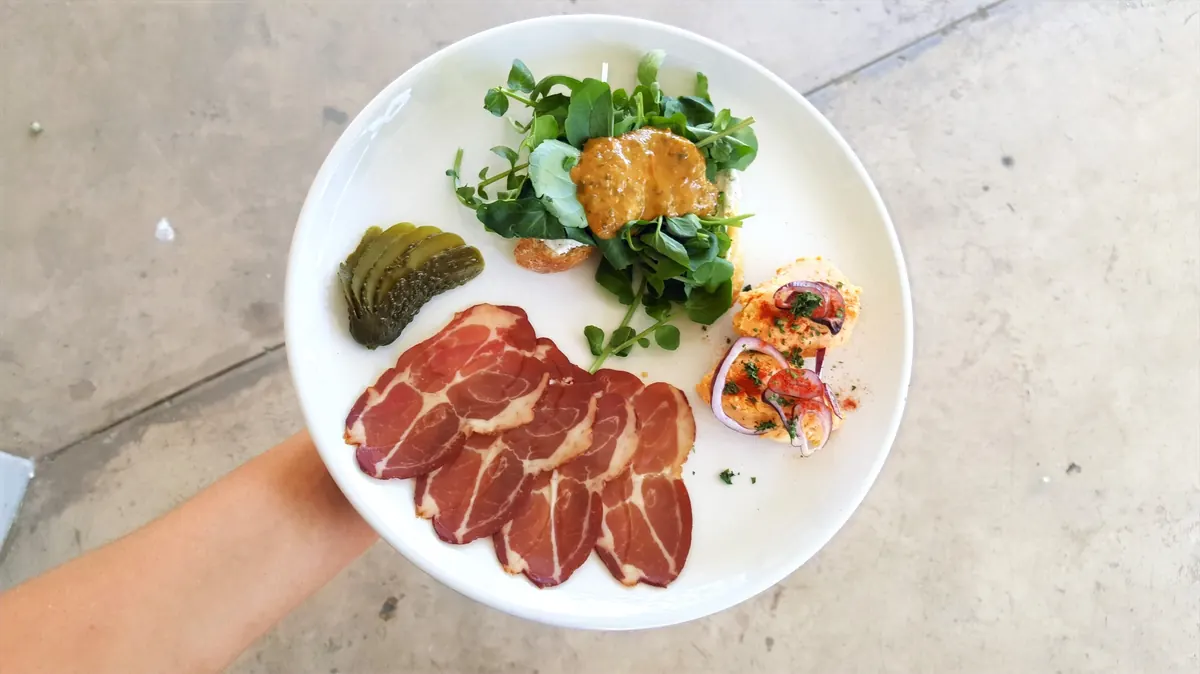
Terrines and charcuterie are made in house as well, which is not something you expect to find in Maun.
What goes into the lunch box
The packed lunch has a sandwich called the Tsunami Sarmi: ham, cheese, pickles, lettuce and mayonnaise on the house ciabatta. With it come a carrot and beetroot salad, a piece of fruit and two home-made biscuits listed as Manon’s Crunchies. The website does not say who Manon is. The boxes are pitched at safari companies and air charter guests, and Maun is where the light aircraft leave for the camps of the Okavango Delta.
Why people call it an oasis
The restaurant uses the word about itself and a Botswana directory repeats it. Both draw the contrast with the heat and dust of town. A travel blogger who spent a month house-sitting in Botswana put it on a list of seven favourite places to eat in town. Expert Africa, a safari tour operator, singles out the garden. It sits on Sir Seretse Khama Road, the road that runs north past the airport towards the camps, about 3 km from the terminal.
By Maun standards it is a newcomer. Expert Africa says Hilary’s Coffee Shop has been feeding the town for nearly thirty years. Marc’s opened in 2017.