Place to stay · Orapa
Makumutu Safari Lodge & Camp-Site
Safari tents, a campsite, restaurant and bar at the Orapa and Mopipi junction on the B300, just outside the diamond town of Orapa on the road towards Maun.
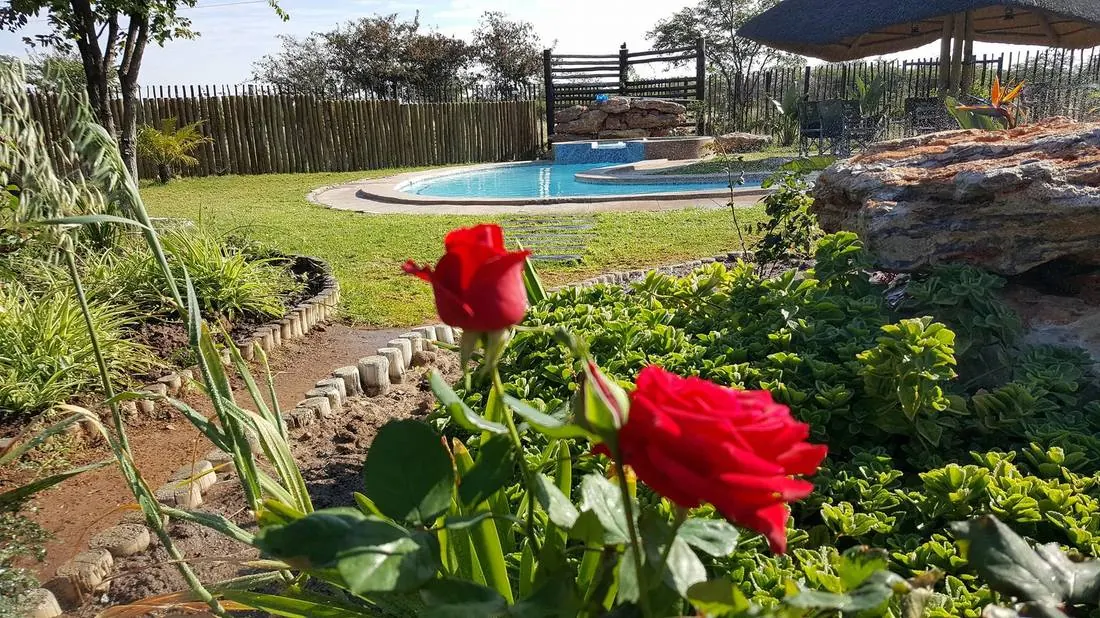
Makumutu calls itself a safari lodge and campsite, and the beds it describes are all under canvas. It stands at the Orapa and Mopipi junction on the B300, just outside Orapa, the town that is home to the diamond mine of the same name. The B300 carries on towards Maun, so it works as a stop on that drive: a bed, a steak and a cold beer without leaving the road.
What to expect
The safari tents stand on decks and have two single beds. There are also smaller dome tents with one single bed and a stretcher, which the lodge rates for two people. Campers get roomy stands and shaded braai areas, and share large ablution blocks with hot showers. There is a swimming pool, a bar and WiFi across the property.
The restaurant gets as much attention on the lodge’s site as the beds do. Beef from the Boteti area is the staple, there is usually game meat on the menu (ask which), and pizza. Buffets can be booked for breakfast, lunch or dinner. The week runs on themed nights: pork ribs on Tuesdays, a ladies’ night on Thursdays, game meat on Sundays.
Practical details
- Phone: +267 371 3840 or 371 3841. Mobile: +267 75957679.
- Address: Orapa and Mopipi junction, B300 road, Orapa.
- A laundry service is available, which is handy halfway through a long self-drive.
Good to know
“Lodge” suggests brick rooms, but the site only describes tents, so ask what you are getting before you book. The grounds are also used for outdoor events and the lodge pitches its bar as an evening venue. If you would like an early night, say so when you book and ask for a tent away from it.
Last updated 12 October 2026. Sources: Makumutu Safari Lodge and Camp-Site, Makumutu Safari Lodge and Camp-Site, services, Makumutu Safari Lodge and Camp-Site, contact, Wikipedia, Orapa.
Boteti beef, and the river the mine borrowed
The restaurant at Makumutu sells its steak by the name of a river. “Boteti beef”, the menu page says, with two exclamation marks. You will not see the Boteti from the bar. It runs out of the Okavango, comes south past Rakops and in a good season carries on to the village of Mopipi, which is the other name on the lodge’s junction. For more than thirty years it did not reach its own lake, and the mine about ten kilometres up the road from your tent had a hand in that.
Where Orapa’s water came from
A diamond mine on the edge of the Kalahari needs water it does not have. In the 1970s the answer was to channel the Boteti below Rakops and steer it round Lake Xau, its natural end, into Mopipi Dam, and pump it from there to Orapa. Lake Xau went dry and grassed over. The lower river had more than 2,000 hectares under grain until 1980. Fewer wet years and the new channel between them ended that.
The lake had been famous once among a small crowd. BirdLife Botswana points out that the cover of Smithers’s 1964 checklist of the birds of the Bechuanaland Protectorate shows a Gull-billed Tern flying over it.
Then the mine found other water, the diversion works came out, and the big Okavango floods of 2010 and 2011 did the rest. Cornelis Vanderpost, writing for the Okavango Research Institute’s library, traced it on satellite pictures. The river reached Lake Xau at the end of June 2011, for the first time since the 1970s, and by New Year the lake had spread a long way across its old bed. How long it holds depends on the flood each year. BirdLife’s warning from 2009 was blunt: no facilities, hard to reach, not for armchair birders. Ask at the lodge what the river is doing before you go looking.
Two bakkies and a cattle track
There was no tar here in 1967. There were no formal roads at all. Manfred Marx, the geologist who found the first diamond-bearing rock at Orapa on the afternoon of 1 March that year, was 71 when he told the story to a packed room at the Gaborone Sun in 2014. The Sunday Standard’s report of that day fills in how the search was done. The exploration manager, Gavin Lamont, and Jim Gibson had covered 4,600 square kilometres in three months with two vehicles and a team of Batswana, following the tracks hunters and cattle farmers had left and bagging soil as they went. The second find came sixteen days after the first.
The pipe kept something odder than diamonds. A lake once lay over it, and the mud on its bed kept its insects. Those sediments are about 90 million years old, and a 2003 paper in African Entomology by Brothers and Rasnitsyn reviews what came out of them, most of all the Hymenoptera, the order that wasps, bees and ants belong to.
What lives at the junction
Not much with horns. The lodge’s own site talks about the roses in its garden, which tells you what kind of stop this is. The game is behind a fence at Orapa Game Park, over by town. Debswana reported in January 2026 that a class of park rangers had finished training with the wildlife department’s anti-poaching unit, and said in the same breath that it wants the mine to move into tourism. Nothing is published yet on how a passing visitor gets in, so ask before you drive over.