Place to stay · Mariental
Kalahari Anib Lodge
Gondwana lodge with 51 rooms in the red dunes of the private Gondwana Kalahari Park, about 30 km northeast of Mariental off the C20. Easy sedan access, drives and walks.
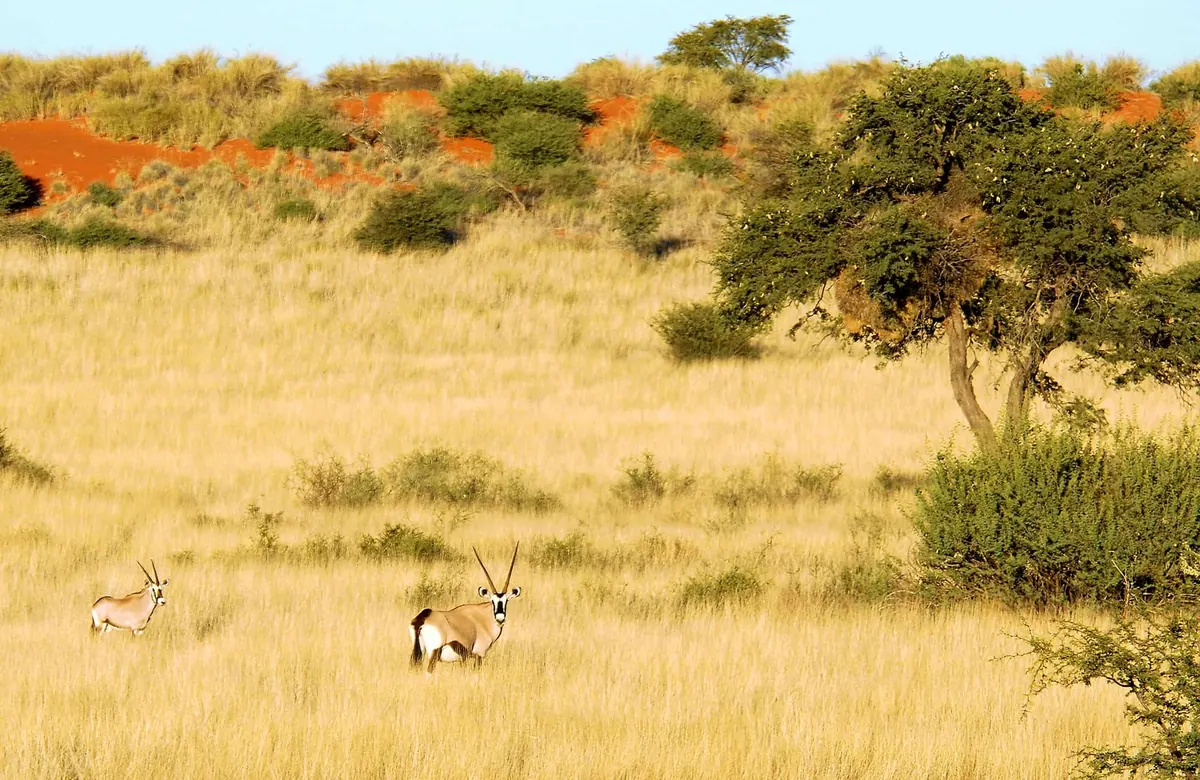
Kalahari Anib Lodge is a Gondwana Collection property about 30 km northeast of Mariental, reached along the C20 and set inside the private Gondwana Kalahari Park on the edge of the red Kalahari dunes. Most people use it as a night between Windhoek and the south, or on the way across to Sossusvlei, and the road in is fine for an ordinary car. The name is Nama for “male bird”, according to Info-Namibia.
What to expect
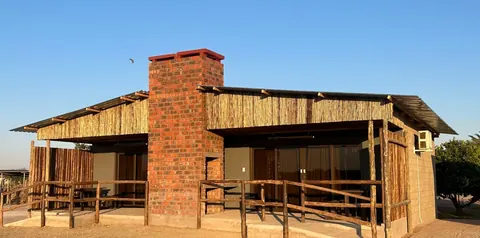
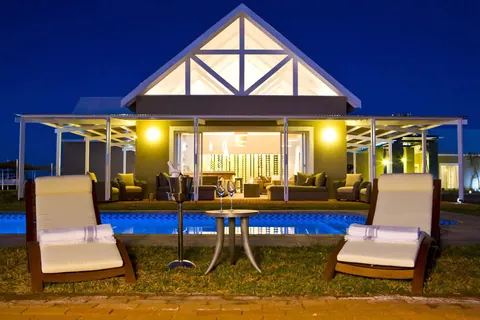
There are 51 rooms in two grades. Most of the 32 standard rooms are twins set around a courtyard by the main pool, while the comfort twins among the 19 comfort rooms face out over the savannah. The family rooms add bunk beds, which are meant for children under 12. All rooms have air conditioning, a safe, a veranda and mosquito nets. There are two cold-water pools, a restaurant, a bar and a curio shop.
The main activity is a nature drive into the dunes, either at sunrise or ending with a sundowner on a dune crest. Gemsbok (oryx), springbok, eland, wildebeest and ostrich are the animals guests usually see, and the big communal nests of sociable weavers hang in the camelthorn trees. There’s also a morning walk led by a San guide on tracking and desert survival, a guided dune walk, a short night walk after dinner and a shorter family drive.
Practical details
- Bookings: +264 61 427 200 (Gondwana reservations), info@gcnam.com.
- Check-in from 14:00, check-out by 10:00.
- Visa and Mastercard accepted. Wi-Fi and mobile signal at the lodge.
- One room is set up for guests with limited mobility.
Good to know
Three self-guided hiking trails of 6 km, 7.5 km and 9.5 km are shown on a map you get at reception, so you can get out on the dunes without paying for a drive. The Go2 shuttle stops here if you aren’t driving yourself.
Last updated 7 October 2026. Sources: Gondwana Collection, Kalahari Anib Lodge, Gondwana Collection, the Kalahari experience, Info-Namibia.
Counting springbok on a farm that gave up sheep
Anib was a karakul sheep farm, and for a few years in the 1990s a guest farm too: Gondwana’s own telling has a Claus Schultz and his wife running it from 1992 to 1996. The company bought the land in December 2004, ended the sheep, took down the interior fences and made waterholes that game could drink from. Springbok, oryx, kudu and ostrich were already on the property. Most of the rest had to be brought in.
Twenty-three zebras and an orphan called Zanib
The first release I can put a date on is 23 plains zebra in July 2006. Five years later there were about 50, and one more in a boma at the lodge: a foal whose mother had been shot in a zebra hunt on a neighbouring farm. Staff bottle-fed it every three hours and called it Zanib. The plan in August 2011 was to let it join the herd about four months on. I have found nothing on how that went.
Blue wildebeest, red hartebeest, eland and giraffe were brought back too, and the restocking is not finished. In June and July 2025 the park took in 128 oryx in three batches, which put its total at 388. In March 2026 fifteen eland, fourteen cows and one bull, joined the 45 already there. They were the first new eland since 2015.
“Don’t talk to me. I’m counting.”
That was the line on the 2021 invitation, the first year the public could join the annual game count. The count itself goes back to 2005. Teams drive the same set routes from year to year, early in the morning, without binoculars, and mark each animal’s position on a map. In 2022 it took six vehicles, one for each section of the park, over two mornings.
The results swing harder than you might expect on about 98 km². In the drought the total fell by 63 per cent between 2019 and 2020. After rain it rose by 49 per cent from 2021 to 2022. The 2024 count had springbok down by more than half on the year before and blue wildebeest down 82.5 per cent. In 2025 the tally was 1,427 animals against 1,276, with ostrich down by two thirds. What a drive shows you depends a good deal on the last two rainy seasons.
What guests do and don’t see
Expert Africa has kept a tally of what its travellers saw here since 2018. It is a small sample, 17 people, but of those about two in three saw oryx, six in ten saw zebra, just over half saw giraffe and wildebeest, four in ten saw eland and fewer than one in four saw meerkats. There are no lions or cheetahs here. The South African writer Roxanne Reid, who went out with the guide Levi Newili in May 2018, gives jackal, bat-eared fox, aardwolf and African wildcat as the possibilities after dark and around dawn and dusk. For the walk after dinner guests are given UV lights, mostly for scorpions.
More than one traveller arrived expecting big tour groups and found the place large enough to absorb them. The grumbles are single voices: one, back in 2009, about thin walls between rooms, and one in 2016 about every vehicle heading to the same spot for sundowners. A couple who came at Christmas wrote of horses grazing by the pool and wished they had booked two nights.
Dunes that are not as parked as they look
Abi Stone and David Thomas drilled down through four of the red dunes between Mariental and Stampriet, taking sand for dating about every half metre from crest to base, and published the results in 2008. Each dune had been built up in several separate bursts, and few of those bursts matched from one dune to the next. Their conclusion was that this dunefield has sat close to the point of moving again for much of its recent geological past.