Region · Namibia
Omusati
Omusati is the western Ovambo heartland, flat mopane and millet country between Outapi and the Kunene, with Ruacana Falls, old royal homesteads and the place where the liberation war began.
Short answer
This page covers 1 towns and cities in Omusati.
- Towns and cities
- 1
- Where
- Namibia18.40°S 14.92°E
Towns and cities in Omusati
1Omusati is the western end of the Ovambo north, named after the mopane tree (omusati), the commonest tree here. It is flat, farmed country of millet fields, cattle and scattered homesteads, home to 316,671 people in the 2023 census, almost nine in ten of them rural. Few overseas visitors stop. Those who do come for Ruacana Falls on the Kunene, the great baobab at Outapi, the Uukwaluudhi royal homestead at Tsandi and Omugulugwombashe, where the armed struggle for independence started in 1966.
Getting there
The tarred C46 runs west from Oshakati through Oshikuku, about 30 km out, to Ruacana on the Angolan border. Outapi, the regional capital, is roughly 90 km north-west of Oshakati, and Okahao about 73 km west of Oshakati on the tarred C41. From the south the C35 is tarred all the way from Kamanjab to Ruacana, which makes a neat loop with Etosha. Windhoek to Ruacana is about 757 km by road. The nearest scheduled flights land at Ondangwa. Off the main roads, D roads are sandy and corrugated, and worse after rain.
When to go
Ruacana Falls is the reason to time a trip. Most of the year the Calueque Dam upstream in Angola and the power station take nearly all the water, leaving a few streams on bare rock. The falls fill the 120 m gorge only when the Kunene floods, roughly December to May, and one guide points to April and May as the best bet. It depends on rain in Angola, so nothing is guaranteed. The dry months are kinder on the gravel roads.
What to do
The Ombalantu baobab at Outapi, thought to be about 800 years old, has sheltered people from raids and served as a post office and a chapel. It now sits in a small heritage centre with a campsite under its branches. At Tsandi the old Uukwaluudhi royal homestead has long offered guided tours of about an hour and a half through a maze of 36 palisaded sections. The write-ups on it are old, so check in Tsandi or Outapi that tours still run before you drive out. Omugulugwombashe, 22 km west of Tsandi on gravel, has a memorial, a statue of the camp’s leaders and one of Namibia’s two state cemeteries for national heroes. At Ruacana the main viewpoint over the falls is near the border post, with stairs down for a view from below. Campsites such as Hippo Pools lie downstream along the river, just over the line in Kunene Region, though you reach them through Ruacana.
Good to know
- Omusati is a malaria area. The US CDC recommends prescription tablets here, so see a travel doctor first.
- Fuel in Ruacana is not a sure thing. One traveller in October 2022 found petrol but no diesel at both filling stations, so arrive with a good margin in the tank, especially if you are heading west into Kaokoland.
- This is working country, not a tourist circuit. Most of the accommodation is aimed at business travellers.
- In a wet year the sluices open and the riverside camps below the falls can flood, as they did in April 2025.
History and culture
Omusati is the western half of the old Ovambo heartland and holds several of the traditional Ovambo kingdoms, among them Ombalantu, Uukwambi, Ongandjera and Uukwaluudhi, whose kings and chiefs still matter here. Namibia's founding president was born here and the armed struggle against South African rule began here in 1966, so a drive between its towns passes a good deal of the country's modern history.
- 14th to 17th century
The ancestors of the Ovambo began moving here from the Zambia region, to the north-east, around the 14th century. They settled first near today's Angola border and spread further south in the 1600s. source
- 1870 to 1873
Finnish Lutheran missionaries reached Ovamboland in July 1870 and went on at once to Uukwambi and Ongandjera. Martti Rautanen rode on an ox to King Tsheya of Ongandjera and in 1871 built a station he called Rehoboth, but a quarrel with the king over a borrowed ladder ended the work in 1873. The Finns came back in 1903, and the station later grew into Okahao. source
- 1884 to 1915
Germany claimed the territory as German South West Africa in 1884, but it concentrated on the south and the coast, where its war against the Herero and Nama became genocide. The Ovambo were left largely alone, north of the Police Zone, the settler area marked off by a veterinary line the Germans drew. source
- 1917
In 1917 the South African administration stripped the rulers of seven Ovambo kingships, Ongandjera among them, of their power to govern. The royal line carried on, and the king of Ongandjera declared the royal family restored after independence. source
- 1932
King Iipumbu ya Tshilongo of Uukwambi refused for years to pay tax or send contract workers, and kept missionaries out until 1924. In 1932 South African forces under Resident Commissioner Hahn moved against him and bombed his homestead at Onashiku from the air. He was deposed and exiled to the Kavango, and he is now one of Namibia's national heroes. source
- 26 August 1966
South African troops landed by eight helicopters attacked a guerrilla training camp of SWAPO's armed wing at Omugulugwombashe, west of Tsandi. It was the first battle of the war of independence (the South African Border War), and 26 August is now Heroes' Day, a public holiday. source
- 1968 to 1989
Under apartheid South Africa made the area part of Ovamboland, a bantustan (an ethnic homeland with nominal self-government) set up in 1968. In practice it was a labour reserve: men could only leave on 16 month labour contracts and women could not leave at all. It was abolished in May 1989. source
- 1988 to 2010
In 1988, during the Angolan Civil War, a Cuban air strike hit the Calueque dam and pumping station across the border that feed the Ruacana power station. Ruacana itself began as 27 staff houses built in the early 1970s, and became a settlement in 1999 and a town in 2010. source
- Language
- In more than nine in ten households the main language is a dialect of Oshiwambo. In the 2023 census the most common were Otshikwambi (17.6 percent of households), Oshimbalantu (16.5), Oshingandjera (14.6), Oshikwanyama (14.1) and Oshikwaluudhi (10.0), each tied to one of the old kingdoms. source
- Peoples
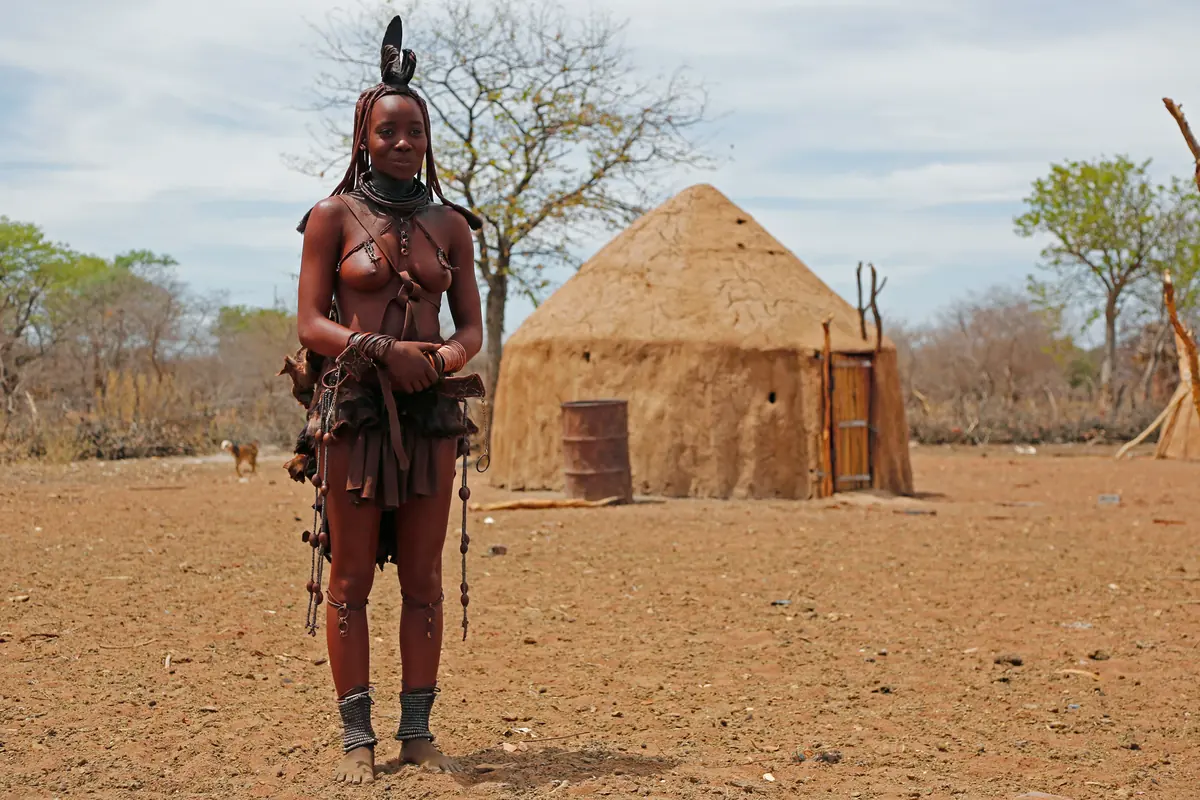
- The census lists the Aambalantu (17.8 percent) and Aakwambi (17.5) as the largest groups, followed by the Aakwanyama, Aangandjera, Aakwaluudhi, Aambadja and Aakolonkadhi. In the far west 3.1 percent are counted as Ovadhimba/Ovazemba. source
- Food and farming
- Mahangu (pearl millet) is the main crop of the region. Near Ruacana the government irrigation farm at Etunda uses canal water from the Kunene to grow maize, bananas and watermelons. source
- Olufuko festival
- Outapi has hosted the Olufuko festival since August 2012, a business fair built around a revived Ovambo initiation rite that prepares girls for womanhood. It is contested: Sam Nujoma was its patron, while the mainstream churches and the rights group NamRights have condemned the rite. source
- Church and dress
- Finnish Lutheran missions shaped the north from the 1870s. The headscarf and long, loose dress many Ovambo women wear today grew out of what the Finnish missionaries wore in the 19th century. source
For German visitors: Joseph Gotthardt, a Catholic missionary from Thalheim in the Westerwald, founded the mission at Oshikuku in 1924, the first Catholic mission in Ovamboland. That same year he was consecrated bishop at Hünfeld in Germany, and in 1923 he had published one of the first criticisms of colonisation in Namibia. source
For German visitors: The German Rhenish Mission had a hand in the Finnish work here. Its missionary Carl Hugo Hahn wanted the Finnish board's approval before the first Ongandjera station went ahead, which put it off by a year. Martti Rautanen married Frieda Kleinschmidt, daughter of the missionary Heinrich Kleinschmidt who founded Rehoboth in the south, and in the 1890s the two missions agreed on a joint Finnish and German station in Ongandjera that the Finnish board then blocked. source
For German visitors: Aatu Järvinen, the Finnish missionary who founded the clinic at Tsandi in 1922, had trained in tropical diseases at Tübingen before the First World War. source
Main sights in Omusati
6- Ombalantu Baobab Tree Heritage Site, Outapi
A baobab estimated at about 800 years old and 26.5 m round, whose hollow trunk holds about 35 people. It has served as a hiding place, a chapel and a post office, and since December 2004 it has housed a display on its place in Ovambo life and on the independence struggle.
Wikipedia: Ombalantu baobab tree - Uukwaluudhi Royal Homestead, Tsandi
The old palace of the Uukwaluudhi kings, kept in traditional style since the royal family moved into a brick house next door in 1978. Guided tours of about 1.5 hours have been run through its 36 palisaded sections, laid out as a maze to confuse enemies and wild animals. The accounts of the tours are old, so check locally that they still run.
Travel News Namibia: Of kings and palaces - Omugulugwombashe
The site of the first battle of the liberation war in 1966, 22 km west of Tsandi on the D3633 gravel road. It has one of Namibia's two state cemeteries for national heroes, a memorial shrine opened in 2013 and a statue of the camp's six leaders unveiled in 2014.
Wikipedia: Omugulugwombashe - Monument for the Uukwambi Kings, Elim
At Elim, the seat of the Uukwambi traditional authority and one of the first Finnish mission stations in the north (1870), a monument stands at the grave and old homestead of Nuuyoma, the sixteenth Uukwambi king.
Wikipedia: Elim, Namibia - Oshikuku Catholic mission
The first Catholic mission in Ovamboland, allowed in 1924 by King Iipumbu ya Tshilongo after years of refusal. The parish is still active, and Iipumbu himself died in Oshikuku in 1959.
Wikipedia: Oshikuku - Ruacana Falls
Most of the year nearly all the Kunene's water is diverted to the power station and only a few streams run down the rock. In flood, roughly December to May, the falls fill again. The viewpoint near the border crossing is worth a stop all year, and stairs to its west lead down to the remains of the small first power station, built to supply the construction of the main one.
Travel News Namibia: Why Ruacana Waterfall
Did you know?
- Sam Nujoma, SWAPO leader and Namibia's first president, was born on 12 May 1929 at Etunda, a village in Ongandjera near Okahao. His mother was a Uukwambi princess. source
- The Ruacana power station is built underground near the foot of the falls and accounts for about half of Namibia's generating capacity. source
- Outapi, now the regional capital, was the smallest town in Namibia in 2001 with just over 2,600 people. By the 2023 census it had 13,664. source
- The Uu- in Uukwambi is the same Bantu prefix as the U- in Uganda, both meaning land of a people. source
- Population density swings from 61.7 people per km² in Okalongo constituency to 2.5 per km² in Okahao constituency, against 11.9 for the region as a whole. source
- Namibia's first luxury passenger train, launched in July 2006 from Windhoek to Ondangwa, was named the Omugulugwombashe Star. It was grounded after a few runs, when its locomotives broke down and were found unsuitable for Namibia's railways. source
Checked 10 October 2026.