Region · Namibia
Oshana
The crowded heart of the Ovambo north, built around the Oshakati, Ongwediva and Ondangwa towns, with seasonal floodplains and Etosha's Okaukuejo camp in its far south.
Short answer
This page covers 1 parks and reserves and 2 towns and cities in Oshana.
- Parks and reserves
- 1
- Towns and cities
- 2
- Where
- Namibia18.50°S 15.74°E
Parks and reserves in Oshana
1Towns and cities in Oshana
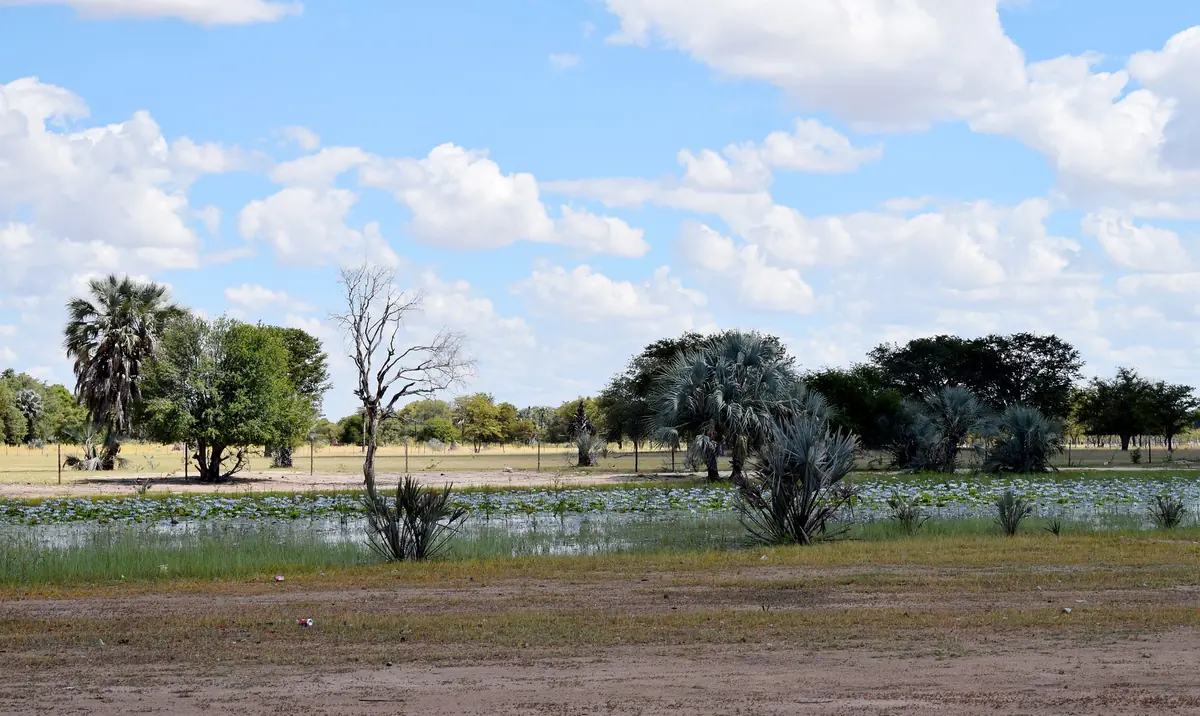
2Oshana is wedged between the other three northern regions that make up what people call the Four-O, with no coast and no foreign border. The 2023 census counted 230,801 people here, and just over half of them live in three towns that have almost grown together: Oshakati, the regional capital, Ongwediva next door, and Ondangwa about 35 km east. The name means the shallow channels that fill with water in the rains. Most travellers only pass through, but it is the best place to see the modern Ovambo north.
Getting there
The B1 from Tsumeb reaches Ondangwa after about 270 km. From there the tarred C46 runs west to Oshakati and on towards Ruacana, and the B1 carries on north for about 60 km to the Angolan border. Andimba Toivo ya Toivo Airport (formerly Ondangwa Airport) is about 5 km north-west of Ondangwa and has scheduled flights to Windhoek. Coaches between Windhoek and Lusaka stop in Oshakati and Ondangwa.
Oshana’s far south is a different world. The region’s line runs through Okaukuejo, the main camp in Etosha, but you cannot reach it from Oshakati. It is 17 km inside the southern gate, which you approach from Outjo, and NWR puts it 432 km from Windhoek.
When to go
Rain falls in summer, about 450 mm a year on average, but it swings wildly: Ondangwa had over 1,000 mm in 2010/2011 and only 169 mm in 2018/2019. In wet years the oshanas flood, travel gets slower and towns can go under (Oshakati was badly flooded in 2008). October can be fierce: Ondangwa recorded 43.2 °C on 28 October 2020. The dry winter months are the easier time to drive the side roads.
What to do
This is a place for markets and people rather than sights. The open market in Oshakati sells dried fish and dried mopane worms (a caterpillar eaten as a snack), and Ondangwa has a big one too. Ongwediva hosts its Annual Trade Fair in late August (22 to 30 August in 2025), when the whole town fills up, and Oshakati runs its Totem Expo in June or July. In good rain years Lake Oponona (also spelt Oponono), in the thinly settled south about 70 km from the Etosha Pan, holds water long after the oshanas dry, and flamingos come to it.
Good to know
- Oshana is a malaria area. The US CDC recommends prescription tablets for the whole region, so see a travel doctor before you go.
- The B roads and the C46 are tarred and in good shape. Wikivoyage describes the D roads and unnumbered tracks as sandy and corrugated, and worse after rain.
- Accommodation here is aimed at business travellers. If you are coming for the trade fair, book early or stay in Oshakati or Ondangwa.
- The south of the region is salty and almost empty (Uuvudhiya constituency has about one person per km²), and the only road into Okaukuejo comes up from Outjo.
History and culture
Oshana covers land of two Ovambo kingdoms, Uukwambi and Ondonga, on the floodplains that gave it its name. Finnish missionaries, a German veterinary line, the South African administration and then the army all left their mark, and Oshakati itself was founded in 1966 by South Africa as a town and military base. That history explains the Lutheran churches, the Finnish first names and the fast growth of the three towns, which now form the biggest cluster of people in Namibia after Windhoek.
- 1890
The Finnish missionaries had a string of setbacks in Uukwambi, Ongandjera and Oukwanyama, so they concentrated on western Ondonga, and in 1890 August Pettinen founded the mission station that became Ondangwa. source
- 1884 to early 1900s
The colonial agreements of 1884 split the Ovambo lands between Germany and Portugal without asking their people. For at least two decades neither power tried to occupy or govern them, and years of gun smuggling had left the Ovambo kingdoms well armed. source
- 1915
When British and South African forces took the territory from Germany in the First World War, they chose Ondangwa as the seat of their administration in Ovamboland and raised the Union Jack there on Christmas Day 1915. The government bought the station from the Finnish mission in 1921. source
- 1932
Iipumbu ya Tshilongo, king of Uukwambi since 1907, refused to pay taxes or send contract labourers. In 1932 troops under Resident Commissioner Hahn attacked Uukwambi, had his homestead bombed by military aircraft and later sent him into exile in Kavango. He is now one of Namibia's nine national heroes. source
- July 1966
South Africa founded Oshakati, and during the liberation war fought by SWAPO (the South West Africa People's Organisation) the South African Defence Force used the town as a base of operations. source
- 1968
The north became Ovamboland, a bantustan (an apartheid ethnic homeland). In practice it was a labour reserve: Ovambo men could leave only on 16-month labour contracts and women not at all. source
- 1970s and 1980s
Until independence Oshakati was split into a white east and a Black west, kept apart by distance, fences and barbed wire, and run like a fortress. A military base was built in 1974, with a pipeline and canal bringing water from the Calueque dam on the Kunene to supply it. source
- 19 February 1988
A bomb wrecked what was then the Barclays Bank branch in Oshakati (today First National Bank), killing civilians going about their day. In February 2026 the vice president unveiled a tombstone for the victims, describing the attack as meant to spread fear and undermine SWAPO and its army. source
- Language
- Three Oshiwambo dialects dominate home life in the 2023 census: Oshikwanyama in 34.9 percent of households, Oshindonga in 30.1 percent and Otshikwambi in 19.1 percent. English is the main home language in 3.4 percent of households and Afrikaans in 1 percent. source
- Peoples
- Almost everyone here is Ovambo, but from several of the old kingdoms: Aakwanyama 34.8 percent, Aandonga 29.6 percent and Aakwambi 21.1 percent in the 2023 census, with smaller numbers of Aangandjera, Aambalantu and Aambadja. source
- Kwambi tradition and the Totem Expo
- Oshakati lies inside the Kwambi traditional authority, and the Kwambi call it Otshakati tsha Nangombe. Since 2012 the town council has held the Oshakati Totem Expo, four days in June or July that mix local traditions with a business show. source
- Churches and Finnish names
- Lutheranism is the main faith in the old Ovamboland because of the Finnish missionaries, and their work is why so many people carry Finnish first names such as Toivo, Martta, Helmi and Martti. source
- Trade fair
- Ongwediva has held its Annual Trade Fair every year since 2000, after a first Northern Namibia Trade Fair in 1995. Its nightlife is said to be second only to Windhoek's. source
For German visitors: The Baltic German missionary Carl Hugo Hahn of the Rhenish Missionary Society tried to reach the Ovambo in 1857 with Johannes Rath. The four-month trip to Ondangwa ended in disaster and they barely escaped alive. His account of a later journey, which included a description of the Etosha Pan, appeared in the German journal Petermanns Geographische Mitteilungen, and in 1870 he persuaded the Finnish Missionary Society to take on Ovamboland. source
For German visitors: Hahn's grandson, Lieutenant C. H. L. Hahn, arrived in Ovamboland in October 1915 and ran its administration from Ondangwa for 30 years, with a strong influence on how the Finnish missionaries and the colonial government got on. source
For German visitors: Okaukuejo began as a German post: a veterinary control point from 1897 and a Schutztruppe (colonial army) fort from 1901, later replaced by a police station with a round limestone tower. The tower you see now is a 1963 rebuild. source
Main sights in Oshana
5- Okaukuejo, Etosha National Park
Etosha's main camp and park headquarters, on the Oshana side of the line, with its floodlit waterhole. The round tower recalls the police station the Germans built after their fort of 1901 was destroyed; the present tower dates from 1963. It became Etosha's first public rest camp in 1950.
Wikipedia (German): Okaukuejo - Oshakati open market
The Dr Frans Aupa Indongo Open Market sells groceries, dried fish and dried mopane worms (a caterpillar eaten as a snack). It replaced the old market on the C46, which was demolished in 2016.
Wikipedia: Oshakati - Lake Oponona
The largest lake in the Cuvelai Basin, in Uuvudhiya constituency about 70 km from the Etosha Pan. After a good rainy season it holds water into the next one, and flamingos and other birds move there when the oshanas dry up.
Wikipedia: Lake Oponona - Olukonda National Monument and Nakambale Museum
In the neighbouring Oshikoto Region, the first Finnish mission to the Ovambo, founded in 1870. The church of 1889 and mission house of 1893 built under Martti Rautanen, known as Nakambale, were declared national monuments in 1992, and the mission house is now a museum.
Wikipedia: Olukonda - Onandjokwe and Oniipa
Oniipa, a Finnish mission of 1872 just outside Ondangwa in Oshikoto, has the old Onandjokwe mission hospital, home to Namibia's only medical museum. Thanks to the Finnish link it also runs the country's only public sauna.
Wikipedia: Oniipa
Did you know?
- In the 2023 census 122,797 of Oshana's 230,801 people lived in its three towns, Oshakati, Ongwediva and Ondangwa, and there were only about 86 men for every 100 women. source
- An oshana is a shallow channel that floods in the rains. Hundreds of them run south from the Angolan highlands towards the Etosha Pan, and because the ground is so flat they flood easily, though many are dry for most of the year. source
- The boundary between Oshana and Oshikoto runs right through Okaukuejo camp in Etosha. The tourist and park offices are in Oshana, the clinic and staff housing in Oshikoto, and because the only road in comes from Outjo, the camp's football club plays in the Kunene league. source
- The Oshakati bank bomb went off at midday on 19 February 1988, killing 27 people and wounding more than 40. Survivors, families and church leaders have gathered in Oshakati to remember them. source
- Sam Nujoma, Namibia's first president, was the son of a Kwambi princess, Helvi Mpingana Kondombolo. source
- Ondangwa is said to mean the end of Ondonga, because the town sits on the western edge of that kingdom. When it was founded, the 15 km to the older Olukonda mission was reckoned as two hours by ox cart. source
Checked 7 October 2026.