Colesberg
Karoo town on the N1 roughly halfway between Johannesburg and Cape Town, with Anglo-Boer War history, old Karoo houses and racehorse and merino farms around it.

See every place on this map as a list
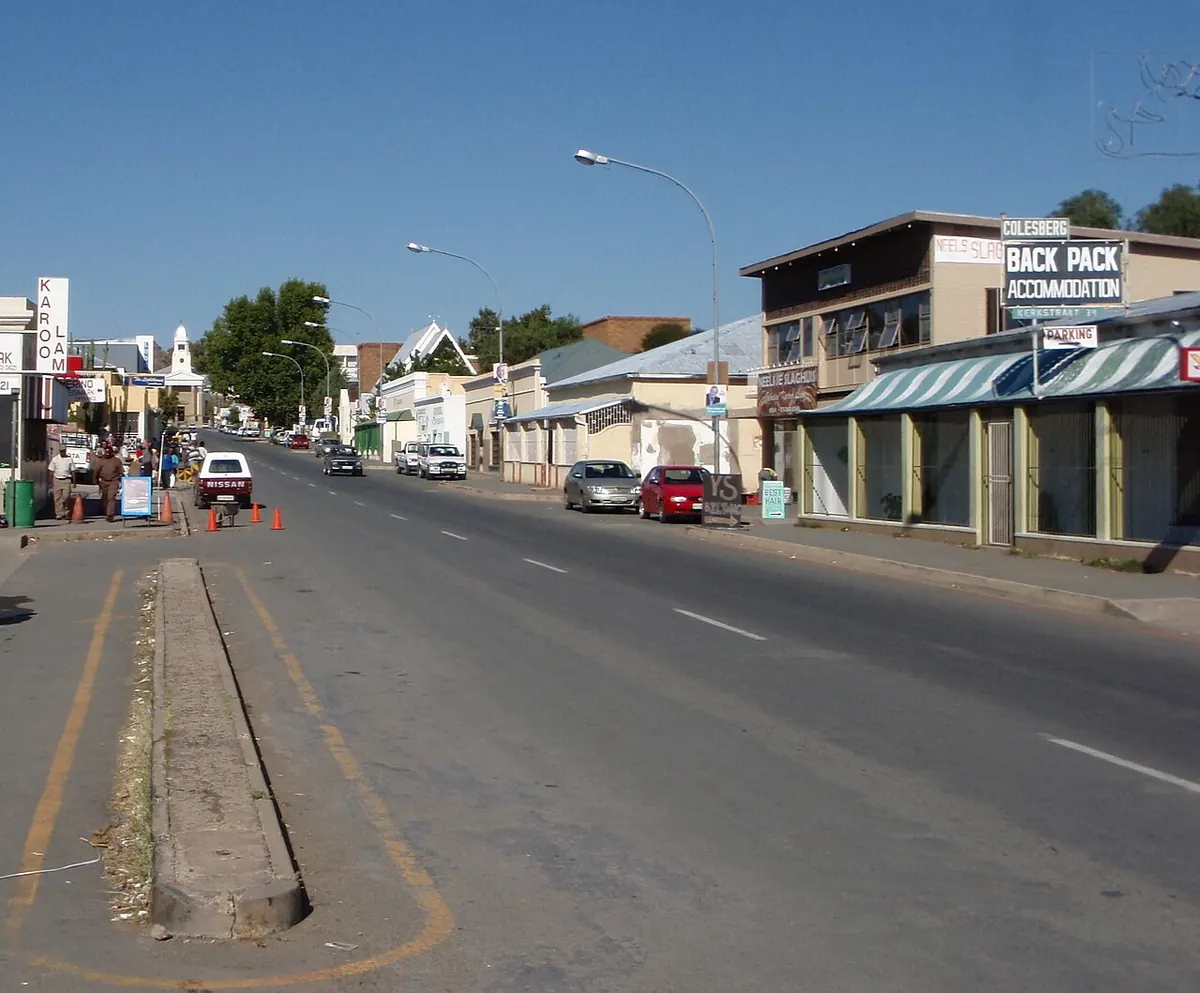
Colesberg is the town most people driving the N1 between Johannesburg and Cape Town end up sleeping in, because it sits roughly halfway. That is a fair reason to stop, but the place has more to it than a bed. It is a Karoo town of reed-ceilinged, yellowwood-beamed houses in Cape Dutch and Georgian styles, ringed by koppies that were fought over again and again in the Anglo-Boer War. Around it are merino sheep farms and the racehorse studs it is best known for.
Getting there
You drive. The town is just off the N1, which runs straight past it, and Siyabona puts it at about 790 km from Cape Town and about 680 km from Johannesburg. The landmark to look for is Coleskop, a cone-shaped hill that early travellers called Toverberg (magic mountain). Several sources say it is visible from about 40 km out, so you will know you are close long before the turn-off.
When to go
This is the dry Karoo, and it swings hard between seasons. Summer days can reach around 35°C. Winter middays are mild, around 20°C, but nights can drop below freezing, so a stopover bed in June wants proper blankets. As a stopover it works at any time of year; for walking or cycling the koppies, the cooler months are kinder than a January afternoon.
What to do
Start at the Colesberg-Kemper Museum, in an old 19th-century bank building. Inside are fossils, an Anglo-Boer War section and a permanent photo display on the karretjie people, the donkey-cart nomads of the Karoo. There is also the diamond connection: South Africa’s first diamond was bought by a trader and carried to Colesberg to be tested.
The tourist office on Murray Street runs a guided walking tour of about three hours, which takes in churches, the stone magistrate’s court, old cemeteries and the Karoo cottages. The cottages on Bell Street are the ones to see. Then go and have a drink at the old horse-driven mill, still turning and now a pub, which is a rarity in South Africa these days.
Outside town, the Doornkloof Nature Reserve lies where the Seekoei River meets the Orange. Antelope such as kudu and eland live there, and the night shift includes aardwolf and brown hyena. Guest farms around Colesberg offer mountain bike and 4x4 trails, and Gariep Dam, with its 90 m wall, is close enough for a day out.
Good to know
The town was named in 1830 after Sir Lowry Cole, then Governor of the Cape (some older accounts give an earlier date for the settlement). Golfer Gary Player owns a stud farm nearby. Several sheep festivals are held through the year, worth timing a stop around if you can find the dates.
In and around Colesberg
37 PLACESPlaces to stay 27
- 30.73°S 25.09°E
- 30.73°S 25.09°E
- 30.73°S 25.08°E
- 30.73°S 25.09°ECampsiteMijn RustColesburg
- 30.73°S 25.09°E
- 30.72°S 25.10°E
- 30.72°S 25.10°E
- 30.72°S 25.09°E
- 30.72°S 25.10°EGuest houseAnnelines Guest House
Sights 2
- Colesberg Kemper MuseumMuseum
- Queen Victoria Diamond Jubilee LightingAttraction
Restaurants and cafes 7
- Ouma Anna Coffee Shop & RestaurantCafe · american, beef bowl, breakfast, bubble tea, cake, chicken · Bain Street+27 81 838 1186
- Allards RestuarantRestaurant
- Bordaux RestaurantRestaurant
- Plattelander RestaurantRestaurant
- Seattle CoffeeCafe
Bars and pubs 1
- Horse & MillPub