Park · Eastern Cape, South Africa
Mountain Zebra National Park
Malaria-free Karoo mountain park near Cradock that saved the Cape mountain zebra, now with cheetah tracking on foot, lions, black rhino and plateau game loops.
Short answer
At Mountain Zebra National Park, international visitors pay R358 (about US$20, €18.50 or £15.50) per adult and R179 per child per day. The rates apply from 1 November 2026 to 31 October 2027.
- Daily fee, international adult
- US$20 €19 · R358
- Malaria
- There is no malaria risk here.
- Places to stay
- 1
- Park fee nearby: Camdeboo National Park
- US$13 €12 · R227about 93 km away
Mountain Zebra National Park fees 2026/27
Checked South African National Parks tariffValid 1 November 2026 to 31 October 2027, per person per day, in rand.
| Who | Adult | Child |
|---|---|---|
| International visitorsUS, Europe and everyone else | US$20 €19 · R358 | US$10 €9 · R179 |
| SADC nationals | R158 | R78 |
| South African residents | R76 | R38 |
- These rates apply from 1 November 2026.
- Adults are 12 and older. Child rate applies to ages 2 to 11; children under 2 enter free.
- Members of the SANParks WILD loyalty programme (Wild Card) do not pay daily conservation fees if they show ID and their card on arrival.
- Wild Card holders do not pay daily fees. Is the Wild Card worth it for you?
- Fees are set by South African National Parks. Official tariff · Seen a new rate? Tell us
US$1 = R17.47 · €1 = R19.20 · £1 = R22.93 (ECB rate, 20 Nov 2026). Converted amounts are approximate; you pay in rand.
How we got these figures
- Checked against the official SANParks tariff on 7 October 2026. Before that these figures came from published reports (places.co.za). They matched the official sheet.
- SANParks conservation fees 2026-11-01 to 2027-10-31 (official tariff) · official · checked 7 Oct 2026
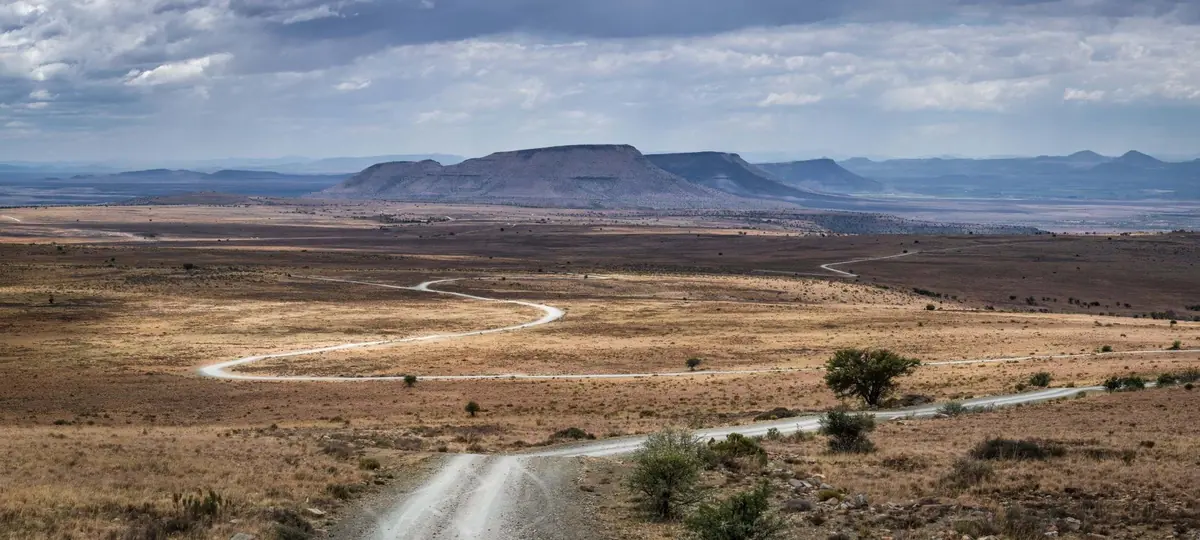
Mountain Zebra National Park was proclaimed in 1937 to save a species down to a handful of animals. It worked. The Cape mountain zebra herd on the Bankberg slopes above Cradock now numbers in the hundreds, and the park has grown to about 284 square kilometres of grassy plateau, rocky kloofs and Karoo plains. It is small enough to cover in a day, malaria-free, and one of the few places in South Africa where you can track cheetah on foot.
Getting there
The park lies about 12 km from Cradock in the Eastern Cape on the R61 towards Graaff-Reinet. From Gqeberha (Port Elizabeth) it is just under three hours: N10 north to Cradock, then the R61. Gates open 07:00 to 19:00 from October to March and 07:00 to 18:00 from April to September. Older guides put April in the summer hours, so if you are arriving late in April, check with the park first.
When to go
The park is high ground, so weather is sharper than you might expect. Summer days (October to April) run warm to hot, sometimes above 40 degrees, with afternoon showers rather than long rain. Winter nights in June and July can drop below freezing and snow falls on the high ground some years. Most people prefer October to April for warmth; regulars say to bring warm clothes whatever the month.
What to do
Two self-drive loops do most of the work. The Rooiplaat loop runs across the grassland plateau north of the camp, where zebra, springbok, blesbok, black wildebeest, red hartebeest and gemsbok graze in the open. The Kranskop loop to the south has less game but far better mountain scenery. The Sonnenrust 4x4 trail climbs onto the plateau in the north-west near the Salpeterkop rock formation.
Cheetah tracking is the park’s special thing. A guide locates a collared animal by radio, drives you close, and you walk the last part. Book it at reception and ask about the minimum age when you do (one 2026 guide gives 16). Cheetah were brought back in 2007, buffalo in 1998, black rhino in 2002, brown hyena in 2008 and lions in 2013, so the plateau is no longer the predator-free place older guidebooks describe.
Two short self-guided walks start in the fenced rest camp area: Imbila (1 km) and Black Eagle (2.5 km). Everything longer is guided. After a hiker was killed by a buffalo in 2010 the park closed its trails, fenced the camp walks and reopened the 10 km Idwala and the three-day, 25 km Impofu trail only as hikes led by armed guides. Recent guides no longer mention either, so ask the park whether they run before you plan around them. Ranger-led morning walks go out from camp. Guided tours visit three San rock art shelters, and a sunset drive in an open vehicle goes out daily at 17:00 for about two hours (no children under six). More than 200 bird species are recorded (South African Tourism counts about 216), including blue crane, secretarybird and martial eagle.
Good to know
- Accommodation is the Victorian Doornhoek guest house on a dam, family cottages, two mountain cottages reached by 4x4 (gas stoves, solar lights, no mains power) and a 20-site campsite.
- The rest camp has a restaurant, a shop selling braai wood and basic supplies, and fuel, though some visitors prefer to self-cater.
- The park is malaria-free, which makes it an easy add-on for families driving between the Garden Route and the Karoo.
Wildlife you might see
15- very likelyCape mountain zebraThroughout, easiest on the Rooiplaat plateau and the plains. All yearsource
- likelySpringbokOpen grassland on the Rooiplaat loopsource
- likelyBlack wildebeestOpen grassland on the Rooiplaat loopsource
- likelyRed hartebeestOpen plains, including the Rooiplaat grasslandsource
- likelyElandOpen plains, and lower ground on the Kranskop loopsource
- likelyGreater kuduOften seen from the walking trails around the rest campsource
- likelyChacma baboon and rock hyraxDassies live in the rocks on the way up to the rest camp pool; baboons are often seen from the camp trailssource
- possibleMountain reedbuck and grey rhebokHigh mountain slopes along the Kranskop loopsource
- possibleCape buffaloThickets and wooded valleyssource
- possibleLionMost often reported on the Rooiplaat plateau, where the open ground makes them easier to spot. Reintroduced 2013source
- possibleCheetahYour best chance is the guided cheetah tracking walk, since the collared animals are found by radio. Reintroduced 2007source
- possibleBlue craneOpen grassland on the Rooiplaat plateausource
- possibleVerreaux's eagle and martial eagleCliffs and mountain slopessource
- rareBlack rhinoAnywhere in the park, but only a lucky few see onesource
- rareAardwolf, aardvark and caracalLook for them on a guided night drive. After darksource
Likelihood is for a normal visit of two or three days, from the sources linked. Nothing is guaranteed in the wild.
Hikes and walks
4- Imbila Trail
The shortest of the walks inside the fenced rest camp, so you can do it on your own.
Permit: No fee and no booking. Sign in at reception before you set off.
Wikivoyage - Black Eagle Trail
Climbs from the rest camp to the top of a rocky outcrop with views over the park. Older guides give it as 3 km and 2 hours; current guides give 2.5 km. It stays inside the fenced camp area.
Permit: No fee and no booking. Tell reception before you set off.
Roxanne Reid, Africa Addict - Salpeterkop guided hike
A ranger-led walk up Salpeterkop, where British soldiers scratched their names and a full-size chessboard into the rock during the Anglo-Boer War. Aimed at fit walkers.
Permit: Guided only, ask at reception
Africa Geographic - San rock art walk
A guided outing to San rock paintings. You have to clamber over rocks to reach them, so it does not suit small children.
Permit: Guided only, ask at reception
Roxanne Reid, Africa Addict
Staying safe in Mountain Zebra National Park
- Malaria
- There is no malaria risk here. In South Africa malaria is limited to low-lying parts of Limpopo and Mpumalanga and the far north-east of KwaZulu-Natal, a long way from Cradock. source
- Lions, buffalo and rhino
- Lions, buffalo and black rhino roam the park, so stay in your car except at the rest camp, picnic sites and marked spots. The only walks you can do on your own are the two short trails inside the fenced rest camp; anything further is with a ranger. source
- Heat and cold
- Summer days reach the upper 30s and sometimes pass 40°C, so carry plenty of water on walks and drives. Snow sometimes falls on the higher ground in winter, so pack warm layers too. source
- Roads and phone signal
- Almost 70 km of the park's roughly 100 km of road is fine in an ordinary car. The three 4x4 trails (Juriesdam, Sonnenrust and Umngeni) need a 4x4 and may close in wet weather. Phone signal is good at the main camp but patchy in parts of the park. source
- Services
- Doctors, pharmacies, vehicle repairs and police are in Cradock, about 12 km away. source
Tips from travellers
- If you only do one game drive, combine the Kranskop and Rooiplaat loops. Between them you get the best mountain and valley views and a chance of lion, buffalo, mountain reedbuck and grey rhebok. several sources
- Book cheetah tracking ahead at reception. A guide picks up a collared cheetah's radio signal and you may get to walk closer on foot. It usually takes one to three hours. several sources
- There is petrol and diesel at the rest camp, plus a small shop for basic groceries and braai wood. several sources
- Bring binoculars and a bird book. The plateau grassland is good for larks, pipits, bustards and blue crane. several sources
- Book a guided sunset or night drive if you want a chance at aardwolf, aardvark and porcupine, which come out after dark. several sources
Checked 7 October 2026. Conditions change, so confirm with the park or venue before you go.
In and around Mountain Zebra National Park
6 places listedWhere to stay in Mountain Zebra National Park 1
- 32.22°S 25.48°ECampsiteMountain Zebra National Park
Sights 5
- Big RockMonument
- Dam lookoutViewpoint
- Mountain Zebra Rest Camp PoolAttraction
- Rooiplaat Loop ViewpointViewpoint
- Sonnenrust Loop ViewpointViewpoint
Quick answers
How much is the entry fee for Mountain Zebra National Park?
International visitors pay R358 (about US$20, €18.50 or £15.50) per adult and R179 per child per day. These rates apply from 1 November 2026 to 31 October 2027 and are set by South African National Parks (SANParks).
Do South Africans and SADC citizens pay less at Mountain Zebra National Park?
South African residents pay R76 per adult and SADC nationals pay R158 per adult per day. You need ID or a passport to get the lower rate.
When were these Mountain Zebra National Park fees last checked?
We last checked them on 7 October 2026 against 1 published source. We re-check every two weeks, but always confirm with South African National Parks (SANParks) before you travel.
What animals can you see in Mountain Zebra National Park?
Most visitors see cape mountain zebra. You have a good chance of seeing springbok, black wildebeest, red hartebeest, eland, greater kudu and chacma baboon. Black rhino, aardwolf, aardvark and caracal are there but rarely seen.
What are the best hikes in Mountain Zebra National Park?
Imbila Trail (1 km), Black Eagle Trail (2.5 km), Salpeterkop guided hike and San rock art walk. See the hikes section for times, difficulty and permits.
Mountain Zebra and the parks nearest it
| Park | International adult | Distance | Where |
|---|---|---|---|
| Mountain Zebra National Park | US$20 €19 · R358 | · | Eastern Cape |
| Camdeboo National Park | US$13 €12 · R227 | 93 km | Eastern Cape |
| Addo Elephant National Park | US$32 €29 · R565 | 109 km | Eastern Cape |
| Garden Route National Park | US$11 €10 · R190 | 245 km | Western Cape |
Where the Mountain Zebra fees come from
Open data: all park fees (CSV) · JSON (CC BY 4.0)
Cite as: Travel Africa Guide, "Mountain Zebra National Park fees 2026/27", checked 7 October 2026, https://travelafrica.guide/south-africa/mountain-zebra-national-park/
Map of Mountain Zebra National Park
See every place on this map as a list