Town · Western Cape, South Africa
Franschhoek
A small valley town 75 km from Cape Town, settled by French Huguenots in 1688 and now the Winelands capital of restaurants, wine estates and the hop-on hop-off wine tram.
Short answer
Franschhoek is in Western Cape, South Africa. This page lists 36 places to stay, 35 places to eat and drink and 6 sights. The nearest park with an entry fee on this site is Kogelberg Nature Reserve, about 43 km away, where international adults pay from R65.

- Places to stay
- 36
- Eat and drink
- 35
- Sights
- 6
- Park fee nearby: Kogelberg Nature Reserve
- US$4 €3 · R65about 43 km away
In and around Franschhoek
91 places listedWhere to stay in Franschhoek 36
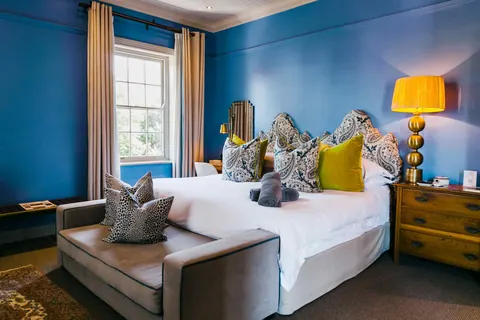
- 33.90°S 19.13°EHotelL'Amitié EstateUitkyk Street, Franschhoek+27 71 280 6089lamitie.co.za
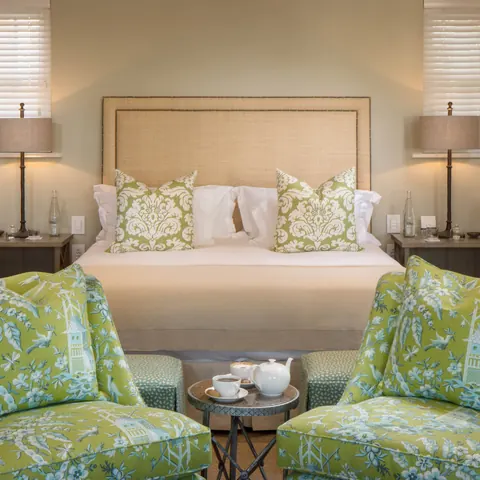
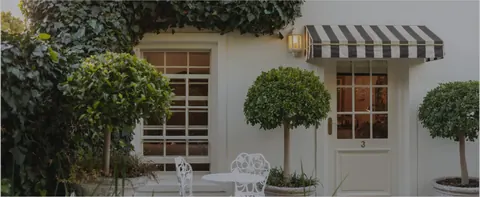
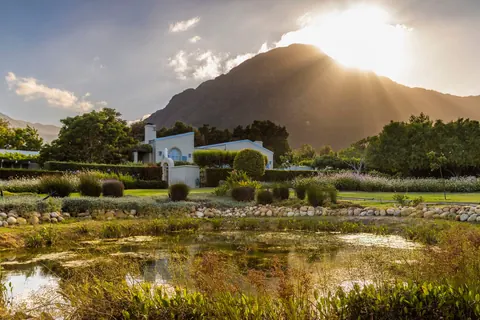
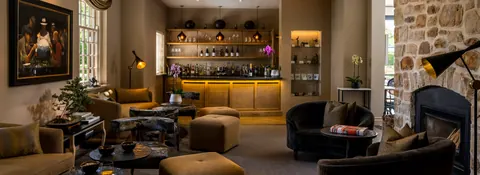
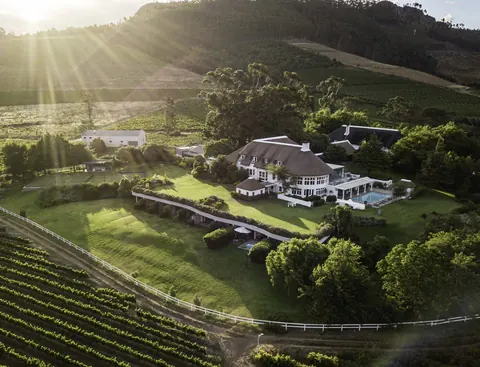
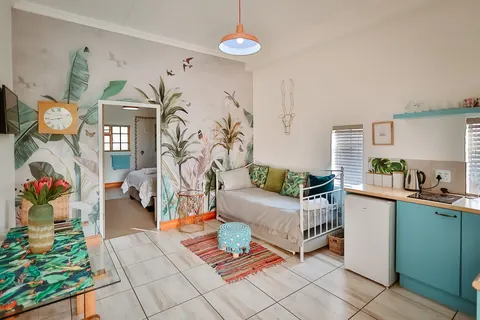
- 33.90°S 19.12°EChaletArtemis Barn Garden Retreat CottagesUitkyk Street, Franschhoek+27 83 383 1614artemisestate.net
Show all 36 places to stay
- Forest Cottages · Chalet · Franschhoeklacottefarm.com
- la cotte farm · Hotel · La Cotte Street, Franschhoek+27 21 207 3907lacottefarm.com
- la cotte farm -Orchard Cottages · Chalet · La Cotte Street, Franschhoeklacottefarm.com
- Mont Bleu Guest House · Guest house · Le Sanctuaire Access Raod, Franschhoek
- L'Ermitage Franschhoek Chateau and Villas · Hotel · Lambrechts Road, Franschhoek+27 81 345 9410lermitage.co.za
- la cotte farm - THE PRIVATE VILLA · Chaletlacottefarm.com
- Franschhoek Boutique Hotel · Hotel+27 21 424 1530franschhoekboutiquehotel.co.za
- Holden Manz · Guest householdenmanz.com
- La Petite Dauphine · Hotellapetite.co.za
- La Réverie · Guest houselareverieguesthouse.com
- Otter's bend lodge · Hostel · Dassenbergstreet
- Plumwood Inn · Guest house · Cabriere Street, Franschhoek
- Sorbonne 1 · Guest house · De Wet Street
- Agtertafelberg Hut - MCSA · Wilderness hut
- Centre Ville Guest House · Guest house · Dirkie Uys Street, Franschhoek
- Coach House · Guest house · 4 star
- La Providence · Hotel · Middagkrans Road, Franschhoek
- Riverstone Cottage · Guest house · Anne Marie Avenue
- Bird Cottage and Frog Lodge · Guest house
- Cape Vue countrÿ house · Guest house
- La Bourgogne Riverside Cottages · Guest house
- La Cotte Inn · Hotel
- La Franschhoek · Hotel
- Lavender Farm Guest House · Guest house
- Neighbourgood Franschhoek · Guest house
- The Last Word Franschhoek · Hotel
- theLAB · Guest house
Sights 6
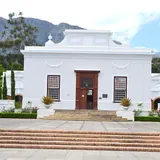
- Dieu Donné Tasting RoomAttraction+27 21 224 0667dieudonnevineyards.com
- Le Lude Tasting RoomAttractionlelude.co.za
- Huguenot MonumentAttraction
- Mullineux & Leeu Wine StudioAttraction
- Franschhoek CellarMuseum
Restaurants and cafes 30
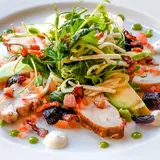 The French Connection BistroRestaurant · Huguenot Road, Franschhoek+27 21 876 4056frenchconnection.co.za
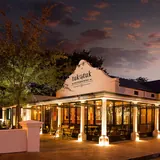
- The Hussar GrillRestaurant · steak house · Louis Botha Street+27 21 876 2308hussargrill.co.za
- ElevenRestaurant · Huguenot Road+27 21 023 3755eleveneats.co.za
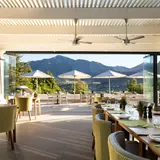

- Terbodore CaféCafe · Huguenot Road+27 21 876 2731terbodore.com
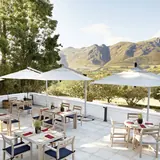 The Country KitchenRestaurant+27 21 876 2770virginlimitededition.com
- Bootlegger Coffee CompanyCafe · coffee shopbootlegger.coffee
- AlloraRestaurant · italian+27 21 876 4375allora.co.za
- Cafe BonBonCafelapetite.co.za
- Franks CornerRestaurant · Huguenot Roadfranks-corner.com
Show all 30 restaurants and cafes
- Le Bon Vivant · Restaurant · Dirkie Uys Street, Franschhoeklebonvivant.co.za
- David’s Bistro · Restaurant · breakfast, bistro · La Roche Estate
- Épice · Restaurant+27 21 492 2222leeucollection.com
- La Petite Ferme · Restaurant · french · Lambrechts Road, Franschoek
- Le Coin Francais · Restaurant · Huguenot Road
- Let's Frite · Restaurant · Reservoir Street, Franschhoek
- Yama · Restaurant · Huguenot Road
- Café du Vin · Restaurant
- Cartel Pizza & Wine Bar · Restaurant
- Franschhoek Kitchen · Restaurant
- Get Lost Coffee · Cafe
- Reuben's · Restaurant
- ROCA @ Dieu Donne Wine Estate · Restaurant
- Ryan’s Kitchen · Restaurant
- Starbucks · Cafe
- Taki's · Restaurant
- The Hoek · Cafe
- Col'Cacchio · Restaurant · regional, pizza, burger+27 21 876 4222colcacchio.co.za
Bars and pubs 5
- Elephant & Barrel Village PubPub · Huguenot Road, Franschhoekelephantandbarrel.co.za
- Blame Lily Gin PalrourBar
- Franschhoek Cellar PlatformBar
- Old Road Wine Co.Bar
- The StationPub
Wineries, breweries and distilleries 14

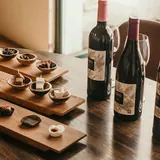
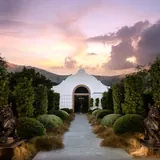

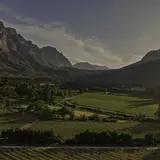
- BoekenhoutskloofWineryboekenhoutskloof.co.za
- ChamonixWinery+27 21 876 8400chamonixestate.co.za
- ColmantWinerycolmant.co.za
- Dieu DonnéWinery+27 21 224 0667dieudonnevineyards.com
- Franschoek CellarWineryfranschhoekcellar.co.za
- Haut EspoirWineryhautespoir.com
Show all 14 wineries, breweries and distilleries
- Holden Manz · Wineryholdenmanz.com
- Le Lude · Winerylelude.co.za
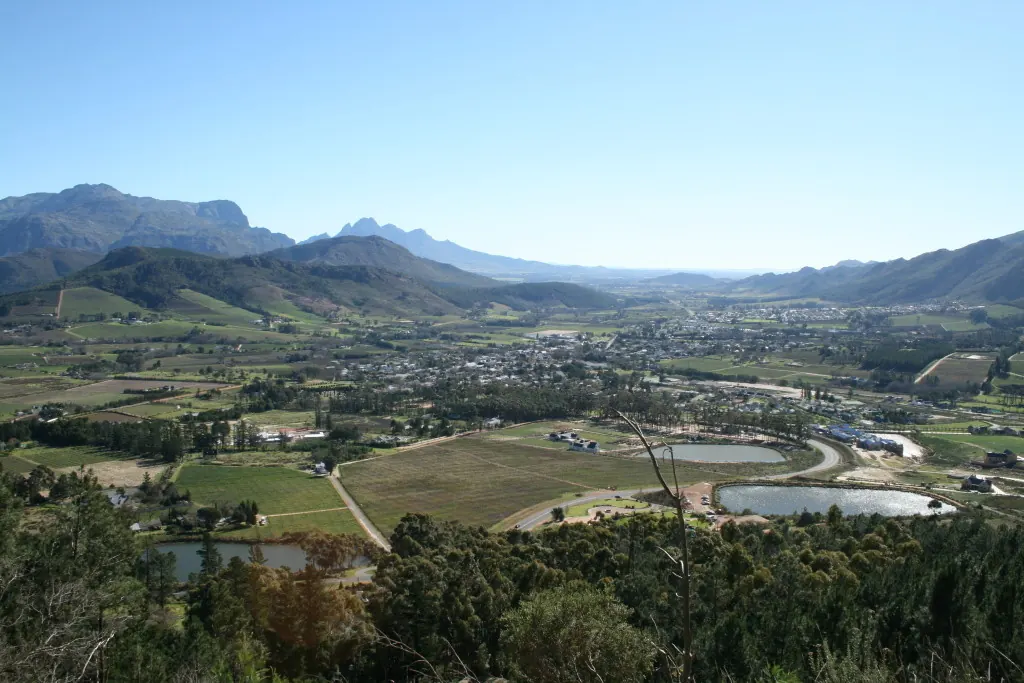
Franschhoek is a small town at the closed end of a mountain valley about 75 km from Cape Town. Nearly 300 French Huguenot refugees settled here from 1688, in a valley then called Olifantshoek for its elephants, and the French names stuck to the streets, farms and restaurants. Today it trades on food and wine: a main street of good kitchens, estates such as Boschendal and Haute Cabrière, and a wine tram that lets you taste without driving. A night or two here is the classic Winelands treat.
Getting there
Allow about 45 minutes to an hour by car from Cape Town. Only one road, the R45, enters the valley from the Stellenbosch and Paarl side. The other way in is over the Franschhoek Pass from Villiersdorp, a proper mountain road with long views back down the valley. There is no passenger train; a 28 km branch line from Paarl was built in 1904 and now carries the wine tram. Minibus taxis run from Stellenbosch and Paarl, but almost everyone drives, books a transfer or joins a tour.
When to go
Summers are hot and dry, winters mild and wet, with around 716 mm of rain a year. Harvest is February and March. The Bastille Festival has taken over the village every July since 1994, with wine and cheese tastings, a boules tournament and a lot of red, white and blue. The Cap Classique and Champagne Festival is held at the Huguenot Monument in early December. In summer, buy tram tickets ahead; they sell out.
What to do
The Franschhoek Wine Tram is a hop-on hop-off loop that mixes a double-decker tram with open-sided tram-buses. Lines are colour coded and each visits its own set of farms. The tram company now runs five lines and has dropped several older ones, so line names in older blogs may no longer exist. Look at the current map on the Wine Tram site before you book. There are two terminals, one in town on the corner of Main Road and Cabriere Street (where the ticket office is) and one at Groot Drakenstein, where the R45 meets the R310, with a link shuttle between them. Vehicles come round roughly hourly. One traveller’s account reckons three farms in a day is plenty, and tastings are paid separately at each estate.
The Huguenot Memorial Museum on the corner of Huguenot and Lambrecht streets explains who the settlers were (Monday to Saturday 09:00 to 17:00, Sunday 14:00 to 17:00). The Franschhoek Motor Museum at L’Ormarins opens Tuesday to Friday 10:00 to 16:00 and weekends 10:00 to 15:00. Hire a bicycle to pedal between farms on the valley floor, or head for Mont Rochelle Nature Reserve, whose entrance is on the Franschhoek Pass. I have not been able to confirm which of its trails are open, so check with CapeNature before you plan a walk there.
Good to know
Franschhoek proper is tiny, about 1,000 people, while the wider area including the townships behind the main street is over 20,000. Restaurants on the main road book out at weekends and in December, so reserve dinner when you reserve your room. The tram ticket does not include tastings, which catches first-timers. If you are driving in over the pass, do it in daylight.
History and culture
Franschhoek is a small Winelands village at the head of a mountain valley, named for the French Protestant refugees (Huguenots) who were given farms here in 1694. Their farm names and surnames are still everywhere, but the valley was Khoekhoe grazing land long before, and its wine wealth was built partly on slave labour, so the story is bigger than the French label suggests.
- Before the late 1600s
San hunter-gatherers passed through the valley for tens of thousands of years, and Khoekhoe herders for about 2,000 years before European settlers arrived, moving in and out with the seasons. The Cochoqua were the main herding group using the Berg River valley. What is left are stone tools on the river terraces and rare rock paintings, including a fairly realistic elephant, in the nearby Wemmershoek valley. source
- 1688 to 1694
Huguenots, French Protestants fleeing persecution, reached the Cape from April 1688 and were first given land in Drakenstein, near today's Paarl. Unhappy with the soil there, they asked Governor Simon van der Stel for better ground, and on 18 October 1694 nine farms were handed out in the valley then called Oliphantshoek (Elephants' Corner), including La Motte, La Provence, Champagne and Cabrière. source
- 1700s
Early Huguenot farmers were poor, with a few cattle and sheep, a few vines and barely enough barley and oats to feed their families and animals. Those who persevered and did well became successful farmers, and slave owners. source
- 1713 and 1805
The valley was first written down as de france hoek (the French corner) in 1713, because most people there spoke French. In 1805 the Batavian administration (the Dutch government of the Cape between two British occupations) made Franschhoek an official ward, and the name stuck to the church congregation of 1845 and the municipality of 1881. source
- 1825
Governor Lord Charles Somerset had 150 soldiers of the Royal Africa Corps, on their way to Sierra Leone, build a new wagon road over the mountain. It replaced Cats se Pad, a narrow road of about 1819, and before that travellers had used a rough track made by elephants. The soldiers' road served until the current Franschhoek Pass was completed in 1933. source
- 1845 to 1847
Franschhoek became its own Dutch Reformed parish in 1845, the first village plots were cut from the farm La Cotte, and the church on the main road was dedicated in April 1847. In the old chapel before it, whites sat at the front and coloured worshippers at the back. source
- 1897
Phylloxera, a vine pest, destroyed the vines around Boschendal in 1890. From March 1897 Cecil Rhodes bought more than 20 old wine farms in the Groot Drakenstein, Wellington and Stellenbosch areas, Boschendal among them, and his managers turned them into fruit farms (later Rhodes Fruit Farms), planting some 200,000 pear, apricot, plum and peach trees. source
- 1994
The Bastille Festival started in July 1994, the year of South Africa's first election open to all adults, which ended apartheid. Since 2000 Franschhoek has been run as part of Stellenbosch Municipality. source
- Language and people
- The village proper (officially Hugenote) is small, about 1,000 people at the 2011 census, split almost evenly between English and Afrikaans speakers. The wider valley, including Groendal and other townships (areas set aside for Black and coloured people under apartheid), has just over 20,000. source
- Huguenot surnames
- About 40 Huguenot surnames survive in South Africa, some unchanged (De Villiers, Malan, Du Toit) and some localised (Cronjé, Pienaar, Retief). The language faded fast: from 1701 the Dutch East India Company required schools to teach only in Dutch, and within two generations French was no longer a home language for most Huguenot families. source
- Huguenot Festival
- The Huguenot Society holds an annual Huguenot Festival with the museum on the last weekend of October, when the museum also puts on an exhibition of roses. source
- Architecture
- Most of the first Huguenot farms, such as La Motte, Champagne, La Provence and Cabrière, still have their Cape Dutch homesteads, the whitewashed, gabled style of the colonial Cape. In the village, limits on renovations and new building keep the old look. source
For German visitors: The decorations on Saasveld, the house rebuilt as the Huguenot Memorial Museum, are generally credited to Anton Anreith, a German sculptor who worked at the Cape. source
For American visitors: California was the model for the fruit farms Rhodes set up near Franschhoek after phylloxera. His adviser Harry Pickstone, an Englishman, had grown fruit in California, and many of the twelve young farm managers had trained there. Cape vineyards were saved by replanting on resistant American vine rootstock. source
Main sights in Franschhoek
6- Huguenot Monument
Three arches for the Holy Trinity behind a woman standing on a globe, holding a Bible and a broken chain, for freedom of religion. It was meant for the 250th anniversary in 1938, held back by that year's Voortrekker centenary and then the Second World War, completed in 1943 and unveiled on 18 April 1948.
Huguenot Memorial Museum: The Monument - Huguenot Memorial Museum
Start in the Annex, where tickets are sold, then cross Lambrechts Street to Saasveld, where rooms on flight, sacred texts, home, family and legacy tell the Huguenots' story before and after they reached the Cape. Open Monday to Saturday 09:00 to 17:00 and Sundays 09:00 to 17:00 from October to April (closed Sundays May to September); R100 for adults when checked.
Huguenot Memorial Museum - Perfume museum in the old slave lodge
The double-storey outbuilding behind Saasveld, which served as the slave lodge and servants' quarters in colonial times, now holds the First South African Perfume Museum, a collection of perfume bottles going back to Roman times.
Huguenot Memorial Museum: Slave Lodge - Dutch Reformed Church
The neo-Gothic church on the main road dates from 1847, was enlarged into a cross shape in the 1880s and has been a national monument since 1972.
Huguenot Memorial Museum: Religion - Franschhoek Motor Museum
Johann Rupert's car collection on the L'Ormarins estate, more than 220 vehicles with over 80 on show at a time in four halls. It grew out of the Heidelberg museum his father Anton Rupert opened in 1974 (in today's Gauteng) and opened here in May 2007. R90 for adults when checked.
Franschhoek Motor Museum: History - Franschhoek Pass
The R45 over the mountains to Villiersdorp was completed in 1933 to replace the 1825 military road and later tarred. The entrance to Mont Rochelle Nature Reserve is on the pass.
Wikipedia: Franschhoek Pass
Did you know?
- The first farm in the valley was not French at all. In 1692 Heinrich Muller, a colonist from Basel, was given a farm he named Keerweder, meaning turn back. source
- In 1860 some residents got the village renamed Roubaixdorp after the local MP, P. E. de Roubaix. It split the community and the name soon went back to Franschhoek. source
- The stone bridge at Jan Joubertsgat on the Franschhoek Pass, built by the 1825 road crew, is described by the museum as the oldest bridge in the country still in use. source
- The Huguenot Memorial Museum is a Cape Town mansion moved here. Saasveld, built in 1791 on Kloof Street, was pulled down in 1954, and on 26 July 1957 nine trucks organised by the Franschhoek Farmers Association carried its salvaged materials to Franschhoek, where it was rebuilt and opened in March 1967. source
- The wine tram uses part of the old 28 km branch line from Paarl, built in 1904 so farmers could get produce to market without ox wagons. Regular trains stopped in the 1990s and the line was brought back into use for the tram in 2012. source
Checked 7 October 2026.
Wildlife you might see
6- possibleChacma baboonCrossing the road over the Franschhoek Passsource
- possibleCape sugarbirdAlong the La Motte hiking trail (on the estate's own bird list for the trail)source
- possibleOrange-breasted sunbirdAlong the La Motte hiking trail (on the estate's own bird list for the trail)source
- possibleMalachite sunbirdAlong the La Motte hiking trail (on the estate's own bird list for the trail)source
- possibleAfrican fish eagleAlong the La Motte hiking trail (on the estate's own bird list for the trail)source
- possibleVerreaux's eagleAlong the La Motte hiking trail (on the estate's own bird list for the trail)source
Likelihood is for a normal visit of two or three days, from the sources linked. Nothing is guaranteed in the wild.
Hikes and walks
2- La Motte Hiking Trail
A circular 5 km route from the La Motte tasting room through the vineyards and up onto the mountain behind the estate, about 2 km of it proper trail, graded 1B and needing fair fitness. It shuts over winter until September, and after flood damage it did not reopen on 1 October as planned, so check with the estate before you go. No dogs, no bikes, no children under 10 and no babies in backpacks.
Permit: Booking essential. Self-guided R95 per person (from 08:00, last start 14:00), or guided R450 per person (Tuesday to Friday at 08:00). Bring photo ID for check-in.
La Motte: Hiking Trail - Boschendal trails
Two marked self-guided loops of 5 km and 10 km on Boschendal farm in the Drakenstein Valley, both starting and finishing at the Trail Centre. Opening depends on the weather. A guided early morning hike is mainly for guests staying on the farm.
Permit: R95 hiking and trail run permit from the Boschendal Trail Centre
Boschendal: Biking, running and hiking trails
Staying safe in Franschhoek
- Franschhoek Pass
- The pass over to Villiersdorp is tarred but has tight bends and steep drops off the edge. It is busy with fast motorbikes as well as slow sightseers, so take it gently and expect baboons and other animals on the road. source
- Summer heat on trails
- Summer days in the valley get very hot. La Motte closes its trail when it goes over 35 degrees, or in rain, and asks hikers to wear closed shoes, a hat and sunscreen. Start early in summer wherever you walk. source
- Wine tasting and driving
- The wine tram and its tram-buses take you between the farms, so nobody in your group has to drive after tasting. Tickets are limited per day, so book ahead. source
Tips from travellers
- The wine tram ticket covers the ride only. You pay for tastings at each estate, and the tram company puts them at roughly R60 to R260 a tasting. official
- The tram company has dropped several older lines, including Grey, Yellow, Purple and Burgundy, and moved their farms onto other lines. Pick your line from the current route map, not an old blog post. official
- Staying in the village but booked on a line that starts at Groot Drakenstein? A shuttle leaves the tram info kiosk on Franschhoek Square at quarter past and quarter to every hour from 08:00. Get there 10 to 15 minutes early. official
- Tram tickets are refunded in full if you cancel at least 24 hours before your slot, and not at all after that. official
- Three farms in a day is a sensible plan on the tram, with about an hour at each and closer to two where you stop to eat. one source
Checked 7 October 2026. Conditions change, so confirm with the park or venue before you go.
Quick answers
What are the best hikes in Franschhoek?
La Motte Hiking Trail (5 km) and Boschendal trails. See the hikes section for times, difficulty and permits.
Map of Franschhoek
See every place on this map as a list