Village · Mpumalanga, South Africa
Marloth Park
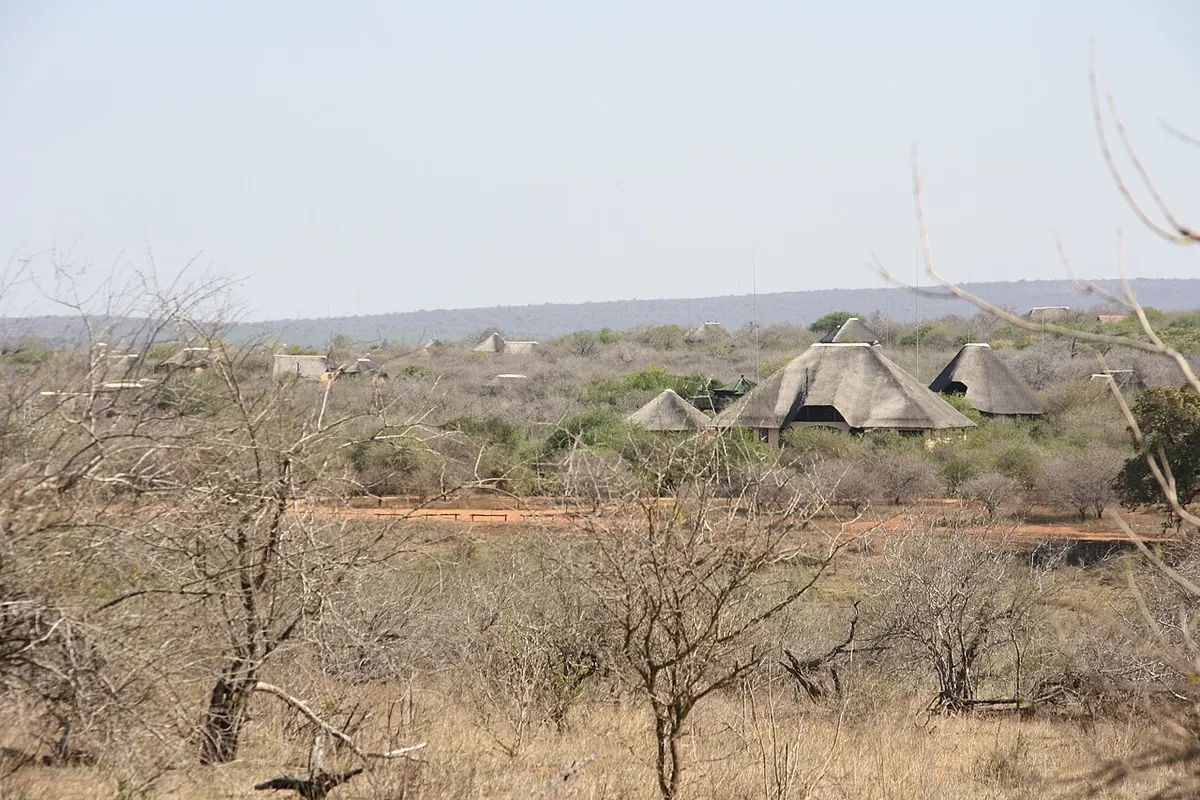
Holiday township and wildlife area across the Crocodile River from Kruger, where giraffe, zebra and kudu wander between the houses and Crocodile Bridge Gate is 14 km away.
Short answer
Marloth Park is in Mpumalanga, South Africa. This page lists 43 places to stay, 2 places to eat and drink and 1 sight. The nearest park with an entry fee on this site is Timbavati Private Nature Reserve, about 117 km away, where international adults pay from R255.

- Places to stay
- 43
- Eat and drink
- 2
- Sights
- 1
- Park fee nearby: Timbavati Private Nature Reserve
- US$15 €13 · R255about 117 km away
In and around Marloth Park
46 places listedWhere to stay in Marloth Park 43
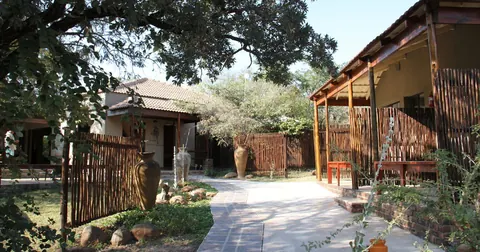 HotelTuraco LodgeKudu Road, Mpumalanga+27 79 208 3040turacolodge.com
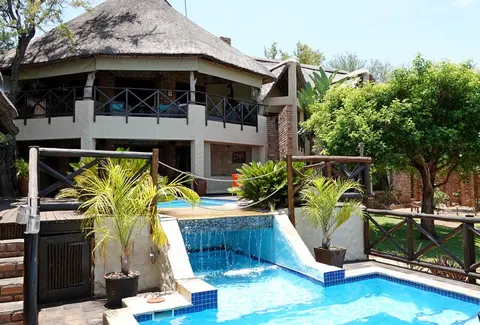 HotelCrocodile Kruger Safari LodgeCrocodile Road, Marloth Park+27 82 570 8172crocodilekruger.co.za
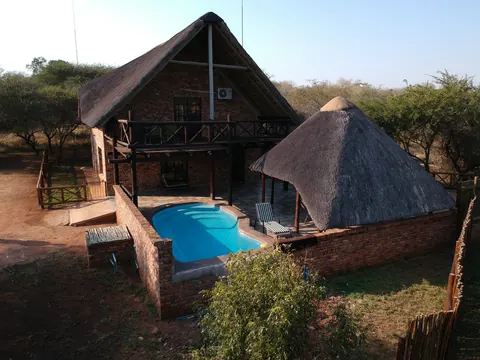 Guest houseGiraffe PlainsVolstruis Road+27 79 701 6365giraffe-plains.co.za
- 25.38°S 31.76°EHotelMajuli River LodgeCrocodile Road+27 87 202 8443majuli.co.uk
- 25.36°S 31.77°EHotelRoyal Kruger LodgeOribi+27 31 566 1013royalkrugerlodge.com
- 25.38°S 31.76°EHotelGame LodgeBosbok Streetnyamazane.co.za
- 25.36°S 31.81°EHotelMarloth Park Self-cateringBuffel Street+27 78 012 0125
- 25.38°S 31.76°EHotelThe Bateleur Bushcamp And Chalets+27 72 144 8332thebateleurbushcampandchalets.wozaonline.co.za
- 25.34°S 31.77°EGuest houseAmnesiaMamba
Show all 43 places to stay
- Jackalberry Ridge · Hotel
- Kruger Inn Backpackers · Hostel
- Le Roux Lodge · Hotel · Porcupine Avenue+27 11 452 4565
- Mvuradona Safari Lodge · Hotel
- Needles Lodge · Hotel · Bushpig Avenue+27 79 953 7009
- Royale Marlothi Safari Lodge · Hotel
- The Wild Bunch Safari House · Chalet · Rinkhals
- Villa Marula · Hostelvillamarula.com
- Walking Tall Marloth Self-Catering Accomodation · Hostel · Karee Avenue+27 82 924 1941
- African Bush Backpackers · Guest house
- Kruger Wielewaal Restcamp · Hotel
- Peaceful Hide Self Catering Lodge · Hostel+27 72 987 2638
- Beauty of Nature Self-Catering Lodge · Guest house
- Bush Pad · Hostel
- Bushbaby Lodge · Hotel
- Bushwise Safari Lodge · Hotel
- Civet's Crest · Hotel
- Du Bois Lodge · Hotel
- Duke's Lodge Marloth Park · Hotel
- Ex Deo Self-Catering Cottage · Guest house
- Fish Eagles Self Catering House · Hostel
- Green Kruger Lodge · Hotel
- Induku Lodge · Hotel
- Khaya Romantica · Hotel
- Kruger Park Hostel · Hostel
- Kruger River Self-Catering · Guest house
- La Kruger Lifestyle Lodge · Hotel
- Leadwood Cottage · Hotel
- Maqueda Lodge · Hotel
- Marloth Bush Retreat · Hotel
- Marlothi Safari Park · Hotel
- Marlothpark Buid It · Hotel
- Moody River Guesthouse · Guest house
- Phumula Kruger Lodge and Safaris · Hotel
Sights 1
- Kranz Look OutViewpoint
Restaurants and cafes 2
- The Tin ShackRestaurant · Olifant Street+27 71 658 9662marlothisc.co.za
- Jabula RestaurantRestaurant · african
Marloth Park is a holiday township of about 3,000 hectares on the south bank of the Crocodile River, which is also the southern boundary of Kruger National Park. There are no internal fences, so giraffe, zebra, wildebeest, kudu, impala and warthog walk through the gardens. People stay here for a self-catering house with animals on the doorstep and Kruger a short drive away. It is a suburb in the bush rather than a wilderness, which is its appeal.
Getting there
Marloth Park lies between Malelane and Komatipoort, off the N4. The drive from Johannesburg or Pretoria is about five hours. By air, Kruger Mpumalanga International near Mbombela has flights from Johannesburg, Cape Town and Durban, and car hire desks. From Marloth, Kruger’s Crocodile Bridge Gate is 14 km east and Malelane Gate 35 km west.
When to go
The climate is humid subtropical, with hot summers and mild winters. June to August is the low season for malaria in the Lowveld, which makes winter the easier time to come.
What to do
The point is the game. Sit on the stoep and see who turns up, drive the roads slowly, and go to the lookout over the river at sunset to look across into Kruger. Lion, buffalo and rhino are kept inside Lionspruit, a separate section of about 1,500 hectares, so Marloth has four of the Big Five. Elephants are the missing one.
For more, Kruger is right there: many lodges run game drives and day trips into the park. There are a few restaurants, shops and a petrol station in the park itself.
Good to know
Marloth sits on the Kruger boundary, and Wits University’s guidance puts Kruger and the Mpumalanga Lowveld in the malaria risk zone, and SA-Venues says antimalarials are recommended from October to May in the high-risk parts. Take medical advice before you travel.
If you feed the animals, regulars ask that you drop approved game pellets on the ground, never hand-feed, never use troughs (they spread disease) and never put out crisps, bread or maize, the last of which can be fatal. Drive slowly, especially at night: speeding cars have killed animals here. Keep noise down, since animals are more likely to come close to a quiet house. The Kruger boundary is an electric fence, so photos across it mean shooting between the strands.
History and culture
Marloth Park is young, a holiday township opened in the 1970s on the south bank of the Crocodile River, facing Kruger. Its history is really the history of the strip of Lowveld around it: the railway to the coast, a Boer government on the run in 1900, the early days of Kruger tourism, and KaNgwane, the apartheid homeland for Swazi people in the surrounding district.
- 1887 to 1895
Construction of the railway from Pretoria to the port of Lourenço Marques (now Maputo) on Delagoa Bay ran from 1887 to 1894, and the steep mountains and deep valleys of the Crocodile River near Komatipoort were a major obstacle. The Netherlands-South African Railway Company (NZASM) ran the South African side, and Paul Kruger, President of the Transvaal, opened the line formally on 8 July 1895. source
- 1898
The Transvaal government (the South African Republic) proclaimed the Sabi Game Reserve in 1898, covering 10,364 square kilometres. It is the reserve that became Kruger National Park in 1926, and the first three tourist cars drove into the park in 1927. source
- 1900
During the South African War (the Anglo-Boer War, 1899 to 1902) British forces entered Pretoria on 5 June 1900. The day before, the Transvaal's gold had gone east by train on the Delagoa Bay line, and the Boer government ran the state from railway carriages at Machadodorp, Waterval Boven and finally Emjejane (Hectorspruit), a stop on this stretch of the line. Kruger left the Transvaal for the last time on 11 September 1900. A government diary records 62 cases of that gold handed to a German firm in Lourenço Marques on 31 August 1900, and the legend of the 'Kruger Millions' buried in the Lowveld only took hold later, from 1905. source
- 1931
Crocodile Bridge, the Kruger gate just east of Marloth Park, started as a pontoon so rangers could cross from Komatipoort. In 1931 eight rondavels (round thatched huts) were built there, making it a rest camp as well as a gate, and the last pontoon was replaced by a causeway in 1945. source
- 1972 to 1977
Marloth Park opened as a holiday township in 1972 and was formally established in 1977. A large part of it was left as natural bush and, apart from the fence around Lionspruit, there are no internal fences, so kudu, zebra, giraffe and impala move freely between the houses. source
- 1976 to 1994
Under apartheid the government set up a bantustan (a so-called homeland for one ethnic group) for Swazi people in 1976, named KaNgwane from 1977. Nkomazi, the district around Marloth Park, was one of its three districts. In 1982 Pretoria tried to hand parts of KaNgwane to Swaziland (now Eswatini), which would have given that country a route to the sea, but popular opposition in the territory stopped the deal. KaNgwane was dissolved into Mpumalanga on 27 April 1994. source
- Languages
- At the 2011 census Afrikaans was the first language of 48.1% of residents inside Marloth Park, siSwati 22.8% and English 21.3%. Figures for the 2022 census were not available at this level. source
- Bush gardens
- The look of the place is deliberate. Gardens are left as natural bush, and the only lawns tend to be the patches impala keep cropped. That is the local culture in a nutshell: houses fitted in around the animals rather than the other way round. source
For German visitors: The park is named after Rudolf Marloth, born in Lübben in Germany on 28 December 1855. He arrived in Cape Town in 1883 as a pharmacist, became professor of chemistry at Victoria College (now Stellenbosch University), wrote the six volume Flora of South Africa (1913 to 1932) and, in German, Das Kapland (1908). He died in Caledon in 1931. source
For American visitors: In March 1929 a large group of American tourists arrived at Crocodile Bridge by luxury train and set off on a game drive in two trucks. Rain bogged them down, one truck overturned in a stream, the party ended up in thorn trees to stay clear of lions, and several caught malaria. The bad press helped push Kruger into closing for part of the year. source
Main sights in Marloth Park
3- Kranz Look Out
A lookout on the Marloth bank of the Crocodile River, with Kruger on the far side. Early morning and evening are when animals come down to drink, and it lets you look into the park without leaving Marloth.
SA-Venues: Visit Marloth Park - Lionspruit
Marloth's own fenced game reserve, about 1,500 hectares, where the lion, buffalo and rhino are kept apart from the houses. You can drive in with your own car, though some tracks need a 4x4, and there are picnic and braai (barbecue) spots and viewpoints. Check the current access rules locally before you go.
Wikipedia: Marloth Park - Old railway bridge at Crocodile Bridge
In 1927 the park board asked South African Railways to take the Selati railway line across the Crocodile River here. The old railway bridge is in disrepair and now used to pump water for farm irrigation, but you can still see it from the Crocodile Bridge rest camp, just inside the Kruger gate (park entry fees apply).
Wikipedia: Crocodile Bridge
Did you know?
- Lion, buffalo and rhino are kept inside Lionspruit, Marloth's own fenced 1,500 hectare game reserve, which gives the park four of the Big Five. Elephant is the missing one, though lions from Kruger have been known to wander across the river into Marloth. source
- About 1,000 people lived here at the 2011 census, on roughly 30 square kilometres, so for a town it has very few people and a lot of bush. source
- The mountain aloe, Aloe marlothii, carries the same name as the park, and both honour the botanist Rudolf Marloth. It has a single stem that occasionally reaches 6 metres and flowers in winter, with blooms that are usually orange but run from yellow to bright red. source
- The Nkomati Accord, a non-aggression pact between South Africa and Mozambique, was signed nearby at Komatipoort on 16 March 1984 by Prime Minister P.W. Botha and President Samora Machel. Mozambique expelled ANC members as agreed. South Africa kept supplying the RENAMO rebels anyway. source
Checked 7 October 2026.
Map of Marloth Park
See every place on this map as a list