Tulbagh
A valley town 90 minutes from Cape Town whose Church Street, rebuilt after the 1969 earthquake, holds 32 national monuments on one street, with wine farms and mountain trails all around.

See every place on this map as a list
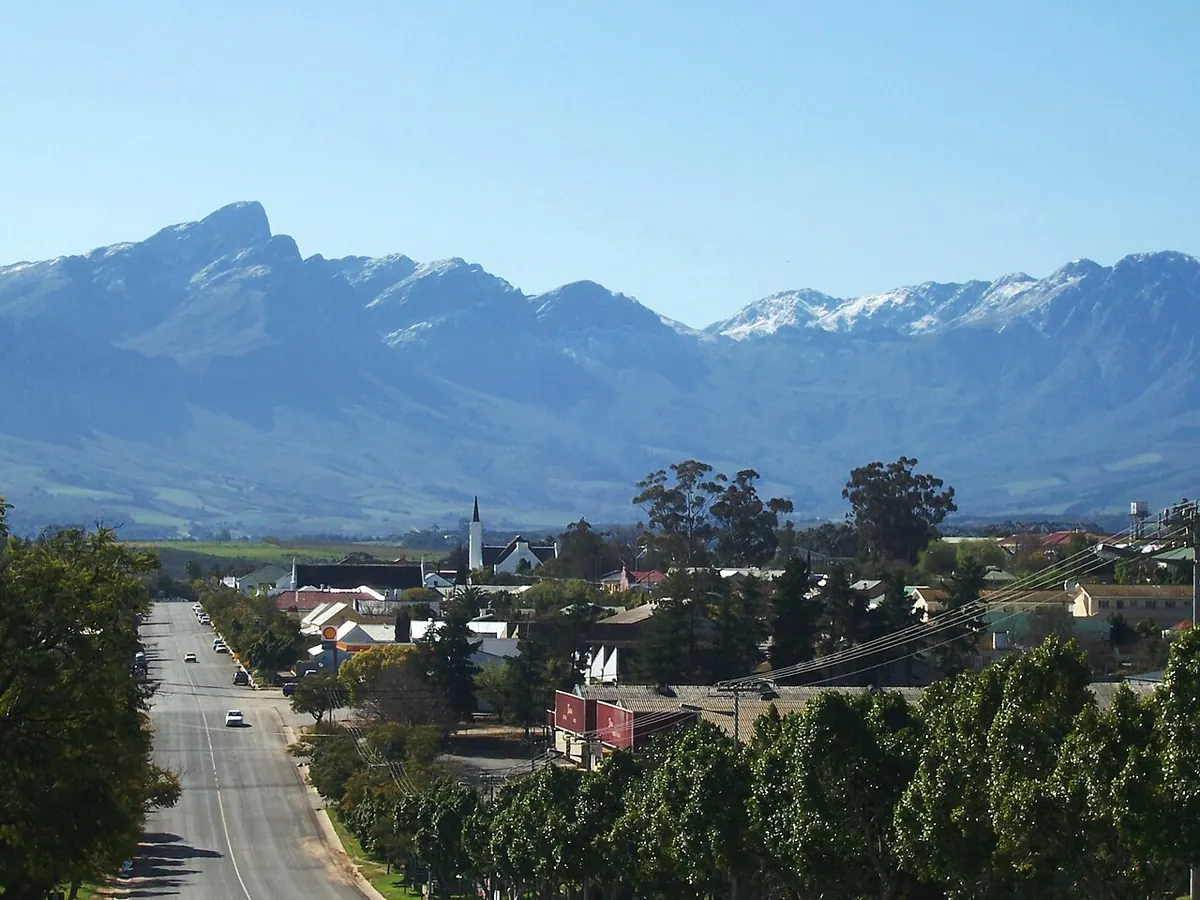
Tulbagh sits in a mountain basin 120 to 130 km north-east of Cape Town, closed in by the Obiqua, Groot Winterhoek and Witzenberg ranges. The valley was granted as Land van Waveren in 1699 and the town was named after Governor Ryk Tulbagh in 1795. Its claim to fame is Church Street. An earthquake in September 1969 wrecked the old houses, and the restoration that followed left 32 national monuments on a single street, more than anywhere else in the country.
Getting there
Allow about 90 minutes by car from Cape Town; one well-used route is the N7 north and then the R46 east over the mountains. From Stellenbosch it is a little over an hour. There is no useful public transport, so you need a hire car, and you will want it for the wine farms spread around the valley. The tourism office is at 38 Van der Stel Street.
When to go
Summers are hot, with highs in the mid-30s, though a south-easter cools the evenings. Winter nights drop to 5 or 6°C and the peaks often carry snow; most rain falls in June and July. Regulars pick September, when the fruit trees blossom and wild flowers are out, or April, when the vineyards turn. Two local events fix the calendar: Christmas in Winter in June, when the town does the full festive dinner in the cold, and the Spring Arts Festival and Horse and Wildflower Show in September.
What to do
Walk Church Street slowly. Panels outside each house explain its style and date, and several are now shops, restaurants and guesthouses you can go into. Four museums sit on the street under one ticket: the Earthquake Museum at number 4, the Oude Kerk of 1743 (a museum since 1925), the Victorian Period House of 1892 and the Pioneer House of 1803. The Oude Drostdy, a courthouse of 1804 designed by Louis Michel Thibault, is 3 km outside town. A path behind 43 Church Street climbs Galgeheuwel, the old gallows hill, for a view over the roofs.
The valley’s wine farms are quieter than Stellenbosch and Franschhoek and keep shorter hours. Twee Jonge Gezellen, home of Krone sparkling wine and Africa’s first underground cellar, Saronsberg, Rijk’s (chenin blanc and pinotage only), Montpellier with its chapel in the vines, and Theuniskraal are the names to look for; Waverley Hills makes organic wine and olives. Hikers have a short Waterfall Trail of 15 to 20 minutes, the 4 km and 10 km Murludi trails and the overnight Silwerfontein trail, and there are about 70 km of mountain bike tracks through orchards and vineyards.
Good to know
Many farms, restaurants and shops close on Mondays and Tuesdays, so a weekend or a Wednesday to Sunday stay works best. Sources differ on the earthquake’s magnitude, putting it at 6.3 or 6.4. One full day covers the street and a couple of farms; two nights lets you add a hike.
In and around Tulbagh
44 PLACESPlaces to stay 21
- 33.32°S 19.10°E
- 33.28°S 19.14°E
- 33.34°S 19.12°E
- 33.35°S 19.13°E
- 33.29°S 19.14°E
- 33.29°S 19.14°E
- 33.29°S 19.14°E
- 33.19°S 19.13°E
- 33.29°S 19.14°EGuest houseDe Oude Herberg Guesthouse
Sights 4
- BlockhouseBattlefield
- Drostdy-HofMuseum
- Museum HouseMuseum
- Old Mission ChurchAttraction
Restaurants and cafes 15
- Daphne'sRestaurant · Church Street, Tulbagh
- Kole & DeegCafe · coffee shop, sandwich · Van der Stel Street, Tulbagh
- Pizza SpotRestaurant · pizza
- Rijk'sRestaurant · regional
- 10 RestaurantRestaurant
- 29 RestaurantRestaurant
- Bike Forge - cafe & bike museumCafe
- Kuierbossie RestaurantRestaurant
- Moniki ChocolatierCafe
- Pammie's RestaurantRestaurant
Wineries, breweries and distilleries 4
- Krone Twee Jonge GezellenWinery
- Lemberg Wine EstateWinery
- Montepellier de TulbaghWinery
- Saronsberg WineryWinery