Place to stay · Linyanti, Selinda and Kwando
Kings Pool Camp
Wilderness camp of eight thatch and canvas suites on a lagoon off the Linyanti River, known for dry-season elephant herds, a sunken hide and a double-decker barge.
King’s Pool is a Wilderness camp on a lagoon beside the Linyanti River, in the 126,000 hectare Linyanti Wildlife Reserve on Botswana’s northern edge, close to the Namibian border. Wilderness says the lagoon takes its name from the King of Sweden, Carl XVI Gustaf, who spent his honeymoon here. People come for elephants, which cross the river in front of the main deck.
What to expect
Eight suites of canvas and thatch stand on wooden decks along the water, joined to the main building by raised walkways so animals can pass underneath. Each has an outdoor shower and a sala on its deck. One is a family suite of two connected rooms sharing a plunge pool. Expert Africa notes the camp had a major refit in 2019.
Days run on morning and afternoon game drives in open 4x4s, with night drives too. When the river is high enough, roughly April to August according to Expert Africa, a double-decker barge called the Queen Silvia goes out on the channels. Later in the dry season the attention shifts to a sunken hide about ten minutes’ drive from camp, where elephants drink at eye level.
Practical details
- Getting there: fly to Maun, then a Wilderness Air light aircraft to the Linyanti.
- The camp runs entirely on solar power.
- Wi-Fi in the suites and the main area.
- Children: Expert Africa gives a normal minimum age of 12, with younger children accepted only if you book private activities.
Good to know
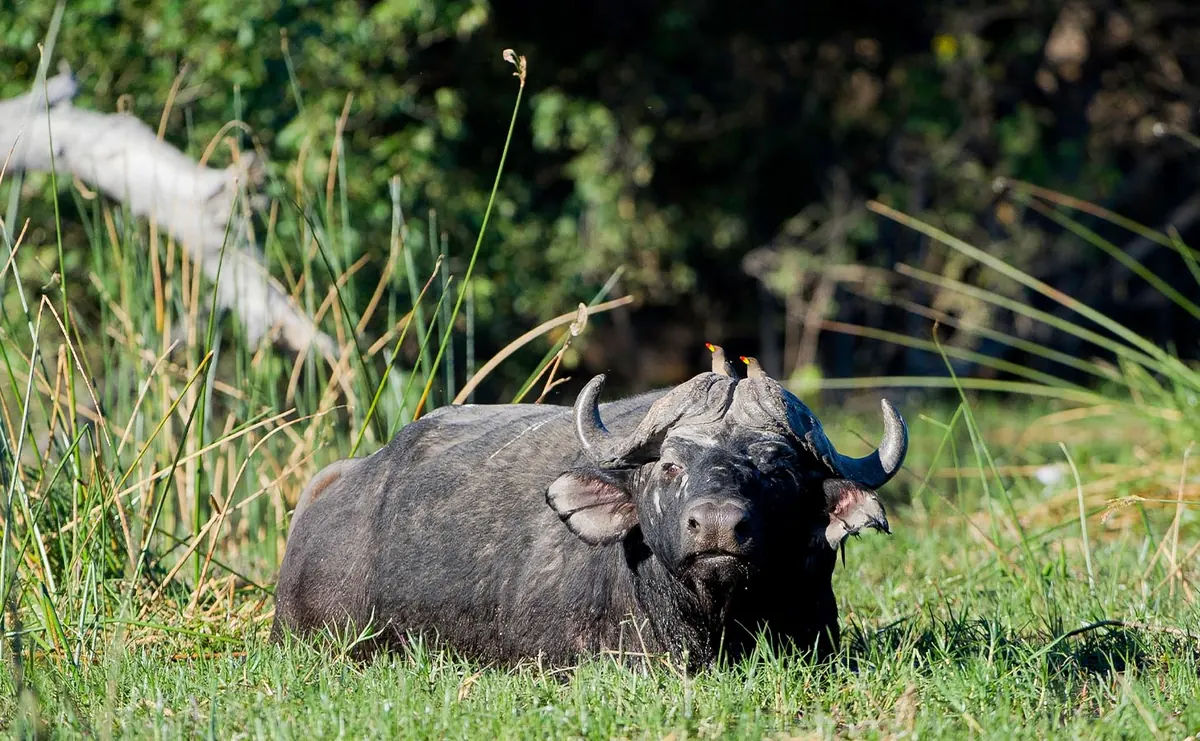
Timing matters more here than at most Botswana camps. June to October is when elephant and buffalo crowd the river in their hundreds. Expert Africa is wary of the green and shoulder months here, and blames the dense mopane south of camp. The camp is unfenced, and hippo and leopard walk through it.
Last updated 12 October 2026. Sources: Wilderness, King's Pool Camp, Expert Africa, King's Pool, Mirus Journeys, Wilderness Kings Pool.
The king's honeymoon lagoon and the trees the elephants killed
On 19 June 1976 Carl XVI Gustaf of Sweden married Silvia Sommerlath in Stockholm Cathedral, and the honeymoon that followed went to Hawaii and then to Africa. Botswana was one of the stops. That much is on record. Wilderness, which runs King’s Pool, says the king spent his honeymoon here on the Linyanti, and the camp barge carries the queen’s name. I could not find a Swedish or Botswana account that puts the couple on this particular oxbow, so the name rests on the camp’s word.
There is an odd echo. In that same year a man called Sommerlatte, very nearly the bride’s surname, put out the first survey of the Linyanti’s riverbank trees. He had counted them in 1973 and 1974 on the 8.5 km of river front inside Chobe National Park, and he was already worried.
Grey trunks on the river front
The big trees that died along this river were mostly camelthorn and knobthorn. Elephants felled them or stripped the bark.
Sommerlatte’s dry-season figure for 1974 was 2.8 elephants per square kilometre. By 1987 it was 12. Gabriella Teren and Norman Owen-Smith, who worked here between December 2006 and February 2007 with help from Wilderness, put the riverside strip at more than 20. A count in March 1992 took in 2,995 large trees and found 42.5% dead, including two thirds of the camelthorns. Fifteen years on, only about a third of the big camelthorns and knobthorns were alive.
Leadwood and jackalberry came through far better, because their bark is hard to strip. Those are the two trees that shade the suites at King’s Pool. Elephants are not the whole story either. Young trees were scarce, and the researchers suspected the soil was drying out. The riverine woodland is only a few hundred metres deep. Behind it is mopane, and that was doing fine.
Mma Mabele’s five
Wilderness identified 63 lions across the reserve between mid May and the end of August 2026. More than half belong to the DumaTau Pride, at 32 the biggest in the concession just now. The pride that holds the ground around King’s Pool is Mma Mabele’s, and it numbers five.
The males are less settled. Toppers, Onix and Quartz, half of a coalition the guides call the Army Boys, range north as far as King’s Pool. Four unknown males turned up early in 2026, probably out of Chobe, and have been followed as far west as the camp.
Leopard in most reports, wild dog in none
Expert Africa publishes its travellers’ reports back to 2007, and leopard keeps appearing in them. A family in October 2007 saw their first one here, a female that hid up a tree while baboons were about, and found her again that evening setting off to hunt. A guest in October 2017, back after sixteen years, saw no lion in three days and wrote that a leopard with a cub saved the stay. A family at the end of April 2022 logged leopard three times and lion four in three nights, and still said April is not the best month because the vegetation is high. A couple in late September 2022 had lion five times in four nights.
Nobody in those reports saw wild dog. Dogs do use the reserve, and Expert Africa’s team write of a den found close to camp. But if dogs are the point of your trip, the Kwando camps further up this river system have the better record.
August 2008 is the warning. Three parties stayed that month and none rated the camp better than average. One sat through a morning drive of nearly five hours with very litle to show for it. Another thought the game good but found the hide not running, because it is seasonal.
Expert Africa’s own team mention a porcupine that noses about camp after dark.